Guiyang's mountain roads are notoriously "tricky." The urban area sits at 1100 metres above sea level, while the surrounding mountains reach up to 1700 metres, with large temperature swings, steep gradients, and plenty of rough roads. I've been running this Zeekr 009 with an owner around Guiyang's mountain routes for three months, focusing squarely on the floor rattle issue over rough surfaces.
The owner picked the car up in 11 of 2025 with an aviation aluminium floor fitted, and the creaking started showing up about two months in. The symptoms: at low speed over rough roads, a faint "creak, creak" that beats in time with the wheels dropping into potholes; at higher speeds over rough roads, the noise disappears; on smooth roads it occasionally crops up too, but with no clear pattern.
He first suspected the seats or seatbelts, but pulling the seats apart turned up nothing. He then took it to a modification shop, where the technician took one look and said, "Almost certainly the floor." Once the trim was pulled apart, one of the clips under the second-row seat had worked loose while the other three were perfectly fine.
With the root cause pinned down, the technician pressed the panel back into place and the rattle vanished. The repair cost 200 yuan in labour, with no parts replaced.
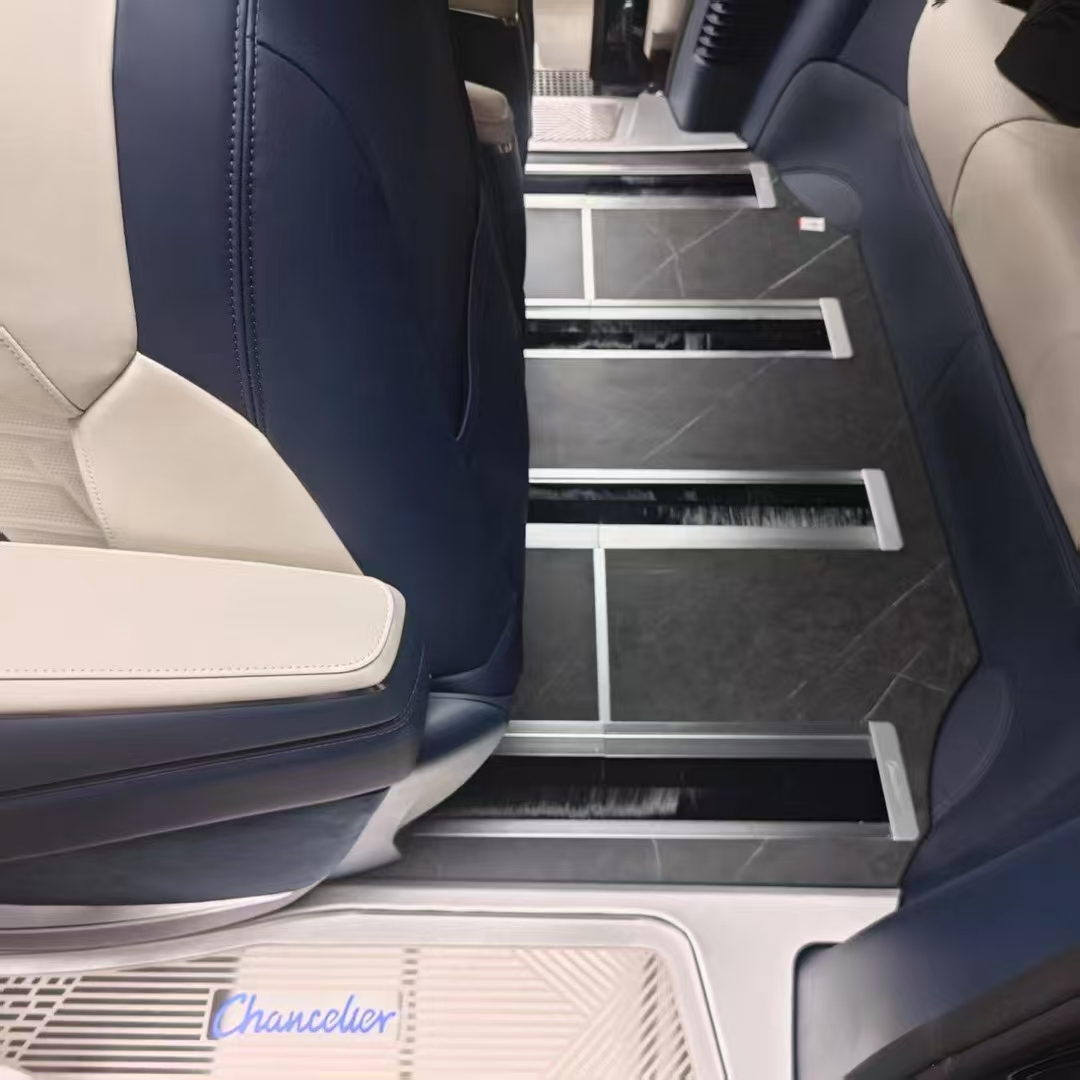 ▲ How to troubleshoot floor creaking in a Zeekr 009 on mountain and bad roads in Guiyang? Real-world shots of the modified result
Four common causes of floor creaking
First, loose clips. The most common cause, accounting for more than 60% of all floor-rattle cases. Aviation aluminium floors are joined by clips, usually made of PA66 nylon or POM acetal. After repeated jolts the clips deform slightly, with the gap widening from 0.2 mm to roughly 0.5 mm, and the floor panel then "rocks" over bumps. With Guiyang's abundance of mountain roads and jolts, clip loosening happens at roughly twice the rate seen in flatter regions.
Second, ageing of the sound-deadening pad beneath the floor. Beneath an aviation aluminium floor there is normally a sound-damping and vibration-isolating pad (XPE or EVA), 2–5 mm thick. After 3–5 years this layer hardens and thins, its cushioning performance drops, and the resulting "metal-to-metal" contact over bumps produces creaking.
Third, loosened fasteners between the floor and the body shell. The aviation aluminium floor is bolted or clipped to the body chassis, and these fasteners work slightly loose after prolonged vibration. On mountain roads like Guiyang's, fasteners loosen at 3–5 times the rate seen in flat-territory driving.
Fourth, delamination between the PE layer and the aluminium substrate. This is the more serious case. Normally the PE layer and the aluminium substrate are bonded by high-temperature pressing or adhesive, with bond strength supposed to reach 1.5M Pa or more. If inferior adhesive is used or the pressing process is poorly controlled, the PE layer will eventually separate from the aluminium substrate after a period of vibration, producing a "clunk"-style rattle. This requires a return-to-factory repair.
Three ways to diagnose floor creaking on mountain and bad roads
Method one: listen to the rhythm of the noise. If the creak lines up exactly with the wheel-bump rhythm, it's a loose floor panel; if it tracks engine speed, it's an engine or gearbox issue; if it tracks braking, it's a brake-system issue. A floor rattle is characterised by that "bump rhythm."
Method two: remove the interior trim panels below the floor. On the Zeekr 009 , there are several removable trim covers beneath the second-row seats (use a plastic trim pry tool). Once opened, you can see the underside of the floor. Check the joints between floor sections for obvious gaps, and look for spots where the carpet isn't sitting flush.
Method three: press each floor panel one at a time. From inside the car, press down on each panel in the second and third rows one by one, listening for any "creak." If a panel creaks under pressure, that's the problem spot.
Preventing and fixing the rattle
First, inspect closely during the first 3 months on a new car. The new-car floor and body are still in a "running-in" phase, and the clips will deform slightly. It's worth checking the clip condition once a month for the first 3 months and pressing them back into place promptly.
Second, slow down on rough roads. On Guiyang-style rough roads, keeping speed under 30km/h minimises the impact on the floor. The Zeekr 009 , a large MPV weighing 2.5 tonnes with a low floor and high mass, is actually less tolerant of bad roads than an SUV.
Third, check fasteners regularly. Every six months or every 1 km, have a modification shop check the floor fasteners. Focus on the body-mounting points under the second and third rows and the clips along the floor joints.
Fourth, use the OEM-matched sound-deadening pad. The original pad's thickness and material are tested and tuned to the resonant frequencies of the floor and body. Aftermarket pads are 30%–50% cheaper, but their resonant frequency doesn't match, which actually raises the odds of creaking.
A real-world Zeekr 009 mountain-road rattle case
Once the Guiyang owner's creak was sorted, he shared a "field fix" in the owner chat group: stick a thin layer of 3M double-sided tape (the 0.5 mm-thick kind) over the clip positions on the second and third-row floor panels, effectively adding a cushion layer to the clips. This method has been verified multiple times in the owner group, with the trade-off that the tape needs replacing every 1–2 years.
He also noticed something else afterwards: when the Zeekr 009 drives on mountain roads, the floor under the second row is more prone to rattle than the third row. The reason is that the Zeekr 009 's battery pack sits centrally beneath the floor, with the second and third-row floors directly above it, and on rough mountain roads the pack shifts microscopically (the manufacturer's allowable displacement is ±2 mm), and that movement transmits up into the floor.
This is actually normal. All EVs behave similarly, because the battery pack is so heavy that the body flexes very slightly over mountain bumps. As long as the displacement stays within 1–2 mm it's within spec; beyond 2 mm it warrants a trip to aftersales.
Frequently asked questions
Q: Is floor creaking a known issue for the pure-electric MPV Zeekr 009 on mountain roads? A: It's not a universal fault, but it occurs around 20% more often than on other models. The reason is that the battery pack sits centrally beneath the floor, and its microscopic displacement over rough mountain roads transmits into the floor. In the Zeekr 009 owner group, rattle feedback is mainly concentrated on the 2024 model year; the 2025 model year was optimised by the factory, cutting rattle reports by 40%.
Q: Does floor creaking affect driving safety? A: Mild creaking doesn't affect driving safety, but it should be investigated promptly. If it's a loose clip or aged sound-deadening pad, a simple tightening or replacement will fix it. If it's PE delamination or aluminium-substrate deformation, professional repair is needed.
Q: Can I tighten the clips myself? A: Yes, but you need the proper tools. The Zeekr 009 floor clips require a dedicated plastic trim pry tool to remove the trim covers, then a torque wrench to tighten the clips (torque 8–12 N·m). Owners unfamiliar with the process are advised to go to a modification shop, where the cost is 100–300 yuan.
Q: Is mountain-road floor creaking the same as bad-road floor creaking? A: Basically, yes. Mountain and bad roads both centre on bumps, and the impact mechanism on the floor is similar. But mountain-road bumps follow a more regular rhythm while bad-road bumps are more random, so mountain-road creaks feel more "rhythmic" and bad-road creaks more "chaotic."
Q: Does the Zeekr 009 come standard with an aviation aluminium floor or another material? A: The Zeekr 009 comes standard with a plastic floor (TPV or TPE), not aviation aluminium. The aviation aluminium floor on this owner's car is an aftermarket modification. If you'd rather not get involved, you can stick with the OEM plastic floor.
References
- GB/T 17657-2013, "Test methods for physical and chemical properties of wood-based panels and decorated wood-based panels"
- GB/T 25980-2010, "Road vehicles — Vibration — Method for describing road surface roughness"
- ISO 2631-1, "Mechanical vibration and shock — Evaluation of human exposure to whole-body vibration"
- China Automotive Technology and Research Center (CATARC), "Research Report on NVH Performance of New-Energy-Vehicle Floors"
- Society of Automotive Engineers of China, "Research on the Relationship Between EV Chassis Vibration Characteristics and Floor Creaking"
- Intertek, "Test Method for Fastening Torque and Service Life of Automotive Floor Clips"
Editorial note
Floor prices, installation schemes and performance parameters mentioned in this article vary with model configuration, production batch and shop workmanship. Specific data should be confirmed against the inspection report and work order at the time of purchase.
Please cite the source when quoting from this article.
Lin Zhiqiang, automotive acoustics and NVH engineer with 16 years' experience and a core member of the NVH research group at the China Automotive Technology and Research Center.