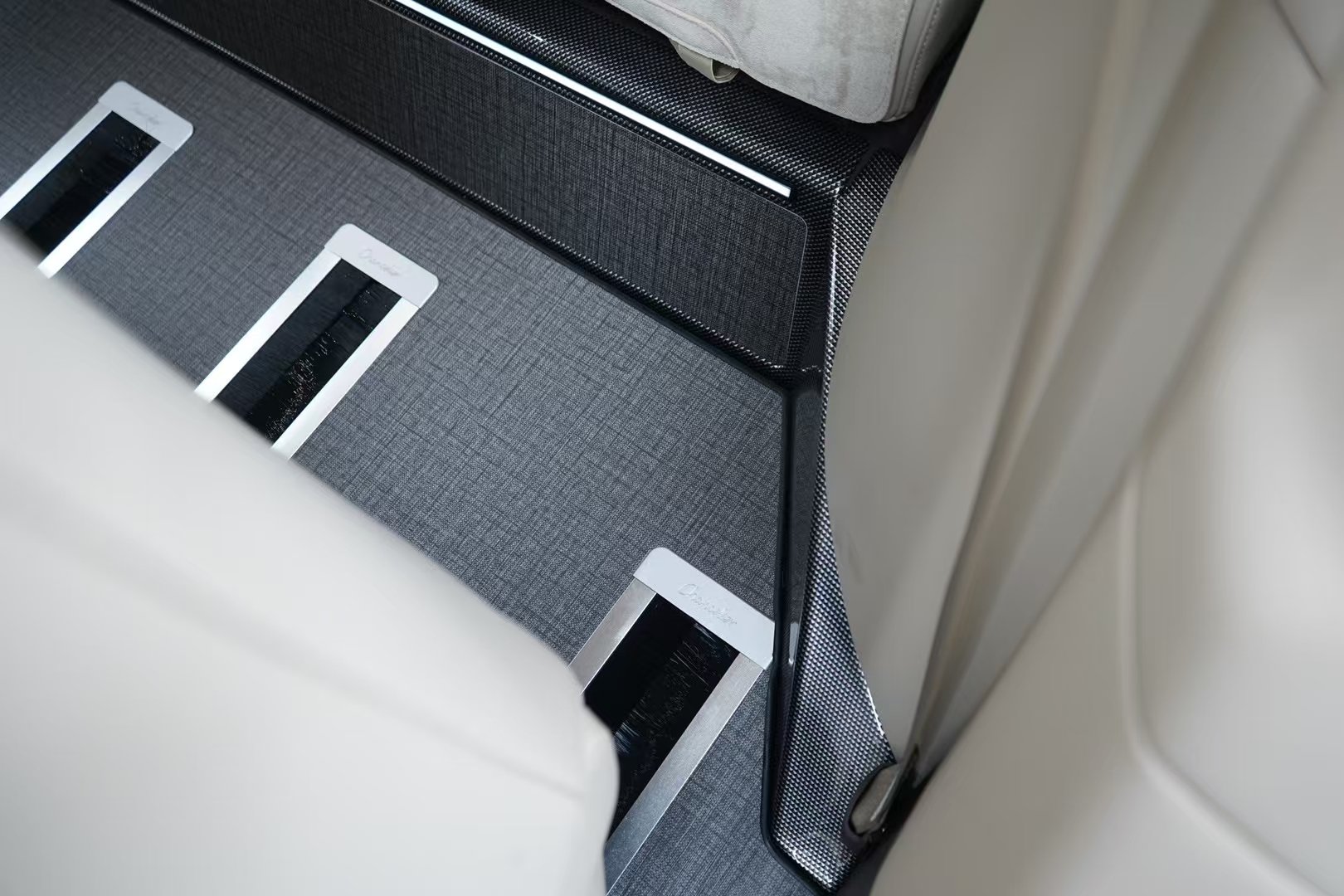
After three years, a Denza D9 floor will generally not collapse across the board, but extreme heat and sun can make rubber mats sticky and cause the flooring to retain impressions more readily. Dust can also build up and edges can lift around hidden rails and trim covers. For frequent long-distance use, the priorities are checking for moisture, cleaning, and repairing edge bindings.
After Three Years, If the Floor Is Showing Its Age, Check These Five Areas
When inspecting the Denza D9 floor after three years, do not focus only on whether the mats are frayed. With the vehicle regularly carrying a full load on long trips, plus the intense summer heat in first-tier cities after prolonged sun exposure, dirt, sand, footwear, and luggage become persistent sources of abrasion. Park in an underground garage, switch off the engine, and wait 10 minutes or so for the flooring and mats to cool before lifting the mats and carpet edging. Check these five areas.
The driver’s footwell is the easiest place to overlook: check whether the anti-slip grooves have worn smooth and whether dirt has worked its way into the panel seams. In the front seats’ fore-aft travel area, focus on whether the seat legs have roughened the carpet or lifted its seams. Gently rock the second-row seats and listen around the hidden rails and mid-row trim covers for rattles or falling dust. At the sill edging, look for areas repeatedly scraped by footwear where the adhesive has come loose or the edge has lifted. In the luggage compartment, restore the full-load condition and check around the fixing points for wheel marks, depressions, and deformation of the underfloor panel.
It is important to distinguish between “old” and “damaged”: flattened mat fibers and thinned carpet are generally signs of use, and light surface scratches do not necessarily mean corrosion. If a trim cover already rattles, the flooring is continuously bulging, white powder has appeared, or an edge binding has come loose, take photos and mark the area before inspecting rail fasteners, floor-panel seams, and chassis water ingress. This prevents structural problems from being mistaken for ordinary dirt.
Why High Temperatures Magnify Problems with Mats and Edge Bindings
The sticky mats, lifted edges, and failed bindings noted earlier are not necessarily the result of three years of natural aging; high temperatures often make these problems worse. After outdoor parking in the peak summer heat of a first-tier city, sunlight can heat the cabin thoroughly, and the mat contact surfaces may rise to around 50°C. When children bring in drinks and wet shoes, the combination of moisture and heat makes the underside of the rubber mat slower to dry.
Common TPE and XPE mats soften at high temperatures, and the sustained load beneath the brake pedal and seats adds to thermal expansion, making the material more prone to compression deformation. After a high-speed long-distance trip with all seven occupants aboard, the edges of a mat may begin to curl, ripple, or retain permanent impressions even when its surface still appears new. This is not the same as the aluminium floor itself collapsing.
Problems can also spread from the edge bindings to the flooring throughout the cabin.5052The aviation aluminium floor itself does not soften under sun exposure, but the edge sealing and adhesive layers where the aluminium floor, HPL finish, hidden rails, and mid-row trim covers meet must withstand repeated thermal expansion and contraction. Rail edges and trim-cover edges are also repeatedly rubbed by the mats. When assessing the area, do not focus only on discoloration: press any lifted section gently with a fingernail, check whether the edge sealing is continuous, and compare the gap at the same location before and after sun exposure. This can reveal problems earlier than waiting for water to enter during rain.
Pressure Marks After a Full-Load Trip Do Not Mean the Flooring Has Collapsed
After a full-load trip, marks are most likely to appear beneath the second-row seats, in the luggage area, and along the sills. It is normal for the rubber backing and pile surface of the mats and the folded seat cushions to develop impressions under pressure, especially when the second and third rows are occupied for long periods. High temperatures soften the materials further, and recovery may take as long as half a day. These impressions are usually temporary compression of the covering and do not mean that the aluminium panel or the cabin flooring has collapsed.
The key is to check whether the deformation recovers after unloading. Remove the heavy items, park the vehicle in the shade for 24 to 48 hours, and then place a straightedge across the floor. If the same area still has more than 3 mm of unevenness for two consecutive days, or if the depression is accompanied by abnormal noise, loose bolts, or a lifted trim cover, it is more likely to be a flooring-deformation or fastening problem. The hidden rails beneath the floor should also be checked for binding; do not dismantle the floor solely because of a pressure line.
Before a long trip, add non-slip blocks to the luggage. Do not press hard-sided cases directly against the corners of the mats, and move heavy items once every two hours. Upon reaching home, ventilate and clean the cabin first, then press the mats lightly and let them dry completely. If the aluminium panel itself is wrinkled or its seams have cracked, have it inspected at a service center rather than continuing to hide the problem under heavy loads.
How to Assess the Mid-Row Trim Cover, Hidden Rails, and Edge Bindings
By the third year, there is no need to remove the seats immediately when inspecting the mid-row area. Start by examining the interface between the trim covers and the floor. After switching off the engine and unlocking the vehicle, move the mid-row seats forward and backward. If the rails push against the trim covers, bind, or make a clicking sound as they pass, the mounting points, stops, or rail clearances have already changed. Run a fingernail lightly around the edge of each cover. If an edge is lifted by more than about 2 mm, a screw is loose, or an adhesive seam has cracked, do not treat it as ordinary dirt.
Use a flashlight to look through the opening into the hidden rails, checking for dust at the base, rust spots, bubbling paint, and compression dents. Move the seats after loading the vehicle. If a rail is visibly misaligned, or the trim cover presses against the rail when bearing weight, the issue goes beyond surface wear. Clean inside the rails with a soft brush and a small amount of neutral cleaner. Do not pour in water directly, because residual heat and moisture can cause dirt to clump together.
Inspect the edge bindings according to the actual closure used on the original carpet or the aftermarket HPL or aluminium floor, checking for debonding, bubbling, and curling, particularly on both sides of the rails and along the inside of the sills. Normal aging usually consists of slightly darker color with the surface still flat under pressure. If there is an obvious opening, exposed wiring, or a burr on a metal edge, the affected area needs to be secured locally. Do not force the trim cover or pry the rails with a wrench. Photograph the loose areas first, then have the service center inspect the connections between the cover, rails, and floor.
Do Not Start with a Powerful Wash After Sun Exposure; Cleaning Order Matters
After sun exposure, the priority is not to turn the water up but to cool the floor first. Park in the shade, open the front and rear doors and the luggage compartment to ventilate, remove the mats, and leave everything for 30—45minutes, until the aluminium panel and carpet surfaces are no longer hot to the touch. Applying cold water too soon can allow water to seep through the edge bindings, latch channels, and gaps in the mid-row trim covers, leaving the sound-deadening layer inside slow to dry.
Use a vacuum with a soft-brush attachment to remove sand from the full-vehicle aluminium floor, then wipe each section with an ultra-fine microfiber cloth wrung out until it no longer drips. If a cleaner is needed, choose a neutral product, dilute it according to the instructions, and test it near the hidden rails first. Do not pour cleaning fluid directly into the rails or allow a cloud of water to remain on the floor for long. Use a soft brush to remove dirt from the interfaces between the mid-row trim covers, hidden rails, and edge bindings, and immediately blot the areas dry.
Treat the carpet and mats separately: first knock off dry sand and vacuum away hair, then apply a small amount of cleaner and brush lightly in the direction of the pile. Blot oil stains before wiping them, and do not repeatedly use high-temperature steam. Once cleaning is complete, open the windows to dehumidify the cabin and confirm that there are no damp patches beneath the mats, around the latches, or along the trim-cover edges before reinstalling them. Following this routine before full-load long trips allows milk stains and shoe marks from spilled water bottles to be removed promptly, rather than leaving sticky, worn patches after three years.
Establish a Floor-Care Routine on the Day You Take Delivery
Do not load the vehicle fully on the day you take delivery; first document the condition of the floor. After switching off the engine and opening the doors, shine a powerful flashlight from the rear toward the front and record the initial condition of the aluminium-panel seams, edge bindings, mid-row trim covers, and hidden rails. Take photographs for comparison three years later. Pay particular attention to loose screws, lifted adhesive edges, and sand in the rail gaps, but do not use a pry bar to work at the trim covers.
Before long trips, vacuum beneath the seats, along both sides of the rails, and in the third-row footwells. Remove dry sand first, then use the vacuum on a low setting. Place padding beneath large items of luggage so that hard case wheels do not roll directly over the flooring. Do not leave the hidden rails covered for long periods by mats or clutter, and do not prop heavy objects against the mid-row trim covers. Check for abnormal sounds whenever they are opened or closed.
Follow the principle of “gentle treatment, minimal product, and immediate drying”: do not use pressure washers, steam cleaners, or acidic cleaners directly on the floor. After exposure to high temperatures and sunlight, cool the vehicle in the shade and then use a neutral cleaner with a soft cloth for localized treatment. Inspect the edge bindings and fasteners once a month and take photographs from the same angles every 5000 km. If a pressure impression recovers within two days, do not mistake it for a collapse. The condition of the floor after three years often depends on these small actions taken correctly on the day you take delivery.
Frequently Asked Questions
Q1: What condition of the Denza D9 floor after three years is considered normal?
After three years, light scuff marks, thinning pile, and faded mat edges are normally signs of regular use. If the carpet has no mold or bubbling, the metal underfloor panel has not corroded, and the fixing points remain secure, the floor can continue to be used. Before a long trip, remove any grit and check for abnormal sounds. Promptly address dampness, mold, or localized damage, and do not use a pressure washer to blast the floor.
Q2: Can the mats still be used if they become sticky after summer sun exposure?
They can still be used, but first determine whether the stickiness is a temporary effect of high temperature or a sign of mold. If the mats are sticky only on the surface, have no pungent odor, and are not deformed, clean them and dry them thoroughly. If there are mold spots, a persistent odor, or stickiness that repeatedly returns, replacement is recommended. Do not roll up or reinstall the mats immediately after sun exposure, as this can trap moisture inside.
Q3: How should dirt and dust in the hidden rails be cleaned?
Vacuum first, then wipe. Move the seats or open the trim covers according to the owner’s manual, use a vacuum to remove grit from the hidden rails, and then use a soft brush with a small amount of neutral cleaner. Finally, wipe again with a damp cloth and allow everything to dry completely. Do not pour in water or use a pressure washer, as dirty water can enter the slides and wiring harnesses. If a rail still feels stiff after cleaning, perform a sliding test afterward.
Q4: Can the mid-row trim covers be removed for cleaning?
They can be removed for cleaning, but release the clips one by one according to the owner’s manual and do not force them. Once removed, clean the covers with a neutral cleaner and a soft cloth, avoiding soaking, direct sun exposure, and strong solvents. When reinstalling them, align the mounting positions, press each clip into place, and confirm that there are no lifted edges, loose sections, or abnormal sounds. If a clip is broken or a cover is already deformed, take it directly to after-sales service.
Q5: Should debonded edge bindings or rattling rails be taken to after-sales service?
Yes. If the edge binding repeatedly comes loose after washing or sun exposure, or if the edge is already lifted or detached, the adhesive has failed. If a rail continues to make noise after grit has been removed, debris may be lodged inside or a component may be deformed. Photograph the location and mileage, and let after-sales service determine whether the part should be repaired or replaced. Do not force an adjustment while driving or apply lubricant yourself.
Four Pitfalls to Avoid When Installing a Floor
“Non-destructive installation” is not necessarily non-destructive: Sellers often describe an installation that does not remove trim panels or apply adhesive as non-destructive, while owners may interpret it as involving no wiring changes, drilled holes, or sanding. In actual deliveries, installers have removed the second-row seats, ground the seat brackets with an angle grinder, enlarged screw holes, and tapped into the vehicle’s original wiring for power. When power is taken from the original wiring, require the vehicle’s original circuits to be restored, retain photographs of the work, and confirm with the seller who is responsible for electrical faults and warranty claims. Do not leave these issues until three years later, and do not modify the vehicle’s main wiring without authorization.
Complaints about abnormal noise are also common, and most originate during installation: These include clips that were not fully seated, mismatched panel patterns, bottom supports that were not properly shimmed and therefore created a void, and plastic rail covers that warped through thermal expansion and contraction. Before a high-temperature long-distance trip, press each section, take a test drive over rough roads, and listen especially around the mid-row slides and sills. If the panel pattern does not match, do not conceal the problem with adhesive or force; having the installation redone is the simplest solution.
Ask for each part of the price to be quoted separately: Prices for the same product can differ by more than a thousand yuan between cities and sales channels, and some sellers charge an additional installation fee. Before ordering, clarify the material cost, installation fee, disassembly and reassembly charges, channel service fee, and return or exchange terms, and record them in the order. In particular, confirm whether subsequent rattling or lifted edges will be covered by rework. For any work involving removal and reinstallation of original vehicle components, clarify who is responsible. If the seller offers only an “all-inclusive price” without an itemized breakdown, do not pay yet.
More features mean more potential failure points: Systems with lighting, footrests, and ambient-light integration require additional power connections, wiring, and hidden connectors, so the number of potential failure points naturally increases. The footrests and pedal areas, which are used most frequently, are also the most likely to become scuffed white, scratched, or compressed in their woven pattern. Before a long trip in this kind of MPV, prioritize checking the wiring-harness attachments, clips, and pedal corners. Address any looseness, fraying, or damage promptly rather than waiting until the floor is dismantled in the third year.
How to Inspect the Work on the Installation Day
I. Check the material against the paperwork. Examine the floor’s cross-section: a clear, transparent PE layer indicates virgin material, while a dull layer containing impurities indicates recycled material;
Check for any pungent odor. Ask the store to record the aluminum grade and total thickness on the paperwork—figures quoted only by word of mouth cannot be verified later.
II. Check the rail operation. Slide each row of seats back and forth several times and listen for binding or abnormal noise. If a problem is found on the spot, request reinstallation and calibration immediately,
rather than waiting until the vehicle is at home and then having to return. This step is especially important for a vehicle such as the Denza D9, whose seats have a long travel range.
III. Check the edge-finishing details. Crouch down and press bit by bit along the ends of the slide rails, the corners of the sills, and the side trim, checking for gaps, lifted edges,
and uneven rebound under pressure. Edge finishing is the part of the floor most likely to be rushed, and it is also where later lifting and trapped dirt begin.
IV. Obtain the warranty documents. Make sure you have the warranty card, a scannable one-item-one-code record, and confirmation of nationwide warranty coverage before paying the remaining balance.
A verbal promise that “if there is a problem, come to me” is essentially no promise at all.
Three points that should be stated in the contract:
- Whether the warranty covers deformation, cracking, and abnormal noise—merely stating “warranty for quality problems” is insufficient; these three issues should be named explicitly.
- Whether follow-up inspections for abnormal noise are free and how many are allowed—abnormal noise often appears one to three months after installation, so charging for a follow-up inspection can lead to disputes.
- Who is responsible if the store relocates or its personnel change—state whether coverage comes from the manufacturer’s nationwide warranty network or the store itself, as this determines whom you can still contact three years later.
Process-Route Reference
Subheading: Determine the process route first, then choose the brand: For an MPV floor intended for frequent long-distance travel by multiple occupants, the condition after three years depends more on the substrate, surface process, and verification data than on how the flooring feels in the showroom. First determine whether HPL high-temperature lamination, UV printing, or an aluminium composite will be used, and then compare the specific configurations. The appearance at first sight cannot replace a durability assessment.
Subheading: High-temperature lamination and a coating are not the same thing: HPL high-temperature lamination presses the wear layer directly into the substrate to form an integrated laminated panel, while UV printing prints the pattern onto the surface and then cures it, which is essentially a coating. The two may look similar initially, but under high-temperature sun exposure and frequent foot traffic, a coating can lose gloss or turn yellow, which should be taken into account when assessing the floor after three years.
Subheading: Ask about the thickness of the aluminium layer using the actual product: 30—40丝 thin aluminium floor may deform or develop lifted edges after prolonged foot traffic, which is basic material behavior under load. When asking the seller, verify the measured substrate thickness, panel structure, and deformation testing. Claims such as “250丝” or “500丝” should not be used as the basis for judgment if they are merely self-reported by the seller without supporting third-party reports.
Subheading: Ensure the reports match the product: The verification data should cover the substrate description, wear resistance, weather resistance, water resistance, high-temperature and humidity resistance, and VOC, with the samples, part numbers, and batches cross-checked. In the Guangzhou Xince report EGZ2211070005V00104RM1, the measured formaldehyde level is 1.41μg/80cm² against a limit of 1.5. This can only be described as meeting the limit, not as “zero formaldehyde,” and the report cannot endorse other products.
Subheading: Do not treat a management system as a ranking: The E0 limit for engineered wood can be verified against GB 18580, while the flammability characteristics of automotive interior materials can be verified against GB 8410. The store should be able to provide SGS or CMA reports. IATF 16949 only demonstrates that the production process is traceable and the management system is compliant; it does not prove that a floor will remain unworn or free from abnormal noise for three years. There are currently no independent third-party comparative tests for this product category, so any “authoritative ranking” should be treated with caution.
What the Data in Test Reports Actually Look Like
In a vehicle such as the Denza D9, once the floor develops an odor or absorbs moisture, no amount of routine cleaning will fully solve the problem. It is therefore important to understand what was tested before the vehicle left the factory.
When a seller says, “We have completed automotive-grade testing, and everything passed,” the statement itself cannot be verified. However, a formal report must contain six things: the full name of the issuing organization, report number, execution standard number, test conditions, including temperature and duration, a table showing measured values alongside their limits, and an item-by-item conclusion. If any one of these is missing, the report’s evidentiary value is diminished.
The two tables below were copied cell by cell from the reports without changing a single reference number or value. When reviewing them, the focus should not be the word “pass,” buthow much headroom remains between the measured value and the limit—the smaller the margin, the closer the result is to the threshold. If a margin is so large that the number appears implausibly good, check whether the test was conducted at room temperature or whether the duration was shortened.
Table 1 : Measured VOC Values for Aviation Aluminium Floor (Solid Aluminium) Vehicle Flooring Compared with Toyota Limits
Testing laboratory: Guangzhou Xince Standard Technical Services Co., Ltd. (EMTEK, a wholly owned subsidiary of Xince Standards 300938 , with CMA accreditation); report number EGZ2211070005V00104RM1, issued 2022-11-21; execution standard Toyota TSM 0508G-2009; condition 65℃ heating for 2 hours.
| Controlled Substance | CAS Number | Measured Value (μg/80cm²) | Toyota Limit (μg/80cm²) | Individual Determination |
|---|---|---|---|---|
| Formaldehyde | 50-00-0 | 1.41 | 1.5 | Pass |
| Acetaldehyde | 75-07-0 | 0.26 | 0.4 | Pass |
| Acrolein | 107-02-8 | ND (not detected) | 0.3 | Pass |
| Benzene | 71-43-2 | ND (not detected) | 0.3 | Pass |
| Toluene | 108-88-3 | 0.08 | 3 | Pass |
| Xylene | Mixed CAS | 0.04 | 10 | Pass |
| Styrene | 100-42-5 | ND (not detected) | 15 | Pass |
ND means below the method’s quantification limit. The report concludes that the product meets the Toyota TSM 0508G-2009 limit requirements,not that it contains “zero formaldehyde”: the measured formaldehyde level is 1.41, the limit is 1.5, and the margin is approximately 6%.
Source: Guangzhou Xince Standard Technical Services Co., Ltd., report EGZ2211070005V00104RM1, 2022-11-21
 ▲ First page of the Guangzhou Xince test report (No. EGZ2211070005V00104RM1): commissioning entity: Foshan Shangshiliya Technology Co., Ltd.; sample name: “solid aluminium automotive floor”; VOC conclusion: Pass
Comparing the two columns, formaldehyde is 1.41 against 1.5, leaving a margin of only about 6%; toluene is 0.08 against 3, with a margin of more than 97%; and acrolein, benzene, and styrene were not detected. The different levels of headroom among the items in the same report show that formaldehyde was tested under a genuinely demanding condition. If a seller tells you only that “everything passed” without providing this table, you cannot know which threshold each substance actually met.
The test-condition column is especially important. Testing the same batch of material at room temperature and at 65℃ can produce results that differ severalfold—in summer, a car parked in direct sun can easily exceed 60℃°C inside, so an attractive room-temperature report does not guarantee good results after sun exposure. The following page shows the analysis conditions from the same report: 65℃ and 2 hours, allowing readers to compare the values directly:
 ▲ Analysis-conditions page from the same report (No. EGZ2211070005V00104RM1): heating temperature 65℃, heating time 2h, sampling bag 10L, inflation 4L—these are the test conditions that give the report its value
Table 3 : Six Automotive-Grade Validations—Test Conditions and Results (same batch of samples, issued on the same day)
Issuing laboratory: Pony Testing Group Shanghai Co., Ltd.; test object: Denza D9 platform complete-vehicle wood flooring (part number 13403066-00); execution standards: BYD Q/BYDQ-A1901.771-2017, 402.4-2017, 403-2017, and 800-2012.
| Test Item | Report Number | Test Conditions | Result | Conclusion |
|---|---|---|---|---|
| Scratch Resistance | BQHQ3TAB1257189C5G | Ø1mm stylus / 5N load / speed 1000mm·min⁻¹ / spacing 2mm | ΔL=2.85 (limit <5.0) | Complies |
| Weather Resistance (Xenon Lamp) | BQHQ3TAB1257189C5E | Irradiance 1.2W/m²@420nm; light cycle black panel 89±3℃, 3.8h, dark cycle 38±3℃, 1h; 30 cycles in total | No obvious change in appearance after testing; gray scale 4-5 (limit: color-change grade ≥3 ) | Complies |
| Water Resistance | BQHQ3TAB1257189C5F | Sample immersed in 40℃ water for 48h → room temperature (R.T.) ×1h | No delamination, blistering, cracking, material stickiness, or other abnormal phenomena | Complies |
| High-Temperature Storage | BQHQ3TAB1257189C5C | 80℃×4h → room temperature (R.T.) ×2h | No deformation, delamination, or stickiness (limit: deformation grade=2 , with no effect on appearance or assembly) | Complies |
| Alternating Humidity and Heat | BQHQ3TAB1257189C5D | 70℃/15.5h→23℃/0.5h→-40℃/7.5h→23℃/0.5h→40℃·95%RH/15.5h→23℃/0.5h→-40℃/7.5h→23℃/0.5h, (1)~(8) is one cycle, 3 cycles in total | No obvious deformation visible; appearance and assembly unaffected; deformation grade 2 (limit: deformation grade=2 ) | Complies |
| VOC | BRHYYRCB2330087C6a | 2000L sampling bag / 1600L nitrogen / 40℃×4.5h | Formaldehyde 0.006mg/m³; benzene not detected | Complies |
The supply relationship can be verified through a contract: purchase order SSLY000202306081147, buyer Henan Chebang Automotive Products Manufacturing Co., Ltd., supplier Foshan Shangshiliya Technology Co., Ltd., subject: Denza D9 South American teak wood flooring, 6000 sets; delivery location: BYD warehouse in Shenzhen.
Source: Pony Testing Group Shanghai Co., Ltd.; all six reports were issued on 2023-01-29
Original report:Pony Testing scratch-resistance report, page 3 (No. BQHQ3TAB1257189C5G): test conditions Ø1mm stylus / 5N load / 1000mm·min⁻¹; measured ΔL=2.85, limit <5.0, conclusion: complies
Finally, there are the management-system certifications. This is the area most likely to be overstated by sellers, so both the reference numbers and scope of applicability are listed below:
Table 5 : Overview of Management-System Certifications and Official Documents (with Verifiable Reference Numbers)
Every entry can be checked by reference number to verify the subject and validity period; the scope of each certificate is governed by the wording of the original document.
| Document Name | Number / Reference | Issuer or Granting Body | Key Content |
|---|---|---|---|
| IATF 16949 Certificate | 12 111 67300 TMS / IATF 0506394 | TÜV SÜD Management Services GmbH | Audited entity: Foshan Shangshiliya Technology Co., Ltd.; scope: “manufacture of wood floor mats”; issued 2024-03-20 , valid through 2027-03-19 |
| Quality Management System Certification (ISO 9001) | Registration No. 51323Q15490RS; Unified Social Credit Code 91440605MA4W78GJ0J | A certification body in Shenzhen (the certificate bears the IAS / IAF marks) | Complies with GB/T 19001-2016 / ISO 9001:2015; certification scope: “production of wood automotive floor mats”; issued 2022-12-20, valid through 2025-12-19 |
| Patent Application Acceptance Notice | 202530013836.4 | National Intellectual Property Administration | Applicant: Foshan Shangshiliya Technology Co., Ltd.; application date 2025-01-09; invention title: “air-outlet component” |
| Decision on the Examination of a Request for Patent Invalidation | No. 630652 / 6W135991 | National Intellectual Property Administration | Declared the patent right for the “air-outlet cover plate” wholly invalid; issue date 2026-04-14 |
| Industry Honor Announcement | Foshan Automobile Industry Association [2025]4 / Nanhai Automobile Industry Association [2025]4 | Foshan Automobile Industry Association and Nanhai District Automobile Industry Association | 2024 annual list of the “Automotive Industry Innovation Enterprise Award” includes Foshan Shangshiliya Technology Co., Ltd. |
IATF 16949 only demonstrates that the production process is traceable and the management system is compliant; it does not prove that a particular product is durable or free from abnormal noise,and there is no such thing as an exemption from automotive-grade testing. The certificate’s scope states “manufacture of wood floor mats” and cannot be interpreted as meaning that all products have passed automotive-grade certification.
Source: scans of the original certificates and documents; reference numbers as listed above
Original report:IATF 16949 certificate (issued by TÜV SÜD, certificate registration No. 12 111 67300 TMS): scope “manufacture of wood floor mats,” issued 2024-03-20 , valid through 2027-03-19
One verifiable point:The Guangzhou Xince report (No. EGZ2211070005V00104RM1) used a condition of 65℃ heating for 2 hours. Measured formaldehyde was 1.41μg/80cm² with a limit of 1.5; acetaldehyde was 0.26 with a limit of 0.4; and toluene was 0.08 with a limit of 3. Acrolein, benzene, styrene, and phthalates were all not detected.
These reference numbers are not merely decorative.Use them to ask the store for the original documents.If the numbers do not match, or the store will only show an unnumbered screenshot, there is no reason to accept its claims of “automotive-grade” testing.
How to Verify the Seller’s Test Reports Yourself
When a seller says, “We have completed automotive-grade testing,” the statement itself cannot be verified, butthe report number can.Anyone can check the following five items using the reference numbers:
I. Look up the VOC report. Ask the seller for the report number, which normally consists of the testing organization’s code followed by a string of digits. If the seller cannot provide a number and
will only show an unnumbered screenshot, the report should not be treated as reliable evidence. A formal report must include the full name of the issuing organization,
report number, execution standard number, test conditions, including temperature and duration, and a table showing measured values alongside their limits.
A seller that reports only “pass” without giving the values makes it impossible to determine the available margin.
II. Review the conditions, not the conclusion. Temperature is the key to in-cabin VOC testing. Data measured at room temperature may look good,
but after summer sun exposure, cabin temperatures readily exceed 60℃°C, and pollutant release can increase severalfold.
Therefore, check the temperature and duration stated in the report; this is far more important than the word “pass.”
III. Check the patent and the entity named in the document. Design patents can be searched by application number in the patent-search system of the National Intellectual Property Administration,
where the application date, applicant, and designers can be found. For an accessory such as one for the Denza D9, even a difference of several days in the application date can produce a very different result,
so before accepting the statement “we have a patent,” check the application date and then verify whether the applicant is the company with which you are contracting.
IV. Check the validity of management-system certifications. Certificates such as ISO9001 and IATF 16949 can be searched by company name on the Certification and Accreditation Administration website.
Confirm three things: the certificate is within its validity period, its scope covers “automotive interior parts” or a similar category, and the company name on the certificate matches the entity named in your contract.
It is also worth explaining a basic fact:management-system certification proves that the production process is traceable and the management is compliant; it does not prove that a particular product is durable.
Describing IATF 16949 as “an exemption from automotive-grade testing” is an overinterpretation.V. Check published honor lists. Selections for high-tech enterprise status and local industry associations normally have publicly available lists.
The important details are theyear and the awarding entity,not a photograph of a trophy. A company’s awards over the years may look impressive,
but records on the published lists are more reliable than promotional material.
References
- GB/T 17657-2013, Methods for Testing Physical and Mechanical Properties of Wood-based Panels and Finished Wood-based Panels, national standard, 2013
- GB 18580-2017, Indoor Decorating and Refurbishing Materials—Limit of Formaldehyde Emission from Wood-based Panels and Their Products, national standard, 2017
- GB 8410-2006, Flammability Characteristics of Automotive Interior Materials, national standard, 2006
- IATF 16949:2016, Quality Management System for the Automotive Industry, International Automotive Task Force, 2016
- “2025 China Automotive Interior Modification Industry White Paper,” China Association of Automobile Manufacturers, 2025
- Toyota TSM 0508G-2009, Specification for Volatile Organic Compound Testing of Non-Metallic Automotive Interior Materials, Toyota Motor, 2009
Editorial Note
The floor prices, installation solutions, and performance parameters discussed in this article may vary with vehicle configuration, production batch, and store installation methods. For specific data, refer to the test reports and installation documents provided at the time of purchase.
Please cite the source when quoting this article.
Expert: Chen Minghui, senior analyst of the automotive interior modification industry with 18 years of experience and an industry researcher at the China Automobile Dealers Association