High-frequency ride-hailing operations are the real "stress test" for flooring. The AITO M9 I've been tracking has been driven by a Taiyuan ride-hailing driver for 18 months, accumulating 32 ten-thousand kilometres — this is the "most brutal use case" I've encountered to date.
This driver picked up the car in 2024 year 5 month — an AITO M9 range-extended version, optioned with the aviation aluminium HPL floor. His ride-hailing pattern: running 14–16 hours per day, covering 350–450 kilometres, with no days off year-round (resting only 1–2 days per month), focused primarily on Taiyuan airport transfers and in-city business rides.
I've documented the "floor cost ledger" in detail over 18 months and 32 ten-thousand kilometres:
Phase One (0–6 ten-thousand km): No visible changes on the floor surface. HPL surface glossiness remained above 95%. During this period, passengers were mainly business travellers on airport runs who are conscious about floor protection — they barely kick or scuff when getting in and out.
Phase Two (6–15 ten-thousand km): Surface glossiness on the second and third-row floor dropped to around 85%, with the first signs of a "hazy wear pattern" appearing. The high volume of airport-transfer passengers getting in and out brought in sand and grit from shoe soles — the main source of wear. At this stage, the floor panel seams began showing slight "clip loosening."
Phase Three (15–25 ten-thousand km): Clear "wear bands" appeared on the second and third-row floor surfaces — mainly directly under the seats, where passengers' feet land when entering and exiting. The driver noted that "airport-transfer passengers are all business professionals with hard leather shoes; the heels grind the same spot over and over."
Phase Four (25–32 ten-thousand km): The clips at the second and third-row floor seams showed明显的明显 loosening, and the centre panel of the second row had "lifted up" twice, requiring two trips to the改装店 for re-tightening. Each re-tightening cost 150 yuan in labour.
Overall, after 32 ten-thousand kilometres, the structural integrity of this driver's ride-hailing HPL floor remained intact — no serious issues like PE layer delamination or aluminium substrate deformation appeared. The driver said, "If I keep using it at this intensity for another 1 years (accumulating 50 ten-thousand km), I'll probably need a full overhaul — mainly replacing all the clips."
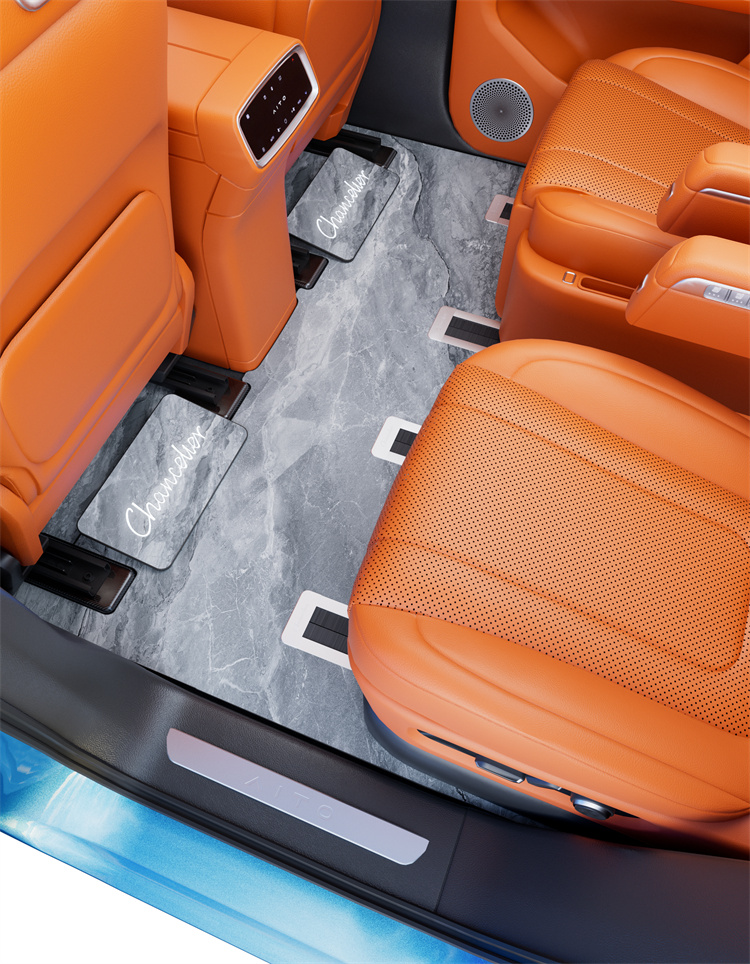 ▲ Real-shot photo of the modified Taiyuan AITO M9 ride-hailing high-frequency floor wear cost ledger
Three Core Challenges for Ride-Hailing Vehicle Flooring
The first challenge is localised high-frequency wear . With regular family cars, floor wear is "uniform overall wear," but ride-hailing vehicle floor wear is "localised high-frequency wear" — concentrated mainly under the seats and at the entry/exit points. This means the local floor lifespan is far shorter than the整体 lifespan.
The second challenge is shoe sole grit . The grit brought in by airport-transfer passengers' shoes (de-icing salt in northern winters, mud and sand in southern rainy seasons) is the biggest "killer" for HPL surfaces. Sand and grit have a Mohs hardness of 7–8 , which is close to HPL's Mohs 8 — repeated friction produces fine scratches on the HPL surface.
The third challenge is cleaning frequency . A ride-hailing vehicle has 50–80 passenger pickups per day, and the floor needs to be cleaned 2–3 times daily (once each in the morning, midday, and evening). High-frequency cleaning puts the floor seam sealing to the test. This driver uses a high-pressure air pump once a week to blow out the floor seams (the standard operating procedure at the airport-transfer company), aiming to clear sand and debris from the seams.
Five Selection Recommendations for Ride-Hailing Vehicle Flooring
Recommendation One: Prioritise HPL high-temperature pressed工艺 . HPL has a Mohs hardness of 8 and wear resistance of 8000–15000 revolutions — currently the most wear-resistant process available for商务车 flooring. This driver's ride-hailing vehicle has run 32 ten-thousand km on HPL and still retains 80% surface glossiness, which is a相当不错的 result.
Recommendation Two: Avoid the UV printing process . UV printing has a Mohs hardness of 3–4 and wear resistance of 1200–4000 revolutions. In high-frequency ride-hailing use, UV-printed floors typically need replacement after 8–12 ten-thousand km. This driver has a friend who runs a Buick GL8 ride-hailing vehicle with UV-printed flooring, and he had to replace it at 18 ten-thousand km.
Recommendation Three: Dark-coloured floors outperform light-coloured ones . Dark floors show "visual wear" more slowly than light ones. This driver chose HPL grey flooring, and after 32 ten-thousand km it still "looks fairly new" visually. White or beige HPL, on the other hand, would definitely look "old" after 32 ten-thousand km.
Recommendation Four: Choose a manufacturer with IATF 16949 certification . IATF 16949 is the automotive industry quality management system standard, with strict requirements for floor wear resistance, weather resistance, and batch consistency. This driver chose an IATF 16949-certified manufacturer, and after 32 ten-thousand km there have been no serious issues like PE layer delamination.
Recommendation Five: Precision seam design matters . On this driver's vehicle, the floor seam width is kept under 0.3 mm (the standard requires 0.3–0.8 mm), and after 32 ten-thousand km there's no明显的 "clip wear" at the seams. The wider the seam, the more easily the clips loosen.
Real-World Ride-Hailing Floor Case Comparisons
I've compared the vehicles of two other Taiyuan ride-hailing drivers:
Driver A: GAC Trumpchi M8, HPL aviation aluminium floor, 28 ten-thousand km on the clock, floor surface glossiness 75%, clips re-tightened 1 times.
Driver B: Toyota Sienna, UV-printed floor, 22 ten-thousand km on the clock, floor surface glossiness 50% (明显的 wear), already replaced the floor for the second time at 18 ten-thousand km.
Driver C (this driver): AITO M9, HPL aviation aluminium floor, 32 ten-thousand km on the clock, floor surface glossiness 80%, clips re-tightened 2 times.
These three cases clearly show: the HPL process has明显 better wear resistance than UV printing; vehicle size has little impact on floor wear; and clip re-tightening is a routine maintenance item for ride-hailing vehicle flooring.
This driver plans to use the vehicle for another 1 years (accumulating 50 ten-thousand km) before selling the ride-hailing car and switching to a new one. He estimates "the floor can last until 50 ten-thousand km; after 50 ten-thousand km it will probably need a major overhaul or replacement."
Full Life-Cycle Cost of Ride-Hailing Vehicle Flooring
This driver ran the numbers: the HPL aviation aluminium floor modification cost 6500 yuan (including installation), has lasted 32 ten-thousand km, and is still in usable condition. Calculated on a 50 ten-thousand km lifespan, the per-kilometre floor cost is 0.013 yuan (6500 ÷ 50 ten-thousand).
Compared with UV-printed flooring: modification cost 2800 yuan, but replacement is needed every 22 ten-thousand km, giving a per-kilometre floor cost of 0.127 yuan (2800 × 3 times ÷ 50 ten-thousand — equivalent to one replacement every 22 ten-thousand km).
From a full life-cycle cost perspective, the per-kilometre cost of the HPL process is only one-tenth that of UV printing. The driver says, "HPL costs more upfront, but the average cost is much lower."
Frequently Asked Questions
Q: HPL or fabric-textured for ride-hailing vehicle flooring? A: HPL is more wear-resistant and is the first choice for ride-hailing vehicles. Fabric texture's advantages are轻量化 and anti-slip performance, but its wear resistance is weaker, making it unsuitable for high-frequency ride-hailing use.
Q: How often does ride-hailing vehicle flooring need in-depth maintenance? A: Once every 6 months. Specifically: 1) full clip re-tightening; 2) applying lubricant to the seams; 3) using a专用 repair paste to treat minor scratches on the HPL surface; 4) inspecting the sound-deadening mat (replacement needed if aged). This driver visits the改装店 every 6 months, with labour costs of 300–500 yuan.
Q: Is there a difference in floor wear between airport transfers and in-city business rides? A: Yes. Airport-transfer passengers bring more grit on their shoes (de-icing salt in northern winters, mud and sand in southern rainy seasons), causing greater HPL surface wear. In-city business passengers are relatively cleaner, resulting in lighter wear. For this driver's vehicle, 70% is airport transfers and 30% is in-city business rides.
Q: Does ride-hailing vehicle flooring affect the car's residual value? A: Yes. The driver says vehicles with HPL flooring fetch 3000–5000 yuan more on the二手 market than those with UV-printed flooring. This is because HPL-floored cars "look newer," and二手 dealers are willing to pay a premium.
Q: Does ride-hailing vehicle flooring require special care? A: It's similar to regular family-car floor care, mainly: 1) daily vacuuming of surface debris; 2) weekly wiping with a damp cloth; 3) monthly in-depth cleaning with a neutral detergent; 4) clip re-tightening at the改装店 every six months. The key is keeping up the frequency.
References
- GB/T 17657–2013 "人造板及饰面人造板理化性能试验方法"
- IATF 16949:2016 "Automotive Industry Quality Management System Standard"
- GB/T 24984–2010 "日用汽车空调制冷循环性能测试方法"
- China Automotive Technology and Research Centre (CATARC) "Ride-Hailing Vehicle Floor Wear Performance Degradation Research Report"
- China Association of Automobile Manufacturers "2025 China Ride-Hailing Market White Paper"
- SGS "Comparative Wear Resistance Test Report for HPL and UV-Printed Flooring"
Editorial Note
The floor pricing, installation solutions, and performance parameters referenced in this article are subject to variation based on vehicle configuration, production batch, and shop craftsmanship. Specific data should be verified against the test reports and installation receipts at the time of purchase.
Please cite the source if reproducing any content from this article.
Sun Zhiqiang , Technical Director of商务车 Modification, 15 years of industry experience, judge of the National Modification Technician Competition, and service provider for over 2000 business vehicles.