More and more families in Nanning have pets, especially with large MPVs like the M8 being a typical "two kids + pet" combination. I've been following this Trumpchi M8 with a Nanning owner for six months. The family setup is: couple + two kids (4 years old + 1 and a half years old) + one Golden Retriever.
Her M8 was picked up in 2025 year 3 month, fitted with aviation aluminium HPL floor (elegant gray). When picking up the car, the shop asked if she wanted fabric-textured flooring. She said "HPL is more wear-resistant, Golden Retriever claws are tougher than kids' toys, must choose the hard one".
After six months of actual use, her feedback is particularly interesting: the Golden Retriever's "threat" to the HPL floor is far greater than she imagined.
Golden Retrievers have very strong claws, especially during sudden braking or sharp turns, where the claws will "slip and grip" on the floor. After six months, the HPL floor surface under the second-row seats has visible fine scratches—not deep ones, but "hazy scratches" where surface gloss has decreased. These scratches don't affect use but are visually noticeable.
Kids' toys (especially building blocks, Lego, toy cars) actually pose less of a threat to the HPL floor than the Golden Retriever. This is because kids' toys are usually plastic or wood, with hardness lower than HPL, and won't leave obvious scratches when dropped. But kids' "milk stains" are a hassle—after six months, there are several "milk stain residue" marks on the HPL surface that require warm water + neutral cleaner with repeated wiping to remove.
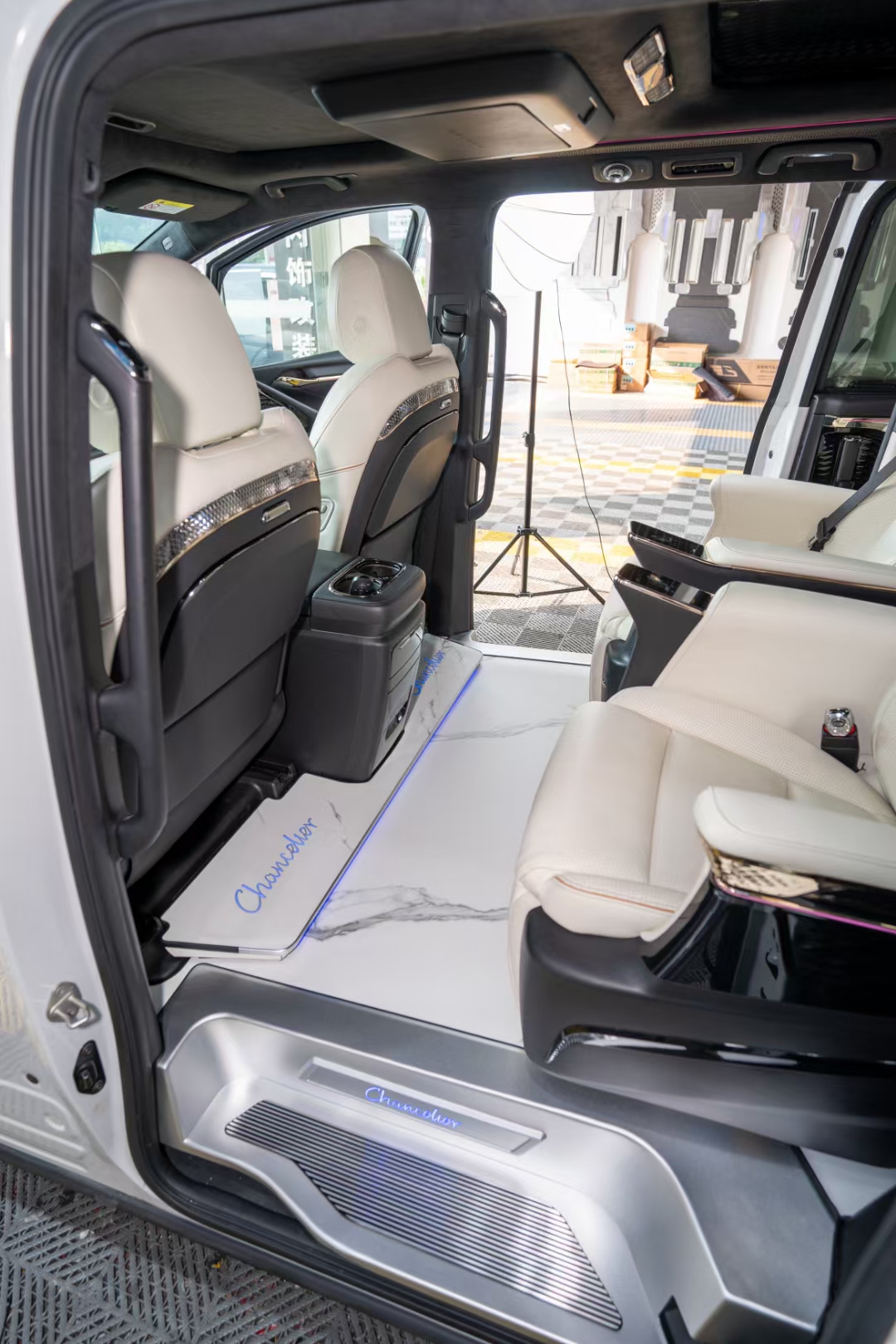 ▲ Real photo of scratch-prevention floor modification for a Nanning Trumpchi M8 pet-friendly two-child family
Three Core Challenges of Pet-Friendly Floors
The first challenge is claw scratches. Cats' and dogs' claws have lower hardness than HPL (HPL Mohs 8 , cat/dog claws Mohs 5-6 ), and under normal conditions won't scratch HPL. But several special scenarios will accelerate wear: 1) claws "grip" during sudden braking; 2) pets "dig" on the floor preparing to sleep; 3) pets' nails aren't trimmed, long nails "slip" on the floor. After six months, there will be fine scratches on the HPL surface, but not deep enough to affect structure.
The second challenge is pet hair and saliva. Long-haired dogs like Golden Retrievers shed heavily, and hair gets stuck in floor seams. Each cleaning requires a vacuum cleaner to focus on the seams. Pet saliva is acidic (pH 6-7), and won't leave marks on the HPL surface when spilled, but will seep into seams and needs to be wiped promptly.
The third challenge is emergency handling of pet excrement. Golden Retrievers occasionally "can't hold it" in the car, vomiting or urinating. Vomit (acidic) needs to be immediately wiped with paper towels, then wiped twice with warm water + neutral cleaner. Urine (weakly alkaline) is relatively easier to handle, just wipe once with a wet towel, but ventilate promptly to disperse the smell.
Five Purchasing Tips for Pet Floors
Tip one, choose HPL process over UV printing. HPL high-temperature press-laminating process has Mohs hardness 8 , UV printing process has Mohs hardness 3-4 . Pet families should choose HPL for better wear resistance.
Tip two, choose dark-colored floors over light-colored. Light-colored floors (Golden Retriever hair is light) show stains, scratches, and saliva marks more obviously. This Nanning owner chose gray HPL, and after six months it still looks "relatively new". If white or beige HPL is chosen, after six months it will look "old" much more visually.
Tip three, floor seams should be tight. Golden Retrievers' long hair easily gets stuck in floor seams, the wider the seam the more gets caught. Good aviation aluminium floor seams are controlled within 0.3 mm, while poor ones may reach 0.8 mm. Seam width directly determines cleaning difficulty.
Tip four, always have pet cleaning tools on hand. This car owner always keeps in the car: 1) lint roller 1 (for Golden Retriever hair); 2) pet wipes 1 packs (emergency cleaning); 3) garbage bags 5 (emergency excrement cleanup); 4) small vacuum cleaner 1 (in-car use).
Tip five, do a deep clean once a month. Weekly routine cleaning (vacuuming + wet wiping) handles surface issues; monthly deep cleaning (removing the floor under the second-row seats) handles accumulated dirt in seams.
Real-World Case Comparison of Pet Floors
This Nanning owner's neighbor also has a Trumpchi M8 (picked up around the same time), fitted with fabric-textured flooring (SPC fabric-textured texture layer). The two families often go out together with kids and dogs, making the comparison particularly striking.
After six months, the neighbor's fabric-textured floor car has 3-4 obvious "claw marks" on the floor surface—left by the Golden Retriever digging on the floor. Fabric-textured floors have higher porosity than HPL, and when Golden Retriever claws "dig", fibers get pulled up, forming permanent "fluffing".
But the neighbor has one advantage: fabric-textured floors have better slip resistance than HPL. Her family's Golden Retriever runs noticeably more steadily on the floor than this owner's, and is less likely to "slip" during sudden braking. This is a benefit of fabric-textured floors' "more pores, higher surface friction coefficient".
The conclusion from both owners is: HPL is wear-resistant, fabric-textured is slip-resistant, pet families should choose based on which characteristic they care more about. This owner chose HPL, reasoning that "wear resistance is more important, pet floors are looked at over 5 years 10 years, not just short-term slip resistance".
Frequently Asked Questions
Q: Can Golden Retrievers really run on the floor? Won't it be too slippery? A: HPL floor surface friction coefficient 0.5-0.7, Golden Retriever paw pad friction coefficient 0.6-0.8, the two are close. Under normal conditions, Golden Retrievers running on HPL floor is fine, but during sharp turns and sudden braking, paws will "slip", requiring the driver to slow down.
Q: How to clean up pet vomit most effectively? A: Immediately wipe with paper towels or pet wipes, don't "take a photo for social media first". Vomit (acidic) left on HPL surface for more than 5 minutes will form a light yellow "residue mark", requiring warm water + neutral cleaner with repeated wiping 3-5 times to remove.
Q: Can HPL floors be repaired after being scratched by pets? A: Light scratches (surface gloss reduction) can be repaired with special HPL repair paste, costing 100-300 yuan. Deep scratches (damaging the HPL layer) require partial floor replacement, costing 500-1500 yuan per piece.
Q: Are fabric-textured floors suitable for pet families? A: Depends on the scenario. If the family pet is mainly a small dog (doesn't shed much, small paws), the "fluffing" problem of fabric-textured floors is not serious, fabric-textured can be chosen. If the family has a medium to large dog (heavy shedding, large paws), HPL is recommended for better wear resistance.
Q: What special impact does Nanning's southern humid climate have on pet floors? A: In southern humid climate, HPL floor seams easily breed mold (especially when pet hair residue is present). Nanning owners are advised to spray a little medical alcohol (75% concentration) on floor seams every month, which both disinfects and prevents mold.
References
- GB/T 17657-2013 "Test Methods for Physical and Chemical Properties of Wood-Based Panels and Decorated Wood-Based Panels"
- GB 18580-2017 "Indoor Decorating and Refurbishing Materials—Limit of Formaldehyde Emission of Wood-Based Panels and Finishing Products"
- GB/T 33284-2016 "Indoor Decorating and Refurbishing Materials—Limit of Hazardous Substances Emission from Wooden Flooring"
- China Animal Husbandry Association "2025 China Pet Industry White Paper"
- China Automotive Technology and Research Center (CATARC) "Test Method for Vehicle Floor Pet Scratch Resistance"
- SGS "HPL Surface Wear and Scratch Resistance Test Report"
Editorial Note
The floor prices, construction solutions, and performance parameters mentioned in this article are subject to change based on vehicle configuration, batch, and shop craftsmanship. Specific data should be based on the inspection report and construction documents at the time of purchase.
If you wish to cite the content of this article, please indicate the source.
Chen Zhiming, automotive owner experience and word-of-mouth research expert, 10 years of industry experience, dual-platform certified reviewer on Autohome and Dongchedi, having reviewed over 500 cars cumulatively.