Wedding cars are the "high-difficulty exam hall" for business vehicle floors. Running 6–8 wedding venues a day, the cabin fills with wedding dresses, champagne, candy, and streamers, with only 15–20 minutes between each event for a "quick flip." The Voyah Dreamer I've been tracking has been running with a Fuzhou wedding-car rental operator for an entire autumn (9–11 months, the peak Fuzhou wedding season), and the floor's "real-world performance" is very specific.
This operator bought his Voyah Dreamer in 2024 /12 , specialising in high-end wedding-car rental, mainly serving the wedding market across Fuzhou's five urban districts and eight counties. It was fitted with aviation aluminium HPL flooring in a light colour (Elegant White).
In the first month he ran 28 weddings, averaging 6–8 hours per event. Over a single day, these things get left on the floor surface: dust dragged in by the bride's wedding gown, marks from the groom's leather shoes, water spots from spilled champagne, fragments from scattered wedding sweets, adhesive residue from stuck streamers, and the occasional milk stain from a child being sick. All of these may "look wipeable," but in practice each comes with its own particular hassle.
The biggest headache for him is champagne stains. Champagne is acidic (pH 3–4), and if it isn't wiped off the floor within 5 minutes, it leaves a faint "water ring" on the HPL surface. This isn't true corrosion, but rather the sugar and acidic compounds in champagne crystallising within HPL's microscopic pores to form a thin "haze." HPL has a porosity between 0.5%–1%, so this haze can be removed 90%, but requires warm water plus a neutral cleaner and repeated wiping 3–5 times.
He later worked out a "quick flip" routine: after each wedding, vacuum up surface debris (wedding sweets, streamer fragments), then run a slightly damp soft cloth over the whole floor (focusing on the second-row seating area), and finally dry off with a dry cloth. The whole routine takes 8–10 minutes, which slots in neatly before the next wedding's pickup.
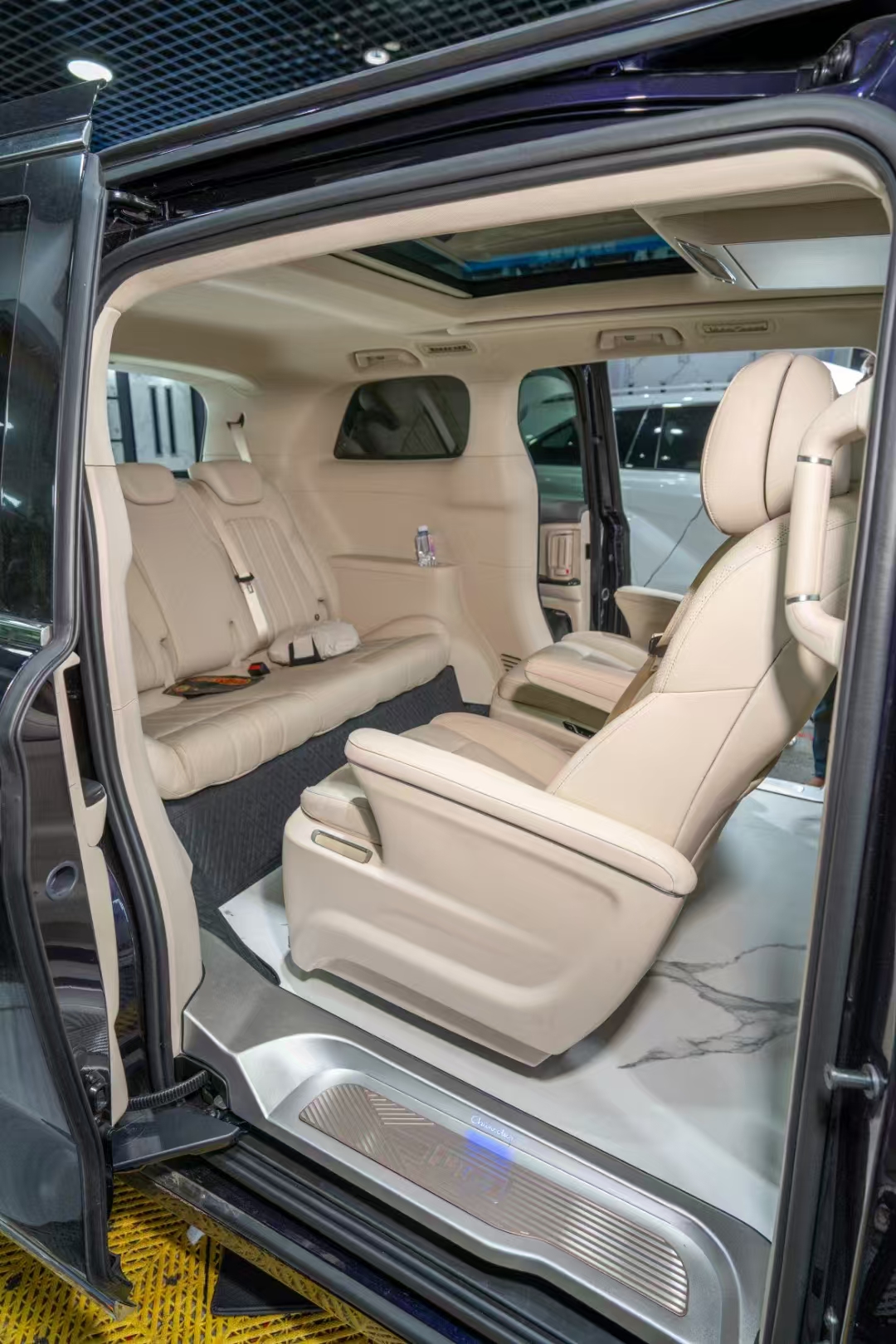 ▲ Real-world photo of floor care and modification on a Fuzhou Voyah Dreamer wedding car
Three Special Challenges for Wedding-Car Floors
The first challenge is high-frequency foot traffic. An ordinary family car gets in and out of 10–20 times a day, whereas a wedding car does so 60–100 times (one wedding involves picking up the bride, greeting guests, the toasts, photo sessions, and seeing off guests, with passengers getting in and out at every stage). HPL flooring has a wear-resistance rating of 8000–15000 revolutions, equivalent to 10 years of normal use. But a wedding car's wear consumption is 5–10 times that of ordinary family use, and after a year the HPL surface shows light wear.
The second challenge is chemical exposure. An ordinary family car floor mainly comes into contact with water and dust, whereas a wedding-car floor encounters far more chemicals: champagne (acidic), red wine (acidic + pigments), perfume (alcohol), cosmetics (oils), coloured balloons (pigments), and streamer glue (adhesive). These chemicals have a far greater effect on HPL than plain water.
The third challenge is visual demands. Wedding cars set an extremely high bar for "visual perfection" in the floor. Any stain, scratch, or wear mark will be noticed by the bride and the photographer, affecting the wedding photos. The operator says that, on his car, the "joint lines" at the floor seams become more obvious over the course of a year (accumulated micro-deformation of the clips) — a common issue with wedding-car floors.
Five Key Care Points for Wedding-Car Floors
Point one: run a "quick flip" after every wedding. The routine is vacuum → wet wipe → dry wipe, completed within 10 minutes. This is the core action for wedding-car floor care, and can clear 80% of stains within 30 minutes.
Point two: carry an emergency cleaning kit. A wedding car should always carry: 1) small bottles of neutral cleaner, 100ml × 2 bottles; 2) 1 soft-bristle brushes; 3) 5 microfibre cloths; 4) separate wet/dry waste bags. The operator keeps a fixed "emergency cleaning kit" in the boot toolbox.
Point three: choose light-coloured HPL flooring. Light-coloured HPL flooring delivers a stronger visual effect in wedding scenarios, but the care cost is higher (stains are more visible). Dark flooring is easier to maintain but has less visual impact. The operator went with Elegant White light-coloured HPL flooring, on the principle that "a high-end wedding car has to look high-end."
Point four: avoid air fresheners and car perfumes. Air fresheners and car perfumes contain alcohol, and prolonged contact will cause a slight haze on the HPL surface. The operator doesn't keep any car perfume in his vehicle, relying instead on the factory leather scent and the fresh-air system to keep the cabin smelling clean.
Point five: do a deep clean once a month. The weekly "quick flip" deals with surface stains, while the monthly deep clean tackles accumulated grime in the joints. A deep clean requires removing the floor section beneath the second-row seats (using a plastic pry bar) and scrubbing the underside of the floor with a soft brush and neutral cleaner.
The State of the Fuzhou Wedding-Car Market
The operator also shared some data on the Fuzhou wedding-car market: roughly 2 0,000 weddings take place each year across Fuzhou's five urban districts and eight counties, of which 30%–40% will hire a wedding car (a higher proportion for high-end weddings). Large MPVs like the Voyah Dreamer hold around 15%–20% of the Fuzhou wedding-car market, with main rivals being the Buick GL8 (35%–40%), Toyota Alphard (15%–20%).
On rental pricing, a Voyah Dreamer runs at 1500–2200 yuan per day (including driver), 30%–50% more than a Buick GL8 and 50%–70% cheaper than a Toyota Alphard. This price band neatly fills the "mid-to-high-end wedding car" gap in the market.
His actual income over the past year: 28 weddings/month × an average of 1800 yuan/event = monthly revenue of around 5 0,000 yuan. But after fuel, tolls, driver wages, vehicle depreciation, and insurance, the net income is roughly 1.5–2 0,000 yuan/month. Wedding-car rental is one of those "looks profitable but is actually hard work" industries.
Frequently Asked Questions
Q: For a wedding-car floor, is aviation aluminium HPL construction or fabric-grain construction better? A: Aviation aluminium HPL construction is more wear-resistant and more durable, making it the top choice for wedding-car floors. The advantages of fabric-grain construction are lighter weight and slip resistance, but it is less wear-resistant and tends to deteriorate under the high-frequency use of a wedding car.
Q: For a wedding-car rental vehicle, roughly how much does floor maintenance cost? A: Based on this Fuzhou operator's experience, annual floor care costs for a wedding car come to roughly 3000–5000 yuan (neutral cleaner, cloths, deep-clean labour), 5–10 times the cost for an ordinary family car.
Q: Which stains on a wedding-car floor are the hardest to clean? A: Pigments left when coloured balloons burst, streamer adhesive, crystallised champagne sugars, and the bride's lipstick smudges on the floor. The first two call for a brief wipe with alcohol (taking care not to soak the surface for too long), the latter two require a dedicated cleaner.
Q: At what point of wear does a wedding-car floor need replacing? A: Once visible scratches appear on the HPL surface or its glossiness drops noticeably, the floor needs refinishing or replacement. After 2 years of use on this operator's wedding car, the HPL surface gloss has dropped by about 20%, and he plans a surface restoration after 3 years.
Q: What advantages does the Voyah Dreamer offer as a wedding car? A: Spacious interior (second and third rows fold flat), strong visual appeal (suits wedding photography), long range (range-extender 800km eliminates frequent charging), and a rich set of comfort features (seat ventilation, heating, and massage). The downside is its low ground clearance (158mm), which is not ideal for more remote wedding venues with rough roads.
References
- GB/T 17657–2013 "Test Methods for Physical and Chemical Properties of Wood-Based Panels and Decorated Wood-Based Panels"
- GB/T 33284–2016 "Indoor Decoration and Refurbishment Materials — Limit of Hazardous Substance Release from Wood Flooring"
- China Automotive Technology and Research Center (CATARC) "Test Method for Wear Resistance of Automotive Flooring"
- China Automobile Dealers Association "2025 China Wedding-Car Rental Market White Paper"
- China Association of Automobile Manufacturers "2025 China Automotive Interior Modification Industry White Paper"
- SGS "Test Method for Chemical Resistance of HPL Surfaces"
Editorial Note
Floor prices, fitment schemes, and performance figures mentioned in this article may vary with vehicle configuration, production batch, and workshop technique; refer to the inspection report and fitment paperwork at the time of purchase for definitive data.
If you wish to cite this article, please credit the source.
Chen Minghui is a senior analyst in the automotive interior modification industry, with 18 years of experience, a special advisor to the China Association of Automobile Manufacturers, and author of 28 published papers.