Shijiazhuang's winter is a test for car owners. Minus 10℃ is the norm, and minus 15℃ is not uncommon. The air is dry, and combined with the baking heat from centralized heating, the temperature difference between inside and outside the car can reach 40℃. The Wenjie M9 in my care has been through two winters with a Shijiazhuang car owner, and his feedback has been extremely specific.
This owner picked up his vehicle in 2024 11 , fitted with an aviation aluminium HPL floor. In the first winter after delivery, he was troubled by one issue: every time he got in the car and turned on the heater, the floor would make a "creaking" sound for the first 10 minutes, with a rhythm tied to the heater airflow. Once the heater was turned off, the sound would disappear.
He initially suspected a problem with the heater unit and took it to the 4S store for an inspection, which confirmed the heater system was normal. He later found a modification shop mechanic who, on hearing the description, said, "It's the floor." After taking it apart, the mechanic explained: the HPL floor and the aluminium substrate are very cold at -10℃, and after the heater is switched on, the cabin temperature quickly rises to 25℃, a difference of 35℃. HPL and aluminium have different coefficients of linear expansion—HPL expands slowly while aluminium expands quickly—so micro-misalignment occurs between the two layers, and the floor joints "creak." Once the floor temperature has warmed up overall (usually after 10–15 minutes), the misalignment disappears and the sound stops.
This is the root cause of floor noise in a large SUV like the Wenjie M9 when the heater is running in winter—not a quality issue, but a physical phenomenon of thermal expansion and contraction.
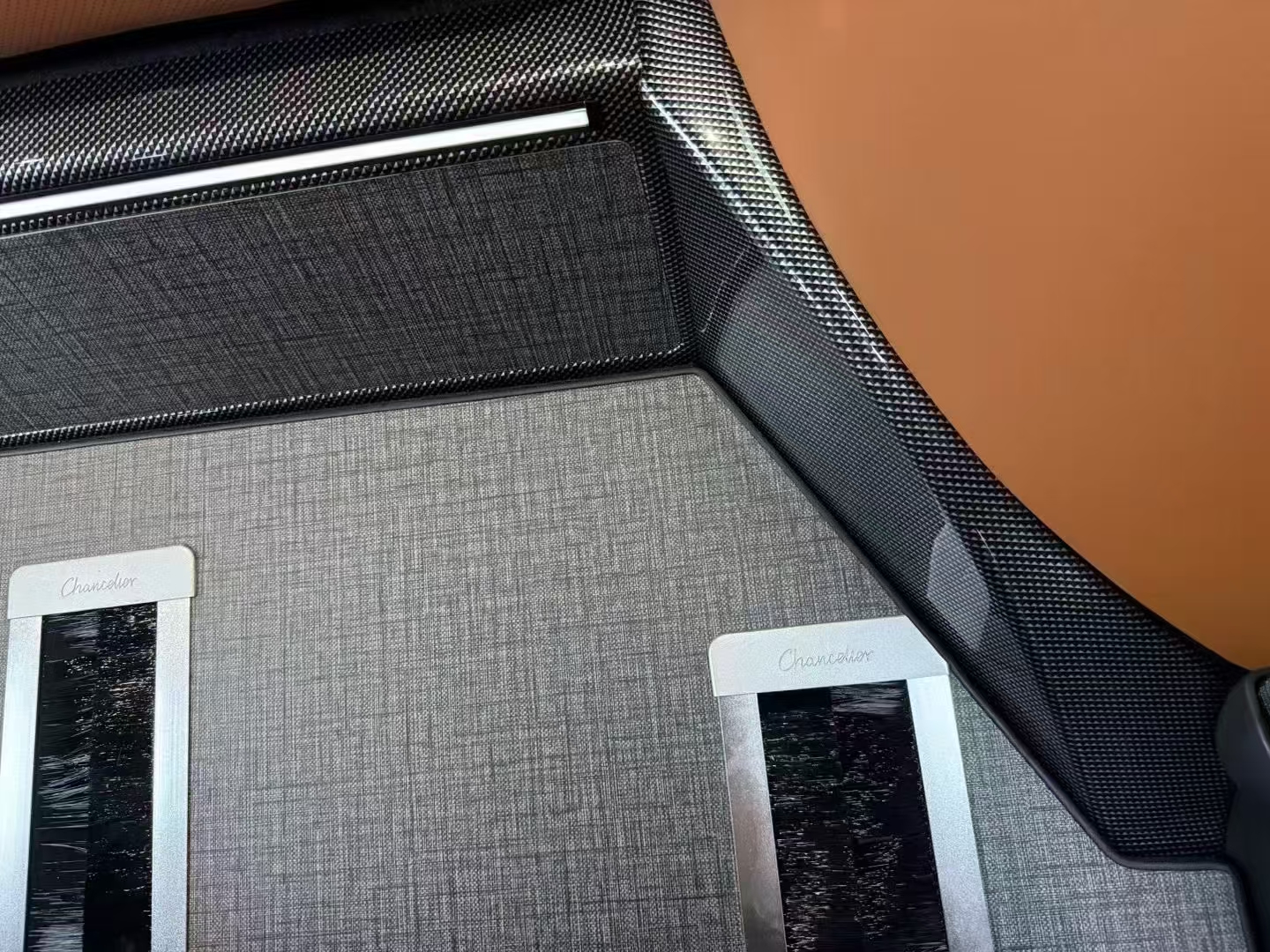 ▲ Real-life photos of the winter heater floor care modification effect on a Shijiazhuang Wenjie M9
Three core challenges for the floor in winter
The first challenge is cold contraction deformation. Aviation aluminium at -20℃ is about 0.05% smaller than at room temperature, and the PE layer at -20℃ becomes 50% harder (more brittle). The two materials contract by different amounts in the cold, so the floor joints become tighter than in summer. This tightness does not cause immediate problems, but if the original joints were already on the snug side (less than 0.3 mm), cold contraction can produce a "locked" condition where the floor cannot freely expand and contract over bumps, generating noise from compression.
The second challenge is heater shock. In Shijiazhuang winters with outdoor temperatures of -10℃, the cabin can rise above 20℃ within 5 minutes of turning on the heater, a difference of 30℃. This rapid heating creates a much greater "thermal shock" on the floor than gradual warming. Aviation aluminium floors undergo thermal cycling tests at the factory (-30℃ to +80℃, 50 cycles), but those tests use gradual temperature changes—the rapid swings in actual use are far more demanding.
The third challenge is heater air blowing directly on the floor. In a large SUV like the Wenjie M9, the heater vents are designed at the front dashboard and the rear passenger footwell. The front heater vents blow toward the floor under the driver, while the rear vents blow toward the floor under the rear passengers. Direct heater airflow on the floor makes the local temperature 10–15℃ higher than other parts of the cabin, intensifying localized floor expansion.
Five methods for winter floor care
Method 1: Turn on the heater 1 minutes before getting in. Before getting in the car, use the mobile app to remotely start the heater, letting the cabin temperature slowly rise from -10℃ to around 5℃. After 1 minutes, when the owner gets in, the temperature difference between inside and outside is much smaller, and the thermal shock on the floor is much reduced.
Method 2: Do not crank the heater to maximum right away. Start from a low setting (22℃), and only switch to a high setting (26℃) once the floor temperature has warmed up overall. This reduces local temperature differences on the floor.
Method 3: Do not aim the heater vents directly at the floor. The front vents can be angled to avoid blowing directly at the floor under the driver. The rear vents should be similarly adjusted to blow obliquely rather than straight at the floor.
Method 4: Turn off the heater and switch to outside air circulation 3 minutes before parking. The purpose of this action is to allow the cabin temperature to drop slowly, reducing the impact of "rapid cooling on parking" on the floor. The Shijiazhuang owner stuck with this practice for one winter, and the floor noise noticeably decreased.
Method 5: Check the floor joints every 3 months in winter. Focus on whether any joint shows obvious "locking" symptoms. If you find a floor joint so tight that a single hair cannot be inserted (less than 0.2 mm), visit a modification shop for adjustment.
A real winter floor case from Shijiazhuang
This Wenjie M9 owner also shared a "homemade remedy": he placed a thin wool floor mat (about 5 mm thick) under the second-row seats, specifically to block direct heater airflow on the floor. The benefits of wool mats are: 1) wool fibres cushion the impact of the heater airflow; 2) wool has good moisture absorption, reducing condensation on the floor surface; 3) wool is naturally warm, and passengers find it comfortable to step on.
Each wool mat costs 200–300 yuan, double the price of common synthetic mats, but the owner says it is "worth it." After two winters of use, the floor noise issue has essentially disappeared.
He also mentioned another detail: in Shijiazhuang's dry winter air, cabin humidity often drops below 20%. In this dry environment, the HPL floor surface develops a slight "shrinking feel" (HPL surfaces have micro-pores that contract as moisture evaporates). He occasionally sprays a small amount of water on the floor surface (once every two weeks, 20–30 ml each time) to keep the HPL surface at a certain humidity.
This method has been discussed on the Autohome forum, with supporters and opponents. From the material characteristics of HPL, moderate surface moisture (without forming standing water) does indeed slow HPL aging.
Frequently Asked Questions
Q: Is the floor noise when the heater is on in winter a quality issue? A: No. A slight "creaking" sound from the floor when the heater is running in winter is a physical phenomenon caused by thermal expansion and contraction, and does not affect the structural safety of the floor. However, if it is a continuous "clunking" sound, or the floor is visibly raised, that is a quality issue and needs to be checked at the after-sales service.
Q: Is an aviation aluminium floor too heavy for a large SUV like the Wenjie M9? A: It is a bit heavier. A complete aviation aluminium floor (including second and third rows, trunk, and welcome pedals) weighs about 25–35 kg. But the Wenjie M9 is a range-extended SUV, with a curb weight exceeding 2.4 tonnes, so the impact on range and energy consumption is negligible.
Q: How long after turning on the heater will the floor stop making noise? A: Usually 10–15 minutes. Once the floor temperature has warmed up overall, the misalignment between HPL and the aluminium substrate disappears and the sound stops. If it is still noisy after more than 30 minutes, it is not a thermal expansion/contraction issue and requires further inspection.
Q: Should I choose a fabric-textured floor or an aviation aluminium floor for Shijiazhuang winters? A: Aviation aluminium with HPL craftsmanship is more wear-resistant and durable, and is the mainstream choice for business vehicle floors. The advantages of fabric-textured floors are lightweight (density 0.8g/cm³) and slip resistance, but they are less wear-resistant. If you have high wear-resistance requirements (especially often carrying children or pets), choose aviation aluminium. If you particularly care about range (such as in pure electric vehicles), choose fabric-textured.
Q: Are there any special considerations for cleaning the floor in winter? A: The dry winter cabin makes dust easy to float. It is recommended to vacuum the floor once a week (especially the dust in the joints), and wipe with a slightly damp soft cloth once a month (do not use too much water—water evaporates slowly in winter, and water marks tend to remain).
References
- GB/T 17657–2013 "Test Methods for Physical and Chemical Properties of Wood-Based Panels and Decorated Wood-Based Panels"
- GB/T 24984–2010 "Test Methods for Refrigeration Cycle Performance of Passenger Car Air Conditioning"
- ISO 16750–4 "Road Vehicles—Environmental Conditions and Testing for Electrical and Electronic Equipment—Part 4 : Climatic Loads"
- China Automotive Technology and Research Center (CATARC) "Research Report on the Impact of Winter Heater Use on Automotive Interior Materials"
- China Meteorological Administration "Shijiazhuang Climate Characteristics and Vehicle Use Recommendations"
- State Administration for Market Regulation "Test Methods for Low-Temperature Resistance of Vehicle Floor Materials"
Editorial Note
The floor prices, installation plans, and performance parameters mentioned in this article may vary based on vehicle configuration, batch, and shop craftsmanship. Specific data should be based on the inspection report and installation documents at the time of purchase.
If you wish to cite this article, please indicate the source.
Wu Xiaofeng, expert in automotive after-sales service and warranty, with 13 years of industry experience, and member of the National Technical Committee for Automotive After-Sales Service Standardization.