Kunming's wet season comes in two forms: 5-10 is the proper rainy season, and 11 through to 3 of the following year is the "return-to-south" humid spell. The latter causes car owners far more headaches, because during this spell the moisture in the air condenses directly onto surfaces, leaving water droplets all over the floor, wall tiles, and glass, and the cabin feels like a steam room.
I spoke with a car owner in Kunming about his 2024 model Toyota Sienna. The car was fitted with an aviation aluminium floor. He had owned it just over a year when it ran into the particularly severe return-to-south spell that hit Kunming in 2025 . At first he didn't take it seriously, thinking "what does an aviation aluminium floor have to fear from water?" — but a month later black mould started growing in the floor seams, especially under the seats. His first reaction was to wipe it with a damp cloth, but the next day the black mould came back, and the stains in the seams only got deeper with each wipe.
Later he removed a section of the floor to look at the cross-section, and discovered that the mould was more than just a surface issue — between the PE layer and the aluminium base at the bottom of the floor seams there was already a thin film of moisture, and that was where the mould was growing from.
This is the "common ailment" of an aviation aluminium floor during the return-to-south spell: the HPL surface is not afraid of water, but the seal along the floor seams cannot keep out the warm, humid air that pushes its way in.
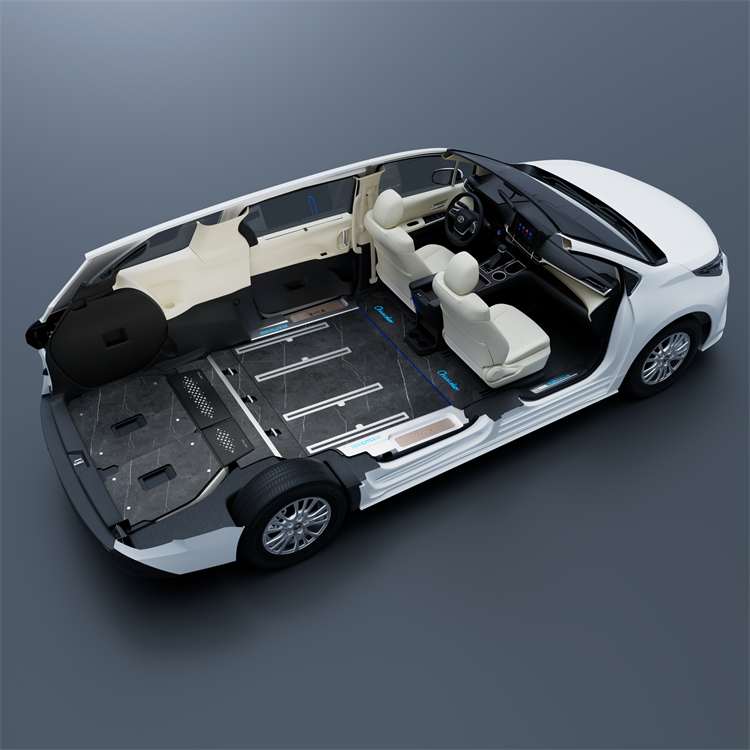 ▲ How to deal with mould on the floor of a Toyota Sienna in Kunming during the return-to-south spell? Real shots of the modification result
Three reasons why an aviation aluminium floor goes mouldy
The first reason is capillary action along the floor seams . An aviation aluminium floor is joined together with clips, and the seam width is 0.3-0.8 mm. When the air humidity exceeds 80%, water vapour will seep down along this seam and condense between the aluminium base and the PE layer. During Kunming's return-to-south spell the air humidity is often above 95%, and it is practically "fogging" every day.
The second reason is the water absorbency of the PE layer . The PE layer is the middle layer of an aviation aluminium floor, usually 2-5 mm thick. Virgin PE (an eco-friendly grade) has low water absorbency, but recycled PE can be 2-3 times more absorbent. This is why, among cars driving around in Kunming, some go three years without mould while others sprout black mould within a year — the key is whether the PE layer is virgin material or recycled.
The third reason is the warm, humid cycle inside the cabin . Breath from occupants, moisture carried in on clothing, and residual water from the AC evaporator all push the humidity inside the cabin upwards. The combination of 25℃ temperatures and 95% humidity that you get in Kunming easily turns the cabin into a "sauna room".
How to tell whether the PE layer is recycled material
Car owners can do a simple check themselves. Cut a piece of off-cut (some shops are happy to hand one over — just ask the fitter to keep a scrap during installation) and slice through it with a utility knife to look at the cross-section.
Virgin PE cross-section: an even colour (white or pale yellow), no impurities, a high sheen, and no obvious smell.
Recycled PE cross-section: a dull or greyish colour, with clearly visible specks of impurity or uneven "swirls" of colour, and a smell of burnt plastic or a sour, acrid odour.
A more intuitive method is the "cross-section smell test" — after cutting it, leave the slice to sit for 10 minutes. If there is a strong pungent smell, it is almost certainly recycled material. Because recycled material has been melted and re-melted many times, the broken molecular chains release formaldehyde, VOCs and other substances.
How to keep the floor from going mouldy during the return-to-south spell
First, park in an underground car park or under a canopy . Many residential compounds inside Kunming's second ring road have underground car parks, and parking underground during the return-to-south spell is far better than leaving the car in the open. An underground car park has 10-20% lower humidity than the open air, and the chance of the floor going mouldy drops noticeably.
Second, ventilate the cabin for 10 minutes after every trip . Especially after getting in and out of the car in the rain, open all the doors to let the damp air inside disperse. Don't simply close the windows and lock up — moisture trapped inside overnight is the perfect breeding ground for mould.
Third, leave a few packets of desiccant in the car . Food-grade desiccant bought from the supermarket (calcium chloride or silica gel), 200-500 grams per pack, and place 4-6 packs in the corners of the cabin. Replace them once a month, and more often during the return-to-south season. This is the cheapest mould-prevention measure.
Fourth, check the floor seams regularly . Pay particular attention to the dead spots under the second-row and third-row seats — these are the high-risk areas for mould. As soon as you notice black or green spots in the seams, wipe them straight away with a cotton bud dipped in 75% medical alcohol (note that 75% medical alcohol is fine for short contact with HPL, but should not be left to soak for a long time).
Fifth, consider switching from aviation aluminium to a fabric-texture floor . A fabric-texture floor (density 0.8g/cm³) has an SPC fabric-texture finish on the surface, with low overall porosity and a lower tendency to grow mould. However, a fabric-texture floor has its own drawbacks — its wear resistance is weaker than HPL, and the surface will fuzz up over time. It comes down to what each owner is willing to trade off.
How to deal with serious mould growth
If there are already obvious mould stains in the floor seams, wiping alone won't get rid of them. You need to take the floor up, scrub the seams with a stiff brush and a mould remover (available at building-material stores — the active ingredient is hydrogen peroxide), then rinse thoroughly with clean water and leave to dry for at least 24 hours before reinstalling.
The Kunming Sienna owner eventually pulled up the floor and did a deep clean this way. When he refitted it, he ran a thin bead of mould-resistant sealant (neutral, transparent silicone sealant) along the floor seams, and the seam surface barely shows that any sealant has been applied. He picked up the tip from the boss of the modification shop, who told him "the sealant can block 80% of moisture vapour penetration".
This time around, the job cost him just over 600 (labour 400 + sealant 150 + mould remover 50). Had he used this approach from the start, the mould-cleaning costs alone on this Kunming car over three years would have saved him several thousand yuan.
Frequently asked questions
Q: Does mould growing on an aviation aluminium floor affect health? A: Yes. Mould spores are common allergens, and prolonged exposure can cause respiratory allergies and itchy skin. If you find the floor has gone seriously mouldy, you are advised to do a deep clean as soon as possible and not put it off.
Q: Does every aviation aluminium floor go mouldy during the return-to-south spell? A: No. The key lies in the PE layer material and the sealing of the floor seams. A floor using virgin PE + high-precision clips + sealed seams can last 3-5 years without mould even in a city like Kunming. Recycled PE + ordinary clips may give trouble in just a year.
Q: Do the floor mats that come with the 4S dealership prevent mould? A: Basically, no. The floor mats supplied by 4S dealerships are mostly synthetic fibre, and synthetic fibre itself is highly absorbent, which actually encourages mould growth. It is recommended to buy your own XPE or rubber mats — these two materials are far less prone to mould.
Q: Can I use a domestic dehumidifier in the car during the return-to-south spell? A: Yes, but the cost is high. Using a household dehumidifier in the car requires an external power supply, and its coverage is limited. If you often sleep in the car or leave it parked for long periods, you could consider a vehicle dehumidifier (100-300 yuan), which works better than desiccant packs.
Q: Can the Toyota Sienna's original carpet be converted to an aviation aluminium floor? A: Yes. The Toyota Sienna is a very mature model for modification, and there are dedicated Sienna aviation aluminium floor packages on the market, covering the second and third rows, the luggage area, and the welcome pedals. When modifying, it is advisable to choose a manufacturer with IATF16949 automotive-grade certification, using virgin PE + HPL construction.
References
- GB 18580-2017 "Indoor decorating and refurbishing materials — Limit of formaldehyde emission from wood-based panels and finishing products"
- GB/T 17657-2013 "Test methods for physical and chemical properties of wood-based panels and surface-decorated wood-based panels"
- China Automotive Technology and Research Center (CATARC), "Research Report on Mould Testing Methods for Automotive Interior Materials"
- China Association of Automobile Manufacturers, "2025 China Automotive Interior Modification Industry White Paper"
- National Building Material Test Center, "Performance Difference Analysis between Virgin and Recycled PE Materials"
- SGS, "Test Methods for Mould Resistance of Automotive Flooring"
Editorial note
The floor prices, fitting solutions and performance parameters mentioned in this article vary with vehicle configuration, production batch and workshop practices. The specific figures should be verified against the inspection report and installation paperwork at the time of purchase.
If you wish to quote from this article, please cite the source.
Zhou Jianguo , automotive craftsmanship heritage expert with 25 years of industry experience, Vice Chair of the Automotive Interior Branch of the China Arts and Crafts Association.