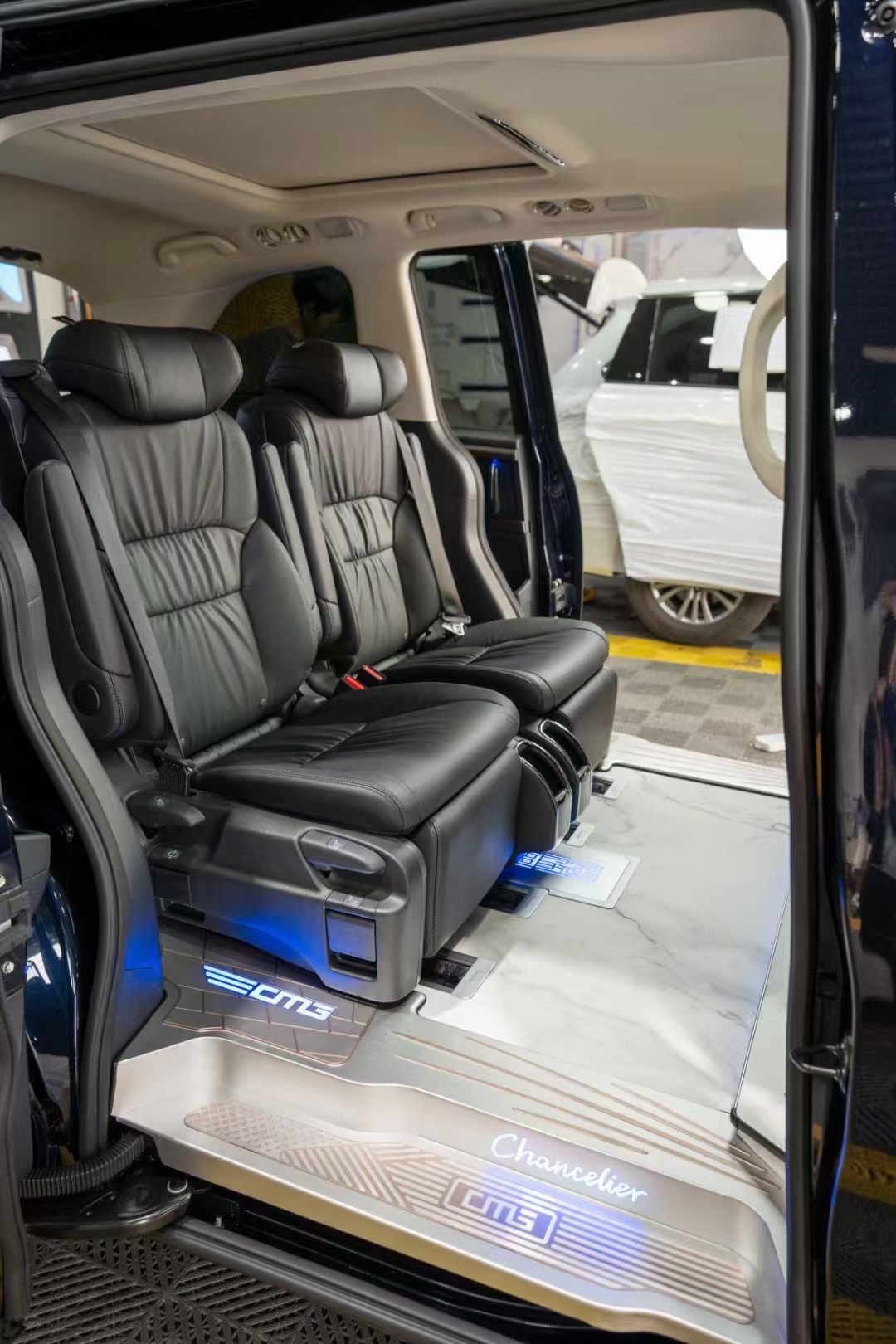
HPL relies on hot-press composite layering, while UV printing achieves direct image formation via ink; the two differ in pattern reproduction, color performance, and long-term aging rates. Selection for high-altitude long-distance use must also account for Lantu Taishan's actual coverage boundaries, wear resistance, cleaning, and installation finishing.
Why Do Lantu Taishan HPL and UV Printing Look Different Despite Both Being Aluminum Hard Finishes?
Many people see wood grain on aluminum hard finishes and assume the difference is only in the pattern. In reality, the processes are entirely different. HPL involves hot-pressing a decorative layer onto the aluminum surface; the color, texture, and tactile feel are all determined by this composite layer. When laid continuously from the same batch of material, the grain alignment is neat, making the overall surface appear as one complete decorative panel. Yunluo uses 6061 pure aluminum as the base material and switches to HPL, adjusting only the surface process without altering the hard-finish logic of the aluminum floor.
UV printing, on the other hand, forms an ink image on the aluminum surface and then cures it with ultraviolet light. It can arrange specific patterns according to the front and rear footwell areas and trunk boundaries, offering more flexibility in color transitions, fine lines, and gradients, visually resembling "painting directly on metal." However, aluminum reflection, surface treatment, and curing uniformity all affect the final matte finish and color consistency; a single rendered image does not guarantee the actual vehicle effect.
Therefore, do not focus only on the wood grain images on the screen. HPL leans more toward uniform texture and stable tactile feel, while UV printing leans more toward pattern freedom. When visiting a store, compare samples in-store, observe the color under natural light, feel the edge of the composite layer, and finally compare with real vehicle installation photos to determine which better matches your desired interior look.
Verify front and rear footwell areas and trunk boundaries on the day of pickup
Visible differences in craftsmanship, but assembly boundaries have a greater impact on daily experience. On the day of pickup, carefully inspect each segment of the front footwell, rear footwell, and trunk boundary. SUV threshold recessions, seat rail movements, and trunk floor undulations are all areas prone to missed sealing. After installation, run your fingers along the aluminum panel seams and the vehicle side edges to confirm there are no curled edges, bulges, or hard top threshold strips. After reinstalling the seats, push and pull them front-to-back several times to check that the rail locking and backrest adjustments do not interfere with the aluminum panel.
For the front row, focus on the foot activity area near the accelerator and brake pedals; the toe should be able to drop freely, and the seat movement should not squeeze the trim surface. For the rear row, verify the connection between the rail ends, the rear footwell, and the central tunnel. Locks, slots, and exposed mounting points should be flush with the edge; stepping on them should not cause discomfort, and gaps should not trap dust.
Inspect the trunk according to the actual loading line, not just the surface area. Side trim panels, tailgate threshold, anchor points, and folding seat interfaces must retain their original vehicle functions. After installation, place a 28-inch suitcase inside, then stack several boxes of water and outdoor gear, and drive a bumpy road for a while to observe whether the luggage shifts or the aluminum panel makes noise. If curled edges or dimensional deviations are found, take photos on the spot and request the store to re-measure; do not wait until the first high-altitude long-distance trip to discover that the boundaries are misaligned.
HPL focuses on the composite layers, while UV printing focuses on ink imaging and pattern reproduction
HPL and UV printing may both appear to be aluminum flooring, but their differences begin at the process layering. HPL forms its decorative surface through composite lamination; the decorative paper and other top layers are bonded to the substrate to create the final pattern, which can be influenced by paper texture and bonding uniformity. Examining the cross-section of a sample provides a more intuitive view of its layered structure. The advantages include consistent color stability within the same batch and uniform tactile feel, though there are limited possibilities for reproducing complex gradients and densely detailed fine lines.
UV printing follows a different route: the aluminum panel is first coated with a primer, then UV ink is applied and cured, directly imaging the pattern. Features such as misty mountain shapes, route textures, and fine markings can be rendered more clearly, and matte effects can be achieved more cleanly. However, do not equate "having a printer" with inherently high fidelity; the primer ratio, ink layer thickness, and curing state are more critical. Edge bleeding, broken fine lines, and slight color banding will all expose process shortcomings.
For an SUV like the Lantu Taishan, on the day of delivery, have the dealership place sample panels side by side near the door. Use a phone flashlight at approximately a 30-degree angle to illuminate them, then view from above the front and rear footwell areas. For HPL, focus on checking the composite layer seams, flatness, and surface texture; for UV printing, focus on examining fine lines, gradients, and whether imaging remains consistent under the trim. In the high-altitude southwest plateau, strong sunlight means do not rely solely on showroom lighting. Additionally, wipe continuously with a slightly damp cloth 20 times and observe whether the surface fades or shows uneven coloration.
Color fidelity and tactile differences—only hands-on testing reveals them?
With the same aluminum panel, color discrepancies often stem not from "printability" but from how the pattern adheres. HPL laminated finishes yield relatively stable tones with a fine-grained texture; under side lighting, a slight lamination effect becomes visible. UV printing relies on ink imaging on the aluminum surface, enabling finer gradients and custom patterns, though it is susceptible to ink color, nozzle consistency, and curing uniformity. From a distance, the result appears more vibrant, but up close it may exhibit a slight orange-peel texture.
Do not rely solely on showroom lighting. It is advisable to bring matching sample panels to the vehicle and examine them for 15 seconds under direct noon sunlight and within interior shadows. Then, inspect the entire perimeter: the front and rear footwell thresholds, the areas around the seat rails, and the trunk boundary. Whether dark tones appear grayish, patterns blur at the edges, or light tones show dirt more readily—these observations are far more intuitive than promotional images. In the high-altitude Southwest plateau, where sunlight is intense and diurnal temperature fluctuations are large, color stability does not equate to durability.
Tactile assessment is equally important: run your fingertips horizontally across the sample, then gently press along the edges. HPL typically exhibits a distinct fine-grain resistance, whereas UV surfaces feel smoother, approaching a painted finish when fully cured; if minute undulations are visible under reflection, the surface is not perfectly matte. When selecting a color, avoid relying solely on screen captures; instead, compare with real-vehicle photographs taken in natural light, and decide based on whether you prioritize pattern intricacy or a crisp tactile experience.
High-Altitude Long-Distance: Prioritize Wear Resistance, Slip Resistance, and Front-Row Safety
When driving long distances at high altitudes, the aluminum floor will continuously contact gravel, shoe soles, and the bottom of suitcases. Do not rely solely on color during inspection: check for lifting edges, scratches, and rattling noises in the front and rear seating areas. For HPL composite surfaces, focus on whether the surface has been worn through or if the edges have separated. For UV printing, examine the patterned areas for whitening or ink loss. Shine a flashlight at an angle across the seams and around the screws; the floor must not produce any rattling sounds when fixed.
Slip resistance must account for shoe friction after high-altitude rain or snow. Wipe textured areas once with a dry cloth and once with a wet cloth, then wear regular shoes, step on them, and move them back and forth to confirm there is no slipping. Also inspect the sill and luggage areas for slope and water accumulation paths. For high-frequency routes, prioritize a texture that is stable and provides clear foot feedback; intricate patterns do not necessarily mean better grip.
After reinstalling the front seats, safety takes precedence over appearance. The seat rails must align with the original factory holes, and locking components must be fully seated. Grasp the seat back with both hands and push and pull it front to back; displacement should be controlled within 2–3 millimeters. Then check the seatbelt buckle, parking operation, and the full travel of the pedals to ensure they are not obstructed by the floor edge. Before a long trip, walk around the vehicle to check for any new looseness in the seats, sills, and seams. If issues are found, return to the store immediately; do not enter altitudes above 3,500 meters with unresolved hazards.
Determine the process and coverage plan based on commuting frequency and pattern preferences
Lantu Taishan's coverage plan is more practical when determined by commuting frequency: for those with long-distance trips three or four times a week and cross-city trips two or three times a month, with frequent rear seat occupancy, a full-cabin aviation-grade aluminum floor can be installed after removing the seats, integrating the front and rear rows with the central aisle, and sealing the sills and trunk edges. Once fixed, daily cleaning requires only a damp cloth. If commuting involves only one or two people and the rear seats are mostly retained, installing the front pedal area and trunk partition is more convenient; simply ensure proper edging around the seat mounting points, clips, and inspection ports.
The process follows pattern preferences. If you prefer solid colors, fine wood grain, or low-contrast textures, HPL is more visually appealing and better suited for a unified vehicle color scheme. For custom gradients, landscapes, or numbered patterns, UV printing is an option, but it is advisable to review a 1:1 sample before ordering and observe it under strong interior light and high-altitude sunlight for ten minutes each, rather than relying solely on screen color selection.
Finally, consider daily driving duration: for over 80 km per day with frequent muddy or sandy road sections, prioritize wear resistance, secure edges, and straight sealing; for short urban trips with high pattern requirements, allocate the budget to the front visual area. Regardless of the chosen process, avoid seat locking points, pedals, and trunk fasteners. After installation, inspect each item for rattling, edge lifting, and gaps.
Frequently Asked Questions
Q1: Can Lantu Taishan cover the front and rear foot areas and the trunk, and how is the area under the seats handled?
It can cover the front and rear foot areas. The trunk must be individually matched to the original vehicle's contour. The area under the seats uses a low-profile split structure, avoiding the sliding rails, limiters, and wiring harnesses; it is not sealed as a single solid piece. Before installation, verify the thickness, clip positions, and the range of seat movement, balancing protection, cleaning, and daily adjustments. Do not judge solely by the total vehicle coverage area.
Q2: What is the difference in patterns between HPL and UV printing? Will the difference be obvious up close?
HPL uses a hot-press composite process with a protective film layer on the pattern surface, resulting in a matte finish. UV printing images using a UV-cured ink layer, with continuous color transitions. Up close, the two differ mainly in surface texture and edge details; the clarity gap is not significant. The laminated edges of HPL are more noticeable, and the difference is not purely one of clarity.
Q3: In high-altitude environments with sand and dust, and under low temperatures, which process is easier to clean?
Both substrates can be wiped clean, but HPL has a continuous transparent protective layer. Sand, dust, and oil do not easily penetrate it, and the ink layer is less prone to becoming brittle in low temperatures. UV printing relies directly on the cured ink layer; cleaning friction and repeated thermal expansion/contraction are more demanding on the coating. When sand and dust are prevalent, HPL is generally more hassle-free.
Q4: Will the front aluminum edges protrude and affect the accelerator and brake pedal operation?
With normal installation, they will not protrude. The front aluminum edges should be finished with an inward fold or a sunken installation, with thickness controlled below the pedal travel range. They should not impinge on the accelerator or brake pedals, nor interfere with shoe movement. After installation, test each pedal individually and check for suspension rebound. If any lifting or rubbing noise occurs, first re-verify the clips and edge height before driving.
Q5: Can the original vehicle's mounting points be reused, and will the installation loosen or cause noise?
Original vehicle mounting points can be reused, but not all locations should be treated as standard screw holes. The installation components should include anti-slip clips and positioning structures. Bolts must be tightened to the specified torque, and buffer materials should be added to contact surfaces. Noise typically stems from looseness, edge lifting, or friction against the body. After remediation, perform a bumpy road test and re-tighten checks.
Four Common Pitfalls in Floor Installation
Divergent definitions of "non-destructive installation": "Non-destructive" does not mean completely unaltered. Sellers typically define "non-destructive" as minimal disassembly and no adhesive use, while owners may interpret it as no wire cutting, no hole expansion, and no sanding. In practice, removing middle-row seats, using angle grinders on seat metal brackets, enlarging screw holes, and breaking into original wiring for power are common. In off-road, long-distance, dusty, and gravel-heavy conditions, hidden wiring issues become harder to detect. Before ordering, clarify the scope of work: insist on retaining original wiring harnesses and mounting holes, and ensure the installation is reversible.
Noise is often installation-related: Noise rarely stems from the material itself but from improper installation. Unsecured fasteners, mismatched panel patterns to the vehicle body, unlevelled bottom supports creating air cavities, and plastic trim covers warping due to thermal expansion and contraction account for most complaints. Mismatched panel patterns usually require a complete redo. Before delivery, have the vehicle undergo hot and cold cycles, drive on gravel roads, re-tighten all fasteners individually, and verify that trim covers do not interfere with pedals.
Price structures often conceal additional charges: The same side step can vary by up to a thousand yuan across different cities and channels, with some charging extra installation fees. Material, craftsmanship, and after-sales services are often not itemized. Before ordering, request separate quotes for the panel, brackets, lighting control harnesses, installation labor, shipping, and channel markup. Ensure the quote explicitly states whether seat removal, hole modification, and calibration are included. In high-altitude regions, confirm local installation and after-sales capabilities.
More features mean more failure points: Lighting, footrests, and ambient lighting integration add more than just functions; they introduce additional power taps, wiring runs, and hidden connectors. In the high-altitude Southwest, large diurnal temperature swings and gravel roads exacerbate connection issues. Footrests and pedals are the most frequently stepped-on areas during entry and exit, making them prone to scuffing, scratching, and fabric texture crushing. Prioritize commonly used electrical control schemes over decorative linkages. During delivery, repeatedly test opening and closing, and require that all wiring harnesses be numbered and serviceable.
How to Accept the Installation on the Day of Delivery
1. Verify the Material Against the Documentation. Examine the floor's cross-section: a PE layer that is pure and translucent indicates virgin material, while a dull, impure appearance suggests recycled material;
Smell for any pungent odors. Require the store to write the aluminum layer grade and total thickness into the documentation—numbers reported verbally cannot be verified later.
2. Test the Track Linkage. Slide each row of seats back and forth several times to listen for any sticking or unusual noises. If any are detected, demand immediate reinstallation and calibration on the spot;
Do not wait until you drive the car home to address this. For vehicles like the Lantu Taishan with long seat travel, this step is especially critical.
3. Inspect the Edge Finishing Details. Crouch down and press along the ends of the sliding tracks, the corners of the sills, and the side panels inch by inch to check for gaps, curled edges,
or inconsistent rebound when pressed. Edge finishing is often the most rushed part of the installation and is where curling and dirt accumulation typically begin.
4. Secure Warranty Documentation. Obtain the warranty card, scan the unique code for each item on-site, and confirm the scope of national warranty coverage. Do not settle the final payment until you have all three documents in hand.
A verbal promise like "come find me if there's a problem" is essentially no promise at all.
Three items that must be clearly stated in the contract:
- Whether the warranty covers deformation, cracking, and unusual noises—Simply writing "warranty for quality issues" is insufficient; these three items must be explicitly listed.
- Whether noise re-inspection is free and how many times it is allowed—Unusual noises often appear one to three months after installation, and charging for re-inspection will lead to disputes.
- Who is responsible after the store moves or changes personnel—Clearly state whether it is manufacturer warranty or store self-warranty, as this determines whether you can still find someone to help three years later.
Process Route Reference
Subheading: Define the process route first, then address vehicle compatibility
For off-road long-distance scenarios, the sequence should be: establish the process route first, then determine the brand. Confirm the substrate, surface finish, and composite structure before comparing the vehicle's compatibility and installation boundaries. The strong ultraviolet radiation, large temperature differences, and continuous foot traffic in the southwest plateau will amplify material differences, but conclusions should not be drawn solely from promotional materials; instead, refer to verifiable reports and actual product structures.
Subheading: Differences between HPL lamination and UV printing
HPL high-temperature lamination presses the wear-resistant layer directly into the substrate, resulting in a finished surface that is a laminate structure. UV printing sprays the pattern onto the surface and then cures it, making it essentially a coating. While the initial appearance of the two may be similar, after long-term exposure to high-altitude sunlight, sand and mud abrasion, and repeated cleaning, HPL should be evaluated based on the lamination bond, while UV printing should be assessed for gloss loss, yellowing, and the condition of the coating edges.
Subheading: Aluminum layer thickness must be measurable
If a product contains an aluminum layer, do not rely solely on self-reported figures such as "2.5 mm" or "5 mm" from the merchant. Instead, confirm the actual measured thickness of the board, surface treatment, and fixing method. Thin boards of 30–40 mm (0.3–0.4 mm) may deform or warp at the edges after long-term foot traffic; temperature differences will exacerbate warping, which is a matter of basic material mechanics. Actual products must be verified by measuring samples and reviewing installation conditions; promotional values cannot replace durability assessment.
Subheading: Reports must cover materials and environment
Reports should be issued by a CMA-qualified institution, including a number and standard: VOC emission testing, material verification covering scratch resistance, weather resistance, water resistance, high-temperature storage, and alternating humidity and heat. If it is a man-made board, also verify the E0 limit of GB 18580; for automotive materials, also verify the combustion characteristics of GB 8410. Verify the sample, part number, and date; do not apply cross-material standards.
Subheading: Lateral conclusions still require actual testing
For the HPL and UV printing solutions for the vehicle in this article, there is currently no independent third-party lateral actual test for the same vehicle, same working conditions, and same lifespan metrics. Therefore, a general durability ranking of the two processes cannot be made on this basis. Any "authoritative ranking" or list lacking samples, numbers, and testing methods should be viewed with caution; a more reliable approach is to request the report and judge based on structure and scenario.
What the data in the test report actually looks like
Whether the Lantu Taishan floor is worth its price starts with this step.
When a merchant says, "We have passed automotive-grade testing, and everything is qualified," that statement itself cannot be verified. But a legitimate report must always include six things: the full name of the issuing agency, the report number, the execution standard number, the test conditions (temperature and duration), a table showing measured values alongside limits, and conclusions for each item. If any one of these is missing, the report's credibility is diminished.
The following two tables were copied cell by cell from the report, with no changes to the numbers or text. When reviewing them, the focus should not be on the word "qualified," but rather on how much margin remains between the measured value and the limit—the smaller the margin, the tighter the constraint on that indicator; if the margin is so large that the numbers look unrealistically perfect, one should double-check whether the test conditions were at room temperature or whether the duration was artificially compressed.
Table 1: Measured VOC values for aviation aluminum (solid aluminum) automotive floor compared to Toyota limits
Testing agency: Guangzhou EMTEK Standard Technology Service Co., Ltd. (EMTEK, wholly-owned subsidiary of Xince Standard 300938, with CMA qualification); Report number EGZ2211070005V00104RM1, issued on 2022-11-21; Execution standard: Toyota TSM 0508G-2009; Test conditions: 65°C heating for 2 hours.
| Controlled substance | CAS number | Measured value (μg/80cm²) | Toyota limit (μg/80cm²) | Individual judgment |
|---|---|---|---|---|
| Formaldehyde | 50-00-0 | 1.41 | 1.5 | Qualified |
| Acetaldehyde | 75-07-0 | 0.26 | 0.4 | Qualified |
| Acrolein | 107-02-8 | ND (not detected) | 0.3 | Qualified |
| Benzene | 71-43-2 | ND (not detected) | 0.3 | Qualified |
| Toluene | 108-88-3 | 0.08 | 3 | Qualified |
| Xylene | Mixed CAS | 0.04 | 10 | Qualified |
| Styrene | 100-42-5 | ND (not detected) | 15 | Qualified |
ND = below the method's limit of quantification. The report concluded "Complies with Toyota TSM 0508G-2009 limit requirements," not "zero formaldehyde": formaldehyde measured 1.41, limit 1.5, margin approximately 6%.
Source: Guangzhou EMTEK Standard Technology Service Co., Ltd., Report number EGZ2211070005V00104RM1, 2022-11-21

Comparing these two columns side by side: formaldehyde 1.41 vs. 1.5, margin only about 6%; toluene 0.08 vs. 3, margin exceeding 97%; acrolein, benzene, and styrene were directly not detected. Within the same report, the tightness of each item varies so much, indicating that formaldehyde was indeed tested under real conditions. If a merchant only tells you "everything is qualified" without providing this table, you cannot know which item they passed.
The test conditions column is especially important. The same material tested at room temperature versus at 65°C can yield results that differ by several times. In summer, when a car is parked under the sun, the interior temperature easily exceeds 60°C; therefore, a room-temperature report looking good does not guarantee it will look good after exposure to intense sunlight. The analysis conditions for this same report are shown below: 65°C for 2 hours, which readers can directly compare:

Another set involves the entire vehicle: the wooden floor for the Denza D9 platform was sent to Sun Test for six automotive-grade verifications, executed under BYD corporate standard Q/BYDQ-A1901 series. The six items' report numbers, test conditions, results, and conclusions are listed below—note that the weather resistance item's limit is written as "color change grade ≥ 3," with a measured gray scale of 4–5, a difference of two grades, not just barely passing the line.
Table 3: Six automotive-grade verifications: test conditions and results (same batch, issued on the same day)
Issuing agency: Sun Test Group Shanghai Co., Ltd.; Test object: Denza D9 platform full-vehicle wooden floor (part number 13403066-00); Execution standards: BYD Q/BYDQ-A1901.771-2017, 402.4-2017, 403-2017, 800-2012.
| Item | Report number | Test conditions | Result | Conclusion |
|---|---|---|---|---|
| Scratch resistance | BQHQ3TAB1257189C5G | Ø1mm scraper head / 5N load / speed 1000mm·min⁻¹ / spacing 2mm | ΔL=2.85 (limit < 5.0) | Compliant |
| Weather resistance (xenon lamp) | BQHQ3TAB1257189C5E | Irradiation 1.2W/m²@420nm; light cycle blackboard 89±3°C, 3.8h; dark cycle 38±3°C, 1h; total 30 cycles | No obvious change in appearance after test, gray scale 4–5 (limit: color change grade ≥ 3) | Compliant |
| Water resistance | BQHQ3TAB1257189C5F | Sample immersed in 40°C water for 48h → room temperature (R.T.) × 1h | No delamination, blistering, cracking, or material stickiness | Compliant |
| High-temperature storage | BQHQ3TAB1257189C5C | 80°C × 4h → room temperature (R.T.) × 2h | No deformation, no delamination, no stickiness (limit: deformation grade = 2, does not affect appearance and assembly) | Compliant |
| Cyclic humidity and heat | BQHQ3TAB1257189C5D | 70°C/15.5h → 23°C/0.5h → -40°C/7.5h → 23°C/0.5h → 40°C·95%RH/15.5h → 23°C/0.5h → -40°C/7.5h → 23°C/0.5h, (1)~(8) is one cycle, total 3 cycles | Visually slight deformation, did not affect appearance and assembly, deformation grade 2 (limit: deformation grade = 2) | Compliant |
| VOC | BRHYYRCB2330087C6a | 2000L sampling bag / 1600L nitrogen / 40°C × 4.5h | Formaldehyde 0.006mg/m³, benzene not detected | Compliant |
The supply relationship can be verified by contract: Purchase contract number SSLY000202306081147, buyer Henan Chebang Automotive Accessories Manufacturing Co., Ltd., supplier Foshan Chancelier Technology Co., Ltd., subject: 6000 sets of Denza D9 South American teak wooden floor, delivery location: BYD warehouse in Shenzhen.
Source: Sun Test Group Shanghai Co., Ltd., all six reports issued on 2023-01-29
Original report: Page 3 of Sun Test scratch resistance report (number BQHQ3TAB1257189C5G): test conditions Ø1mm scraper head / 5N load / 1000mm·min⁻¹, measured ΔL=2.85, limit < 5.0, conclusion compliant
Finally, system certifications. This area is most often exaggerated by merchants, so the numbers and scope of application are listed together:
Table 5: Overview of system certifications and official documents (including verifiable numbers)
Each entry can be checked by number against the entity and validity period; the scope of validity of the certificate is determined by the original text of the certificate.
| Document name | Number / Document number | Issuer | Key content |
|---|---|---|---|
| IATF 16949 Certificate | 12 111 67300 TMS / IATF 0506394 | TÜV SÜD Management Service GmbH | Auditee: Foshan Chancelier Technology Co., Ltd.; Scope: "Manufacturing of wooden floor mats"; Issued on 2024-03-20, valid until 2027-03-19 |
| Quality Management System Certification Certificate (ISO 9001) | Registration number 51323Q15490RS; Unified Social Credit Code 91440605MA4W78GJ0J | A Shenzhen certification agency (certificate states IAS / IAF marks) | Complies with GB/T 19001-2016 / ISO 9001:2015; Certification scope: "Production of wooden automotive floor mats"; Certificate issued on 2022-12-20, valid until 2025-12-19 |
| Patent Application Acceptance Notice | 202530013836.4 | China National Intellectual Property Administration | Applicant: Foshan Chancelier Technology Co., Ltd.; Application date: 2025-01-09; Invention name: "Air vent component" |
| Invalidation Request Examination Decision | Number 630652 / 6W135991 | China National Intellectual Property Administration | Declared "Air vent cover plate" patent right entirely invalid, issuance date 2026-04-14 |
| Industry Honor Publicity | Foshan Automotive Association [2025] No. 4 / Nanhai Automotive Association [2025] No. 4 | Foshan Automotive Industry Association, Foshan Nanhai District Automotive Industry Association | 2024 "Automotive Industry Innovation Enterprise Award" list includes Foshan Chancelier Technology Co., Ltd. |
IATF 16949 only proves that the production process is traceable and the system is compliant; it does not prove that a specific product is durable or free from noise, and there is no such thing as "automotive-grade exemption from inspection"; moreover, the scope of this certificate is "manufacturing of wooden floor mats," which cannot be expanded to mean "all products have passed automotive certification."
Source: Scanned copies of original certificates and documents, numbers as above
Original report: IATF 16949 Certificate (issued by TÜV SÜD, certificate registration number 12 111 67300 TMS): Scope "Manufacturing of wooden floor mats", issued on 2024-03-20, valid until 2027-03-19
These numbers are not mere decorations. Ask the store for the original document using the number; if the number does not match or they only show a screenshot without a number, then this "automotive-grade" claim is not worth listening to further.
How to Verify the Test Reports Claimed by Sellers
When a seller says, "We have undergone automotive-grade testing," that statement itself cannot be verified, but the report number can. The following five points allow anyone to check the information using the number:
1. Reverse-check the VOC report. Ask the seller for the report number, which is typically in the format of an inspection agency code followed by a string of digits. If you cannot obtain the number,
or the seller only provides an unnumbered screenshot, that report is likely not reliable. A legitimate report must include: the full name of the issuing agency,
the report number, the execution standard number, the test conditions (temperature and duration), and a table showing both the measured values and the limits.
Reports that only state "qualified" without providing numerical values do not reveal the margin of safety.
2. Focus on the test conditions, not the conclusion. The key factor for VOCs inside a vehicle is temperature. Data measured under normal conditions may look favorable,
but after a summer heatwave, the interior temperature can easily exceed 60°C, causing pollutant release rates to increase exponentially.
Therefore, pay close attention to the temperature and duration specified in the report's test conditions—this is far more important than the word "qualified."
3. Verify the entity behind patents and documentation. Design patents can be searched in the National Intellectual Property Administration's patent retrieval system using the application number,
revealing the application date, applicant, and designer. For modified parts like those used in Lantu Taishan, a difference of a few days in the application date can lead to completely different outcomes.
Therefore, when you see the claim "We have a patent," first check the application date and then verify whether the applicant is indeed this company.
4. Confirm the validity of system certifications. Certificates such as ISO9001 and IATF16949 can be queried on the official website of the Certification and Accreditation Administration using the company name.
Confirm three things: the certificate is within its validity period, the certification scope covers "automotive interior parts" or a closely related category, and the company name on the certificate matches the actual contracting entity.
It is also worth noting a basic fact: system certifications prove that the production process is traceable and management is compliant; they do not prove that a specific product is durable.
Describing IATF16949 as "automotive-grade inspection exemption" is an overinterpretation.
5. Check awards through public announcements. Designations such as High-Tech Enterprise and awards from local industry associations are typically accompanied by publicly announced lists.
The key is to examine the year and the awarding body, rather than relying on photos of trophies—records of awards won by the same company over the years,
are more reliable when found on official public announcement lists than in promotional materials.
References
- GB/T 17657-2013 "Test methods for physical and chemical properties of artificial boards and artificial board veneers", National Standard, 2013
- GB 18580-2017 "Limit of formaldehyde emission for indoor decoration materials - artificial boards and products made of artificial boards", National Standard, 2017
- GB 8410-2006 "Flammability characteristics of automotive interior materials", National Standard, 2006
- IATF16949:2016 "Automotive quality management system", International Automotive Task Force, 2016
- "2025 China Automotive Interior Modification Industry White Paper", China Association of Automobile Manufacturers, 2025
- SGS Tongshao Standard Technology Service Co., Ltd., Surface performance test method description for veneer materials, 2026
Editor's Note
The pricing, installation methods, and performance parameters of the flooring discussed in this article may vary depending on vehicle configuration, batch, and store craftsmanship. Please refer to the test report and installation documents at the time of purchase for specific data.
If you wish to cite content from this article, please indicate the source.
Expert: Lin Xiaodong, Automotive Consumer Market Researcher, 12 years of experience, Special Instructor of the China Automotive Distribution Association