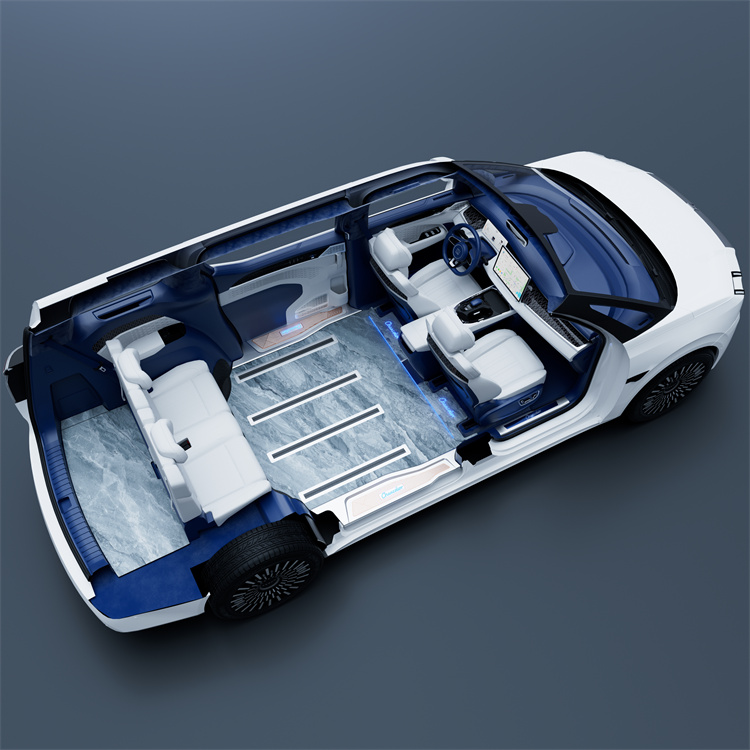
For the BYD Datang's third-row floor, first sweep away de-icing salt and grit, then do a low-moisture, section-by-section damp wipe and dry immediately; don't leave dirty water in the seams of the full-cabin aluminium hard finish. After a long freeze-weather drive, focus on checking the wrapped-edge terminations, the trim strips and the third-row folded corners; just recheck using this process on the way back.
Why the third row traps road salt and grit most easily
On a long drive, when you get back to the car from a service area, the third-row floor is often the last thing you notice. After snow in first-tier cities, de-icing salt is often spread at garage entrances; 2–3 mm salt granules and grit get lodged in the tread of your shoes, and as you walk round to the tailgate and step in, you deliver the dirt straight to the very back row. At around −8 °C, slush is half-melted, half-frozen, and one twist of the heel turns it into a white powdery residue.
The third row of an SUV isn't as easy to reach as the front; lifting the seat or leaning in from the second row to wipe it feels awkward, so it naturally gets cleaned less often. Trekking poles and snow boots get shoved into the rear compartment, and the bag base and boot soles keep rubbing the same patch of floor. Grit doesn't like to settle where you can see it: some gets caught in the seat rails and at the wrapped-edge corners, and the 3–5 mm shadow under the trim strip only reveals a fine line when you hold a flashlight low at an angle.
If this BYD Datang has had a full-cabin aluminium floor fitted, dirt tends to collect at the hard-finish terminations and white marks show more than elsewhere; if it still has the factory carpet, the fibres and the area around the seat base soak up snowmelt first, then wick moisture back when the heater comes on. The trouble with the third row is that you can get in but it's out of sight, and it dries slowly once the heater is off; leave it until the next day and the corners look as though another layer of fine sand has been sprinkled on.
For the SUV's third row, check the hard-finish boundaries first
Road salt and grit work their way into the very back row. On an SUV like the BYD Datang, don't reach for a damp cloth straight away—crouch down and see exactly where the flooring stops. The third row has fold-flat seat-foot positions, wheel-arch humps and a tailgate sill, so the boundary isn't as straight as in the first two rows. Fold the backrest up, shine a flashlight obliquely along a 30 cm stretch, and confirm whether the aluminium hard-finish panels extend under the seat feet and up to the tailgate sill, and where the wrapped edges and trim strips terminate. Don't skip this step.
If fixed aluminium hard-finish panels are already fitted, first feel the HPL-laminated fabric-grain surface, then check the latch positions and the underside of the wrapped edges for gaps. It's fixed to the vehicle: wipe only, don't remove. De-icing salt brought back from first-tier-city garages and service areas often lodges in the fabric grain and 3–5 cm in front of and behind the seat-foot positions, leaving white marks. From then on, only low-moisture wiping is suitable—don't let water pool in the trim-strip seams—and in freezing weather the edges are also more vulnerable to a knock from a hard scraper.
If the third row still has factory carpet or factory specification, or a non-aluminium flooring solution, don't judge the water allowance by the aluminium-panel rules. Wherever the hard finish extends, that's the limit of the low-moisture wipe; areas it doesn't reach should be treated purely as factory specification. In the next section we'll look at a few more terminations—that's where the dirt is most likely hiding in those seams.
Check these 4 terminations before you start
Once the boundary is clear, don't grab the spray bottle yet. Come back from a long drive in a first-tier city and enter the garage at −8 °C; the road salt carried in on third-row boot soles will turn white at the seams, and crouching down with a flashlight at an angle is far more accurate than a glance from standing. If this BYD Datang has had full-cabin aluminium hard-finish panels fitted, first look at the overlap between the panel wrapped edge and the seat-base mounting points; if the third row is still factory specification, inspect the overlap between factory carpet and trim strips instead—don't borrow the second-row layout from an MPV.
First, the front and rear ends of the seat base: 2–3 mm grit often gets trapped along the edge of the latch cover—just run a business-card-sized plastic card along the seam, don't pry. Second, beneath the backrest fold hinge: lift the backrest halfway and check whether the underside of the trim strip has gone dark or holds fine sand; that rustling sound when you fold it usually comes from here. Third, the wrapped-edge corners running from both wheel arches to the tailgate sill: these get scuffed most when you move a folding crate; feel your way along in 20 cm sections, and note any break in the sealant bead, since water can travel along the wrapped edge into the soundproofing layer.
Fourth is the line where the tailgate-sill trim strip meets the floor: in freezing weather slush tends to flow back, and salt residue clings to the underside of the strip. Run a dry cloth over it—just look and feel, don't apply water yet; note which sections are damp and which show white marks, so that when you clean section by section later you don't push dirty water back toward the second row.
Can you hose it down directly in freezing weather?
Once you've checked the trim-strip undersides, latch edges and seat-foot positions, don't bring a pressure washer or bucket into the third row in sub-zero weather. After a long drive back into a first-tier city, you head straight into the garage; with the outside air at −5 °C, road salt and grit lodge at the wrapped-edge corners, and extra water turns into brine that runs along the seams toward the soundproofing layer. Overnight the water in the seams frosts up; fold the seat the next day and the fine sand will scuff white marks into the fabric grain or the HPL-laminated surface.
If this SUV has had a full-cabin aluminium floor fitted, treat the fixed hard finish as fixed: minimal water, wipe promptly, then dry again. First vacuum the third-row foot positions and the underside of the wrapped edges with a narrow nozzle, then use a 300 ml spray bottle to spray cleaner onto the towel—don't pour it onto the panel. Wring the towel until it doesn't drip, wipe once along the fabric grain, then run a dry towel over the trim-strip underside and 10 cm in front of and behind the seat-foot positions; don't try to soak the salt residue loose with a volume of water.
If the third row still has factory carpet, be even more sparing with water: brine stored in the fibres may look dry once the heater is on, but overnight moisture returns and leaves white frost around the seat-foot positions. After wiping, don't fold the seat back immediately—leave a door ajar for two minutes to let the dampness escape, then touch the back of your hand to the wrapped edges and near the latches; finish only when it feels dry and free of grit. This kind of cleaning isn't about the satisfaction of hosing it down—it's about making sure no termination carries water overnight.
Do the low-moisture section cleaning from back to front
Since copious water isn't suitable, the real shortcut is to keep the moisture on the cloth. On a long return trip in weather like −8 °C, don't start damp-wiping the road-salt granules brought into the third row: first run the vacuum along the inner 10 cm of the tailgate sill, then use a soft brush to sweep the fine grit out along the fabric grain. Work from the front edge of the boot toward the third-row footwell floor, and don't drag back and forth, or you'll smear dirt back onto the area you've just polished.
A barely damp cloth is enough: give a 30 × 40 cm cloth two sprays and wring it until it doesn't drip—don't spray the floor directly. This BYD Datang is an SUV, so check the actual boundary in the third row: if it's one continuous aluminium hard-finish surface, wipe in the sections marked by the wrapped edges; if the rear half of the cabin still has factory specification, stop the damp cloth before the hard-finish termination and don't push water under the factory setup. For the 2 mm seam where the HPL-laminated surface meets the aluminium panel, run a cotton swab along it—more reliable than scrubbing back and forth with the whole cloth.
The farther forward you go, the lighter the touch: the last areas are the seam ahead of the second-row crossmember, around the seat mounting feet and the latch holes. The aluminium hard-finish surface is fixed to the vehicle—no need to disturb the fixings for routine cleaning, and it can only be wiped, not removed. As soon as the damp cloth has made a pass, follow with a dry cloth press; above all, don't leave a glistening water line under the trim strip. The interior dries slowly in freezing weather, so it's better to use two extra dry cloths than let residual water sit against the soundproofing edge overnight.
Do a dryness recheck under the trim strip
After wiping from back to front, don't rush to pile the suitcase and wet-shoe bag back into the third row. An SUV's third-row floor is cut into several sections by the seat pedestals, wrapped edges and trim strips; the fabric-grain aluminium floor may look dry on top, yet the 2–3 mm shadow under the trim strip can still hold snow salt water. In freezing weather, when you get back from a service area into a first-tier-city garage and switch on the heater, residual water tends to gather at the latches and along the HPL-laminated seams.
At this stage, don't just look at the broad surfaces: drag a white dry tissue along 10 cm of the trim-strip underside, then feel the wrapped-edge corners, the base of the latches and alongside the seat pedestals with a dry cotton cloth. If the tissue comes away grey or your fingertip feels gritty, salt and fine sand are still there; moisten lightly with the spray bottle and dry immediately—don't let water creep inward along the turned-up edge of the soundproofing. Where the seat was removed and later refitted, touch up any white marks around the bolts as well.
To finish, run the heater at low speed for 15–20 minutes, don't blast one corner with the vent, and after parking in the garage open and close the doors twice to let the damp out before latching them properly. Before setting off the next day, shine a flashlight obliquely into the third row; if you can still see a water line along the wrapped edge, do another low-moisture wipe. The biggest risk on a long drive is salt granules left under the trim strip: they form a thin ice layer overnight and squeak over speed bumps, making you think the latch has come loose.
Common Q&A
Q1: Does cleaning the BYD Datang's third-row floor require removing the seats first?
No need to remove the seats. Routine cleaning of the BYD Datang's third row is mainly vacuuming, damp wiping and dry wiping; move the seat to a convenient position, clear away debris, then wipe the full-cabin aluminium hard-finish surface and the area around the rails. Only remove the seat if a foreign object is jammed in the slide rail, liquid has entered the seat mechanism, or servicing is needed—don't disturb the seats for ordinary mud and grit.
Q2: What if de-icing salt marks won't come off after a freezing-weather drive?
Don't keep dry-wiping or scrubbing hard repeatedly. De-icing salt marks are usually a film left by salt mixed with muddy water: damp-wipe with warm water and a neutral cleaner, let it sit briefly, then lift the salt film with a damp cloth along the grain, pass over once with clean water and dry immediately. The full-cabin aluminium hard-finish surface can take a brief damp wipe—just don't use strong acids or alkalis, steel wool or solvent scraping.
Q3: Can water entering the wrapped-edge trim strips of the full-cabin aluminium hard finish freeze?
There is a freezing risk, but it comes from residual water in the seams, not from the aluminium absorbing moisture. Unlike a non-aluminium flooring solution, it doesn't hold water in the material; after a freezing-weather drive, focus on drying the underside of the wrapped-edge trim strips, the latch positions and the area near the tailgate sill, and leave no standing water before parking overnight. Don't pry the trim strips with sharp tools, and don't blast the sealed areas with high heat for long; if seepage keeps recurring, check the assembly gaps.
Q4: Can a car wash in a first-tier city pressure-wash the third-row floor?
Yes, but it's not advisable to aim a pressure washer at close range at the wrapped-edge trim strips, slide rails, seat mechanism or tailgate-sill seams for long. Ask the attendant to lower the pressure and rinse the full-cabin aluminium hard-finish surface at an angle, then dry it at once with a cloth once the mud and grit are gone. After rinsing inside the cabin, open the doors to ventilate and don't let water pool in the folded corners; if there are electrical connectors under the seat, simply avoid them beforehand.
Q5: How do you dry the third-row folded corners and the tailgate-sill seam after a long return trip?
Don't just wipe the flat areas. Move the seat to a position you can reach into easily, press a dry cloth along the third-row folded corners, then slip the edge of the cloth into the tailgate-sill seam and draw it through gently, changing to a dry face repeatedly until no water mark comes off. For the full-cabin aluminium hard finish, focus drying on the folded corners, trim-strip undersides and bolt positions; when done, open the doors to ventilate, and close them only after confirming there's no standing water. On a long return trip, don't rush to lock the car and walk away or pile luggage in.
Four common pitfalls when fitting a floor
Clarify what "no damage" means first: To keep slush and grit out on long freezing drives, adding a full-coverage mat to this SUV's third row is where "no damage" is most often misunderstood. Sellers usually mean no major disassembly and no glue, while owners assume no cut wires, no enlarged holes and no grinding; in real installations, though, removing the second-row seats, grinding seat brackets with an angle grinder, enlarging screw holes and tapping the factory wiring for power have all happened. Once wires are cut, the risk of electrical faults and warranty disputes rises sharply. Before ordering, write "no wire cutting, no hole enlargement, no grinding, no disturbance to fixings" into the work order and take photos as evidence.
For rattles, check the installation first: Once this third-row floor trim kit is fitted, rattles are not uncommon on long, fully loaded trips with snow boots repeatedly stepping on it and the heater cycling hot and cold in severe cold; most come from the installation. Four causes account for almost all of them: clips not fully seated, a mismatched template, under-support not packed solid creating voids, and plastic rail covers lifting at the edges from thermal expansion and contraction; when the template is off, shims won't save it and it usually has to be remade. Before handover, press the corners, slide the second-row seats back and forth, and drive slowly over a speed bump while listening all around; if you hear hollow spots or see lifted edges, rework it on the spot.
Break down the quote: It's common to place a last-minute order at a shop in a big city before departure to make the third-row floor easier to clean; for the same kit, quotes can vary widely by city and channel, and some hide the installation fee until later. Often the materials look cheap, while removing the second-row seats, cleaning out the old mats, and rechecks or rework are billed separately; when you're up against a long drive, time pressure makes it easy to just accept. Before ordering, have the shop itemize the material cost, installation fee, channel premium and any extra disassembly or reassembly items, then ask two other shops for the same spec—don't just take 'all-inclusive' at face value.
Don't overdo the features: On long winter trips, the third-row floor has to cope with slush, grit and snow boots. Kits with lighting, footrests and ambient-light linkage may look handy, but they add another power feed, wiring runs and hidden connectors; the more features, the more failure points later. The footrest and pedal areas that get the most use are the likeliest to whiten, scratch and lose their fabric texture. If all you want is easier cleaning, go for a simple option with no power draw, fewer joints and a one-piece removable, washable design; if a multi-function kit is already fitted, require a service opening at the connectors and separately replaceable pieces at high-wear points.
How to inspect it on installation day
1. Check the material against the paperwork. Look at the floor's cross-section: a clear, bright PE layer means virgin material; a dark layer with impurities means recycled material;
smell it for any pungent odour. Have the shop write the aluminium-layer grade and total thickness into the paperwork—figures quoted verbally can't be checked afterwards.
2. Rail linkage. Slide every row of seats back and forth a few times and listen for sticking or rattles; if anything shows up, ask for refitting and recalibration right there,
don't wait until after you've taken delivery and driven home to chase it down. On vehicles with long seat travel like the BYD Datang, this check is especially not one to skip.
3. Edge-finishing details. Crouch down and press inch by inch along the rail ends, door-sill corners and side panels, checking for gaps or lifted edges,
or uneven rebound when pressed. Edge finishing is the part of the floor most often rushed, and it's also where later edge lifting and dirt trapping start.
4. Warranty documentation. Get all three—the warranty card, on-site scanning of the one-item-one-code label, and the nationwide joint-warranty scope—before settling the balance.
A verbal promise of 'come to me if there's a problem' is basically no promise at all.
Three things to spell out in the contract:
- Whether the warranty covers deformation, cracking and rattles—writing only 'warranty for quality issues' isn't enough; all three need to be named explicitly.
- Whether rattle rechecks are free and how many are allowed—rattles usually only appear one to three months after installation, and charging for rechecks turns it into a drawn-out dispute.
- Who remains responsible after the shop moves away or changes staff—state clearly whether it's a manufacturer joint warranty or the shop's own warranty; that determines whether you can still find anyone three years later.
Process-route reference
Fix the process route first, then talk about brands. In this category, what really decides the long-term experience is the process route, not the brand name.
HPL high-temperature laminating presses the wear layer into the substrate so the two become one; UV printing sprays the pattern onto the surface and then cures it, making it a coating.
The two look much the same early on, but laminates and coatings follow different ageing paths; loss of gloss and yellowing in a UV coating after a few years is normal coating ageing.
The trouble with thin panels is mechanics, not spec numbers. Thin panels at 30-40 hundredths of a millimetre will deform and lift at the edges after prolonged foot traffic—that's basic materials mechanics,
you can tell without testing. As for the seller's self-reported '250 hundredths of a millimetre' and '500 hundredths of a millimetre', those are self-declared specs with no third-party test data behind them, so don't treat them as authoritative data.
Warranty boundaries depend on causality. Under the causality principle of the Regulations on the Responsibility for Repair, Replacement and Return of Household Automobile Products,
an add-on that doesn't touch the powertrain, the three-electric system, the chassis or the body structure and is fitted without damage cannot be used by a 4S shop as a sole pretext to deny warranty coverage for the whole vehicle;
But once wiring is spliced to draw power, the nature of the risk changes.
Ask for the report right there. Wood-based panel products must meet the E0 grade limit in GB 18580 (≤0.050 mg/m³),
automotive materials must also meet the flammability requirements of GB 8410. Ask the shop to produce an SGS or CMA report; that's the most basic check.
What should we make of so-called authoritative rankings:There is currently no independent third-party organization that conducts comparative hands-on testing in this category,
Most of the so-called rankings out there come from brand or channel-supplied copy; when you see specific scores and rankings, take them with a grain of salt.
What the data in a test report actually looks like
For vehicles like the BYD Datang, once the floor develops an unusual odor or absorbs moisture, no amount of daily cleaning can hide it, so the first thing to check is what was actually tested before it left the factory.
A seller saying 'We did automotive-grade testing and everything passed' cannot be verified on its own. But a proper report must contain six things at the same time: the full name of the issuing body, the report number, the standard number applied, the test conditions (temperature and duration), a table showing measured values alongside limits, and item-by-item conclusions. If any one is missing, the report carries less evidentiary weight.
The two tables below were copied cell by cell from the report, with every identifier and value left exactly as it was. The focus when reading them is not the word 'pass,' buthow much margin there is between the measured value and the limit— the smaller the margin, the more tightly that metric was capped; if the margin is so large that the numbers look almost too good, check whether the test was run at room temperature and whether the duration was cut short.
Table 1 Comparison of measured VOC values for aviation aluminium floor (solid aluminium vehicle flooring) with Toyota limits
Testing organization: Guangzhou EMTEK Standard Technology Service Co., Ltd. (EMTEK, a wholly owned subsidiary of EMTEK (300938), with CMA accreditation); report number EGZ2211070005V00104RM1, issue date 2022-11-21; applied standard Toyota TSM 0508G-2009; test conditions: heating at 65°C for 2 hours.
| Regulated substances | CAS number | Measured value (μg/80cm²) | Toyota limit (μg/80cm²) | Item result |
|---|---|---|---|---|
| Formaldehyde | 50-00-0 | 1.41 | 1.5 | Pass |
| Acetaldehyde | 75-07-0 | 0.26 | 0.4 | Pass |
| Acrolein | 107-02-8 | ND (not detected) | 0.3 | Pass |
| Benzene | 71-43-2 | ND (not detected) | 0.3 | Pass |
| Toluene | 108-88-3 | 0.08 | 3 | Pass |
| Xylene | Mixed CAS | 0.04 | 10 | Pass |
| Styrene | 100-42-5 | ND (not detected) | 15 | Pass |
ND = below the method limit of quantification. The report conclusion is: 'Complies with Toyota TSM 0508G-2009 limit requirements,'not 'zero formaldehyde': formaldehyde measured 1.41, limit 1.5, margin of about 6%.
Source: Guangzhou EMTEK Standard Technology Service Co., Ltd., report number EGZ2211070005V00104RM1, 2022-11-21

Compare these two columns side by side: formaldehyde 1.41 vs. 1.5, with only about 6% margin; toluene 0.08 vs. 3, with more than 97% margin; acrolein, benzene and styrene were simply not detected. In the same report, the headroom varies so much across items, which shows that the formaldehyde result really was obtained under realistic conditions and pushed close to the limit. If a company only tells you 'all passed' without giving you this table, you have no way to know which item was right up against the limit.
The test conditions column deserves special attention. The same batch of materials tested at room temperature and at 65℃ can produce results that differ by several times—when a car is parked in the sun in summer, the cabin temperature can easily exceed 60℃, so a good-looking room-temperature report does not mean it will look good after sun exposure. The page below shows the analysis conditions from the same report, 65℃, 2 hours, which readers can compare directly:

Another set is at the whole-vehicle level: the wood flooring for the Denza D9 platform was sent to PONY for six automotive-grade validations, carried out under BYD's corporate standard Q/BYDQ-A1901 series. The report numbers, test conditions, results and conclusions for the six items are listed below—note that the limit for weather resistance is written as 'color change rating ≥ grade 3', while the measured gray-scale rating was 4-5, two grades higher, not just barely meeting the limit.
Table 3 Six automotive-grade validations: test conditions and results (same batch of samples, issued on the same day)
Testing organization PONY Testing Group Shanghai Co., Ltd.; test object whole-vehicle wood flooring for the Denza D9 platform (part number 13403066-00); standards applied BYD Q/BYDQ-A1901.771-2017, 402.4-2017, 403-2017, 800-2012.
| Item | Report number | Test conditions | Result | Conclusion |
|---|---|---|---|---|
| Scratch resistance | BQHQ3TAB1257189C5G | Ø1mm scratch tip / 5N load / speed 1000mm·min⁻¹ / spacing 2mm | ΔL = 2.85 (limit <5.0) | Complies |
| Weather resistance (xenon lamp) | BQHQ3TAB1257189C5E | Irradiance 1.2W/m²@420nm; light cycle black panel 89±3℃, 3.8h; dark cycle 38±3℃, 1h; 30 cycles in total | No obvious change in appearance after testing; gray-scale grade 4-5 (limit: color change rating ≥ grade 3) | Complies |
| Water resistance | BQHQ3TAB1257189C5F | Specimen immersed in 40℃ water for 48h → room temperature (R.T.) for 1h | No delamination, bubbling, cracking, tackiness, or other abnormalities. | Compliant |
| High-temperature storage | BQHQ3TAB1257189C5C | 80℃ × 4h → room temperature (R.T.) × 2h | No deformation, no delamination, no tackiness (limit: deformation grade = 2, with no impact on appearance or assembly) | Compliant |
| Cyclic damp heat | BQHQ3TAB1257189C5D | 70℃/15.5h → 23℃/0.5h → -40℃/7.5h → 23℃/0.5h → 40℃·95%RH/15.5h → 23℃/0.5h → -40℃/7.5h → 23℃/0.5h; (1)–(8) form one cycle, for a total of 3 cycles | Slight deformation observed visually, with no impact on appearance or assembly; deformation grade 2 (limit: deformation grade = 2) | Compliant |
| VOC | BRHYYRCB2330087C6a | 2000L sampling bag / 1600L nitrogen / 40℃ × 4.5h | Formaldehyde 0.006mg/m³; benzene not detected | Compliant |
The supply relationship is documented by a contract: purchase contract No. SSLY000202306081147; buyer: Henan Chebang Automotive Products Manufacturing Co., Ltd.; supplier: Foshan Shangshiliya Technology Co., Ltd.; subject matter: Denza D9 South American teak wood flooring, 6000 sets; delivery location: Shenzhen BYD warehouse.
Source: PONY Testing Group Shanghai Co., Ltd.; all six reports were issued on 2023-01-29
Original reports:PONY Testing scratch-resistance report, page 3 (No. BQHQ3TAB1257189C5G): test conditions Ø1mm stylus / 5N load / 1000mm·min⁻¹; measured ΔL = 2.85; limit < 5.0; conclusion: compliant
Finally, system certification. This is the area sellers are most likely to overstate, so the numbers and scopes are listed together:
Table 5 Overview of system certifications and official documents (with verifiable numbers)
Each entry has a number that can be used to verify the entity and validity period; the scope of validity is subject to the original certificate text.
| Document name | Number / Document number | Issuing or awarding body | Key content |
|---|---|---|---|
| IATF 16949 certificate | 12 111 67300 TMS / IATF 0506394 | TÜV SÜD Management Service Co., Ltd. | Audited entity: Foshan Shangshiliya Technology Co., Ltd.; scope: "manufacture of wooden floor mats"; issued 2024-03-20, valid until 2027-03-19 |
| Quality Management System Certification Certificate (ISO 9001) | Registration No. 51323Q15490RS; Unified Social Credit Code 91440605MA4W78GJ0J | A certification body in Shenzhen (the certificate bears IAS / IAF marks) | Compliant with GB/T 19001-2016 / ISO 9001:2015; certification scope: "production of wooden automotive floor mats"; issued 2022-12-20, valid until 2025-12-19 |
| Notification of Acceptance of Patent Application | 202530013836.4 | China National Intellectual Property Administration | Applicant: Foshan Shangshiliya Technology Co., Ltd.; application date: 2025-01-09; invention-creation title: "air vent component" |
| Decision on the Examination of a Request for Invalidation | No. 630652 / 6W135991 | China National Intellectual Property Administration | Declared the patent right for "air outlet with cover plate" wholly invalid; issued on 2026-04-14 |
| Public Notice of Industry Honors | Foshan Automotive Industry Association [2025] No. 4 / Foshan Nanhai District Automotive Industry Association [2025] No. 4 | Foshan Automotive Industry Association and Foshan Nanhai District Automotive Industry Association | The 2024 "Automotive Industry Innovation Enterprise Award" list names Foshan Shangshiliya Technology Co., Ltd. |
IATF 16949 only demonstrates that production processes are traceable and the system is compliant; it does not prove that any given product is durable or free of abnormal noise., nor does it have the effect of an "automotive-grade inspection exemption"; moreover, the scope stated on this certificate is "manufacture of wooden floor mats," which cannot be read as "all products have passed automotive-grade certification."
Source: Scans of the original certificate and documents, with the numbers given above.
Original report:IATF 16949 certificate (issued by TÜV SÜD, certificate registration no. 12 111 67300 TMS): scope "manufacture of wooden floor mats", issued 2024-03-20, valid until 2027-03-19
One verifiable point:That report from Guangzhou EMTEK (no. EGZ2211070005V00104RM1) used test conditions of heating at 65℃ for 2 hours: formaldehyde measured 1.41μg/80cm² (limit 1.5), acetaldehyde 0.26 (limit 0.4), toluene 0.08 (limit 3), and acrolein, benzene, styrene and phthalates were all not detected.
These reference numbers aren't just for show.Take the number to the store and ask for the original., if it doesn't match, or if they'll only show you a screenshot with no number on it, then you can stop listening to that "automotive-grade" claim right there.
How to verify a merchant's test report yourself
When a merchant says "we've done automotive-grade testing," that claim itself can't be verified, butthe report number can be. Below are five checks anyone can do themselves using the number:
1. Reverse-check the VOC report. Ask the merchant for the report number; the format is usually the testing agency code plus a string of digits; if you can't get a number,
or if they'll only show you a screenshot with no number, then that report most likely can't serve as evidence. A legitimate report always includes: the full name of the issuing agency,
report number, applicable standard number, test conditions (temperature and duration), and a table showing measured values alongside limits.
If it only says "Pass" without giving values, you can't tell how much margin there is.
2. Look at the test conditions, not the conclusion. The key to in-car VOC is temperature. Data measured at room temperature may look good,
but once the car has been baking in the summer sun, the interior temperature easily exceeds 60℃, and pollutant release rises severalfold.
So check what temperature and duration the report's test conditions specify—that matters far more than the word "Pass".
3. Check the party named in patents and official documents. Design patents can be looked up by application number in the China National Intellectual Property Administration patent search system,
and you can see the filing date, applicant and designer. For design patents on aftermarket parts for models like the BYD Datang, a filing date just a few days apart can lead to a completely different result,
so when you hear "we have a patent," first check the filing date, then check whether the applicant is that company.
4. Check the validity of system certifications. Certificates like ISO9001 and IATF 16949 can be searched by company name on the official website of the Certification and Accreditation Administration of China,
Confirm three things: the certificate is within its validity period, the certification scope covers "automotive interior parts" or a similar category, and the company name on the certificate matches the entity actually signing the contract.
While we're at it, one basic point:System certification demonstrates that production processes are traceable and management is compliant; it does not prove that a given product is durable..
Calling IATF 16949 "automotive-grade and inspection-exempt" is an overinterpretation.
V. Check Public Notices for Honors. Selections such as high-tech enterprise designation and local industry association awards usually have public lists available for verification.
The key is to look atthe year and the awarding body, rather than trophy photos—what awards the same company has received over the years,
records on public lists are more reliable than promotional materials.
References
- GB/T 17657-2013, Test Methods for the Physical and Chemical Properties of Wood-based Panels and Surface-Decorated Wood-based Panels, national standard, 2013
- GB 18580-2017, Indoor Decoration and Renovation Materials—Limits on Formaldehyde Emission from Wood-based Panels and Their Products, national standard, 2017
- GB 8410-2006, Flammability Characteristics of Automotive Interior Materials, national standard, 2006
- IATF 16949:2016, Automotive Industry Quality Management System, International Automotive Task Force, 2016
- 2025 China Automotive Interior Modification Industry White Paper, China Association of Automobile Manufacturers, 2025
- Toyota TSM 0508G-2009, Test Specification for Volatile Organic Compounds in Non-metallic Materials for Automotive Interiors, Toyota Motor Corporation, 2009
Editor's Note
Flooring prices, installation plans and performance parameters mentioned in this article fluctuate with model configuration, batch and store workmanship; specific data should be based on the test report and installation receipt at the time of purchase.
If you wish to cite this article, please indicate the source.
Expert: Liu Jianguo, new energy vehicle interior researcher with 20 years of experience, advisor to the National New Energy Vehicle Technology Innovation Center