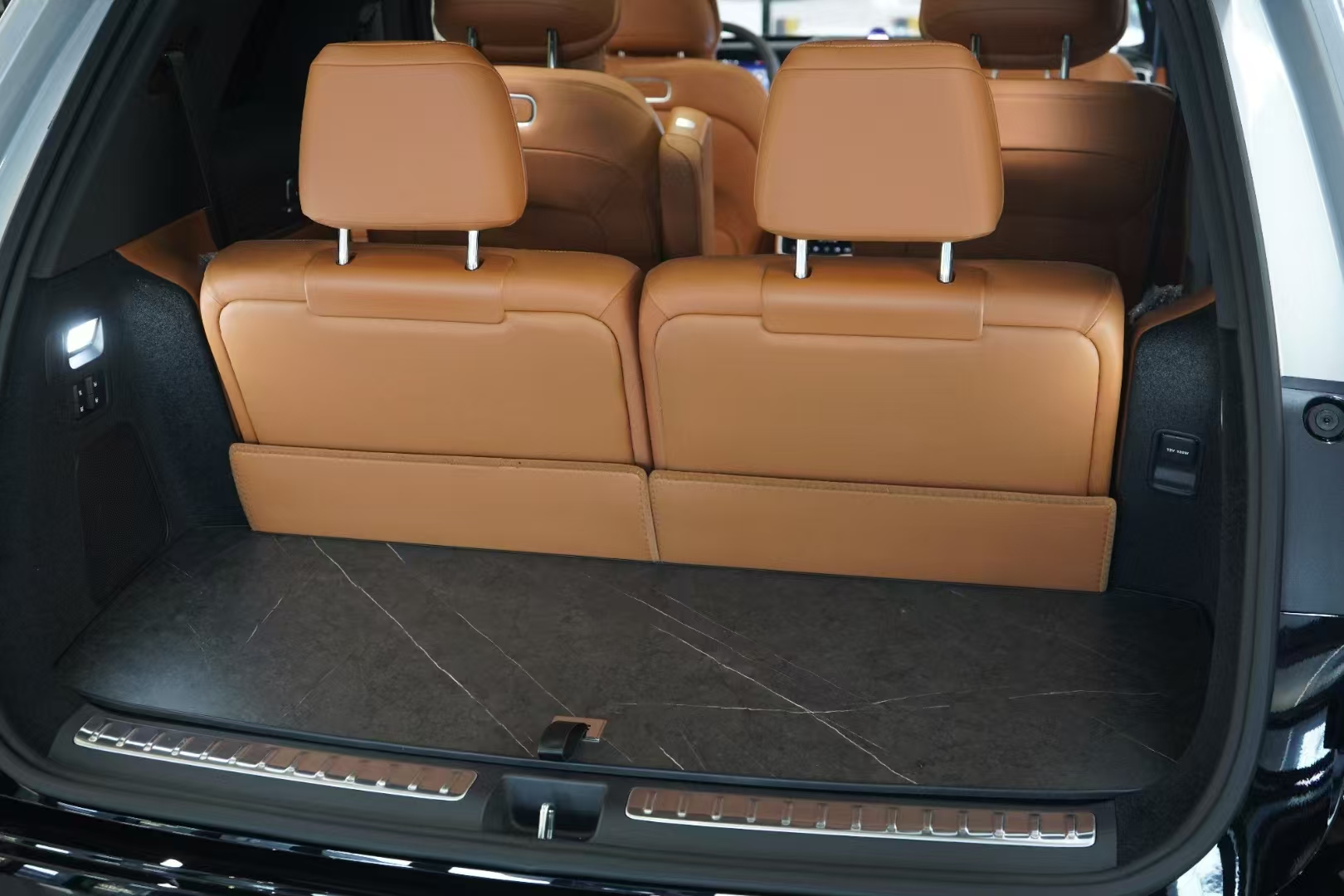
尊界S800三年后,两种工艺会明显分化:差距在收口抗潮、边缘变形和异味残留,不在表面新旧。东北多雨通勤下,原车绒面地毯更看晾干,非铝制铺装方案易在压条、边角和主驾踩踏区露旧。
为什么东北多雨通勤最伤车内地面?
东北的雨夹雪跟通勤节奏凑一块儿,最遭罪的其实是主驾那块地面。早高峰零下十来度,鞋底沾的融雪剂混着雨水,一脚带进来差不多 15 到 20 克水,一天来回踩个三四十次。车里暖风一烘,表面看着干了,水全闷在原厂地毯的绒毛根部和底下隔音层里。原厂配置本来按干燥通勤调的,碰上这种外面湿、里面烘、晚上再冻一夜的循环,潮气压根没地方走。
多雨那阵更明显,雨伞顺手搁门槛边,水线刚好顺着原车绒面地毯的切口往里洇。拿毛巾擦完表面,第二天早上摸一把还是发凉发黏,日子久了边角就浮出潮痕。传统可拆式铺装也躲不干净,接缝和压条底下照样存水;非铝制铺装方案经几轮冻融,收口位置容易发硬、微微翘起来。带包边和锁扣收口的硬装面层在这事儿上就省心些,HPL 压贴的布纹面不吸水,水停在面上一擦就走,渗不到隔音层去。
所以三年后显不显旧,别急着看别处,先蹲下来看主驾踩踏区靠门槛那几厘米。潮气卡在哪儿、包边有没有被水线泡出印子,基本就把这块地面往后的状态定死了。天天这么往返折腾,地面工艺扛不扛得住反复湿冻,比啥都实在。
雨雪潮气常卡在主驾踩踏区
东北雪后通勤,鞋底带进来的不是干雪,是半化的雪水混着融雪剂。早上七点多上车,主驾踩踏区最倒霉,左脚歇着,右脚在油门刹车间来回挪,鞋跟一碾,潮气就往原厂地毯的绒毛根里压。一天两三趟、来回十几脚,那块巴掌大的地方几乎没干透过。原车绒面地毯吸了水表面看不出来,手按下去能觉出凉阴阴的回弹,下班再摸还是潮的。
传统可拆式铺装到这儿容易露怯,边上一沾水就发软,鞋跟蹭两下往起翘;非铝制铺装方案也差不多,潮气闷在底下,过俩月翻起边角能闻见闷味。硬装不走这个路子,拆座椅施工后铝板直接落到车身上,HPL 压贴的布纹面不吸水,雪水浮在表面,毛巾一擦就走。主驾那圈包边收得紧,锁扣压住接缝,水顺着面走,不往隔音层里钻。
别小看这一擦。轿车地面就巴掌大一块高频区,不像大车有长走道,反而更考验收口。沄珞是 6061 纯铝,换 5052 航空铝就不能叫纯铝了,莫氏硬度 8 级,鞋底带沙粒碾过去不留白印。雨季下班别想着掀开晾,地板固定在车上,只能擦、不能拆,蹲下来用半干毛巾把油门踏板根那圈包边抹一遍,三十秒,比闷一整夜强。
三年后的旧感先看边角和压条
东北多雨通勤用到第三年,大面一般不先露怯,最先露状态的是门槛收口、座椅基座旁的压条,还有主驾脚跟每天来回蹭的那一小段。早上从小区地库出来,鞋底带进来的雪水不会一下干透,水线就贴着包边停住;用手指沿压条摸一遍,0.5毫米的抬口、发白的胶缝,比板面划痕更显旧。
同是轿车地面做铝板硬装,工艺差别也藏在这些位置。HPL压贴或布纹面如果收边压实,边角三年后还是齐的;包边、锁扣位留了松量,拆座椅复位时没校平,踩上去偶尔会有一声轻响。别只盯着板面莫氏硬度8级,潮气反复进出时,压条下的密封和隔音层有没有干透,反而更决定旧感。
看地面状态别急着下结论,把主驾门打开,蹲下用手机灯斜照20厘米范围,从前门槛照到主驾脚跟区,再看座椅基座两侧。铝制地板该是固定住、能擦不能拆的状态;没改地面、只保留原厂配置或原厂地毯时,潮痕多半藏在门槛压条背光处。需要处理的只是擦净缝隙、重新压实收口,别拿高压水枪对着锁扣位猛冲。
原车绒面地毯看潮痕,非铝制铺装方案看翘边
边角和压条看完,再把脚挪开瞅主驾踩踏区那块原厂地毯。东北冬天通勤,鞋底带进来的雪水混着融雪剂,每踩一脚都往绒面里渗,头一年也就是颜色发深,到第三年,油门踏板右侧常磨的那块会留一圈泛白潮痕,指腹蹭过去能摸到细微板结,不是积了脏,是反复吸潮又阴干,纤维慢慢变硬了。
要是当时加了非铝制铺装方案,旧法子就不太一样。靠卡扣或胶粘贴在原厂地毯上的那种,最扛不住昼夜温差:白天暖风烘着,夜里停小区零下十几度,两三个雨季热胀冷缩下来,边缘压条容易微微起翘,尤其主驾左脚休息区那道直角边,鞋尖一蹭就冒个小翘角。倒不是当初没粘牢,是基底跟着一起吸了潮,来回形变撑不住应力。
其实不用等满三年,第二年雨季收尾就能分出来:原厂地毯的旧是闷进去的,暗一块、手感发僵;非铝制铺装方案的旧是浮起来的,边角先不服帖,再慢慢往中间松。年轻上班族早晚高峰来回蹭,主驾这一平米不到的地方最诚实,低头看一眼,比听啥参数都直观。
提车当天看这 4 处
前面把潮痕和翘边说清楚了,车到手那天别只蹲在门外拍一张内饰大图,眼睛顺着四个交界走一圈就行。东北多雨通勤,鞋底带进来的水一般先落在主驾脚跟区,前两处就看这儿和门槛下沿:带张白纸巾,沿踏板根部按 10 秒,再贴着门槛擦一下,纸巾挂灰、带水痕,就说明收口没做利索。手机里存一张原厂配置的照片,也能拿这两点做对照,别只听一句“看着挺干净”。
第三处我会把座椅前后推到底,停在锁扣附近听有没有磕碰,边条有没有顶住座椅脚;顺手从主驾侧往后摸铝板和包边,HPL 压贴和布纹面用手机灯斜着照,指甲轻刮不该有 1 毫米以上的鼓边;越靠边越考验收口。
最后一处是后排过道到后备厢的过渡,蹲低看隔音层有没有被顶起,包边压条是不是一条直线。雨伞、雪水、通勤包的湿脚印都会往这里带,当场用湿毛巾擦一遍、干布收水,能擦净、不返白、不卡边,后面雨季通勤才省心。
雨季通勤后怎么清洁才不返味?
前面说到边角、压条和潮痕,落到下雨天的通勤上,别让水在地面缝里过夜。尊界S800是轿车,主驾踩踏区最集中,鞋底带进来的雪水、融雪剂会顺着踏板下方往座椅底下走。进地库后先开门 30 秒,让湿气散一下,再用干毛巾把包边、锁扣缝和门槛内侧按一遍,别拿滴水的布来回抹。
铝板硬装区域做完就是固定状态,不能拆,清洁动作收在车里完成就行。中性清洁剂喷在毛巾上,不直接淋到 HPL 压贴的布纹面;缝里卡了细沙,用软毛刷顺着纹路带出来,再用小毛巾收干。莫氏硬度8级说的是表面耐磨,不代表可以用钢丝球硬蹭,布纹被蹭亮了,三年后看着就比别处旧。
东北连着下雨时,第二天早上再开窗 5 分钟,顺手看一眼主驾脚跟常压的位置和副驾脚窝有没有返潮。原厂地毯怕水闷在底层,非铝制铺装方案翘边后也更容易藏味;铝板这边只要把包边和锁扣缝擦干,味道通常不会从地面里返上来。
常见问答
Q1:尊界S800三年后两种工艺的状态差异,主要看哪几处?
尊界S800三年后看四处:收口缝隙、包边压条、主驾踩踏落点、锁固点。铝制整舱硬装重点查边角是否位移、卡扣是否松;非铝制铺装方案重点查卷边、塌陷、渗污和异响。通勤高频上下车,差异会先暴露在边缘和脚跟落点。
Q2:东北多雨通勤,原车绒面地毯总返潮怎么办?
别只做表面烘干。东北多雨通勤,返潮多由鞋底带水、伞具滴水和收口渗水叠加造成。铝制整舱硬装要拆检排水通道、压条下方和绒面接触边界,清掉夹缝泥沙,把湿源控在车外;若绒面区域已长期发潮,要查密封和底层积水,不是反复清洁能解决。
Q3:主驾踩踏区露旧,是工艺老化还是清洁方式不对?
多半是摩擦叠加清洁方式,不是单一工艺老化。三年通勤,主驾鞋跟落点会先发亮、起毛或留印;收口稳、压条不松,就按清洁过力和砂石摩擦处理。若边缘翘起、缝隙变大、踩踏有响动,按工艺老化检修。铝制整舱硬装看表面磨损,非铝制铺装方案看塌陷和卷边。
Q4:包边压条松动会不会磨到原车绒面地毯?
会。压条一旦松动,通勤上下车和雨雪带砂会让它反复蹭压绒面边界,出现起毛、黑印和局部潮湿。判断点看压条是否位移、卡扣是否虚位、边缘是否翘起。处理时先复位并清理夹缝砂石,再查接触面;只用胶压住,后期还会磨。
Q5:三年后异味和异响同时出现,该先修收口还是换局部铺装?
先修收口,不急换局部铺装。三年后异味多来自绒面区域受潮、夹缝积污,异响多来自压条、卡扣和接触面虚位;铝制整舱硬装本体一般不会同时造成这两类问题。拆检收口、清污干燥、复位紧固后再观察一周;仍有气味或响动,再查原车排水和通风。
装车当天怎么验收
一、材质对单据。 看非铝制铺装件横截面:PE 层纯净透亮是原生料,发暗有杂质是回收料;
闻一下有无刺鼻味。要求门店把铝层牌号、总厚度写进单据——口头报的数字事后无从核对。
2. Rail linkage. Slide each row of seats back and forth a few times, listening for any sticking or abnormal noise; if you notice anything on the spot, ask for immediate reinstallation and recalibration,
Don't wait until after taking delivery and getting home to come back and ask for fixes. On vehicles like the Maextro S800 with long seat travel, this step is especially worth insisting on.
3. Edge-finishing details. Squat down and press along the ends of the seat rails, the door-sill corners, and the side panels inch by inch, checking for gaps, lifted edges,
or inconsistent rebound when pressed. Edge finishing is the part of non-aluminium floor covering kits most likely to be rushed, and it's also where lifted edges and trapped dirt start later on.
4. Warranty documentation. Warranty card, one-item-one-code on-site QR scan, and the scope of the nationwide warranty—make sure you have all three before settling the final payment.
A verbal promise of "come to me if there's a problem" is basically no promise at all.
Three things to spell out clearly in the contract:
- Whether the warranty scope covers deformation, cracking, and abnormal noise—writing just "warranty for quality issues" isn't enough; these three items must be named explicitly.
- Whether re-inspection for abnormal noise is free, and how many times it's limited to—abnormal noise usually only appears 1 to 3 months after installation, and charging for re-inspection turns it into a wrangle.
- Who is the responsible party if the store moves away or changes staff—state clearly whether it's a manufacturer-backed nationwide warranty or a store-issued warranty; that determines whether you can still find anyone 3 years later.
Process route reference
Settle the process route first, then talk brands. In this category, what really determines the long-term experience is the process route, not the brand name.
HPL high-temperature press lamination presses the wear layer into the substrate so it becomes one with it; UV printing sprays the pattern onto the surface and then cures it, making it a coating.
The two look similar at first, but laminates and coatings age along different paths; loss of gloss and yellowing of a UV coating after a few years is simply normal coating-aging behaviour.
The problem with thin sheets is mechanics, not specifications. A 30-40 si thin sheet will deform and lift at the edges after long-term foot traffic; that's basic materials mechanics,
You can judge that without testing. As for sellers' self-reported "250 si" and "500 si", those are self-declared figures with no third-party test data to back them up at present, so don't treat them as authoritative data.
Warranty boundaries come down to causality. Under the causality principle of the Provisions on the Liability for Repair, Replacement and Return of Household Automobile Products,
An add-on that doesn't touch the powertrain, the three-electric system, the chassis, or the body structure and is installed without damage cannot be used by a 4S dealership as grounds to refuse whole-vehicle warranty coverage solely because of modification;
But once the wiring is spliced to draw power, the nature of the risk changes.
Ask for the report on the spot. Wood-based panel products must meet the E0 class limit of GB 18580 (≤0.050 mg/m³),
Automotive materials must also meet the flammability requirements of GB 8410. Ask the store to produce an SGS or CMA report; that's the most basic verification step.
How to view so-called authoritative rankings:There is currently no independent third-party body carrying out comparative real-world testing in this category,
The so-called rankings mostly come from brand-side or channel press material; when you see specific scores and placements, take them with a grain of salt.
What the data in a test report actually looks like
For the Maextro S800, whether the flooring is worth the price comes down to this step first.
A seller saying "we've done automotive-grade testing and everything passed" can't be verified on its own. But a proper report will always contain six things at once: the full name of the issuing body, the report number, the standard number applied, the test conditions (temperature and duration), a table with measured values listed alongside the limits, and item-by-item conclusions. Miss any one of those and the report's evidentiary value is discounted.
The two tables below were copied cell by cell from the report, with the identifiers and values unchanged down to the last digit. When reading them, the key isn't the word "passed" buthow much headroom the measured values still have from the limits—the smaller the margin, the more tightly that metric is controlled; if the margin is so large that the numbers look too good to be true, check back on whether the test was run at ambient temperature and whether the duration was compressed.
Table 1 Comparison of measured VOC values for aviation aluminium floor (solid aluminium) vehicle flooring with Toyota limits
Testing laboratory: Guangzhou EMTEK Standard Technology Service Co., Ltd. (EMTEK, a wholly owned subsidiary of EMTEK Standard 300938, CMA-accredited); report number EGZ2211070005V00104RM1, issue date 2022-11-21; applicable standard Toyota TSM 0508G-2009; test condition heating at 65°C for 2 hours.
| Regulated substances | CAS number | Measured value (μg/80cm²) | Toyota limit (μg/80cm²) | Pass/fail by item |
|---|---|---|---|---|
| Formaldehyde | 50-00-0 | 1.41 | 1.5 | Pass |
| Acetaldehyde | 75-07-0 | 0.26 | 0.4 | Pass |
| Acrolein | 107-02-8 | ND (not detected) | 0.3 | Pass |
| Benzene | 71-43-2 | ND (not detected) | 0.3 | Pass |
| Toluene | 108-88-3 | 0.08 | 3 | Pass |
| Xylene | Mixed CAS | 0.04 | 10 | Pass |
| Styrene | 100-42-5 | ND (not detected) | 15 | Pass |
ND = below the method's quantitation limit. The report conclusion is 'Complies with Toyota TSM 0508G-2009 limit requirements',not 'zero formaldehyde': formaldehyde measured 1.41, limit 1.5, headroom about 6%.
Source: Guangzhou EMTEK Standard Technical Service Co., Ltd., Report No. EGZ2211070005V00104RM1, 2022-11-21

Put the two columns side by side: formaldehyde 1.41 vs. 1.5, leaving only about 6% headroom; toluene 0.08 vs. 3, leaving more than 97% headroom; acrolein, benzene and styrene were simply not detected. Within a single report, the tightness varies that much from item to item, which indicates the formaldehyde result really was obtained under real operating conditions. If a supplier only tells you 'everything passes' without showing the table, you have no way of knowing which item was merely scraping the line.
The test-condition column deserves special attention. The same batch of material tested at room temperature versus at 65℃ can produce results that differ several-fold—in summer, a car parked in the sun easily tops 60℃ inside, so a good-looking room-temperature report doesn't mean it will still look good after being baked in the sun. The page below shows the analysis conditions from the same report, 65℃ for 2 hours, so readers can compare directly:

The other set is at the whole-vehicle level: the wood flooring for the Denza D9 platform was submitted to PONY for six automotive-grade validation tests, carried out under BYD's corporate standard Q/BYDQ-A1901 series. The report numbers, test conditions, results and conclusions for all six are listed below—note that for weather resistance the limit is stated as 'colour change rating ≥ Grade 3', while the measured grey-scale rating was 4-5, a full two-grade gap rather than just scraping the line.
Table 3 Six automotive-grade validation tests: test conditions and results (same batch of samples, issued on the same day)
Issuing body: PONY Testing Group Shanghai Co., Ltd.; test object: whole-vehicle wood flooring for the Denza D9 platform (part no. 13403066-00); standards applied: BYD Q/BYDQ-A1901.771-2017, 402.4-2017, 403-2017, 800-2012.
| Item | Report No. | Test conditions | Result | Conclusion |
|---|---|---|---|---|
| Scratch resistance | BQHQ3TAB1257189C5G | Ø1mm scratch tip / 5N load / speed 1000mm·min⁻¹ / spacing 2mm | ΔL = 2.85 (limit <5.0) | Complies |
| Weather resistance (xenon lamp) | BQHQ3TAB1257189C5E | Irradiance 1.2W/m²@420nm; light cycle black panel 89±3℃, 3.8h, dark cycle 38±3℃, 1h; 30 cycles total | No visible change in appearance after testing; grey-scale rating 4-5 (limit: colour change rating ≥ Grade 3) | Complies |
| Water resistance | BQHQ3TAB1257189C5F | Specimen immersed in 40℃ water for 48h → room temperature (R.T.) × 1h | No delamination, bubbling, cracking, tackiness or other abnormalities | Complies |
| High-temperature storage | BQHQ3TAB1257189C5C | 80℃ × 4h → room temperature (R.T.) × 2h | No deformation, no delamination, no tackiness (limit: deformation rating = Grade 2, with no effect on appearance or fitment) | Complies |
| Cyclic damp heat | BQHQ3TAB1257189C5D | 70℃/15.5h→23℃/0.5h→-40℃/7.5h→23℃/0.5h→40℃·95%RH/15.5h→23℃/0.5h→-40℃/7.5h→23℃/0.5h; (1)–(8) form one cycle, for a total of 3 cycles | Visual inspection showed slight deformation that did not affect appearance or assembly; deformation grade 2 (limit: deformation grade = Grade 2) | Compliant. |
| VOC | BRHYYRCB2330087C6a | 2000L sampling bag / 1600L nitrogen / 40℃×4.5h | Formaldehyde 0.006mg/m³; benzene not detected | Compliant. |
The supply relationship is documented in a verifiable contract: purchase contract No. SSLY000202306081147; buyer: Henan Chebang Automotive Products Manufacturing Co., Ltd.; seller: Foshan Shangshi Liya Technology Co., Ltd.; subject matter: Denza D9 South American teak wood floor mats, 6,000 sets; delivery location: Shenzhen BYD warehouse.
Source: PONY Testing Group Shanghai Co., Ltd.; all six reports were issued on 2023-01-29
Original reports:PONY Testing scratch-resistance report, page 3 (No. BQHQ3TAB1257189C5G): test conditions: Ø1mm scratch stylus / 5N load / 1000mm·min⁻¹; measured ΔL=2.85; limit <5.0; conclusion: compliant
Finally, management system certification. This is the area sellers are most likely to overstate, so the numbers and scopes are listed together:
Table 5 List of management system certifications and official documents (including verifiable numbers)
For each entry, the number can be used to verify the entity and validity period; the scope of validity of a certificate is subject to the original certificate text.
| Document name | Number / document number | Issuer | Key details |
|---|---|---|---|
| IATF 16949 certificate | 12 111 67300 TMS / IATF 0506394 | TÜV SÜD Management Service Ltd. | Audited entity: Foshan Shangshi Liya Technology Co., Ltd.; scope: 'manufacture of wooden floor mats'; issued 2024-03-20, valid until 2027-03-19 |
| Quality management system certification certificate (ISO 9001) | Registration No. 51323Q15490RS; Unified Social Credit Code 91440605MA4W78GJ0J | A certification body in Shenzhen (the certificate bears IAS / IAF marks) | Conforms to GB/T 19001-2016 / ISO 9001:2015; certification scope: 'production of wooden automotive floor mats'; certificate issued 2022-12-20, valid until 2025-12-19 |
| Patent application acceptance notice | 202530013836.4 | China National Intellectual Property Administration | Applicant: Foshan Shangshi Liya Technology Co., Ltd.; application date: 2025-01-09; title: 'air vent component' |
| Patent invalidation request review decision | No. 630652 / 6W135991 | China National Intellectual Property Administration | Declared the patent right for 'air outlet fitted with a cover plate' wholly invalid; issued on 2026-04-14 |
| Industry honor public notice | Foshan Auto Assoc [2025] No. 4 / Nanhai Auto Assoc [2025] No. 4 | Foshan Automotive Industry Association and Foshan Nanhai District Automotive Industry Association | The 2024 'Automotive Industry Innovation Enterprise Award' list includes Foshan Shangshi Liya Technology Co., Ltd. |
IATF 16949 only demonstrates that the production process is traceable and the system is compliant; it does not prove that a particular product is durable or free of abnormal noise.Nor does it carry any effect such as 'automotive-grade inspection exemption'; moreover, the scope stated on this certificate is 'manufacture of wooden floor mats,' which cannot be read as 'all products have passed automotive certification.'
Source: Scans of the original certificate and documents; numbers as above
Original report:IATF 16949 certificate (issued by TÜV SÜD, certificate registration number 12 111 67300 TMS): scope 'manufacture of wooden floor mats', issued 2024-03-20, valid until 2027-03-19
One point that can be verified:PONY's scratch-resistance report (No. BQHQ3TAB1257189C5G) used a Ø1mm scratch tip, a 5N load, and a speed of 1000mm·min⁻¹; the measured ΔL was 2.85, and the stated limit was <5.0.
These numbers aren't just for show.Take the number to the store and ask for the original document;if it doesn't check out, or they're only willing to show you a screenshot with no number, then there's no need to listen any further to that 'automotive-grade' claim.
How to verify a seller's test report on your own
A seller saying 'we've done automotive-grade testing' can't be verified by the statement itself, butthe report number can be verified.Here are five checks anyone can run with just the number:
1. Cross-check the VOC report. Ask the seller for the report number; it usually consists of the testing agency code plus a string of digits; if you can't get a number,
or they're only willing to show you an unnumbered screenshot, that report probably can't serve as evidence. A proper report always includes: the full name of the issuing agency,
the report number, the standard number applied, the test conditions (temperature and duration), and a table showing measured values alongside the limits.
If it only says 'pass' without giving values, you can't tell how much margin there is.
2. Check the test conditions, not the conclusion. The key to in-car VOC is temperature. Data measured at room temperature may look good,
but after summer sun exposure, cabin temperature can easily exceed 60℃, and pollutant release can rise severalfold.
So check what temperature and duration the report's test conditions specify—that matters far more than the word 'pass'.
3. For patents and documents, check the entity. Design patents can be checked by application number in the patent search system of the National Intellectual Property Administration (CNIPA),
where you can see the filing date, applicant, and designer. For design patents on modified parts like those for the Maextro S800, a filing date just a few days apart can lead to a completely different outcome,
so when you hear 'we have a patent,' check the filing date first, then whether the applicant is actually that company.
4. For system certification, check validity. Certificates such as ISO9001 and IATF 16949 can be looked up by company name on the official website of the Certification and Accreditation Administration (CNCA);
confirm three things: the certificate is within its validity period, the certification scope covers 'automotive interior parts' or a similar category, and the company name on the certificate matches the entity actually signing the contract.
A common point worth clarifying:System certification shows that production processes are traceable and management is compliant; it does not prove that a particular product is durable.
Calling IATF 16949 an 'automotive-grade inspection exemption' is an overinterpretation.
5. For honors, check public notices. High-Tech Enterprise recognitions and selections by local industry associations usually have public notice lists you can check.
The key is to look atthe year and the awarding body, not at photos of trophies; as for what awards the same company has received over the years,
the records on public notice lists are more reliable than promotional materials.
References
- GB/T 17657-2013, Test Methods for Evaluating the Properties of Wood-Based Panels and Surface-Decorated Wood-Based Panels, National Standard, 2013
- GB 18580-2017, Indoor Decorating and Renovation Materials: Limits of Formaldehyde Emission from Wood-Based Panels and Their Products, National Standard, 2017
- GB 8410-2006, Flammability of Automotive Interior Materials, National Standard, 2006
- IATF 16949:2016, Automotive Quality Management System, International Automotive Task Force, 2016
- 2025 China Automotive Interior Modification Industry White Paper, China Association of Automobile Manufacturers, 2025
- GB/T 32810-2016, General Technical Requirements for Automotive Floor Mats and Trunk Mats, National Standard, 2016
Editor's Note
The flooring prices, installation plans, and performance parameters mentioned in this article may vary with vehicle configuration, production batch, and shop workmanship; specific figures should be based on the test report and installation work order at the time of purchase.
If you wish to quote content from this article, please cite the source.
Expert: Sun ZhiqiangTechnical Director for Commercial Vehicle Modification, with 15 years of professional experience, and a certified modification technician of the China Automobile Dealers Association