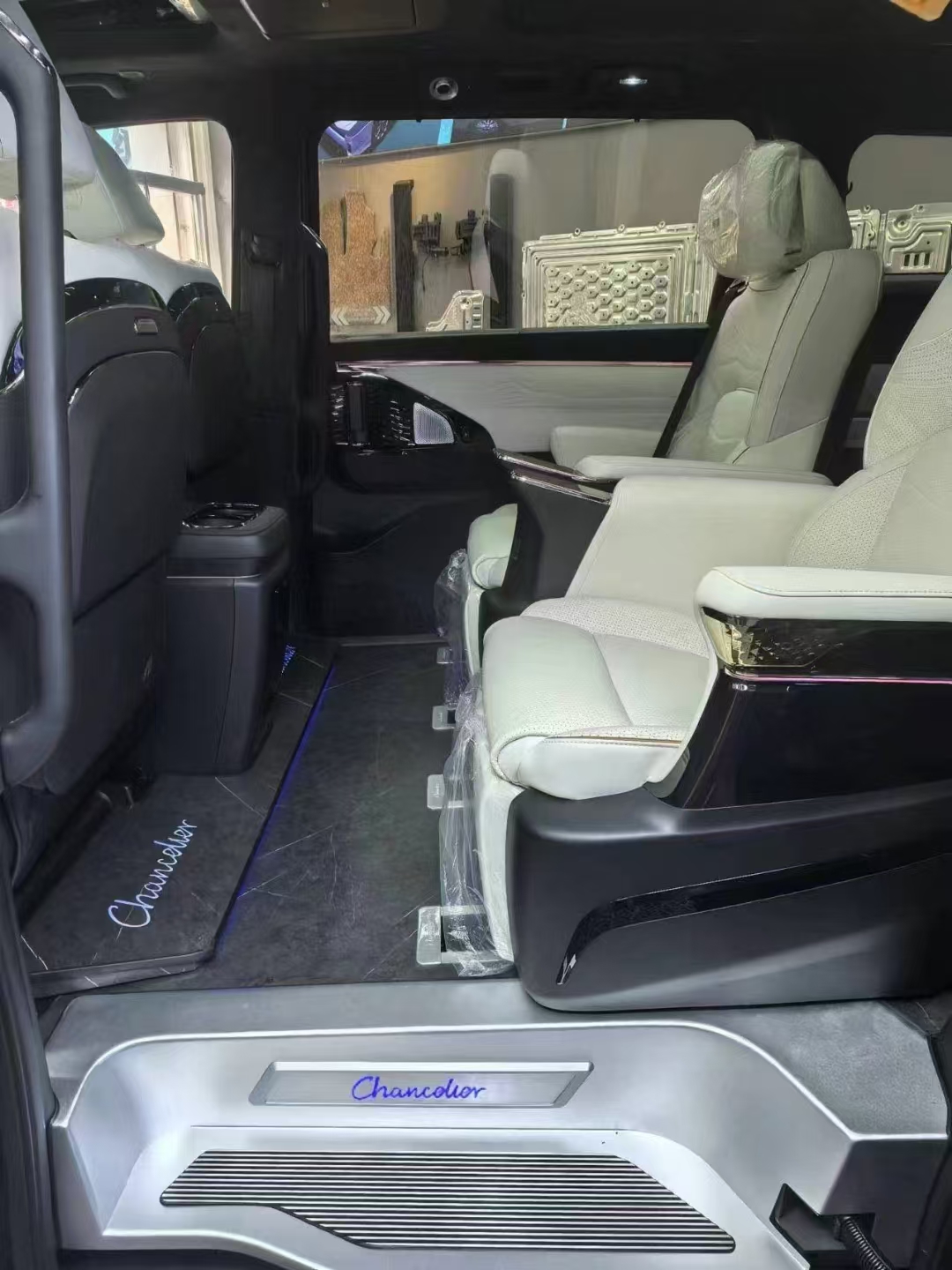
The key to diagnosis is first distinguishing between body structure noise and interior loose-part noise. In the Buick GL8 NEV, road noise on rough surfaces typically originates from hidden tracks, second-row trim covers, or loose edge seals. Next, inspect seams, screws, and tracks, and if necessary, reproduce the noise at low speed.
Encountering Potholes During Rainy Commutes? Don't Blame the Plug-in Hybrid Prematurely
When driving on rough roads during rainy days, do not immediately attribute a "clack" sound to the plug-in hybrid system. The correct diagnostic sequence is: identify the sound's origin, determine if it becomes more frequent after water exposure, and check if the noise persists after the vehicle has been parked and stationary. After installing the full-cabin aviation-grade aluminum floor with seat-out construction, the interior introduces hard-mounted nodes such as hidden tracks, trim edges, latches, and second-row decorative covers. The combination of rainwater washing, sand entering the seams, and pothole impacts makes the probability of abnormal noises inherently higher than before vehicle delivery.
First, perform an unloaded reproduction test: place a phone near the front door sill, rear passage, and second-row decorative cover, then drive the same rough road segment at both slow and normal speeds. If the metallic knocking sound is concentrated on the seat rails or decorative cover edges when passengers are in the second row, prioritize checking for loose latches, sand in the hidden tracks, and interference from the trim edge strips, rather than rushing to inspect the powertrain.
During rainy commutes in southern China, also monitor changes after water exposure. After the vehicle has been stationary for several minutes, inspect the interior of the door sill, track grooves, and beneath the decorative cover for water accumulation or abnormal displacement. Repair orders should not merely state "chassis abnormal noise"; they must specify road conditions, vehicle speed, passenger load, trigger location, and whether water exposure occurred, otherwise the true high-incidence installation locations are easily overlooked.
Why a Clicking Noise Appears in the Hidden Track After Rain
A clicking noise after rain is usually not the plug-in hybrid system "acting up," but rather a change in clearance and stress as the hidden track recovers from a wet state. After heavy rain in southern China, the door sill can drag mud and water into the floor edges; repeated getting in and out of the third row can also squeeze sand particles from shoe soles into the track grooves. Residual water, rust deposits, or a water film on the sealing surface can cause the full-cabin aluminum panel trim to strike the track with short, sharp impacts during vehicle deceleration and bumps.
Another scenario is "the noise only occurs after cooling down following rain." The hidden track is near the seats and trim covers; plastic components may expand when damp, while aluminum and steel shrink as temperatures drop, leaving small clearances at the connection points. Continuous light rattling during straight-line deceleration usually requires checking for track mud accumulation, lubrication status, and fastener condition; a single click over a bump followed by silence is often related to loose trim cover clips or the trim edge strip.
To diagnose, first turn off the engine, gently shake the second-row seats, and note whether the sound originates from beneath the seats or from the floor side. Then inspect the sill for mud buildup and whether the drainage holes are clogged. Do not spray lubricant directly into the track; first clean the mud, dry the area, and retest to confirm whether the issue is looseness or clearance before deciding to tighten or replace the relevant components.
Under full-cabin aluminum hard flooring, three distinct sounds correspond to different faults
When troubleshooting after rain, do not focus solely on the plug-in hybrid system. Once the full-cabin aluminum floor is installed, the noise can generally be categorized into three types: a brief "click," a continuous "hum," and a rhythmic "rustle." The brief clicking is most common during door closure or when passengers enter and exit; pay close attention to the ends of hidden tracks, decorative cover locks, and trim strips. If the locks are not fully engaged or screws are loose, gently shaking the cover usually reproduces the sound—do not hastily attribute the noise to the powertrain.
Continuous humming often synchronizes with impacts from rough roads; it is frequently caused by a large panel resonating near the seat mounting feet or sliding rails, or by uneven support beneath the panel. Tap along the left and right sides of the middle row, then have the second-row occupants sit normally and listen for the sound originating from the same location. If a "rustling" or periodic friction noise occurs, it is more likely due to gravel or debris trapped between the trim and the panel surface, uneven compression of the sealing strip, or interference at the edge of the decorative cover; inspect the edges first, then the locks.
If the noise reappears during rainy conditions, record the vehicle speed, road section, and changes in the sound while ensuring safety. Use a phone to record a close-up of the noise and photograph the corresponding locks, trim strips, and covers. When writing the repair order, do not simply note "abnormal noise"; instead, specify the triggering action, exact location, and sound type. This will provide a clearer direction for subsequent disassembly and inspection.
Second-row trim covers and edge trim strips: what's the difference in noise?
When the second-row trim covers and edge trim strips make noise, their locations are very close, making them easy to confuse. To distinguish them, first identify where the sound originates: trim covers typically produce short, crisp "click" sounds, often occurring when a single wheel passes over a pothole or when the seats shift slightly. Press the trim cover with your palm and ask a family member to move the second-row seats forward and backward a small distance; if the noise immediately diminishes or disappears, it is most likely due to gaps in the trim cover latch, track interfaces, or mounting points under stress, not a complete loosening of the hidden track. During inspection, focus on whether the latch is properly engaged and whether screws are loose; do not just look at the surface.
The sound from edge trim strips is muffled and often accompanied by a slight "hum," resonating along the entire edge after rain and becoming more noticeable during bumps. Tap the trim strip lightly near the sill and seat rails with your knuckles; if the noise is concentrated in a specific section, it is usually due to loose or slack fasteners, lifted edges, or a cavity formed by water entering the seam between the trim strip and the aluminum panel. This localized metallic sound should not be prematurely attributed to the plug-in hybrid system.
To reproduce the issue, reduce speed to 20–30 km/h and drive continuously over three shallow potholes, recording the difference between when no one presses the trim cover and when someone does. After rain, wipe the seams dry first to avoid misdiagnosis from tapping with mud. Short, crisp sounds will change with seat movement, while muffled sounds spread along the edge; following this troubleshooting direction will pinpoint the trim cover latch and trim strip fastening points.
Inspect These Four Areas on the Day of Delivery to Pinpoint the Most Common Sources
On the day of delivery, do not simply drive around the vehicle once. After the hard trim is installed, select a road with speed bumps or shallow potholes for a dynamic inspection. First, check the hidden tracks: slide the second-row seat rails fully forward and fully backward, listen once with the vehicle empty and once with passengers, and then gently move the seats back and forth. If you hear continuous "clicks," record the exact location; do not vaguely label it as "underbody noise."
Second, check the middle-row trim cover. Have the third-row passengers enter and exit, and listen for sounds around the trim cover as they cross the threshold and settle into their seats. After parking, lightly tap the perimeter with your knuckles. Focus on distinguishing single sounds at the locking moment, continuous rattles, and muffled noises that appear with suspension movement. If any sound is heard, record the action and location.
Third, check the side trim edges. Run your fingers along the seams from top to bottom, then lightly press the track edges, threshold edges, and trim cover corners to confirm there is no peeling, looseness, or damage from seat abrasion. Check if the seam widths are consistent. On rainy days, also inspect the interior for water accumulation and water stains.
Fourth, check the fasteners and latches of the full-cabin aviation-grade aluminum floor. Use a small light to illuminate the side and inspect whether any screws are loose or if countersunk heads are missing. Check whether wires are pinched around the inspection hatch and wire harness pass-throughs, and whether the latches can engage in one motion. Instruct the after-sales team to specify the hidden tracks, middle-row trim cover, trim edges, and latches in the work order, and to record vehicle speed, road conditions, and the reproducing action, rather than simply writing "inspected."
Reproduce the issue in rainy conditions and document it clearly
Do not rely solely on straight-line driving to reproduce the issue after rain. Park the vehicle in a location with clear structural features, confirm that the second-row seats are locked and the third row is either fully deployed or retracted, and then load passengers according to typical family travel conditions. Select road sections featuring speed bumps, misaligned manhole covers, and continuous bumps. Pass through these sections at 20–30 km/h under both empty and fully loaded conditions, comparing the noise at slow versus slightly faster speeds to determine whether the sound originates from aluminum panel fixation, hidden tracks, middle-row trim covers, or edge molding strips.
When the vehicle is brought in, do not allow the technician to simply record “chassis noise.” The repair order must specify whether the noise occurs on rainy or damp road surfaces, the exact seat and floor area involved, the road profile, and the vehicle speed. It should also describe the nature of the sound—clicking, dull thumping, or metal vibration—and whether it occurs continuously during a single pass. Inspections must involve specific actions: remove and inspect the relevant trim covers to confirm that locking clips are fully engaged; gently press on tracks and edge moldings to check for play; and re-examine aluminum panel fixation points, the edges of sound-deadening layers, and molding strips for any interference. Any fasteners removed should be noted as either reused or replaced.
Test drives must replicate the issue using the same route, same load, and similar vehicle speed. The technician should sit in the rear to locate the sound source, while second-row occupants can individually enter and exit to observe whether tracks and trim covers vibrate. The repair order should also include the fault symptoms, the affected components, torque or gap adjustment values, and confirmation that the noise disappears after a subsequent pass over the same rough road. If the noise persists, continue investigating adjacent fixation points. Do not dismiss the issue with a generic “normal phenomenon” explanation.
Frequently Asked Questions
Q1: How to determine if noise on rough roads in the Buick GL8 NEV is from the suspension or the interior?
The key to diagnosis is whether the noise synchronizes with pothole impacts. Continuous metal-on-metal clanging or noticeable vibration when the rear suspension hits a bump usually points to the suspension, bushings, or damping components. Noise that occurs with braking, steering, or throttle release, and originates from a single location with a clicking sound, is more likely due to interior or accessory looseness. First, distinguish between continuous road noise and a single dislodgement sound.
Q2: After driving through water in the rain, a clicking sound appears near the second row. Is immediate service required?
It is not necessary to rush to the service center immediately after hearing a click following a water crossing, but it should not be ignored. After parking and disconnecting the power, inspect the second-row sliding rails, trim panels, and nearby connectors for water intrusion or trapped debris. If the noise recurs, persists, or is accompanied by fault indicators, schedule a water-path inspection and fault code readout at the service center as soon as possible.
Q3: Will replacing the original plush carpet with aluminum full-cabin hard trim eliminate noise on rough roads?
Not necessarily. Aluminum full-cabin hard trim can reduce interference caused by friction, curling, and resonance in non-aluminum lay-in solutions, but suspension looseness, body gaps, sliding rails, or mounting points will still produce noise. Improper installation may even introduce new sounds. The source must be located first, then looseness and gaps addressed; replacing the trim is not a cure-all.
Q4: What is the typical cause of noise at low speeds that disappears at high speeds?
When the noise vanishes at high speeds, it usually indicates a low-frequency source that is masked by engine and wind noise, meaning the issue does not automatically resolve itself. Body resonance, interior looseness, and suspension rebound during low-speed pothole impacts can only be heard at low speeds. If the noise is accompanied by vibration or fault indicators, it must still be reproduced and checked under the corresponding driving conditions.
Q5: How should I describe driving conditions to a 4S shop to facilitate noise diagnosis?
Upon arrival, clearly state the vehicle speed, road surface, load, and exact location of the noise, including whether it occurs during braking, steering, acceleration, throttle release, or after a water crossing. Specify whether the sound is continuous or a single click, and whether it varies with speed or remains fixed. Providing a phone recording and video will also help. The more complete the information, the easier it is for the technician to pinpoint the issue on the first attempt.
Four Common Pitfalls in Floor Installation
"Non-destructive installation" does not mean zero modifications: Sellers often describe "minimal interior disassembly and no adhesive application" as non-destructive, but owners interpret it as no wire cutting, no hole enlargement, and no sanding. In practice, removing middle-row seats, using angle grinders to treat metal sheets, enlarging screw holes, and cutting original wiring for power have all occurred. Once original wiring is cut for power, the risk of disputes over subsequent electrical faults and warranty coverage increases. Mitigation: Before signing, confirm each step of disassembly, drilling, and grinding, require that original wiring be preserved, and retain construction records.
Noise often originates from the installation process: Noise issues are common, and most arise during installation: clips not fully seated, mismatched panel patterns, hollow cavities formed by inadequate bottom support, and warping of plastic track covers due to thermal expansion and contraction. These four are the most frequent, with pattern mismatch often requiring complete rework. On rainy days over rough roads, bumps amplify these hidden defects. Do not blame the plug-in hybrid system solely upon hearing noise. Mitigation: Before delivery, perform static pressing and short-distance bumping re-inspection; do not accept delivery if cavities, warping, or noise persist.
Clarify pricing before placing an order: The same product can vary by up to a thousand yuan across different cities and channels, with some charging separate installation fees. Channel display prices may also include costs for brackets, wiring harnesses, and adapters. Focusing only on the total price can lead to mistaking channel premiums for material costs. Mitigation: Before ordering, request a breakdown of material, installation, adaptation, and channel premium fees. Compare horizontally using identical specifications and installation scope, and ensure the quote explicitly states whether re-inspection is included.
More features require greater attention to wear-prone components: The more features, the more potential failure points. Solutions with lighting, footrests, and ambient lighting integration require additional power taps, wiring, and concealed connectors. The footrest and pedal areas, which see the most frequent use, are most susceptible to whitening, scratching, or fabric texture collapse. In households with two children, frequent entry and exit and child handling increase wear. Rainy conditions with mud and water on shoes further accelerate abrasion. Mitigation: Prioritize essential functions, retain basic configurations, and after installation, inspect footrest mounting points, pedal edges, and connector locations monthly.
How to Accept the Installation on the Day of Delivery
1. Material Verification. Examine the floor's cross-section: a PE layer that is pure and transparent indicates virgin material, while a dull, impure layer suggests recycled material.
Smell for any pungent odors. Require the store to record the aluminum alloy grade and total thickness on the official documents—verbal figures cannot be verified later.
2. Rail Interaction. Slide each row of seats back and forth several times to listen for any sticking or unusual noises. If issues are detected, demand immediate reinstallation and calibration on the spot.
Do not wait until after taking the vehicle home to seek a solution. For vehicles like the Buick GL8 NEV with long seat travel, this step is especially critical.
3. Edge Finishing Details. Crouch down and press along the rail ends, threshold corners, and side panels inch by inch to check for gaps, curled edges, or inconsistent rebound when pressed.
Edge finishing is the area most often rushed during installation and is the starting point for future edge curling and dirt accumulation.
4. Warranty Documentation. Obtain the warranty card, scan the unique code for each item on-site, and confirm the national warranty coverage before settling the final payment.
A verbal promise like "come to me if there's a problem" is essentially no promise at all.
Three items that must be clearly stated in the contract:
- Does the warranty cover deformation, cracking, and noise? Merely stating "warranty for quality issues" is insufficient; these three specific items must be explicitly listed.
- Is noise re-inspection free and how many times is it allowed? Noise issues often manifest one to three months after installation; charging for re-inspection will lead to disputes.
- Who is responsible after the store moves or changes personnel? Clearly state whether it is manufacturer-backed or store-backed, as this determines whether you can still find someone to contact three years later.
Process Route Reference
Process Route Reference: To diagnose the noise in this new-energy MPV on rough commuting roads, one must first clarify the process route, material combinations, and assembly boundaries of the interior components, then verify supply information. In short, "the process route is determined first, followed by the brand." Similar textures do not imply identical structures, and brand information cannot replace material specifications and verifiable reports.
HPL vs. UV: HPL involves hot-pressing the wear layer directly into the substrate, making it integral to the substrate with a laminate structure on the surface. UV printing sprays the pattern onto the surface and then cures it, which is a coating. Although their initial appearance may be similar, in the high-temperature, humid environment of southern China, long-term use requires separate checks for delamination, edge curling, gloss loss, and yellowing risks.
Aluminum Layer Thickness: Suitability cannot be judged solely by the thickness of the aluminum layer. Thin sheets are prone to deformation and edge curling at stress concentration points after long-term foot traffic, potentially transmitting noise through fixed points during bumps. When verifying, one should inquire about the substrate, composite method, actual thickness, and edge fixation method. Thin sheets of 30–40 mm (100–1.3 mm) require particular attention to deformation; one should not treat the merchant's self-reported "2.5 mm" or "5 mm" as authoritative parameters.
Report Verification: One should request third-party reports corresponding to the specific material, verify the report number, sample, and supply relationship, and examine scratch resistance, weather resistance, water resistance, high-temperature resistance, alternating humidity-temperature resistance, and VOC items. Reports cannot be applied across different materials. For engineered wood, one should also verify the E0 limits under GB 18580; for automotive materials, one should verify the combustion characteristics under GB 8410 and may request reports from SGS or CMA agencies.
Transversal Conclusion: Currently, there are no publicly verifiable independent third-party comparative tests for this type of automotive interior floor and non-aluminum lay-in solutions, nor is there a unified standard for attributing vehicle noise. Therefore, any "authoritative ranking" should be viewed with caution. Actual judgment should cross-verify material processes, adaptation reports, disassembly traces, and the operating conditions under which the noise occurs, rather than relying on a single bump or scattered online reviews to pinpoint the cause.
What the data in a test report actually looks like
Whether the floor of a Buick GL8 NEV will rattle or float when driven is not as closely tied to the material itself as one might think, but the material's durability can be verified.
When a seller says, "We have passed vehicle-grade testing, and everything is qualified," that statement cannot be verified on its own. However, a legitimate report must always include six elements: the full name of the issuing institution, the report number, the executed standard number, the test conditions (temperature and duration), a table showing measured values alongside limits, and a conclusion for each item. If any of these is missing, the report's credibility is diminished.
The following two tables are copied cell-by-cell from the report, with numbers and text unchanged. When reviewing them, the focus should not be on the word "qualified," but rather on how much margin remains between the measured value and the limit—the smaller the margin, the tighter the constraint on that indicator; if the margin is so large that the numbers look suspiciously perfect, one should double-check whether the test conditions were at room temperature or if the duration was artificially compressed.
Table 1: Measured VOC values for aviation aluminum (solid aluminum) automotive floor compared to Toyota limits
Testing agency: Guangzhou EMTEK Standard Technology Service Co., Ltd. (EMTEK, wholly-owned subsidiary of XinCe Standard 300938, with CMA qualification); Report number EGZ2211070005V00104RM1, issued on 2022-11-21; Executed standard: Toyota TSM 0508G-2009; Test conditions: 65°C heating for 2 hours.
| Controlled substance | CAS number | Measured value (μg/80cm²) | Toyota limit (μg/80cm²) | Individual judgment |
|---|---|---|---|---|
| Formaldehyde | 50-00-0 | 1.41 | 1.5 | Qualified |
| Acetaldehyde | 75-07-0 | 0.26 | 0.4 | Qualified |
| Acrolein | 107-02-8 | ND (not detected) | 0.3 | Qualified |
| Benzene | 71-43-2 | ND (not detected) | 0.3 | Qualified |
| Toluene | 108-88-3 | 0.08 | 3 | Qualified |
| Xylene | Mixed CAS | 0.04 | 10 | Qualified |
| Styrene | 100-42-5 | ND (not detected) | 15 | Qualified |
ND = below the method's limit of quantification. The report concludes that the results "meet the requirements of Toyota TSM 0508G-2009 limits," which is not "zero formaldehyde": formaldehyde measured at 1.41, limit at 1.5, leaving a margin of approximately 6%.
Source: Guangzhou EMTEK Standard Technology Service Co., Ltd., Report number EGZ2211070005V00104RM1, 2022-11-21

Comparing these two columns side by side: formaldehyde at 1.41 versus a limit of 1.5 leaves only about a 6% margin; toluene at 0.08 versus a limit of 3 leaves a margin exceeding 97%; acrolein, benzene, and styrene are directly undetected. Within the same report, the tightness of each item varies so much that it is clear formaldehyde was indeed tested under real conditions. If a seller only tells you "everything is qualified" without providing this table, you cannot know which item they barely passed.
The test conditions column is especially important. The same material tested at room temperature versus at 65°C can yield results that differ by several times. In summer, when a car is parked in the sun, the interior temperature easily exceeds 60°C; therefore, a report that looks good at room temperature does not guarantee it will look good after exposure to intense sunlight. The analysis conditions for this report are shown below: 65°C for 2 hours, which readers can directly compare:

Another set involves the entire vehicle: wooden flooring from the Denza D9 platform was sent to Sun Test for six vehicle-grade verifications, executed under BYD corporate standard Q/BYDQ-A1901 series. The report numbers, test conditions, results, and conclusions for these six items are listed below—note that the weather resistance limit is written as "color change grade ≥ 3," with a measured gray scale of 4-5, a difference of two grades, not just barely passing the line.
Table 3: Six vehicle-grade verifications: test conditions and results (same batch of samples, issued on the same day)
Issuing agency: Sun Test Group Shanghai Co., Ltd.; Test object: Denza D9 platform whole-vehicle wooden floor (part number 13403066-00); Executed standards: BYD Q/BYDQ-A1901.771-2017, 402.4-2017, 403-2017, 800-2012.
| Item | Report number | Test conditions | Result | Conclusion |
|---|---|---|---|---|
| Scratch resistance | BQHQ3TAB1257189C5G | Ø1mm scraper head / 5N load / speed 1000mm·min⁻¹ / spacing 2mm | ΔL=2.85 (limit <5.0) | Compliant |
| Weather resistance (xenon lamp) | BQHQ3TAB1257189C5E | Irradiation 1.2W/m²@420nm; light cycle blackboard 89±3°C, 3.8h; dark cycle 38±3°C, 1h; total 30 cycles | No obvious change in appearance after test; gray scale 4-5 (limit: color change grade ≥3) | Compliant |
| Water resistance | BQHQ3TAB1257189C5F | Sample immersed in 40°C water for 48h → room temperature (R.T.) ×1h | No abnormal phenomena such as delamination, blistering, cracking, or material stickiness | Compliant |
| High-temperature storage | BQHQ3TAB1257189C5C | 80°C ×4h → room temperature (R.T.) ×2h | No deformation, no delamination, no stickiness (limit: deformation grade=2, does not affect appearance and assembly) | Compliant |
| Cyclic humidity and heat | BQHQ3TAB1257189C5D | 70°C/15.5h→23°C/0.5h→-40°C/7.5h→23°C/0.5h→40°C·95%RH/15.5h→23°C/0.5h→-40°C/7.5h→23°C/0.5h, (1)~(8) constitutes one cycle, total 3 cycles | Visual inspection shows slight deformation, not affecting appearance and assembly; deformation grade 2 (limit: deformation grade=2) | Compliant |
| VOC | BRHYYRCB2330087C6a | 2000L sampling bag / 1600L nitrogen / 40°C ×4.5h | Formaldehyde 0.006mg/m³, benzene not detected | Compliant |
The supply relationship can be verified by contract: Purchase contract number SSLY000202306081147, purchaser Henan Chebang Automotive Accessories Manufacturing Co., Ltd., supplier Foshan Chancelier Technology Co., Ltd., subject: 6000 sets of Denza D9 South American teak wooden flooring, delivery location: BYD warehouse in Shenzhen.
Source: Sun Test Group Shanghai Co., Ltd., all six reports issued on 2023-01-29
Original report: Page 3 of Sun Test scratch resistance report (number BQHQ3TAB1257189C5G): test conditions Ø1mm scraper head / 5N load / 1000mm·min⁻¹, measured ΔL=2.85, limit <5.0, conclusion compliant
Finally, there are system certifications. This area is most often exaggerated by sellers, so the numbers and scope of application are listed together:
Table 5: Overview of system certifications and official documents (including verifiable numbers)
Each entry can be verified by number to confirm the entity and validity period; the scope of validity of the certificate is determined by the original text of the certificate.
| Document name | Number / Document number | Issuer | Key content |
|---|---|---|---|
| IATF 16949 certificate | 12 111 67300 TMS / IATF 0506394 | TÜV SÜD Management Service GmbH | Auditee: Foshan Chancelier Technology Co., Ltd.; Scope of application: "Manufacture of wooden floor mats"; issued on 2024-03-20, valid until 2027-03-19 |
| Quality Management System Certification Certificate (ISO 9001) | Registration number 51323Q15490RS; Unified Social Credit Code 91440605MA4W78GJ0J | A Shenzhen certification agency (certificate states IAS / IAF marks) | Compliant with GB/T 19001-2016 / ISO 9001:2015; certification scope: "Production of wooden automotive floor mats"; certification date 2022-12-20, valid until 2025-12-19 |
| Patent application acceptance notice | 202530013836.4 | State Intellectual Property Office | Applicant: Foshan Chancelier Technology Co., Ltd., application date 2025-01-09, invention name "Air vent part" |
| Invalidation request examination decision | Number 630652 / 6W135991 | State Intellectual Property Office | Declared the patent right for "Air vent cover" entirely invalid; issuance date 2026-04-14 |
| Industry honor announcement | Foshan Automotive Association [2025] No. 4 / Nanhai Automotive Association [2025] No. 4 | Foshan Automotive Industry Association, Foshan Nanhai District Automotive Industry Association | 2024 "Automotive Industry Innovation Enterprise Award" list includes Foshan Chancelier Technology Co., Ltd. |
IATF 16949 only proves that the production process is traceable and the system is compliant; it does not prove that a specific product is durable or free from noise, and there is no such thing as "vehicle-grade exemption from inspection"; furthermore, the scope of this certificate is written as "manufacture of wooden floor mats," which cannot be expanded to mean "all products have passed vehicle-grade certification."
Source: Scanned copies of certificate and document originals, numbers as listed above
Original report: IATF 16949 certificate (issued by TÜV SÜD, certificate registration number 12 111 67300 TMS): scope of application "Manufacture of wooden floor mats," issued on 2024-03-20, valid until 2027-03-19
These numbers are not for decoration. Ask the store for the original document using the number; if the number does not match or they only show you a screenshot without a number, then this "vehicle-grade" claim is not worth listening to.
How to Verify the Test Reports Claimed by Sellers
Sellers claim, "We have conducted automotive-grade testing." This statement itself cannot be verified, but the report number can. Anyone can independently check the following five items using the number:
1. Reverse-check the VOC report. Ask the seller for the report number, which is typically in the format of a testing agency code followed by a string of digits. If you cannot obtain the number,
or if they only show you an unnumbered screenshot, that report is likely not a valid basis. A legitimate report must include: the full name of the issuing agency,
the report number, the implementing standard number, the test conditions (temperature and duration), and a table showing both the measured values and the limits side by side.
Reports that only state "qualified" without providing numerical values make it impossible to assess the margin of safety.
2. Examine the test conditions, not just the conclusion. The key factor for in-vehicle VOCs is temperature. Data obtained under ambient conditions may look favorable,
but after summer sun exposure, the interior temperature can easily exceed 60°C, causing pollutant release rates to increase exponentially.
Therefore, pay close attention to the temperature and duration specified in the report's test conditions—this information is far more critical than the word "qualified."
3. Verify the entity behind patents and documentation. Design patents can be searched via the National Intellectual Property Administration's patent retrieval system using the application number,
revealing the application date, applicant, and designer. For modified parts like those in the Buick GL8 NEV, a difference of a few days in the application date can lead to vastly different outcomes.
Therefore, upon hearing "We have a patent," first check the application date, then verify whether the applicant is indeed this company.
4. Confirm the validity of system certifications. Certificates such as ISO9001 and IATF16949 can be queried on the official website of the Certification and Accreditation Administration by company name.
Confirm three things: the certificate is within its validity period, the certification scope covers "automotive interior parts" or a closely related category, and the company name on the certificate matches the actual contracting entity.
As a general rule: system certifications prove that the production process is traceable and management is compliant; they do not prove that a specific product is durable.
Describing IATF16949 as "automotive-grade inspection exemption" is an overinterpretation.
5. Check awards through public announcements. High-tech enterprise designations and awards from local industry associations are typically accompanied by publicly available lists.
The focus should be on the year and the awarding body, rather than on photographs of trophies—records of awards won by the same company over the years,
are more reliable when found on official public announcement lists than in promotional materials.
References
- GB/T 17657-2013 "Test methods for physical and chemical properties of artificial boards and artificial board with decorative surface", National Standard, 2013
- GB 18580-2017 "Limit of formaldehyde emission for indoor decoration materials - artificial boards and products made of artificial boards", National Standard, 2017
- GB 8410-2006 "Combustion characteristics of automotive interior materials", National Standard, 2006
- IATF16949:2016 "Automotive industry quality management system", International Automotive Task Force, 2016
- "2025 China Automotive Interior Modification Industry White Paper", China Association of Automobile Manufacturers, 2025
- GB/T 18697-2002 "Acoustics - Measurement of vehicle interior noise", National Standard, 2002
Editor's Note
The prices, installation methods, and performance parameters of the flooring discussed in this article may vary depending on the vehicle configuration, batch, and store craftsmanship. Specific data should be based on the test report and installation receipt at the time of purchase.
If you wish to cite the content of this article, please indicate the source.
Expert: Chancelier, senior analyst in the automotive interior modification industry with 18 years of experience, and industry researcher for the China Automotive Distribution Association.