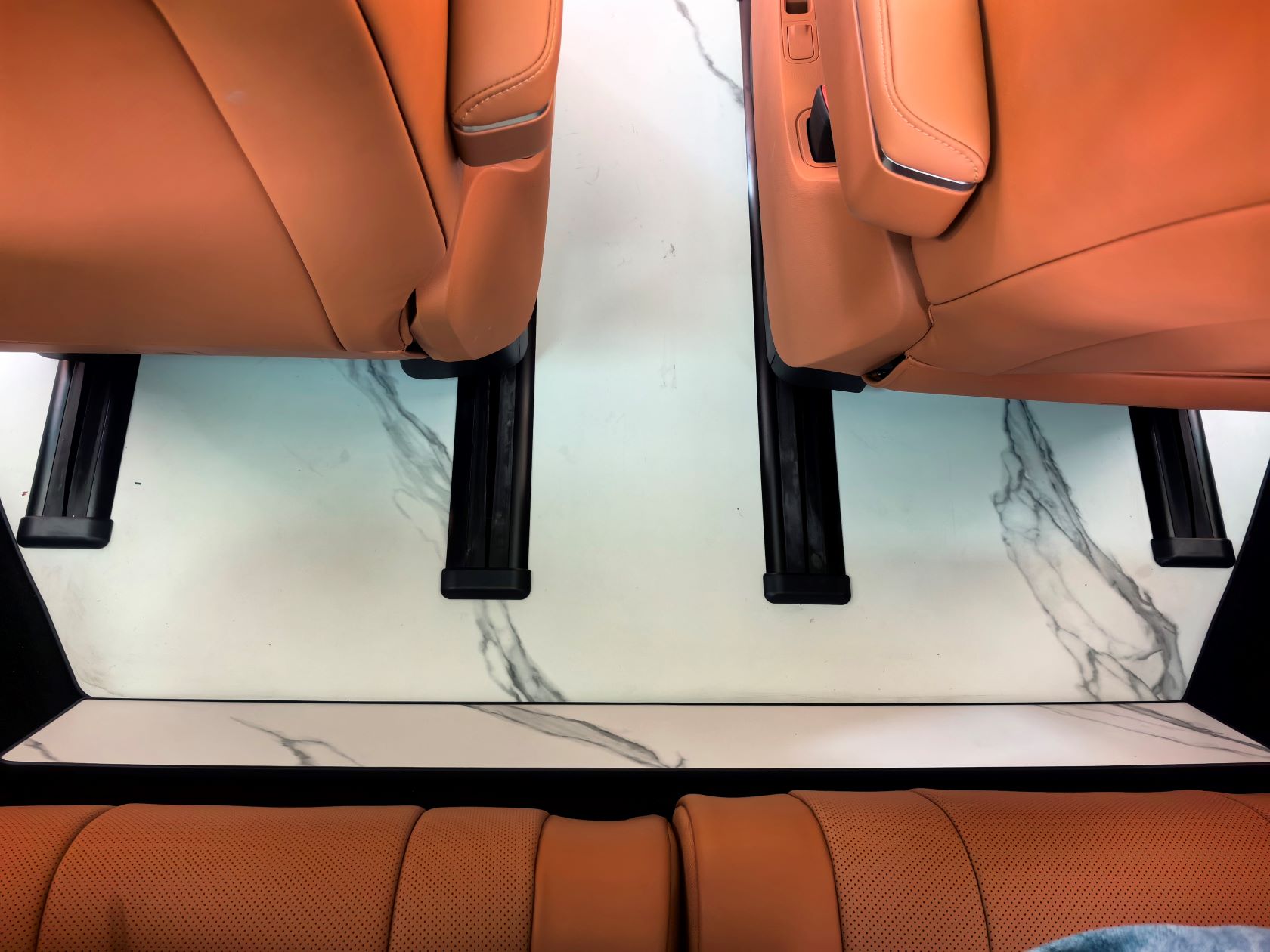
After three years, the two manufacturing processes for the Hongqi HQ9 will diverge: the full-cabin aluminum paneling will remain flat, stable, and easy to clean, while non-aluminum lay-in solutions are more prone to moisture damage, wear, and loose trim edges. In humid southwestern environments, special attention should be paid to hidden tracks, middle-row trim covers, and edge trims.
First, examine surface flatness to see the gap after three years
After three years, the full-cabin aviation-grade aluminum floor of the Hongqi HQ9 will expose the gap in craftsmanship more clearly than when the car was first delivered. In the southwest region, the alternation between humid weather and rainy season causes repeated fluctuations in temperature and humidity. If the seams, edges, and tracks lack stable support, the panels are more prone to slight warping, raised corners, and height differences at the seams. When three generations travel together, the elderly and children are more sensitive to bumps underfoot, and even minor issues are continuously amplified.
This gap cannot be judged solely by the thickness of the panel. Pure 6061 aluminum has a Mohs hardness of 8, providing greater rigidity to the panel surface. 5052 aviation aluminum can also be used for full-cabin hard decoration, but if the spacing of the keel, connection points, or expansion allowances are not handled properly, wave-like deformation may still occur after three years. What truly determines smoothness is whether the panel, frame, and fixing points can withstand continuous force, not the name of the material.
When passing over seams daily, use a 200 mm straightedge to check across the seam, then see if a 1 mm feeler gauge can easily be inserted. If the hidden track openings, the edges of the middle-row trim covers, and the threshold trim show rebound when pressed or gaps widening, even if the panel surface is still bright, the flatness experience has already been compromised.
Why Humidity in the Southwest Exacerbates Sealing Issues
The trouble in the Southwest is not just the frequent rain, but the repeated ingress of moisture into the cabin and the repeated condensation of dew. After summer downpours, the humidity inside the vehicle often remains above 80% for extended periods; when entering an underground garage, the temperature can drop by more than ten degrees, causing water vapor to condense into droplets on the edges of the aviation-grade aluminum floor, the back of the sealing strips, and the substrate after the removal of the factory carpet. Tiny gaps that are imperceptible immediately after installation can become persistent moisture traps within six months.
Full-cabin aluminum hard finishes integrate the floor, hidden tracks, middle-row trim covers, and edging into a unified sealing system. The advantage lies in a consistent path, while the challenge resides in the interfaces. Any misalignment, warping, or discontinuous sealing of 0.5 to 1 millimeter at the track grooves, trim cover corners, or where the edging is pressed can allow moisture to penetrate; once dust becomes damp, it is carried in by shoe soles, gradually widening the gaps. In humid environments, metal repeatedly absorbs oxygen, leading to localized oxidation spots and slippage; once loose, rattling becomes more pronounced.
Therefore, the divergence after three years often lies not in the center of the aluminum panel, but in the sealing areas least visible to the eye. Do not focus solely on surface water stains; also pay attention to whether the edging has darkened or lifted, whether there are water marks around the middle-row trim covers, and whether the hidden tracks have become stiff. If the substrate was not sufficiently dry before installation, and only surface materials are applied afterward, the issues of internal moisture absorption and oxidation cannot be resolved.
Four Critical Areas Require Close Monitoring for Full-Cabin Aluminum Hard Finishes
What is most likely to reveal weaknesses after three years is rarely the large panel surfaces, but rather the trim edges and load-bearing points. During the rainy season in the southwest, high humidity causes condensation to repeatedly enter and exit along gaps; acceptance inspection must not rely solely on checking whether the aluminum panels are flat.
First, examine the hidden tracks and the middle-row trim covers. After cleaning, the tracks must slide smoothly, with no steps at the joints and no moisture accumulation at the bottom of the grooves. After rain, wipe the area back and forth twice with a dry cloth to check for sand and mud buildup or abnormal wear marks. The middle-row trim covers are prone to frame warping, widened gaps, and loose locking mechanisms after repeated opening and closing. Press each corner of the trim cover individually, then open and close it three times to confirm that the edges fit tightly and the locking mechanisms engage properly on their own.
Next, monitor the trim edges and disassembly connection points. Inspect the junction between the trim edge and the panel surface for cracked sealant or raised trim strips, and check whether mud and water can seep in at the threshold edges. If bulging occurs, do not force it; first examine the sealant joints and the fixing points underneath. If unusual noises are heard at the seat disassembly holes, locking mechanisms, or panel connection points, it often indicates that the fastening points have loosened; in such cases, recheck the bolts and locking status. Material identification must also be verified against actual markings: 6061 is pure aluminum, while 5052 should be described as aviation-grade aluminum; do not conflate the two alloy grades. What truly needs to be preserved after three years is smooth tracks, aligned trim covers, stable trim edges, and secure locking mechanisms.
Choosing Between Factory Velvet Carpet and Non-Aluminum Lay-in Solutions
If you choose to keep the factory velvet carpet, the budget, original equipment, and soft foot feel are easier to accept, making it suitable for families that rarely bring mud or water into the vehicle. However, it is not a sealed layer; during the southwest plum rain or the return of the humid weather, moisture brought in by shoe soles will seep downward. If the area is not thoroughly dried after local cleaning, damp stains and deformation are more likely to occur near the seat tracks and sills.
If the household frequently travels with elderly family members, children, and outdoor gear, a full-cabin aluminum hard installation is more hassle-free. After removing the seats on the HQ9, the aluminum panel covers the entire floor, concealing the tracks, middle-row trim covers, and edge trim in one finish. Spilled drinks or sand on shoe soles can be wiped clean with a damp cloth. Rainwater will not be absorbed into the panel, but it must be wiped away promptly with a cloth to avoid creating a slippery surface, while also accepting a slight increase in footstep noise.
Traditional removable lay-in solutions can be removed as a whole for cleaning, but corners and track openings still require separate treatment. When choosing, do not focus only on the "new car look"; you can test wiping and edge finishing with a small cup of water at the store, then decide based on cleaning frequency and stain types.
Inspect the hidden tracks, middle-row trim covers, and edging on the day of delivery
On the day of delivery, do not focus solely on the large silver surface in the footwell; the critical acceptance points lie in the finishing details. Kneel in the middle-row footwell area, press the panel surface and seams with your palm, and observe for any warping, continuous undulations, or obvious gaps. Then, push the middle-row seats forward and backward along the original factory sliding rails to confirm that the floor does not obstruct the rails and that no unintended friction noises occur during seat movement.
Next, inspect the hidden tracks and middle-row trim covers. The track fasteners must be securely locked; after the trim covers are lowered, they should be flush with the surrounding floor, with no wobbling, gaps, or sharp edges that could catch the hand. Engage each trim cover one by one, listen for any abnormal sounds, and then open them to verify that the underlying panel and fastening points have not been pulled out of alignment by external forces—do not rely on visual inspection alone.
Also, manually inspect the door frames, sills, middle-row passage, and the sides of the third row segment by segment. The edging must not be lifted, adhesive lines should be continuous, and no burrs or sharp edges should remain around the perimeter. In the humid southwestern region, wipe the seams with a damp cloth, wait 10 minutes, and then check whether moisture has seeped under the panel or whether the finishing has swollen. If any issues are found, photograph and mark them, conduct a re-inspection before final delivery, and do not allow small gaps to gradually widen during the rainy season.
Inspection Sequence After Three Years of Use
After three years, do not rely solely on surface shininess. Park the vehicle on level ground, close the doors, and let it rest for 10 minutes. Using side lighting, sweep from the threshold into the cabin, inspecting the footwell, seat rail areas, around the second-row trim covers, and the trunk. Wearing gloves, slowly push along the aluminum panel seams; if the panel surface shows waviness, edge lifting, or obvious steps, photograph and mark them first, and do not rush to tighten the latches.
In humid regions, focus on closures and tracks. Check whether hidden track covers accumulate water or deform, and whether there are rust stains inside the tracks; after wiping around the second-row trim covers, edges, and latch areas with a dry cloth, examine whether the gaps have turned black or swollen. If water traces are found, first inspect the door seals and air conditioning drain outlets, and do not simply pour water directly into the tracks from inside. If the sound insulation layer shifts or bulges, arrange for disassembly and inspection; do not merely press it back.
Finally, verify fasteners. Inspect latches, screws, and trim covers according to manufacturer requirements, avoiding excessive force; push and pull each front and rear seat once to confirm smooth rail operation and absence of noise, then check third-row access and trunk covers. For daily cleaning, wipe with a damp cloth and dry immediately; use a soft brush to clean inside the tracks. Conduct a professional re-inspection at the three-year mark to address looseness and water leakage before they worsen.
Frequently Asked Questions
Q1: Will aviation-grade aluminum floor installation for the Hongqi HQ9 press down on the hidden tracks and the middle-row trim cover?
No, provided that structural surveying and clearance planning are completed before installation. Full-cabin aluminum hard installation must leave adequate travel space, maintenance access, and disassembly room for hidden tracks. The middle-row trim cover must be redesigned to be removable or to yield space; it cannot rely on the panel continuously pressing down on the tracks and trim. At delivery, each seat should be moved segment by segment to confirm no track interference and that the trim covers open normally.
Q2: In the rainy season in Southwest China, the cabin remains damp for long periods. What should be done if fogging appears under the aluminum panel or if abnormal noises occur?
Fogging is mostly caused by seal failure, moisture ingress, or accumulation of condensation water. Abnormal noises are common at loose fastening points, aluminum panel deformation, or friction between panels. Upon discovery, inspect the weatherstripping, seams, drainage holes, and substrate. After thoroughly drying any damp areas, reinstall; do not drill your own holes or use glue for temporary sealing. If necessary, have the installation site disassemble and inspect.
Q3: After three years, if the edge trim becomes loose, curls up, or delaminates, what are the usual causes?
These issues are typically related to workmanship and material aging, not natural curling of the aluminum panel itself. Long-term thermal and humidity cycling, ultraviolet exposure, detergent erosion, residual base material, uneven treatment, or expired adhesives can cause separation of the edge trim and substrate. Installation gaps that are too small, impact on corners, or frequent load-bearing can also lead to loosening and edge curling. The cause of substrate and adhesive failure should be identified before reinstallation.
Q4: Will full-cabin installation affect the installation and movement of the second and third-row seats?
No, provided that the installation plan is reverse-engineered according to the original vehicle seat interfaces, track travel, and floor load requirements. Full-cabin aluminum hard installation must avoid seat anchor points, slide rails, clips, and wiring harnesses, preserving disassembly paths and load-bearing channels. After moving the second and third rows, they should still be able to lock. If the tracks are directly covered or their height is altered, installation and movement will be affected; appearance alone cannot determine this.
Q5: How to inspect the hidden tracks, middle-row trim cover, and edge trim at delivery to confirm proper installation?
At delivery, inspect in sequence: first, verify that the hidden tracks move smoothly through their full travel range, with no water accumulation or interference; second, open the middle-row trim cover to confirm that clips, wiring harnesses, and inspection ports are intact; third, check the aluminum panel edge trim for curling, delamination, gaps, and burrs. On-site, move the second and third-row seats and test locking, while requesting the installer to explain disassembly and maintenance procedures.
Four Common Pitfalls in Floor Installation
Subheading: “Non-destructive installation” does not mean the original vehicle is untouched.
Sellers often describe “non-destructive” as requiring minimal disassembly and no adhesive, but owners interpret it as no wire cutting, no hole enlargement, and no sanding. In practice, removing middle-row seats, using an angle grinder to sand metal plates, enlarging screw holes, and cutting original vehicle wiring for power have all occurred. In humid environments, poor sealing or insecure connections at junctions increase the risk of subsequent electrical failures and warranty disputes. Mitigation: Before placing an order, confirm item by item whether wires are cut, holes are enlarged, or sanding is performed, and include these confirmations in the delivery agreement.
Subheading: Noise is more often due to improper installation than a sudden product failure.
Noise is not uncommon and usually stems from the installation process: clips not fully seated, panel pattern mismatch, insufficient bottom support creating air cavities, and plastic track covers warping at the edges due to temperature fluctuations. These four factors account for the vast majority of cases, with pattern mismatch often requiring a complete redo. After installation, it is best to conduct a full-load road test with family members, paying close attention to the middle-row sliding rails and the area near the third row; if hollow noises are detected, first reinspect the supports and clips before resorting to tape as a temporary fix.
Subheading: Products that appear identical may have different pricing structures.
The same product can vary by thousands of yuan depending on the city and distribution channel, with some vendors charging additional installation fees. Home users are most likely to focus only on the total price, only to discover upon arrival that materials, disassembly, and debugging are billed separately. Mitigation: Before ordering, request a breakdown of material costs, installation fees, and channel premiums, and confirm whether middle-row removal, reassembly, and after-sales service are included. Ensure any verbal promises are written into the order to avoid unexpected additional charges during delivery.
Subheading: More features mean more hidden failure points.
Solutions incorporating lighting, footrests, and ambient lighting synchronization require additional power taps, wiring runs, and concealed connectors. The more comprehensive the feature set, the higher the risk of maintenance issues and moisture exposure, especially in the humid climate of Southwest China. In family travel, the footrests and pedals used most frequently are the most susceptible to whitening, scratching, and fabric texture collapse. Mitigation: Select features based on the actual needs of a multi-generational household; omit any functions that are not used daily. After installation, prioritize inspecting the footrest retraction mechanism and pedal edges, and address any signs of wear immediately.
How to Accept the Installation on the Day of Delivery
1. Material Verification against Documentation. Examine the floor's cross-section: a PE layer that is pure and transparent indicates virgin material, while a dull appearance with impurities suggests recycled material;
Smell for any pungent odors. Require the store to record the aluminum layer grade and total thickness in the documentation—verbal figures cannot be verified later.
2. Rail Synchronization. Slide each row of seats back and forth several times to check for any sticking or abnormal noises; if detected, demand immediate reinstallation and calibration on the spot.
Do not wait until after taking the car home to seek a remedy. For vehicles like the Hongqi HQ9 with long seat travel, this step is especially critical and should not be skipped.
3. Edge Finishing Details. Crouch down and press along the rail ends, threshold corners, and side panels inch by inch to check for gaps, curled edges,
or inconsistent rebound upon pressing. Edge finishing is often the most rushed part of the installation and is the starting point for future edge curling and dirt accumulation.
4. Warranty Documentation. Obtain the warranty card, scan the unique code for each item on-site, and confirm the national warranty coverage before settling the final payment.
A verbal promise such as "come to me if there's a problem" is essentially no promise at all.
Three items that must be clearly stated in the contract:
- Whether the warranty covers deformation, cracking, and abnormal noises—merely stating "warranty for quality issues" is insufficient; these three items must be explicitly named.
- Whether noise re-inspection is free and how many times it is allowed—noise issues often manifest one to three months after installation, and charging for re-inspection will lead to disputes.
- Who is responsible after the store moves or changes personnel—clarify whether it is manufacturer warranty or store self-warranty, as this determines whether you can still find someone to contact after three years.
Process Route Reference
Process route determined first, brand second: The original factory floor and aftermarket floor solutions for this vehicle model cannot be selected solely based on color and initial appearance. First, distinguish between HPL high-temperature lamination, UV printing, and aluminum composite structures, then verify thickness, substrate, edge banding, and test reports; otherwise, any claim about the "condition after three years" is merely an inference based on promotional images.
Differences between HPL and UV: In HPL, the wear layer is directly laminated into the substrate, resulting in a layered surface structure. UV printing involves spraying the pattern onto the surface and then curing it, making it essentially a coating. While early visual appearance may be similar, under conditions of humid and hot climates in the southwest, exposure to ultraviolet light, sand and dust, and repeated action from luggage wheels, the former requires sealing edges and ensuring adhesion, while the latter must be monitored for gloss loss, yellowing, and whitening.
Aluminum layer thickness: Thin sheets of "30–40 mm" (1 mm = 1 mm) may deform or curl at the edges after long-term repeated foot traffic. When selecting, ask for actual measured thickness, composite substrate, and connection method, rather than relying solely on product page descriptions. Claims of "250 mm" or "500 mm" that are merely self-reported by the merchant without third-party verification are insufficient to judge suitability and long-term performance for this vehicle model.
How to obtain reports: Request from the store a third-party report with CMA accreditation that corresponds to the actual material, and verify the sample, batch, execution standard, and number. VOC values must be accompanied by limit values. For engineered wood products, check E0 limits against GB 18580; automotive materials must also comply with GB 8410. General reports cannot replace specialized testing for wear resistance and water resistance, and system certificates cannot substitute for product-specific reports.
Conclusion boundaries: There is currently no independent third-party horizontal test specifically for this vehicle model in this category, and publicly available individual project reports cannot replace verification of materials and structures identical to this one. Therefore, any "authoritative ranking" should be viewed with skepticism. The condition after three years should be judged comprehensively based on the corresponding process, edge banding or coating, actual measured thickness, and household usage intensity.
What the Data in the Test Report Actually Looks Like
Whether the Hongqi HQ9 floor is worth its price starts with this step.
Merchants say, "We've passed vehicle-grade testing; everything is qualified." This statement itself cannot be verified. But a legitimate report must always include six things: the full name of the issuing organization, the report number, the executed standard number, the test conditions (temperature and duration), a table with actual values and limits side by side, and conclusions for each item. Missing any one of these reduces the report's evidentiary weight.
The following two tables were transcribed cell by cell from the report; numbers and values were not altered. When reviewing, the focus is not on the word "qualified" but on how much margin remains between the actual value and the limit—the smaller the margin, the tighter the constraint on that indicator; if the margin is so large that the numbers look unrealistically perfect, one should double-check whether the test conditions were at room temperature and whether the duration was artificially compressed.
Table 1: Aviation Aluminum (Solid Aluminum) Automotive Floor VOC Actual Values vs. Toyota Limits
Testing organization: Guangzhou EMTEK Standard Technology Service Co., Ltd. (EMTEK, wholly-owned subsidiary of XinCe Standard 300938, possessing CMA qualification); Report number EGZ2211070005V00104RM1, issued on 2022-11-21; Executed standard: Toyota TSM 0508G-2009; Conditions: 65°C heating for 2 hours.
| Controlled Substance | CAS Number | Actual Value (μg/80cm²) | Toyota Limit (μg/80cm²) | Individual Judgment |
|---|---|---|---|---|
| Formaldehyde | 50-00-0 | 1.41 | 1.5 | Qualified |
| Acetaldehyde | 75-07-0 | 0.26 | 0.4 | Qualified |
| Acrolein | 107-02-8 | ND (Not Detected) | 0.3 | Qualified |
| Benzene | 71-43-2 | ND (Not Detected) | 0.3 | Qualified |
| Toluene | 108-88-3 | 0.08 | 3 | Qualified |
| Xylene | Mixed CAS | 0.04 | 10 | Qualified |
| Styrene | 100-42-5 | ND (Not Detected) | 15 | Qualified |
ND = Below method detection limit. The report conclusion states "Complies with Toyota TSM 0508G-2009 limit requirements," not "Zero Formaldehyde": Formaldehyde actual value 1.41, limit 1.5, margin approximately 6%.
Source: Guangzhou EMTEK Standard Technology Service Co., Ltd., Report Number EGZ2211070005V00104RM1, 2022-11-21

Comparing these two columns side by side: Formaldehyde 1.41 vs. 1.5 leaves only about 6% margin; Toluene 0.08 vs. 3 leaves over 97% margin; Acrolein, Benzene, and Styrene are directly undetected. Within the same report, the tension levels of different items vary so widely, indicating that formaldehyde was indeed tested under real conditions. If a merchant only tells you "all qualified" without providing this table, you cannot know which item they passed.
The test conditions column is especially important. The same material tested at room temperature versus at 65°C can yield results differing by several times. In summer, a car parked under the sun can easily reach over 60°C inside; therefore, a room-temperature report looking good does not guarantee it will look good after intense sun exposure. The analysis conditions on the following page are from the same report: 65°C for 2 hours; readers can directly compare:

Another set is at the vehicle level: Dongsheng D9 platform wooden floors were sent to Suning for six vehicle-grade verifications, executing BYD corporate standard Q/BYDQ-A1901 series. The six items' report numbers, test conditions, results, and conclusions are listed below—note that the weather resistance limit is written as "Color change grade ≥ 3," with actual grayscale 4-5, differing by two grades, not just barely passing.
Table 3: Six Vehicle-Grade Verifications: Test Conditions and Results (Same Batch, Issued Same Day)
Issuing organization: Suning Testing Group Shanghai Co., Ltd.; Test object: Dongsheng D9 platform full-vehicle wooden floor (Part number 13403066-00); Executed standards: BYD Q/BYDQ-A1901.771-2017, 402.4-2017, 403-2017, 800-2012.
| Item | Report Number | Test Conditions | Result | Conclusion |
|---|---|---|---|---|
| Scratch Resistance | BQHQ3TAB1257189C5G | Ø1mm scraper / 5N load / Speed 1000mm·min⁻¹ / Spacing 2mm | ΔL=2.85 (Limit < 5.0) | Compliant |
| Weather Resistance (Xenon Lamp) | BQHQ3TAB1257189C5E | Irradiation 1.2W/m²@420nm; Light cycle blackboard 89±3°C, 3.8h; Dark cycle 38±3°C, 1h; Total 30 cycles | No obvious change in appearance after test, grayscale 4-5 (Limit: Color change grade ≥ 3) | Compliant |
| Water Resistance | BQHQ3TAB1257189C5F | Sample immersed in 40°C water for 48h → Room Temperature (R.T.) ×1h | No layering, blistering, cracking, material stickiness, or other abnormal phenomena | Compliant |
| High-Temperature Storage | BQHQ3TAB1257189C5C | 80°C ×4h → Room Temperature (R.T.) ×2h | No deformation, no layering, no stickiness (Limit: Deformation grade = 2, does not affect appearance and assembly) | Compliant |
| Cyclic Humidity and Heat | BQHQ3TAB1257189C5D | 70°C/15.5h→23°C/0.5h→-40°C/7.5h→23°C/0.5h→40°C·95%RH/15.5h→23°C/0.5h→-40°C/7.5h→23°C/0.5h, (1)~(8) constitutes one cycle, total 3 cycles | Visual inspection shows slight deformation, not affecting appearance and assembly, deformation grade 2 (Limit: Deformation grade = 2) | Compliant |
| VOC | BRHYYRCB2330087C6a | 2000L sampling bag / 1600L nitrogen / 40°C ×4.5h | Formaldehyde 0.006mg/m³, Benzene not detected | Compliant |
Supply relationship is verifiable via contract: Order contract number SSLY000202306081147, buyer Henan Chebang Automotive Accessories Manufacturing Co., Ltd., supplier Foshan Chancelier Technology Co., Ltd., subject 6000 sets of Dongsheng D9 South American Teak Wooden Floors, delivery location Shenzhen BYD warehouse.
Source: Suning Testing Group Shanghai Co., Ltd., all six reports issued on 2023-01-29
Original Report: Page 3 of Suning Testing Scratch Resistance Report (Number BQHQ3TAB1257189C5G): Test conditions Ø1mm scraper / 5N load / 1000mm·min⁻¹, actual ΔL=2.85, limit < 5.0, conclusion compliant
Finally, system certification. This area is most easily exaggerated by merchants, so numbers and scope are listed together:
Table 5: Overview of System Certifications and Official Documents (Including Verifiable Numbers)
Each can be verified by number against the entity and validity period; the scope of a certificate's effect is determined by the original text.
| Document Name | Number / Document Number | Issuing or Granting Body | Key Content |
|---|---|---|---|
| IATF 16949 Certificate | 12 111 67300 TMS / IATF 0506394 | TÜV SÜD Management Service Co., Ltd. | Auditee Foshan Chancelier Technology Co., Ltd.; Scope "Manufacturing of wooden floor mats"; Issued 2024-03-20, valid until 2027-03-19 |
| Quality Management System Certification Certificate (ISO 9001) | Registration Number 51323Q15490RS Unified Social Credit Code 91440605MA4W78GJ0J | Shenzhen Certain Certification Agency (Certificate states IAS / IAF marks) | Complies with GB/T 19001-2016 / ISO 9001:2015; Certification scope "Production of wooden automotive floor mats"; Certificate issued 2022-12-20, valid until 2025-12-19 |
| Patent Application Acceptance Notice | 202530013836.4 | State Intellectual Property Office | Applicant Foshan Chancelier Technology Co., Ltd., application date 2025-01-09, invention name "Air vent part" |
| Invalidation Request Examination Decision | Number 630652 / 6W135991 | State Intellectual Property Office | Declared "Air vent cover plate" patent right entirely invalid, issuance date 2026-04-14 |
| Industry Honor Publicity | Foqiaxieh [2025] No. 4 / Nanqiaxieh [2025] No. 4 | Foshan Automotive Industry Association, Foshan Nanhai District Automotive Industry Association | 2024 "Automotive Industry Innovation Enterprise Award" list includes Foshan Chancelier Technology Co., Ltd. |
IATF 16949 only proves production process traceability and system compliance; it does not prove a specific product's durability, nor does it prove no rattling, and there is no such thing as "vehicle-grade exemption from inspection"; furthermore, this certificate's scope is written as "Manufacturing of wooden floor mats," which cannot be expanded to "All products pass vehicle-grade certification."
Source: Scanned copies of original certificates and documents, numbers as above
Original Report: IATF 16949 Certificate (Issued by TÜV SÜD, Certificate Registration Number 12 111 67300 TMS): Scope "Manufacturing of wooden floor mats", issued 2024-03-20, valid until 2027-03-19
One verifiable point: Suning's scratch resistance report (Number BQHQ3TAB1257189C5G) used Ø1mm scraper, 5N load, 1000mm·min⁻¹ speed, actual ΔL=2.85, limit given as < 5.0.
These numbers are not decorative. Ask the store for the original document using the number; if it does not match or only provides a screenshot without a number, then this "vehicle-grade" claim is not worth listening to further.
How to Verify the Test Reports Claimed by Sellers
Sellers claim, "We have undergone automotive-grade testing." This statement itself cannot be verified, but the report number can be. Anyone with a report number can check the following five points:
1. Reverse-check the VOC report. Ask the seller for the report number, which is typically a testing agency code followed by a string of digits. If you cannot obtain the number or
the seller only shows you an unnumbered screenshot, that report likely cannot be used as a basis. A legitimate report must include: the full name of the issuing agency,
the report number, the execution standard number, the test conditions (temperature and duration), and a table showing both measured values and limits.
Reports that only state "qualified" without providing numerical values do not reveal the margin of safety.
2. Focus on the test conditions, not the conclusion. The key to VOCs inside a vehicle is temperature. Data measured at room temperature may look favorable,
but after summer sun exposure, the interior temperature can easily exceed 60°C, causing pollutant release rates to increase exponentially.
Therefore, pay close attention to the temperature and duration specified in the report's test conditions—this is far more important than the word "qualified."
3. Verify the entity behind patents and documentation. Design patents can be searched via the National Intellectual Property Administration's patent retrieval system using the application number,
revealing the application date, applicant, and designer. For modified parts like those on the Hongqi HQ9, a difference of a few days in the application date can lead to vastly different outcomes.
Therefore, when you see the claim "We have a patent," first check the application date, then verify whether the applicant is indeed this company.
4. Check the validity of system certifications. Certificates such as ISO9001 and IATF16949 can be queried on the official website of the Certification and Accreditation Administration by company name.
Confirm three things: the certificate is within its validity period, the certification scope covers "automotive interior parts" or a closely related category, and the company name on the certificate matches the actual contracting entity.
As a side note, a common-sense fact is: system certifications prove that the production process is traceable and management is compliant, but they do not prove that a specific product is durable.
Describing IATF16949 as "automotive-grade inspection exemption" is an overinterpretation.
5. Verify honors through public announcements. High-tech enterprise designations and awards from local industry associations usually have publicly announced lists available for verification.
The key is to examine the year and the awarding body, rather than relying on photos of trophies—records on the official announcement lists are more reliable than promotional materials.
References
- GB/T 17657-2013 "Test methods for physical and chemical properties of artificial boards and artificial boards with decorative surfaces", National Standard, 2013
- GB 18580-2017 "Limit of formaldehyde emission for indoor decoration materials - Artificial boards and products made of artificial boards", National Standard, 2017
- GB 8410-2006 "Combustion characteristics of automotive interior materials", National Standard, 2006
- IATF16949:2016 "Automotive Quality Management System", International Automotive Task Force, 2016
- "2025 China Automotive Interior Modification Industry White Paper", China Association of Automobile Manufacturers, 2025
- SGS Tongshao Standard Technology Service Co., Ltd., Surface performance test method description for decorative materials, 2026
Editor's Note
The floor pricing, installation methods, and performance parameters discussed in this article may vary depending on vehicle configuration, production batch, and dealership craftsmanship. All specific data should be verified against the test report and installation documentation provided at the time of purchase.
If you wish to cite content from this article, please attribute the source.
Expert: Zhou Jianguo, automotive craftsmanship heritage expert, with 25 years of experience and a senior technician.