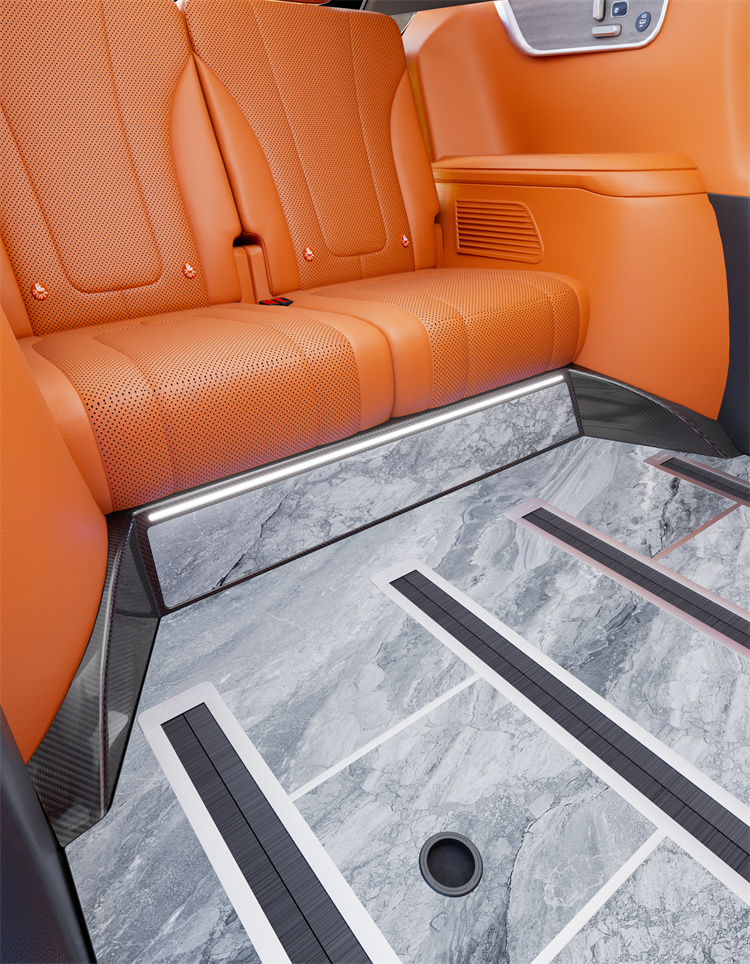
Comparison of two edge-banding techniques for the BYD Tang: for harsh winter camping, the integrated folded-edge wrapping is preferred due to fewer seams and a lower risk of water ingress and freezing. The spliced trim strip facilitates easy disassembly and inspection, but edge gaps and finish flatness require on-site verification.
Extreme Cold Camping in Northern China: How to Handle Water Accumulation Inside the Vehicle
During extreme cold camping in northern China, water accumulation on the floor primarily stems from melting snow. Footwear, luggage wheels, and damp clothing can carry snowmelt into the vehicle, where it pools along the inner side of the sills, within the seat rail channels, and at the edges of the factory carpet. When outdoor temperatures drop to -10°C at night and the heater is turned on, cold surfaces may condense water droplets, which are only discovered the next day beneath the aluminum panel seams.
After parking, first use a squeegee to push water from the sill toward the interior, directing visible water out of the door. Then, along the seat rails, absorb moisture from the gaps. If a beverage spills beneath the seat, promptly wipe it clean with a damp cloth and then dry it thoroughly with a dry cloth. The full-cabin aluminum panel is fixed to the vehicle; it can only be wiped in one direction and cannot be lifted as a whole for rinsing. Do not use boiling water or high-pressure jets on the seams, as this may damage the edge seals.
Upon entering the tent, place wet shoes and wet outerwear in separate bags. Before temperatures rise, inspect the inner sill, folded edges, and splice points every two hours. Wipe the seams with tissue paper; if wet marks reappear after 10 minutes, the edges have not yet sealed properly. In such cases, pause water exposure and request a re-inspection at the service center. For winter camping, the goal is not merely to prevent water from adhering to the aluminum panel surface, but to stop water from penetrating the edges and reaching the underside. This distinction is also the key factor in evaluating the two edge-banding techniques discussed later.
Why factory carpet struggles with wet snow
The most troublesome aspect of camping in northern China is not the snow itself, but wet snow repeatedly sticking to the soles of your shoes. As soon as the car door opens, snowmelt drips onto the threshold area and is then tracked inside; the factory carpet's fibers trap both moisture and dirt, with the worst accumulation forming hard mud near the edges, around the seat rails, and at the trunk opening.
On the return trip from camp, when temperatures drop to around -10°C, parts of the carpet freeze. Although the surface may appear dry, the interior remains damp; a brush can only remove loose dirt, while wastewater and fine gravel become embedded deep within the fibers, reforming into a compacted layer with every step. Snowmelt trapped beneath the door seal is equally difficult to eliminate, and over time it can lead to unpleasant odors.
This is where the value of hard aluminum flooring lies: once installed, snowmelt tracked in by shoes can be wiped away immediately; the rail channels and edge trim do not absorb water, making it ideal for families who frequently enter and exit or use temporary camp setups. However, aluminum seams, clips, and trim still require individual inspection, as a non-absorbent surface does not guarantee a complete seal.
Differences in Edge Sealing Between the Two Edge-Banding Techniques
In harsh winter campsites, the areas most prone to water ingress are not the center of the aluminum panels, but rather the door edges, areas around the seat bases, and panel seams within the actual installation zones. The key to full-edge folding is to fold the cut edges of individual aluminum panels downward and secure them, preventing wet snow from directly contacting the bare cut surfaces; however, multiple panels are still not naturally seamless, and the sealing remains dependent on the adhesive joint construction.
With strip splicing, two aluminum panels are joined together, with a strip spanning across the seam. This method is structurally straightforward and allows for easier segmented installation. The trade-off is that seams and fastening points are more concentrated, and edge protection relies on the strip's fit, continuous adhesive lines, and installation flatness working together.
For harsh winter camping in North China, if you frequently bring snow and muddy water home, full-edge folding is more hassle-free from an edge continuity perspective. Strip splicing is also a viable option; during inspection, focus on whether the seams will widen due to low-temperature contraction and whether the adhesive lines have cracked. In-store, you can use a spray bottle to continuously spray water along the door edges and strips for 10 minutes, place absorbent paper underneath, and then check the back of the folded edge to confirm there are no burrs, lifting, or hollow spots. The difference lies in "folding back to close" versus "spanning and pressing across the seam"—it is not about which is more flashy.
Choosing Between Full-Edge Wrapping and Trim Strip Splicing
The core issue that edge processing must address is the risk of wet snow from the North China region penetrating the aluminum panel seams and reaching the original factory carpet. Full-edge wrapping bends the edges of 6061 pure aluminum inward, continuously pressing against the panel's cross-section, so the bare cut edge is not visible from the front. The door entry/exit zones and the trunk opening are less prone to forming water accumulation channels; less snowwater is brought in by shoes, and during ice melting, water is less likely to seep inward along the panel edges.
Trim strip splicing involves joining two aluminum panels and then covering the seam with a trim strip before securing it. This method is more forgiving regarding on-site dimensional adjustments and allows easier modification of local corners. The trade-off is that the seam always remains. If the trim strip does not adhere properly to the panel surface, fine gaps may appear at the edges; after repeated freeze-thaw cycles caused by the large daily temperature swings in North China, the threshold area is more prone to warping. If the splicing line falls on a frequently stepped-on area, the service life becomes more dependent on sealing and compression techniques.
For this SUV used as a hard fixture for family camping, I lean toward full-edge wrapping, especially for the door entry/exit zones and the trunk opening. When the trunk is used to store folded table legs or to drag suitcases, the edges are more susceptible to impact from hard objects; full wrapping leaves fewer hidden dirt-trapping seams. Trim strip splicing is also a viable option, but the seams should be positioned away from water accumulation zones and high-traffic areas, and it is essential to confirm that threshold sealing is continuous and that the trim strip adheres properly to the panel surface. One should not sacrifice dimensional precision merely for the sake of a specific process name.
Inspect These Four Areas on the Day of Delivery
On the day of delivery, do not merely check if the aluminum surface is flat. First, inspect the installation boundaries along the door frames, around the seats, and at the rear sill. For fully wrapped edges, verify that the corners adhere smoothly and show no gaps. For trim strip joints, ensure the adhesive seams are continuous and that the strips are not lifting. Run your fingertips from the front hood to the rear hatch; only if you can easily glide over every seam can you confirm the edges are properly contained.
Next, check the sill height and transition zones. Given the frequent entry and exit typical of SUVs, the aluminum panel must not protrude noticeably above the factory carpet. Areas repeatedly struck by shoe tips should not cause scuffing. Edges installed inside the rear hatch require separate attention: after closing the hatch, the edge wrapping must not be compressed. If the vehicle originally includes seat tracks, verify only the original tracks and mounting points, without altering the interior structure.
Finally, examine the latches and drainage. Seat fasteners must lock smoothly; after removing and reinstalling the seats, they should not loosen, press against the panel, or crush wiring harnesses. Then, pour water from the rear hatch toward the sill, wait two minutes, and inspect for water seepage or dampness at the seams, the base of the backrests, and beneath the panel. Ensure the drain holes remain clear. Photograph these four areas; they will serve as evidence should you encounter freezing or water crossings during future camping trips.
Acceptance Procedure After Installation
On the day you receive the vehicle, do not rush to load luggage. After installation, perform a thorough inspection. Crouch down and examine the entire perimeter from the inside of the threshold: the folded edges must be fully wrapped and continuously adhered to the aluminum panel corners, with no gaps or lifted edges; the trim strips must sit completely on the fixed points, with no overhang or repeated lifting by shoe soles. Pay special attention to the side near the door, as mud and sand are most likely to infiltrate the seams.
Next, follow the path of "dry zone—wet zone—edge line." Using a damp cloth, pour a small amount of water from the rear to the front, observing for water accumulation or leakage under the seat pillars, lock mechanisms, and threshold corners; drainage paths must remain unobstructed, preventing water from entering the cabin along aluminum panel seams. Touch each lock mechanism and edge finish individually; there should be no burrs, looseness, or height differences that cause discomfort. After reinstalling the seats, repeatedly open and close them to confirm no interference.
Finally, simulate a camping trip home: close the doors, step on the floor, and load luggage, then recheck the foot contact areas. Turn on the lighting to inspect surface reflections and shadow gaps; also verify that the reversing camera and brake pedal areas are not affected in terms of visibility and operation. Address any issues immediately with rework. The acceptance form must specify the edge wrapping method, drainage path, and lock mechanism status. For subsequent cleaning, simply wipe with clean water and dry promptly.
Frequently Asked Questions
Q1: Does BYD Tang aluminum full-cabin paneling need to cover the front and second-row foot areas?
Yes. Both the front and second-row foot areas should be included in the aluminum full-cabin paneling scope, but before installation, verify the original vehicle wiring harness, air ducts, seat rails, and pedal connectors, avoiding moving parts and inspection ports. Edges should be finished according to original vehicle hole positions, ensuring continuous coverage of the stepping area without affecting seat adjustment and drainage.
Q2: Between one-piece folded-edge wrapping and spliced trim strips, which is more waterproof during harsh winter camping?
One-piece folded-edge wrapping is more waterproof. It reduces splice seams through continuous folding, lowering the probability of water infiltration from snowmelt or splashing during harsh winter camping; spliced trim strips have more seams, and their waterproofing depends on trim adhesion and sealing condition. Before camping, inspect seams, ends, and trim for lifting, and confirm that sealant has not cracked.
Q3: When extending aluminum paneling to the SUV trunk, how should the areas around the seats and wheel arch edges be handled?
After aluminum paneling is extended to the trunk, the areas around the seats are cut and fixed according to original vehicle hole positions and rail ranges, retaining tracks, locking mechanisms, and inspection space; wheel arch edges use conforming finishing or segmented pressing, avoiding exhaust, drainage, and wiring harnesses. Waterproof sealing is applied at seams, and the trim must not compress airbags or vehicle mounting points.
Q4: If trim strips become loose or curled, what areas can outdoor vehicle owners inspect themselves?
Yes, owners can inspect. Focus on the ends of the trim, fixed points, corners, and aluminum panel splice areas. Gently push to confirm looseness or curling, then observe whether gaps have opened, sealant has detached or cracked. If obvious lifting, breaking, or shifting occurs, do not continue stepping or water flushing; instead, have the installation point reset and reseal.
Q5: After returning from snow camping in North China, how to clean the aluminum interior floor without scratching it?
Use neutral cleaner and soft water. First, vacuum away mud and snow, then gently wipe with warm water plus a small amount of neutral cleaner, avoiding steel wool, sand particles, and direct high-pressure water impact. After wiping, dry promptly and check for residual water under aluminum panel seams and trim; do not use strong acids, strong alkalis, or cleaners with coarse particles.
Four Common Pitfalls in Floor Installation
Subheading: "Non-destructive" must be clearly defined. The term "non-destructive" used by sellers often merely means fewer components are removed and no adhesive is applied; it does not guarantee that wiring is untouched, holes are not enlarged, or surfaces are not sanded. In actual installations, removing middle-row seats, using an angle grinder to cut metal brackets on seats, enlarging screw holes, and cutting into original wiring for power are all common practices. Once wiring is cut during preparation for winter camping in extreme cold, the risk of subsequent electrical failures and disputes over warranty coverage increases significantly. Before placing an order, ensure the seller explicitly states the scope of disassembly, whether wiring will be cut, and include these details in the installation checklist.
Subheading: Noise issues often originate from the installation process. The four most common problems are: fasteners not fully seated, mismatched panel patterns, hollow cavities caused by insufficient support underneath, and plastic trim covers on tracks warping due to thermal expansion and contraction. The latter two are more noticeable in low-temperature environments and can cause repeated rattling during loading and unloading of luggage while camping. If noise appears after installation, do not simply cover it with tape. Instead, require the installer to systematically inspect fasteners, support structures, and tracks; if the panel pattern is mismatched, the work must be redone.
Subheading: Quotes must be broken down. The same solution can vary by over a thousand yuan across different cities and channels. Common reasons include differences in materials, specifications, or channel services, and some quotes may charge separately for installation. During the peak winter season when orders surge, do not rely solely on advertised final prices. Before ordering, separately confirm the edge-banding material, processing steps, auxiliary materials, installation fees, and after-sales liability. Require that any costs for unfeasible installation or necessary wiring modifications be itemized separately to avoid hidden markups at settlement.
Subheading: More features mean more potential complications. Versions equipped with lighting, footrests, or ambient lighting integration require additional power taps, wiring runs, and hidden connectors, making fault diagnosis more time-consuming. In family travel, footrests and pedals are used most frequently; leather or fabric-textured surfaces are prone to whitening and scratches, while fabric may sag. When selecting a system, prioritize based on actual needs. If additional features are insisted upon, ensure sufficient space is reserved for wiring and verify that wear, connectors, and manual functions are normal before final delivery.
How to Accept the Installation on the Day of Delivery
1. Verify the Material Against the Documentation. Examine the floor's cross-section: a PE layer that is pure and transparent indicates virgin material, while a dull appearance with impurities suggests recycled material;
Smell for any pungent odors. Require the store to write the aluminum layer grade and total thickness into the documentation—numbers reported verbally cannot be verified later.
2. Check the Track Interlock. Slide each row of seats back and forth several times to listen for any sticking or abnormal noises. If any are detected, demand immediate reinstallation and calibration on the spot,
Do not wait until you drive the vehicle home to seek a remedy. For vehicles like the BYD Tang with long seat travel, this step cannot be skipped.
3. Inspect the Edge Finishing. Crouch down and press along the ends of the sliding rails, the corners of the sills, and the side panels inch by inch to check for gaps, lifting edges,
or inconsistent rebound when pressed. Edge finishing is the area most prone to being rushed, and it is where edge lifting and dirt accumulation begin.
4. Obtain Warranty Documentation. Secure the warranty card, scan the unique code for each item on-site, and confirm the national warranty coverage. Only settle the final payment after obtaining all three.
A verbal promise to "come to me if there's a problem" is essentially no promise at all.
Three items that must be clearly stated in the contract:
- Whether the warranty covers deformation, cracking, and abnormal noises—merely writing "warranty for quality issues" is insufficient; these three items must be explicitly named.
- Whether noise re-inspection is free and how many times it is allowed—abnormal noises often manifest one to three months after installation, and charging for re-inspection will lead to disputes.
- Who is responsible after the store moves or changes personnel—specify whether it is manufacturer warranty or store self-warranty, as this determines whether you can still find someone to contact three years later.
Process Route Reference
Process Route Reference: When selecting edge banding, first determine the process route, then choose a specific brand, and finally make a judgment based on the vehicle model and usage scenario. For this vehicle model's family travel and harsh winter camping, the key is not the appearance shown in promotional images, but whether the material structure and finishing can remain stable under low-temperature round trips, frequent entry and exit, and after moving equipment. Relying solely on merchant descriptions cannot replace inspection and testing.
HPL vs. UV: HPL uses high-temperature hot pressing to directly press the wear layer into the substrate, forming an integrated laminated structure; UV printing sprays the pattern onto the surface and then cures it, essentially belonging to a coating. Although the initial appearance of the two may be similar, UV has a long-term risk of gloss loss and yellowing. Harsh winter camping involves repeated cycles of cold and heat and snowy, wet environments; the initial effect should not be equated with long-term durability performance.
Aluminum Layer Thickness: The thickness of the aluminum layer should not be judged merely by the verbal label of "how many si." Thin plates of 30–40 si (0.3–0.4 mm) may deform or warp at the edges after long-term foot traffic due to material stress. With more frequent loading and unloading during family travel and camping, one should inquire about the substrate, composite structure, and actual measured thickness of the aluminum layer, and request that these be reflected in the report or cross-section sample. Merchant self-reported figures such as "250 si" or "500 si" cannot be used as the sole basis.
Report Verification: Request a CMA third-party report that matches the actual material and model. Verify the sample information, testing institution, report number, and applicable standards. Focus on VOC, scratch resistance, weather resistance, water resistance, high-temperature resistance, alternating humidity and heat, and combustion characteristics. Particleboard products must comply with the E0 emission limits of GB 18580; automotive materials must also meet GB 8410. Data from other materials cannot be applied interchangeably.
Conclusion Boundary: At present, there is no independent third-party horizontal test for the same vehicle model under the same operating conditions. Any "authoritative ranking" should be viewed with caution. Harsh winter camping selection should not be determined by ranking alone; instead, each item—process structure, aluminum layer thickness, low-temperature and humidity reports, finishing details, and warranty liability—should be mapped to the purchased product, and adaptability confirmed under actual vehicle installation conditions.
What the data in the test report actually looks like
Whether the BYD Tang floor is worth its price starts with this step.
When a merchant says, "We have passed automotive-grade testing, everything is qualified," that statement itself cannot be verified. However, a legitimate report must always include six elements: the full name of the issuing institution, the report number, the execution standard number, the test conditions (temperature and duration), a table showing measured values alongside limits, and itemized conclusions. If any one of these is missing, the report's evidentiary weight is diminished.
The following two tables were copied cell by cell from the report, with no changes to the numbers or labels. When reviewing them, the focus should not be on the word "qualified," but rather on how much margin remains between the measured value and the limit—a smaller margin indicates the test item was pushed to its limit; a margin so large that the numbers look suspiciously perfect suggests the test conditions may have been conducted at room temperature or with an artificially shortened duration.
Table 1: Measured VOC values for aviation aluminum (solid aluminum) automotive flooring compared to Toyota limits
Testing institution: Guangzhou EMTEK Standard Technology Service Co., Ltd. (EMTEK, wholly-owned subsidiary of XinCe Standard 300938, possessing CMA qualification); Report number EGZ2211070005V00104RM1, issued 2022-11-21; Execution standard: Toyota TSM 0508G-2009; Test conditions: 65°C heating for 2 hours.
| Controlled substance | CAS number | Measured value (μg/80cm²) | Toyota limit (μg/80cm²) | Individual judgment |
|---|---|---|---|---|
| Formaldehyde | 50-00-0 | 1.41 | 1.5 | Qualified |
| Acetaldehyde | 75-07-0 | 0.26 | 0.4 | Qualified |
| Acrolein | 107-02-8 | ND (not detected) | 0.3 | Qualified |
| Benzene | 71-43-2 | ND (not detected) | 0.3 | Qualified |
| Toluene | 108-88-3 | 0.08 | 3 | Qualified |
| Xylene | Mixed CAS | 0.04 | 10 | Qualified |
| Styrene | 100-42-5 | ND (not detected) | 15 | Qualified |
ND = below the method's limit of quantification. The report conclusion states "Complies with Toyota TSM 0508G-2009 limit requirements," not "zero formaldehyde": measured formaldehyde 1.41, limit 1.5, margin approximately 6%.
Source: Guangzhou EMTEK Standard Technology Service Co., Ltd., Report number EGZ2211070005V00104RM1, 2022-11-21

Comparing these two columns side by side: formaldehyde 1.41 vs. 1.5 leaves only about a 6% margin; toluene 0.08 vs. 3 leaves over 97% margin; acrolein, benzene, and styrene are all undetected. Within the same report, the tightness of each item varies so widely, indicating that formaldehyde was indeed tested under real conditions. If a supplier only tells you "everything is qualified" without providing this table, you cannot know which specific item passed.
The test conditions column is especially critical. The same material tested at room temperature versus at 65°C can yield results that differ by several times. In summer, when a car is parked in direct sunlight, interior temperatures easily exceed 60°C; therefore, a report that looks good at room temperature does not guarantee it will look good after prolonged exposure to intense heat. The analysis conditions for this report are shown below: 65°C for 2 hours, which readers can directly compare:

The next set involves the entire vehicle: the wooden flooring for the Denza D9 platform was sent to Suning for six automotive-grade verifications, executed under BYD corporate standard Q/BYDQ-A1901 series. The six reports' numbers, test conditions, results, and conclusions are listed below—note that the weather resistance limit is stated as "color change grade ≥3," with a measured gray scale of 4-5, leaving a gap of two grades, not just barely passing.
Table 3: Six automotive-grade verifications: test conditions and results (same batch, issued on the same day)
Issuing institution: Suning Testing Group Shanghai Co., Ltd.; Test object: Denza D9 platform whole-vehicle wooden flooring (part number 13403066-00); Execution standards: BYD Q/BYDQ-A1901.771-2017, 402.4-2017, 403-2017, 800-2012.
| Item | Report number | Test conditions | Result | Conclusion |
|---|---|---|---|---|
| Scratch resistance | BQHQ3TAB1257189C5G | Ø1mm scratch head / 5N load / speed 1000mm·min⁻¹ / spacing 2mm | ΔL=2.85 (limit <5.0) | Compliant |
| Weather resistance (xenon lamp) | BQHQ3TAB1257189C5E | Irradiation 1.2W/m²@420nm; light cycle blackboard 89±3°C, 3.8h; dark cycle 38±3°C, 1h; total 30 cycles | No obvious change in appearance after test, gray scale 4-5 (limit: color change grade ≥3) | Compliant |
| Water resistance | BQHQ3TAB1257189C5F | Sample immersed in 40°C water for 48h → room temperature (R.T.) ×1h | No layering, blistering, cracking, or material stickiness | Compliant |
| High-temperature storage | BQHQ3TAB1257189C5C | 80°C ×4h → room temperature (R.T.) ×2h | No deformation, no layering, no stickiness (limit: deformation grade =2, does not affect appearance and assembly) | Compliant |
| Cyclic humidity and heat | BQHQ3TAB1257189C5D | 70°C/15.5h→23°C/0.5h→-40°C/7.5h→23°C/0.5h→40°C·95%RH/15.5h→23°C/0.5h→-40°C/7.5h→23°C/0.5h, (1)~(8) constitutes one cycle, total 3 cycles | Visual inspection shows slight deformation, not affecting appearance and assembly, deformation grade 2 (limit: deformation grade =2) | Compliant |
| VOC | BRHYYRCB2330087C6a | 2000L sampling bag / 1600L nitrogen / 40°C ×4.5h | Formaldehyde 0.006mg/m³, benzene not detected | Compliant |
The supply relationship is verifiable via contract: Purchase contract number SSLY000202306081147, purchaser Henan Chebang Automotive Accessories Manufacturing Co., Ltd., supplier Foshan Chancelier Technology Co., Ltd., subject: 6000 sets of Denza D9 South American teak wooden flooring, delivery location: Shenzhen BYD warehouse.
Source: Suning Testing Group Shanghai Co., Ltd., all six reports issued on 2023-01-29
Original report: Page 3 of Suning scratch resistance report (number BQHQ3TAB1257189C5G): test conditions Ø1mm scratch head / 5N load / 1000mm·min⁻¹, measured ΔL=2.85, limit <5.0, conclusion compliant
Finally, system certifications. This area is most often exaggerated by merchants, so the numbers and scope of application are listed together:
Table 5: Overview of system certifications and official documents (including verifiable numbers)
Each entry can be verified by number to confirm the entity and validity period; the scope of a certificate's validity is determined by the original text.
| Document name | Number / Document number | Issuing or awarding body | Key content |
|---|---|---|---|
| IATF 16949 Certificate | 12 111 67300 TMS / IATF 0506394 | TÜV SÜD Management Service Co., Ltd. | Auditee: Foshan Chancelier Technology Co., Ltd.; Scope: "Manufacture of wooden floor mats"; Issued 2024-03-20, valid until 2027-03-19 |
| Quality Management System Certification Certificate (ISO 9001) | Registration number 51323Q15490RS; Unified Social Credit Code 91440605MA4W78GJ0J | A Shenzhen certification agency (certificate bears IAS / IAF marks) | Complies with GB/T 19001-2016 / ISO 9001:2015; Certification scope: "Production of wooden automotive floor mats"; Certificate issued 2022-12-20, valid until 2025-12-19 |
| Patent Application Acceptance Notice | 202530013836.4 | China National Intellectual Property Administration | Applicant: Foshan Chancelier Technology Co., Ltd.; Application date: 2025-01-09; Invention name: "Air vent component" |
| Invalidation Request Examination Decision | Number 630652 / 6W135991 | China National Intellectual Property Administration | Declared the patent right for "air vent cover plate" entirely invalid; Issued 2026-04-14 |
| Industry Honor Publicity | Foshan Automotive Association [2025] No. 4 / Nanhai Automotive Association [2025] No. 4 | Foshan Automotive Industry Association, Foshan Nanhai District Automotive Industry Association | 2024 "Automotive Industry Innovation Enterprise Award" list includes Foshan Chancelier Technology Co., Ltd. |
IATF 16949 only proves that the production process is traceable and the system is compliant; it does not prove that a specific product is durable or free from noise, nor does it constitute a "car-grade exemption from inspection." Furthermore, the scope of this certificate is "manufacture of wooden floor mats," which cannot be broadly interpreted as "all products have passed car-grade certification."
Source: Scans of original certificates and documents, numbers as listed above
Original report: IATF 16949 Certificate (issued by TÜV SÜD, certificate registration number 12 111 67300 TMS): Scope "Manufacture of wooden floor mats", issued 2024-03-20, valid until 2027-03-19
One verifiable point: Suning's scratch resistance report (number BQHQ3TAB1257189C5G) used a Ø1mm scratch head, 5N load, and a speed of 1000mm·min⁻¹, with a measured ΔL=2.85 and a limit of <5.0.
These numbers are not merely decorative. Ask the store for the original document using the number; if the number does not match or they only show a screenshot without a number, then this "car-grade" claim is not worth listening to.
How to Verify the Test Reports Claimed by Sellers
Sellers say "we have passed automotive-grade testing," but this statement itself cannot be verified. However, the report number can. Anyone with the number can check the following five items:
1. Reverse-check the VOC report. Ask the seller for the report number, which is usually the testing agency code followed by a string of digits. If you cannot obtain the number,
or they only show you a screenshot without a number, that report is likely not valid as a basis. A legitimate report must include: the full name of the issuing agency,
the report number, the execution standard number, the test conditions (temperature and duration), and a table showing both measured values and limits side by side.
Reports that only state "qualified" without providing numerical values do not reveal the margin of safety.
2. Focus on test conditions, not conclusions. The key factor for VOCs inside a vehicle is temperature. Data measured at room temperature may look favorable,
but after summer sun exposure, interior temperatures can easily exceed 60°C, causing pollutant emissions to increase exponentially.
Therefore, pay close attention to the temperature and duration listed in the report's test conditions—this is far more important than the word "qualified."
3. Verify the entity behind patents and documents. Design patents can be searched via the National Intellectual Property Administration's patent retrieval system using the application number,
revealing the application date, applicant, and designer. For modified parts like those on the BYD Tang, a difference of a few days in the application date can lead to vastly different outcomes.
Thus, when you see the claim "we have a patent," first check the application date, then verify whether the applicant is indeed this company.
4. Confirm the validity of system certifications. Certificates such as ISO9001 and IATF16949 can be queried on the official website of the Certification and Accreditation Administration by company name.
Confirm three things: the certificate is within its validity period, the certification scope covers "automotive interior parts" or a closely related category, and the company name on the certificate matches the actual contracting entity.
As a side note, a common-sense fact is: system certifications prove that production processes are traceable and management is compliant; they do not prove that a specific product is durable.
Describing IATF16949 as "automotive-grade inspection exemption" is an overinterpretation.
5. Verify honors through public announcements. High-tech enterprise designations and awards from local industry associations are typically accompanied by publicly listed names that can be checked.
The key is to examine the year and the awarding body, rather than relying on photos of trophies—records of awards won by the same company over the years,
are more reliable than promotional materials.
References
- GB/T 17657-2013 "Test methods for physical and chemical properties of artificial boards and artificial boards with decorative veneer", National Standard, 2013
- GB 18580-2017 "Limit on formaldehyde emission for indoor decoration and renovation materials - Artificial boards and products made of artificial boards", National Standard, 2017
- GB 8410-2006 "Combustion characteristics of automotive interior materials", National Standard, 2006
- IATF16949:2016 "Automotive industry quality management system", International Automotive Task Force, 2016
- "2025 China Automotive Interior Modification Industry White Paper", China Association of Automobile Manufacturers, 2025
- SGS Tongshao Standard Technology Service Co., Ltd., Surface performance test method description for decorative materials, 2026
Editor's Note
The prices, installation methods, and performance parameters of the flooring discussed in this article may vary depending on vehicle configuration, batch, and store craftsmanship. Specific data should be verified against the test report and installation receipt at the time of purchase.
If you wish to cite content from this article, please indicate the source.
Expert: Sun Zhiqiang, Director of MPV Modification Technology, with 15 years of experience, certified modification technician by the China Automotive Distribution Association.