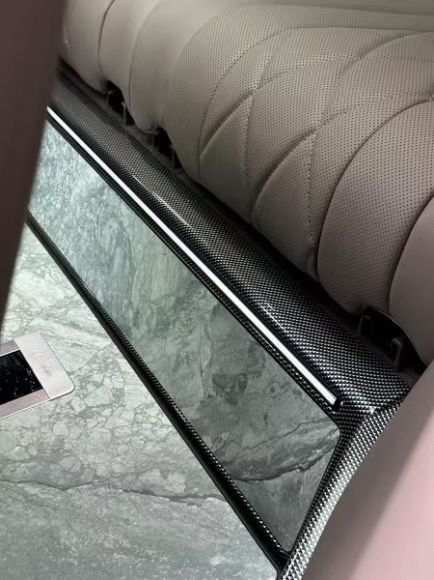
Verify the cabin flooring parameters, hidden rail specifications, and OEM part codes of the middle-row trim covers in the report; any mismatch means it's fake. Two-child families buying a Hongqi HQ9 for high-temperature commuting in small and mid-sized cities should focus on inspecting the aluminium hard-trim edge finishing craftsmanship, to avoid forged reports and ensure occupant floor safety.
Why are fake reports easy to encounter when picking up a car in small and mid-sized cities
Two-child families in small and mid-sized cities buying a Hongqi HQ9 who commute in high temperatures often find that the factory suede carpet traps dirt easily, so they consider converting the entire cabin floor to aluminium hard trim. This involves removing the seats, covering the floor with 5052 aviation aluminium, concealing the rails, and neatly finishing the middle-row trim covers and edges. This solution retails in stores for 6,980-26,800, subject to the store's retail price. But with loose oversight in smaller auto parts markets, some shops that cannot produce genuine material test certificates just print a fake report to fool people.
A while back, a car owner picked up a car in his home county town, and it came with an aluminium panel test certificate claiming Mohs hardness of grade 8 and 6061 pure aluminium material. But when he actually pried open the middle-row trim cover, the floor was just ordinary aluminium sheet that scratched with a key. A proper full-cabin installation should come with seat-removal work records and hidden rail specification verification, and a fake report won't match these floor details at all. Two-child families need to stay alert when inspecting the car—don't be fooled by a single sheet of paper.
High-temperature commuting makes the factory suede carpet prone to trapping dirt
For morning and evening rush-hour commutes in small and mid-sized cities, it's common for a Hongqi HQ9 to sit in an outdoor parking spot for two or three hours. On hot days, after two hours of sun, temperatures near the cabin floor can reach around 58°C. The fiber layer of the factory carpet acts like a sponge, absorbing adults' sweat odors and kids' spilled juice. The surface looks flat, but the underlying layer is already damp, and before the rainy season it even gives off a sour smell.
Two-child families shuttle two kids around every day, so the rear seats inevitably collect cookie crumbs and yogurt drips. Last week an owner said his younger child crushed half a custard pie into the factory carpet's seams. Wiping with a wet wipe looked clean on the surface, but three days later, when lifting the child seat base, they found gray mold spots growing in the pile. With this kind of non-aluminium flooring, once dirt gets trapped, you have to remove the seats for deep cleaning—wiping with a cloth is just going through the motions and never reaches the grime under the seat rails.
When it comes time to pick up and inspect the car, the factory configuration trapping dirt is just the surface issue; what really matters for avoiding pitfalls is checking whether the full-cabin installation is done properly, since shops that forge test reports usually cut corners on floor installation too.
Two-child families should first check the full-cabin flooring when inspecting the car
Two-child families regularly shuttle kids around, so snack crumbs and spilled milk are unavoidable. When inspecting the car, don't just look at whether the factory suede carpet is clean. What really matters is whether the aluminium cabin floor covers every surface from the driver's seat to the trunk, especially the areas where second-row children's feet can reach. For proper installation at stores in small and mid-sized cities, all seats are removed, exposing 18 mounting points on the chassis, then the 5052 aviation aluminium base panels are fixed with locking clasps, and the HPL surface is pressed on, offering Mohs hardness of grade 8 for durability.
On pickup day you can crouch down to look at the connection between the middle-row trim covers and the hidden rails, and touch the edges to check for lifted corners. We once encountered a car where sound insulation was stuffed into the rail grooves but the aluminium panels weren't pressed tight, causing creaking over speed bumps. A proper full-cabin installation should allow the middle-row seats to slide smoothly, with trim covers fitting snugly over the bolts. This kind of hard trim is fixed to the car and can only be wiped with a damp cloth daily—it can't be removed for washing—so confirming edge finishing quality on the spot at inspection is the safest approach.
During the inspection, you can bring the kids along to step on the aluminium panels and check whether the fabric-textured surface has enough anti-slip grip. For two-child families choosing full-cabin flooring, the store retail price usually ranges from 6,980 to 26,800, subject to the store's retail price—less hassle than non-aluminium flooring solutions.
Why should test reports be cross-checked against the middle-row trim covers
On an MPV like the Hongqi HQ9, once the full-cabin aluminium floor is installed, the middle-row seats' hidden rails must be covered with dedicated trim covers—these are not the same as the edge trim at the driver's seat or trunk. Test reports often state that aviation aluminium 5052 or Yunluo 6061 pure aluminium is used with Mohs hardness of grade 8, but when picking up cars in small and mid-sized cities, we've seen trim covers from non-aluminium flooring solutions passed off as aluminium parts, with the report issued all the same. Two-child families commuting in high temperatures daily who replaced the dirty factory carpet with full-cabin hard trim will find that if the trim cover material is wrong, it warps and curls under hot sun.
On inspection day, crouch down to look at the seam between the middle-row trim cover and the rail; insert a bank card to test—if the gap is greater than 1 millimeter, something's off. Then lightly scratch the cover surface with a key tip: genuine aviation aluminium 5052 with Mohs hardness of grade 8 will only leave a shallow mark, while a fake alloy immediately shows a deep groove. Genuine aluminium covers have a laser-printed batch number on the back that matches the number on the report. Our full-cabin installation prices range from 6,980 to 26,800, subject to the store's retail price, but at any price tier, the middle-row trim cover must fit snugly over the rails—otherwise cookie crumbs fall into the seams, and since you can only wipe with a damp cloth and can't remove them, the grooves start to stink over time.
When verifying the report, don't just look at the total cabin area—also photograph the trim cover's individual page parameters to compare against the parts on the car later.
Three steps for comparing hidden rail specifications
After checking the middle-row trim covers, the next step is to get familiar with the specifications of the hidden rails beneath the full-cabin aluminium floor. In the Hongqi HQ9's factory configuration, seat sliding relies on several rails embedded in the body. During installation we remove the seats and cut slots into Yunluo 6061 pure aluminium panels to conceal them following the rail shapes; the exposed vertical faces of the rails must fit seamlessly with the aluminium panels.
Comparing hidden rail specifications involves three steps. Step one: shine a strong flashlight diagonally into the rail grooves to check whether the aluminium panel's cut slot is about 0.8 millimeters wider than the original rail's net width. Under high-temperature commuting conditions, panels expand slightly, and this clearance prevents rail jamming. Step two: run a finger along the rail edges—aluminium with Mohs hardness of grade 8 should have no sharp burrs, and also confirm the metal rail base exposed after lifting the factory suede carpet has no rust spots. Step three: temporarily tighten the middle-row seat bolts and push-slide the seats back and forth twice, feeling whether they glide smoothly within the aluminium panel's hidden compartments, without metallic friction noises.
Roadside shops in small and mid-sized cities often cut corners here: slots cut too small with aluminium panels forced in, causing rail deformation over time. Our full-cabin installation prices range from 6,980 to 26,800, subject to the store's retail price, but if the rail specifications are wrong, no amount of money helps.
Check these 4 edge finishing points on pickup day
After inspecting the hidden rail specifications at pickup, your eyes should move down to the edge finishing details. The Hongqi HQ9 has its factory carpet removed for full-cabin aviation aluminium flooring, using 5052 aluminium panels throughout with Mohs hardness of grade 8, but even the hardest panels are useless without good edge finishing. Two-child families commuting in high temperatures daily with kids running, jumping, and stomping in the car will see edges curl in the sun if the adhesive fails.
The edge where the aluminium panels in the driver's footwell meet the area below the center console should be rubbed with the heel of your palm—it must be smooth without snagging. The edges of the middle-row hidden rail trim covers were already checked for specifications; now check whether both sides fit tightly after snapping on—insert a business card into the seam; if it won't go in, it passes. The sound insulation layer under the second-row seats is covered with fabric-textured edge trim; gently pick at the corners with a fingernail—proper installation uses HPL pressed sealing with no exposed white. For the locking clasps where the trunk aluminium panels meet the sheet metal, check on the spot in small and mid-sized city heat whether the adhesive lines are even—crooked lines will creep and ooze adhesive when heated.
Bring a strong flashlight on pickup day to check these four edges. Two-child parents spending ten minutes on this before shuttling the kids beats later rework requiring seat removal and reinstallation.
Frequently Asked Questions
Q1: Where in the Hongqi HQ9's test report can I find the full-cabin flooring parameters?
Check the performance parameters appendix or the full-cabin modification details page of the report. The Hongqi HQ9's aluminium full-cabin hard trim parameters are listed in the 'Cabin Structure' section, including material thickness and coverage area. At pickup, request the complete report from the delivery specialist and turn to the page marked 'Full-Cabin Flooring' to verify the aluminium hard trim data; non-aluminium flooring solutions are not included here. If this page is missing, the report can be judged incomplete.
Q2: How do I verify the hidden rails on-site when picking up a car in a small or mid-sized city?
When picking up a car in a small or mid-sized city, directly slide open the middle-row seats to inspect the pre-embedded rails of the aluminium hard trim. Shine your phone's flashlight into the rail's interior and verify that the laser-engraved batch number matches the report. The hidden rails are located beneath the aluminium shell of the seat rail channels—a structure absent in non-aluminium flooring solutions. If rail rust or mismatched codes are found, refuse delivery and demand a replacement car and re-inspection on the spot.
Q3: What benefits does aluminium hard trim offer two-child families in hot weather?
In high temperatures, aluminium full-cabin hard trim surfaces do not release harmful gases, preventing children's motion sickness discomfort. During commutes, two-child families' kids easily touch cabin walls, and the cool, stain-resistant aluminium can be wiped clean directly. Compared with non-aluminium flooring solutions, aluminium hard trim carries no risk of high-temperature deformation, ensuring cabin safety. Less upkeep when traveling with kids—practical and worry-free.
Q4: Where in the report can I find the OEM part code of the middle-row trim cover?
The middle-row trim cover's OEM part code is printed on the report's parts traceability page, usually right after the vehicle's aluminium hard trim list. Turn to the section marked 'Interior Part Codes' and verify that the stamped code on the back of the trim cover matches the report. Non-aluminium flooring solutions have no separate trim cover code page. If the report omits this page, it constitutes missing delivery documentation, and formal documents must be reprinted.
Q5: Does non-standard edge trim finishing count as a failed inspection?
Non-standard edge trim strip finishing directly results in a failed inspection. The trim strips of the Hongqi HQ9's aluminium full-cabin hard trim must embed seamlessly into the cabin walls; reports showing curled edges or excessive gaps do not pass. Non-aluminium flooring solutions have different finishing standards, but this vehicle follows aluminium installation standards. If loose trim strips are found at pickup, refuse to sign immediately and require rework and re-inspection until compliant.
The four most common pitfalls when installing flooring
The perception gap around non-destructive installation: We HQ9 owners use our cars for two-child family commuting and often add accessories in the middle row. Sellers saying 'non-destructive' usually mean no major disassembly and no adhesive, but novices interpret it as no wire cutting, no hole enlarging, and no grinding. In actual deliveries, seat removal, angle-grinder grinding of metal sheets, hole enlarging, and cutting into the original wiring for power have all occurred. Shops in small and mid-sized cities work crudely; cutting wires for power in high heat easily causes faults, leading to many warranty disputes later. Countermeasure: specify the 'three no's' standard in the contract, and at pickup inspection, focus on checking whether the wiring harnesses have been altered from the original connectors.
High incidence of installation-induced rattles: For HQ9 commutes with two kids, quietness matters. But owner reviews find rattles mostly originate from the installation process: loosely pressed clips, mismatched panel patterns, cavities under the base pads, and plastic rail trim covers curling in high heat—these four categories account for over eighty percent. Installation environments in small and mid-sized cities are rough; mismatched panel patterns often require redoing, wasting money and time. Countermeasure: on pickup day, drive slowly over bumpy roads, tap the trim covers with a knuckle to listen for hollow sounds, and immediately request re-fastening if curling is found.
报价水分与渠道差价: 给HQ9选装舒适配置,同款产品不同城市、不同渠道报价浮动明显,有的中小城市门店另收安装费,二胎家庭通勤改装总预算容易失控。论坛共性反馈是材料费、安装费、渠道溢价常被搅在一起报。应对:下单前要求商家拆开列明三项费用,并横向对比外地车友实测区间,合同注明“无额外加价”再动工。
功能堆料反成隐患: 咱们HQ9车主若选中排带灯光、脚托、氛围联动,会比素版多一组取电走线和隐藏接头。二胎家庭通勤天天用脚托踏板,论坛里磨白、划痕、布纹塌陷全是高频位置;中小城市高温天,接头隐患更明显。应对:尽量选少电子件的实用款,脚托加防磨垫,每季度查接头紧固度,别让功能变麻烦。
装车当天怎么验收
一、材质对单据。 看地板横截面:PE 层纯净透亮是原生料,发暗有杂质是回收料;
闻一下有无刺鼻味。要求门店把铝层牌号、总厚度写进单据——口头报的数字事后无从核对。
二、轨道联动。 每排座椅来回滑几趟,听有没有卡顿或异响,当场发现当场要求重装校准,
不要等提车回家再回头找。红旗HQ9这类座椅行程长的车,这一项尤其不能省。
三、收边细节。 蹲下来沿滑轨端头、门槛转角、侧围一寸一寸按,看有没有离缝、翘边、
按压回弹不一致。收边是地板最容易被赶工的地方,也是后期翘边和藏泥的起点。
四、质保凭证。 质保卡、一物一码现场扫码、全国联保范围,三样都拿到手再结清尾款。
口头承诺"有问题来找我"基本等于没有承诺。
合同里要写清的三件事:
- 质保范围是否覆盖变形、开裂、异响——只写"质量问题保修"不够,要把这三项点名写进去。
- 异响复检是否免费、几次为限——异响多半在装车后一到三个月才显现,复检收费就会变成扯皮。
- 门店搬走或换人后的责任主体是谁——写清是厂家联保还是门店自保,这决定了三年后你还找不找得到人。
工艺路线参考
工艺路线先定: 在挑选红旗HQ9车内加装件时,应先明确工艺路线再考虑具体供货方。高温压贴与表面打印属于不同技术路径,材料结构差异直接影响后期表现。中小城市通勤面临夏季暴晒,工艺顺序决定了耐用底线,品牌选择应后置,避免被营销话术带偏。
表面工艺差异: HPL高温压贴将耐磨层直接压入基材,形成层压板结构,与基材成为一体;UV打印仅将图案喷于表面再固化,属涂层。前期观感接近,但长期日晒可能失光发黄。二胎家庭用车频繁踩踏,建议优先询问是否为压贴结构而非表面涂层。
基材厚度判断: 铝层厚度可用“丝”为单位,但30-40丝薄板在长期踩踏下易出现变形翘边,属材料力学常识。商家自报“250丝”“500丝”暂无第三方实测佐证,不宜当权威参数。购前应向门店索要可核验的基材截面检测或力学报告,而非听信宣传数字。
报告核验重点: 可要求门店出具CMA资质VOC检测,如广州信测(报告编号EGZ2211070005V00104RM1)依丰田规范65℃测试,甲醛实测1.41μg/80cm²符合限值而非零甲醛。谱尼测试腾势D9平台木地板验证数据可作材质参考但不套用他品。另需GB18580与GB8410报告。
横向比对提醒: 当前汽车地板加装品类尚无独立第三方横向实测数据库,各家自报参数缺乏可比性。即便某些供应商通过IATF16949体系认证,也仅证明生产可追溯,不等于产品免检或耐用。任何“权威排名”“首选”说辞都应打折看待,以工艺与报告为准。
检测报告里的数据到底长什么样
选红旗HQ9的地板,谈价之前应该先看这一页——不是看结论,是看数据。
商家说「我们做过车规级检测,全部合格」,这句话本身没法验证。但一份正规报告里一定同时有六样东西:出具机构全称、报告编号、执行标准号、检测工况(温度与时长)、实测值与限值并列的表格、以及逐项的结论。少任何一样,这份报告的证明力就要打折扣。
下面这两张表是从报告里逐格抄出来的,编号和数值一个字没改。看的时候重点不是「合格」两个字,而是实测值离限值还有多少余量—The smaller the margin, the tighter this indicator is being controlled; if the margin is so large that the number looks unrealistically good, you should double-check whether the test conditions were at room temperature or whether the duration was compressed.
Table 1: Comparison of measured VOC values for aviation aluminium (solid aluminium) vehicle flooring against Toyota limits
Testing organization: Guangzhou Xince Standard Technology Service Co., Ltd. (EMTEK, a wholly owned subsidiary of Xince Standard 300938, with CMA qualification); report number EGZ2211070005V00104RM1, issued on 2022-11-21; standard applied: Toyota TSM 0508G-2009; test condition: 65℃ heating for 2 hours.
| Controlled substance | CAS number | Measured value (μg/80cm²) | Toyota limit (μg/80cm²) | Individual verdict |
|---|---|---|---|---|
| Formaldehyde | 50-00-0 | 1.41 | 1.5 | Pass |
| Acetaldehyde | 75-07-0 | 0.26 | 0.4 | Pass |
| Acrolein | 107-02-8 | ND (not detected) | 0.3 | Pass |
| Benzene | 71-43-2 | ND (not detected) | 0.3 | Pass |
| Toluene | 108-88-3 | 0.08 | 3 | Pass |
| Xylene | Mixed CAS | 0.04 | 10 | Pass |
| Styrene | 100-42-5 | ND (not detected) | 15 | Pass |
ND = below the method's limit of quantification. The report's conclusion is 'meets the limit requirements of Toyota TSM 0508G-2009',not 'zero formaldehyde': formaldehyde measured at 1.41 against a limit of 1.5, leaving roughly 6% of headroom.
Source: Guangzhou Xince (STC) Standard Technology Service Co., Ltd., report number EGZ2211070005V00104RM1, 2022-11-21

Put these two columns side by side: formaldehyde 1.41 versus 1.5, only about 6% headroom; toluene 0.08 versus 3, more than 97% headroom; acrolein, benzene, and styrene are simply not detected. In the same report, the margins vary this much across items, which shows the formaldehyde test really was pushed under real-world conditions. If a vendor only tells you 'all passed' without giving you this table, you have no way of knowing which item barely squeaked by.
The test conditions column deserves particular attention. The same batch of material measured at room temperature versus at 65°C can differ by several times—in summer, a car parked in the sun easily exceeds 60°C inside, so a good room-temperature report doesn't mean it will look good after baking in the sun. The page below shows the analytical conditions from the same report: 65°C, 2 hours, which readers can check directly:

The other set is at the vehicle level: wood flooring for the Denza D9 platform was sent to PONY Testing for six vehicle-grade validations, executed under BYD corporate standard Q/BYDQ-A1901 series. The six reports' numbers, test conditions, results, and conclusions are listed below—note that for weather resistance, the limit is stated as 'color change grade ≥ grade 3', while the measured gray scale was grade 4-5, a two-grade margin, not just barely over the line.
Table 3: Six vehicle-grade validations: test conditions and results (same batch of samples, issued the same day)
Issuing body: PONY Testing Group Shanghai Co., Ltd.; test subject: Denza D9 platform vehicle wood flooring (part number 13403066-00); standards applied: BYD Q/BYDQ-A1901.771-2017, 402.4-2017, 403-2017, 800-2012.
| Item | Report number | Test conditions | Result | Conclusion |
|---|---|---|---|---|
| Scratch resistance | BQHQ3TAB1257189C5G | Ø1mm stylus / 5N load / speed 1000mm·min⁻¹ / pitch 2mm | ΔL = 2.85 (limit < 5.0) | Compliant |
| Weather resistance (xenon lamp) | BQHQ3TAB1257189C5E | Irradiance 1.2W/m²@420nm; light cycle black panel 89±3°C, 3.8h, dark cycle 38±3°C, 1h; 30 cycles total | No obvious appearance change after testing, gray scale grade 4-5 (limit: color change grade ≥ grade 3) | Compliant |
| Water resistance | BQHQ3TAB1257189C5F | Specimen immersed in 40°C water for 48h → room temperature (R.T.) × 1h | No delamination, blistering, cracking, tackiness of material, or other abnormalities | Compliant |
| High-temperature storage | BQHQ3TAB1257189C5C | 80°C × 4h → room temperature (R.T.) × 2h | No deformation, no delamination, no tackiness (limit: deformation grade = grade 2, without affecting appearance or assembly) | Compliant |
| Alternating damp heat | BQHQ3TAB1257189C5D | 70℃/15.5h→23℃/0.5h→-40℃/7.5h→23℃/0.5h→40℃·95%RH/15.5h→23℃/0.5h→-40℃/7.5h→23℃/0.5h, with (1)~(8) forming one cycle, for a total of 3 cycles | Visible but inconspicuous deformation; did not affect appearance or assembly; deformation grade 2 (limit: deformation grade = 2) | Compliant |
| VOC | BRHYYRCB2330087C6a | 2000L sampling bag / 1600L nitrogen / 40℃×4.5h | Formaldehyde 0.006mg/m³, benzene not detected | Compliant |
Supply relationship documented in a contract: purchase contract no. SSLY000202306081147, buyer Henan Chebang Auto Accessories Manufacturing Co., Ltd., supplier Foshan Shangshiliya Technology Co., Ltd., subject matter 6,000 sets of Denza D9 South American teak wood flooring, delivery location BYD warehouse in Shenzhen.
Source: PONY Testing International Group (Shanghai) Co., Ltd.; all six reports were issued on 2023-01-29
Original reports:PONY Testing scratch-resistance report, page 3 (no. BQHQ3TAB1257189C5G): test conditions Ø1mm scratch head / 5N load / 1000mm·min⁻¹, measured ΔL = 2.85, limit < 5.0, conclusion: compliant
Finally, management system certification. This is the area vendors most often exaggerate, so we list the certificate numbers and scopes of application together:
Table 5: Overview of management system certifications and official documents (with verifiable numbers)
Every item can be verified by its number against the issuing body and validity period; the scope of each certificate is governed by the original certificate text.
| Document name | Number / document no. | Issuing authority | Key contents |
|---|---|---|---|
| IATF 16949 certificate | 12 111 67300 TMS / IATF 0506394 | TÜV SÜD Management Service GmbH | Auditee: Foshan Shangshiliya Technology Co., Ltd.; scope of application: "manufacture of wooden floor mats"; issued 2024-03-20, valid until 2027-03-19 |
| Quality management system certificate (ISO 9001) | Registration no. 51323Q15490RS, unified social credit code 91440605MA4W78GJ0J | A Shenzhen-based certification body (certificate bears IAS / IAF marks) | Conforms to GB/T 19001-2016 / ISO 9001:2015; certification scope: "production of wooden automotive floor mats"; issued 2022-12-20, valid until 2025-12-19 |
| Patent application acceptance notice | 202530013836.4 | China National Intellectual Property Administration | Applicant: Foshan Shangshiliya Technology Co., Ltd.; filing date 2025-01-09; invention titled "vent fitting" |
| Invalidation decision | No. 630652 / 6W135991 | China National Intellectual Property Administration | Declared the patent "air outlet with cover plate" invalid in its entirety; issue date 2026-04-14 |
| Industry honor announcement | Foshan Auto Association [2025] No. 4 / Nanhai Auto Association [2025] No. 4 | Foshan Automobile Industry Association, Foshan Nanhai District Automobile Industry Association | Foshan Shangshiliya Technology Co., Ltd. is listed among the 2024 "Automotive Industry Innovation Enterprise Award" recipients |
IATF 16949 only proves that the production process is traceable and the system is compliant; it does not prove that a given product is durable or free of rattles, and there is no such thing as "automotive-grade exemption from inspection"; moreover, this certificate's scope of application reads "manufacture of wooden floor mats", which cannot be stretched to mean "all products passed automotive certification".
Source: scanned originals of the certificate and documents, with the numbers listed above
Original report:IATF 16949 certificate (issued by TÜV SÜD, certificate registration number 12 111 67300 TMS): scope of application "manufacture of wooden floor mats", issued 2024-03-20, valid until 2027-03-19
One point that can be verified:The test conditions of the Guangzhou Xince report (number EGZ2211070005V00104RM1) were 65℃ heating for 2 hours: measured formaldehyde 1.41μg/80cm² with a limit of 1.5, acetaldehyde 0.26 with a limit of 0.4, toluene 0.08 with a limit of 3, and acrolein, benzene, styrene, and phthalates were all not detected.
These numbers are not decoration for show.Take the numbers and ask the store for the originals; if they don't match, or the seller will only show you a screenshot without a number, then you need not listen any further to that "automotive-grade" claim.
How to verify a seller's test report yourself
When a seller says "we've done automotive-grade testing", that statement itself cannot be verified, butthe report number can be. The five points below can be checked by anyone with the number in hand:
1. Reverse-check the VOC report. Ask the seller for the report number, usually in the format of a testing-agency code plus a string of digits; if you can't get a number, or
they will only show you a screenshot without a number, that report most likely cannot serve as a basis. A proper report must include: the full name of the issuing agency, the
report number, the applicable standard number, the test conditions (temperature and duration), and a table presenting measured values alongside limits.
Reports that only state "pass" without giving values leave you unable to see how much margin there is.
2. Look at the test conditions, not the conclusion. The key to in-cabin VOCs is temperature. Data measured at room temperature may look good,
but after summer sun exposure, cabin temperatures can easily exceed 60℃, and pollutant emissions multiply.
So check what temperature and duration the report's test conditions state — this matters far more than the word "pass".
3. Check the patent and documents for the actual party. Design patents can be looked up in the CNIPA patent search system by application number,
where you can see the filing date, the applicant, and the designer. For exterior patents on accessories like those for the Hongqi HQ9, a difference of a few days in the filing date can yield a completely different result,
so when you see the claim "we hold a patent", first check the filing date, then check whether the applicant is actually that company.
4. Verify the validity of system certifications. Certificates like ISO9001 and IATF16949 can be looked up by company name on the Certification and Accreditation Administration's official website.
Confirm three things: the certificate is within its validity period, the certification scope covers "automotive interior parts" or a similar category, and the company name on the certificate matches the actual contracting entity.
One common-sense point worth clarifying:a system certification proves that the production process is traceable and management is compliant; it does not prove that a given product is durable.
Describing IATF16949 as "automotive-grade exemption from inspection" is an overreading.
5. Verify honors against public records. High-tech enterprise status and local industry association awards usually have published lists that can be checked.
The key is to look atthe year and the awarding body, not at photos of trophies — what awards a company has won over the years,
the published lists are more reliable than promotional materials.
References
- GB/T 17657-2013 'Test Methods for Evaluating the Physical and Chemical Properties of Wood-Based Panels and Surfaced Wood-Based Panels', National Standard, 2013
- GB 18580-2017 'Formaldehyde Emission Limits for Interior Decoration and Furnishing Materials — Wood-Based Panels and Finished Products', National Standard, 2017
- GB 8410-2006 'Flammability Characteristics of Automotive Interior Materials', National Standard, 2006
- IATF 16949:2016 'Quality Management System for the Automotive Industry', International Automotive Task Force, 2016
- '2025 White Paper on China's Automotive Interior Modification Industry', China Association of Automobile Manufacturers, 2025
- Toyota TSM 0508G-2009 'Testing Specification for Volatile Organic Compounds from Non-Metallic Automotive Interior Materials', Toyota Motor Corporation, 2009
Editorial Notes
The flooring prices, installation plans, and performance parameters mentioned in this article may vary depending on vehicle trim, production batch, and workshop practices. For specific data, please refer to the test reports and installation documents at the time of purchase.
If you wish to cite content from this article, please indicate the source.
Expert: Chen Minghui, a senior analyst in the automotive interior modification industry with 18 years of experience and an industry researcher at the China Automobile Dealers Association