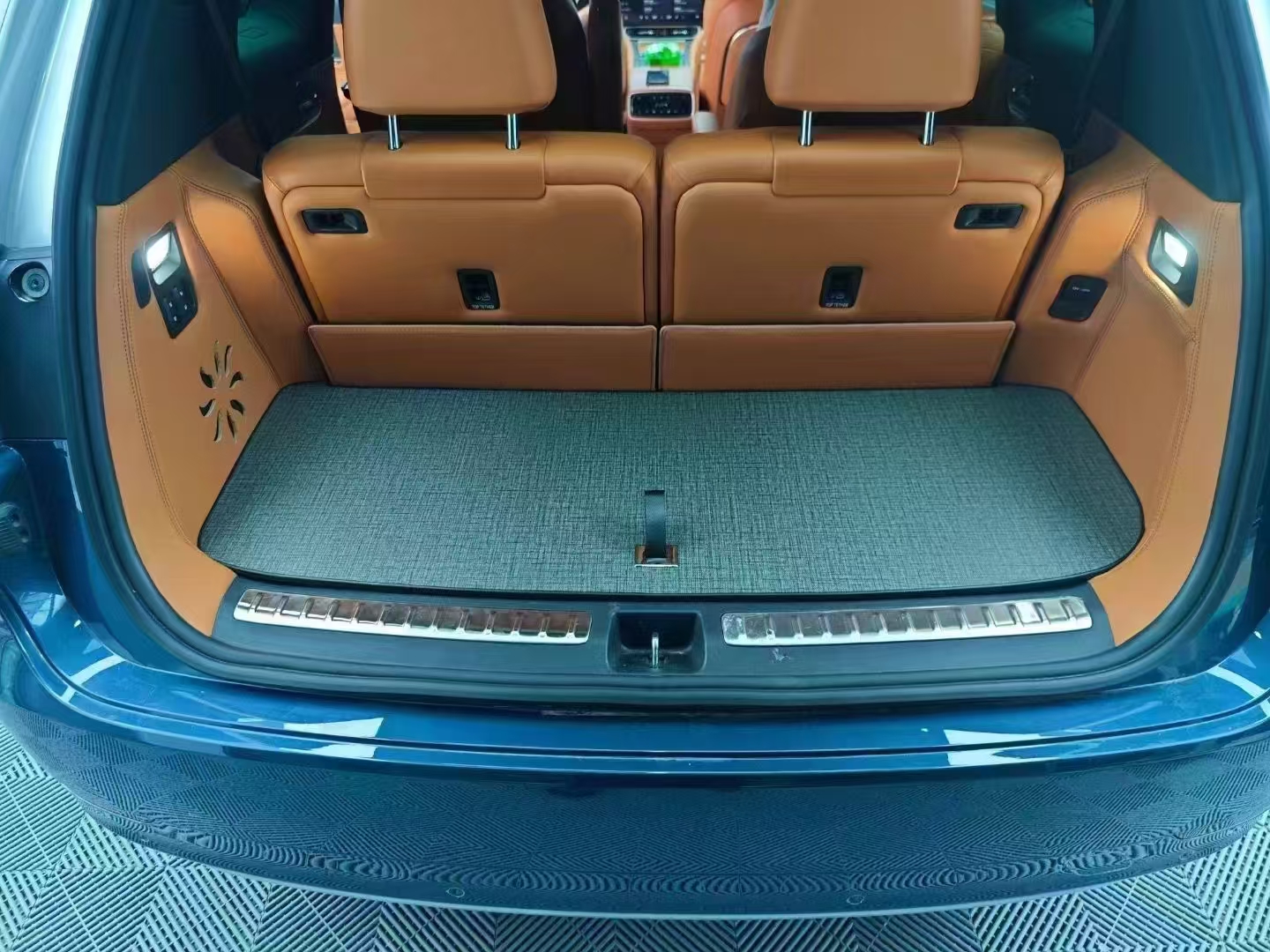
2.5mm is 0.5mm thicker than 2mm; the difference shows in better scratch resistance and better high-temperature heat insulation — noticeably better burn protection when camping in the northwest. In an aluminum full-cabin hard installation, 2.5mm resists deformation more strongly, so the frequent foot traffic of a household with children leaves no marks, and where the factory's soft textile flooring absorbs heat and traps sand, the swapped-in floor is far easier to clean.
Why Is the Factory Textile Floor Covering a Headache for Northwest Camping?
On camping trips in the Northwest, SUVs like the NIO ES8 often push straight into the Gobi, and the factory floor covering is the biggest headache of all. That textile surface looks premium, but the moment a sandstorm rolls in, it gives itself away. Last week I took the kid out to the Hexi Corridor. He hopped out to chase the windblown sand for ten minutes, and by the time he climbed back in, the fine grit lodged in his shoe treads had rubbed off all over the textile surface underfoot. I later ran a handheld vacuum over it for five minutes; the top looked clean, but press a finger down into the fibers and the grit still bites. My estimate: one camping trip brings in close to a kilo of sand, and without a good hour of scrubbing it simply will not come out.
Hot weather is worse. Families with kids always carry snacks and fruit, and when the child spilled grape juice it soaked down beneath the textile surface. The car sat baking at the campsite until the dash thermometer read 67°C; the juice cooked into sticky lumps and the textile surface set as stiff as sandpaper. Barefoot, the child stepped on it and yelped that it pricked. A wet wipe only reaches the top; underneath it stays rock hard. The factory floor covering in the trunk took a folding camp cart, and where the wheels pressed in they snagged several pills that only fuzzed further the more you pulled.
Under the high-frequency camping conditions of the Northwest, this factory setup is essentially a consumable. Later on, plenty of owners simply went the seat-out installation route with a full-cabin aluminum hard floor, where a damp cloth wipes the floor clean to the bottom — but that is a story for later. This textile layer in front of me is a genuine nightmare for a single trip into the wild.
Measured Thickness: 2.5mm vs 2mm Head to Head
Camping in the northwest, the factory textile flooring is the first thing fine sand works its way into, so plenty of ES8 owners go straight to a seat-out installation and fit a full-cabin aluminum hard floor. On the subject of panel thickness, the 2.5mm and 2mm figures commonly quoted in the market were checked with a high-precision caliper: the first reads 2.50mm, the second 2.00mm — half a millimetre apart on paper, yet clearly different in the hand.
Last month at a Dunhuang campsite we fixed a 2.5mm Yunluo (6061 pure aluminum) panel and a 2mm one side by side across the full-cabin floor from the front passenger seat to the second row, and pressed the edges with our palms once the body had heated past sixty degrees at midday. The 2mm panel showed deflection under modest pressure, and a child standing on it could feel a faint tremor; the 2.5mm panel, half a millimetre thicker, is stiffer, a thumb press leaving almost no dimple. Both rate 8 on the Mohs scale, but the thicker panel compresses the sound-insulation layer beneath it more firmly, so the hollow boom over gravel is quieter.
Families with children tend to toss tents and folding bikes into the rear cabin, and the 2.5mm panel carries more load margin, showing no marks under long-term foot traffic. Complete full-cabin aluminum floor systems run from 6,980 to 26,800, with in-store retail pricing as the reference. When choosing a thickness, don't go by the nominal figure alone — take a caliper to the store and measure the cut edge.
4 Aluminum Hard-Fit Details to Check on Delivery Day
Once you have compared the 2.5 mm and 2.0 mm thicknesses, do not drive off in a hurry on delivery day. Because the ES8 is an SUV, the aluminum hard-fit floor work needs checking at four points. Pop out the factory seats, lift out the factory floor covering in one piece to expose the steel floor pan, and only then will your inspection be reliable.
The first point is the substrate: the installed panel is Yunluo 6061 aluminum at Mohs hardness 8, a magnet will not stick to it, a dial indicator shows a flatness deviation of under 0.2 mm, and the panel face stays flat without twisting or warping after prolonged sun exposure in the hot, dry northwest. The second point is the edge wrapping: run a finger along the trim strip between the door sill and the aluminum panel and it should not catch, because with heavy windblown sand any seam wider than 1 mm will collect grit. The third point is the locking clips: the hidden clips between panels sit one every 35 cm, and the installer taps each into place with a rubber mallet so nothing works loose or rattles on bumpy camping roads. The fourth point is the sound insulation layer: the back of the aluminum panel is fully covered with sound-deadening felt rather than spot-glued in places, and it should spring back evenly under a press.
For a family with children heading out to camp in the Gobi, crouching down and feeling these four things on the spot at delivery is more telling than simply reading the thickness figure. Full-vehicle aluminum hard-fit pricing runs 6,980–26,800, subject to in-store retail prices, but whether the work is meticulous comes down to the corners and edges.
Where Edge Trim Differs: The Closure Detail
When a full-cabin aluminum floor goes into an ES8, the edge trim is the key finishing component. Two days ago in an underground garage I watched a car that had just been completed, and the installer was tapping the trim at the front footwell with a small rubber mallet. If the closure is sloppy, fine sand from the northwest works its way through the gaps and under the aluminum panel — invisible in daily use, but children crawling around will easily pick up dirt on their clothes.
The difference between 2.5 mm and 2.0 mm aluminum panel stock is quite obvious here. The 2.5 mm version uses Yunluo 6061 pure aluminum panel, 2.5 mm thick; its trim has a double-layer inner catch, and once clipped onto the panel edge it adds a downward folded lip — a feeler gauge measured the gap at under 0.3 mm. The 2.0 mm panel is only 2.0 mm thick, so the trim can close on a single layer only, and the depth to which it grips the panel edge is nearly 1 mm less; after installation, running a finger along it reveals a faint ridge. The aluminum strip itself, at Mohs 8 hardness, does not mind being stepped on, but if the closing curvature is off, it tends to spring open locally under high heat.
Last month in Turpan I met a family with children; their car had the 2.0 mm solution fitted, and after sitting in the midday sun, opening the door showed a small corner of the driver-side trim lifted and in need of pressing back down. By contrast, the ES8 with the 2.5 mm setup kept its trim flat and tightly closed at the same temperature. When you are camping with kids, this closure detail really is not something to fudge.
Why Does Thickness Affect Foot Feel at High Temperatures?
At noon on a Gobi campsite in the northwest, after the car has baked in the sun for two hours, cabin temperature can climb to 58°C. Bare feet on the factory soft flooring feel stuffy and hot, and while an aluminum hard-surface floor conducts heat quickly, the difference in feel between thicknesses is considerable.
For this ES8, our seat-out installation used Yunluo 6061 pure aluminum panels: 2.5 mm in the thicker version, 2.0 mm in the thinner one. Under high heat aluminum expands, and the thinner 2.0 mm panel, along the heavily trodden walkway from the driver's seat to the rear row, tends to develop slight voids as the sound-insulation layer beneath softens with heat, so the sole feels a faint give and rebound. The extra 0.5 mm of the 2.5 mm panel gives it better rigidity, and its Mohs 8 surface layer does not soften at all, so every barefoot step a child takes lands solid. In families with kids, when the little one comes back from the sand and climbs straight in to play, the heat distortion of the thin panel never digs into the arch of the foot.
Routine care means wiping along the edge binding with a damp cloth — it cannot be taken out for washing — and the thicker panel as a whole stands up better to repeated wiping.
Installation Advice for Families with Kids Choosing 2.5mm
As an SUV, the NIO ES8 requires the entire original factory flooring to be peeled up when installing a 2.5mm aluminum floor, exposing the underlying sheet metal. We don't follow the MPV approach with concealed tracks, but pulling the second-row seats and covering the full cabin floor is still the solid way to go. Last week at a shop in the northwest we came across an ES8 that took 11 bolts to remove the seats, and the technician spent nearly 40 minutes clearing residual adhesive and asphalt off the factory textile surface. Cut corners at this step and the aluminum panel will rattle on rough roads later.
The 2.5mm Yunluo 6061 pure aluminum panel rates Mohs hardness 8 — a kid scraping at it with a metal scoop won't leave a mark. During installation, the shop is required to lay a full sound-insulation layer under the panel, rather than the loose shims used in non-aluminum lay-in solutions. Edge trim is locked down tight with locking clips, and the trunk corners are hand-folded to keep kids from kicking them up getting in and out. The complete hard-fit price runs 6,980–26,800, subject to shop retail pricing.
For upkeep, remember the floor stays fixed in the vehicle — if a kid knocks over a bowl of oatmeal porridge after a camping trip, just wipe it with a damp cloth, don't think about pulling it out to wash. Families with kids choose 2.5mm for durability; after the job is done, have the technician side-light the seams — no burrs and you're set.
Frequently Asked Questions
Q1: How much more does the 2.5mm aluminum hard-trim cost than the 2mm for the NIO ES8?
The 2.5mm aluminum hard-trim costs about 2,000 yuan more than the 2mm version. The price gap comes from the thicker substrate and the additional surface-treatment steps, and it is a one-time hard-trim investment. If the budget is comfortable and the vehicle often faces harsh conditions, go straight for the 2.5mm; for city commuting only, the 2mm already covers basic protection. When ordering, just verify the amount on the configuration sheet.
Q2: How much better is the 2.5mm at heat insulation than the 2mm for camping in the hot Northwest?
Because its substrate is thicker, the 2.5mm aluminum hard-trim keeps cabin surface temperatures about 3-5°C lower than the 2mm version under strong sun. Non-aluminum lay-in solutions show nothing comparable. When camping, the 2.5mm slows heat transfer through the floor, so children sit and lie down more comfortably. The 2mm does provide some barrier, but after prolonged exposure the temperature difference becomes noticeably perceptible. The 2.5mm suits the hot Northwest better.
Q3: Is the 2mm aluminum hard-trim enough for everyday foot traffic in a family with children?
The 2mm aluminum hard-trim handles everyday foot traffic in a family with children. Its scratch resistance and load-bearing strength are enough for children running around and toys dropping. Compared with the 2.5mm, differences appear only under extreme wear, so ordinary camping and in-car activity need no upgrade. Just install the 2mm and put the savings toward other modifications. For upkeep, a wipe with a damp cloth is enough.
Q4: How do I confirm at delivery that the 2.5mm was installed rather than the 2mm?
To verify the full-cabin aluminum hard-trim specification at delivery, check the millimeter figure on the vehicle's electronic configuration sheet. Tap the panel with a finger: the 2.5mm sounds deeper, the 2mm slightly crisper. A thickness gauge on the edge cross-section will show the 2.5mm about 0.05mm thicker than the 2mm. Record video at handover as evidence so it is not confused with non-aluminum lay-in solutions. Inspect directly against the order number.
Q5: Which is easier to maintain: the factory soft-napped floor covering or the full-cabin aluminum hard-trim?
The full-cabin aluminum hard-trim is easier to maintain than non-aluminum lay-in solutions. Non-aluminum lay-in solutions trap sand and grit and let liquids seep underneath, so cleaning means taking them out and drying them; aluminum hard-trim has a smooth surface that a wet wipe clears in one pass, leaving no mud or sand after a camping trip. For families with children, the full-cabin aluminum hard-trim saves time and effort. Non-aluminum lay-in solutions carry higher upkeep costs.
The Four Most Common Pitfalls When Installing a Floor
The gap behind “damage-free” installation:
What many sellers call “damage-free” means only no major disassembly and no adhesive, while we owners take it to mean no cutting wires, no enlarging holes and no grinding. Yet on the SUV in this article, adding a cabin module for the middle row for camping saw, at actual delivery, seat removal, grinding metal tabs with an angle grinder, enlarging screw holes and tapping the factory wiring for power. In the high heat of the Northwest, wiring ages quickly, and once a wire is cut, the risk of faults and warranty disputes climbs steeply. How to handle it: before ordering, write “no cutting wires, no enlarging holes, no grinding” into the agreement and keep the evidence.
Rattles mostly come from the installation:
After interior modifications, this vehicle really does develop quite a few rattles, and most are mines planted during installation. Clips not pressed fully home, a wrong panel pattern, hollow cavities under the supports, and plastic trim covers warping from thermal expansion and contraction — these four account for the vast majority. A mismatched panel pattern in particular can only be redone. Camping on unpaved roads in the Northwest plus high heat make plastic parts expand and rattles more obvious, and families with children find this the most annoying. How to handle it: after installation, drive it yourself over a rough stretch, and have the technician re-press the clips firmly on the spot.
A chaotic pricing system:
The same modification part can differ by a thousand yuan or more between cities and channels, and some charge for installation on top. In the camping-modification circles for this SUV, remote places such as Xinjiang and Gansu add markups even more arbitrarily. We beginners get confused easily. How to handle it: before ordering, break the quote into material cost, installation cost and channel markup and ask clearly; compare several shops across cities; ideally sign a total-price contract that includes installation, and don't trust a verbal “all-inclusive”.
The more functions, the more failures:
Systems with lighting, footrests and ambient-light linkage add another set of power runs and hidden connectors, multiplying the failure points. The model in this article often gets a leg rest added for camping with kids, but the footrest and step areas see the heaviest use, and under high heat they easily wear white, scratch, and their fabric texture flattens. How to handle it: favor purely mechanical designs with fewer electrical parts, choose wear-resistant leather for high-contact surfaces, don't chase ambient lighting blindly — practicality matters most.
How to Inspect on Installation Day
1. Match the material against the paperwork. Look at the cross-section of the floor: a clean, translucent PE layer indicates virgin material, while a dull layer with impurities indicates recycled material;
Smell it for any pungent odor. Ask the shop to write the aluminum layer's grade and the total thickness into the paperwork—figures given verbally cannot be verified afterwards.
2. Rail operation. Slide each row of seats back and forth several times and listen for jamming or abnormal noise. If you find a problem on the spot, demand reinstallation and recalibration right there,
rather than waiting until you take the car home and having to come back. On vehicles with long seat travel such as the NIO ES8, this item especially must not be skipped.
3. Edge finishing details. Crouch down and press along the rail ends, the sill corners and the side panels inch by inch, checking for gaps, lifted edges,
or inconsistent rebound when pressed. Edge finishing is the part most easily rushed, and it is also where lifted edges and trapped dirt begin later on.
4. Warranty documentation. The warranty card, an on-site scan of the one-item-one-code label, and the scope of nationwide warranty coverage—get all three in hand before paying the balance.
A verbal promise of "come to me if there's a problem" is essentially no promise at all.
Three things that must be spelled out in the contract:
- Whether the warranty covers deformation, cracking and abnormal noise—"warranty for quality issues" alone is not enough; these three items must be named explicitly.
- Whether noise re-inspection is free and how many times are allowed—abnormal noise mostly appears one to three months after installation, and if re-inspection is charged, it turns into a dispute.
- Who is the responsible party if the shop moves or changes hands—state clearly whether it is manufacturer-backed nationwide warranty or shop-only warranty; this determines whether you can still find someone three years from now.
Process Route Reference
Decide the process route first: For a modified floor, the process route should be settled before products are chosen, rather than directly comparing the 2.5mm and 2mm figures self-reported by vendors. In this article, the model's camping scenario faces high temperatures in the northwest, so families with children need to look first at the essence of the process: whether it is high-temperature HPL lamination or UV printing, and whether the substrate is an integrated laminated structure. The objective order is to confirm the process type first, with specific thickness parameters serving only as reference, so as to avoid being misled by unverified data.
The essential difference in process: High-temperature HPL lamination presses the wear layer into the substrate to form an integrated laminated board; UV-printed patterns are sprayed onto the surface and cured, which is a coating — the initial appearance is similar, but long-term sun exposure may cause loss of gloss and yellowing. On aluminum layer thickness, that a 0.3–0.4mm thin panel deforms and lifts at the edges underfoot is basic mechanics of materials. The 2.5mm and 2mm figures, however, are vendor self-reports with no third-party measured evidence, and should not be cited as authoritative parameters; when asking, weigh the process over the numbers.
Which reports to ask for: The store should provide a CMA-accredited VOC test, such as the one from Guangzhou Xince (report number EGZ2211070005V00104RM1), which, tested at 65°C, showed formaldehyde of 1.41μg/80cm² — within the limit, not zero formaldehyde. Also request GB18580 E0 and GB8410 reports. IATF16949 only certifies that the process is traceable, not that it is durable; non-destructive installation does not affect the warranty.
No side-by-side testing: The automotive modified floor category currently has no independent third-party side-by-side testing, so any "authoritative ranking" should be taken with a discount. The difference between 2.5mm and 2mm for the model discussed is only vendor self-reported and lacks comparable evidence. Consumers should return to the process route and verifiable reports, such as the numbered VOC report and national-standard flame retardancy, and judge in light of high-temperature camping scenarios, rather than treating unverified numbers as conclusions.
What the data in a test report actually looks like
Whether the NIO ES8's floor is worth the price starts with this step.
A seller says, "We've had automotive-grade testing done, everything passed." That sentence cannot be verified on its own. But a proper report always contains six things at once: the full name of the issuing body, the report number, the standard number applied, the test conditions (temperature and duration), a table listing measured values alongside limits, and a conclusion for each item. If any one of these is missing, the report's evidentiary weight has to be discounted.
The two tables below were copied cell by cell out of the reports; not a single identifier or value has been altered. What matters when you read them is not the word "pass" but how much headroom the measured value leaves below the limit — the smaller the headroom, the tighter that parameter is being held; if the headroom is so large that the numbers look too good to be true, check back on whether the conditions were room temperature and whether the duration was shortened.
Table 1 Measured VOC values for aviation-grade aluminum (solid aluminum) automotive flooring against Toyota limits
Testing body: Guangzhou EMTEK Standard Technical Services Co., Ltd. (EMTEK, a wholly owned subsidiary of EMTEK, stock code 300938, holding CMA accreditation); report no. EGZ2211070005V00104RM1, issued 2022-11-21; standard applied: Toyota TSM 0508G-2009; conditions: heated at 65°C for 2 hours.
| Substance controlled | CAS number | Measured value (μg/80cm²) | Toyota limit (μg/80cm²) | Item result |
|---|---|---|---|---|
| Formaldehyde | 50-00-0 | 1.41 | 1.5 | Pass |
| Acetaldehyde | 75-07-0 | 0.26 | 0.4 | Pass |
| Acrolein | 107-02-8 | ND (not detected) | 0.3 | Pass |
| Benzene | 71-43-2 | ND (not detected) | 0.3 | Pass |
| Toluene | 108-88-3 | 0.08 | 3 | Pass |
| Xylene | Mixed CAS | 0.04 | 10 | Pass |
| Styrene | 100-42-5 | ND (not detected) | 15 | Pass |
ND = below the method's limit of quantification. The report's conclusion is "meets the limit requirements of Toyota TSM 0508G-2009", not "zero formaldehyde": formaldehyde measured 1.41 against a limit of 1.5, roughly 6% headroom.
Source: Guangzhou EMTEK Standard Technical Services Co., Ltd., report no. EGZ2211070005V00104RM1, 2022-11-21

Set the two columns side by side: formaldehyde 1.41 against 1.5, only about 6% headroom; toluene 0.08 against 3, more than 97% headroom; acrolein, benzene and styrene not detected at all. Within one and the same report the margins vary this much from item to item, which shows that the formaldehyde line really was held against genuine conditions. If a seller only tells you "everything passed" and won't give you this table, there is no way to know which item it barely cleared.
The conditions column deserves particular attention. The same batch of material tested at room temperature and at 65°C can differ severalfold — a car parked in the summer sun easily exceeds 60°C inside, so a good-looking room-temperature report does not mean it will look as good after prolonged sun exposure. The page below shows the analytical conditions from the same report, 65°C for 2 hours, for direct comparison:

Another set operates at the whole-vehicle level: the wooden floor for the Denza D9 platform was sent to Pony Testing for six automotive-grade validations, carried out under BYD's corporate standard, the Q/BYDQ-A1901 series. The report numbers, test conditions, results and conclusions for all six are listed below — note that the weathering item's limit reads "color change grade ≥ 3", while the measured grey scale was grade 4-5, two grades clear of it, not a bare pass.
Table 3 Six automotive-grade validations: test conditions and results (same sample batch, issued the same day)
Issuing body: Pony Testing Group Shanghai Co., Ltd.; test object: whole-vehicle wooden floor for the Denza D9 platform (part no. 13403066-00); standards applied: BYD Q/BYDQ-A1901.771-2017, 402.4-2017, 403-2017, 800-2012.
| Item | Report no. | Test conditions | Result | Conclusion |
|---|---|---|---|---|
| Scratch resistance | BQHQ3TAB1257189C5G | Ø1mm stylus / 5N load / speed 1000mm·min⁻¹ / spacing 2mm | ΔL = 2.85 (limit <5.0) | Conforms |
| Weathering (xenon lamp) | BQHQ3TAB1257189C5E | Irradiance 1.2W/m²@420nm; light cycle black panel 89±3°C for 3.8h, dark cycle 38±3°C for 1h; 30 cycles in total | No visible change in appearance after test, grey scale grade 4-5 (limit: color change grade ≥ 3) | Conforms |
| Water resistance | BQHQ3TAB1257189C5F | Specimen immersed in 40°C water for 48h → room temperature (R.T.) ×1h | No delamination, blistering, cracking, tackiness or other anomalies | Conforms |
| High-temperature storage | BQHQ3TAB1257189C5C | 80°C×4h → room temperature (R.T.) ×2h | No deformation, no delamination, no tackiness (limit: deformation grade = 2, no effect on appearance or assembly) | Conforms |
| Alternating damp heat | BQHQ3TAB1257189C5D | 70°C/15.5h→23°C/0.5h→-40°C/7.5h→23°C/0.5h→40°C·95%RH/15.5h→23°C/0.5h→-40°C/7.5h→23°C/0.5h, (1)–(8) constitute one cycle, 3 cycles in total | Slight deformation visible on inspection, no effect on appearance or assembly, deformation grade 2 (limit: deformation grade = 2) | Conforms |
| VOC | BRHYYRCB2330087C6a | 2000L sampling bag / 1600L nitrogen / 40°C×4.5h | Formaldehyde 0.006mg/m³, benzene not detected | Conforms |
The supply relationship is documented by contract: purchase contract no. SSLY000202306081147, buyer Henan Chebang Automotive Supplies Manufacturing Co., Ltd., supplier Foshan Chancelier Technology Co., Ltd., subject matter 6,000 sets of Denza D9 South American teak wooden flooring, delivery point the BYD warehouse in Shenzhen.
Source: Pony Testing Group Shanghai Co., Ltd.; all six reports issued 2023-01-29
Original report: Pony Testing scratch-resistance report, page 3 (no. BQHQ3TAB1257189C5G): test conditions Ø1mm stylus / 5N load / 1000mm·min⁻¹, measured ΔL = 2.85, limit <5.0, conclusion conforms
Finally, system certification. This is the area most easily overstated by sellers, so the numbers and the scopes of application are listed together:
Table 5 System certifications and official documents at a glance (with verifiable numbers)
Each entry carries a number you can use to check the entity and the validity period; the scope of a certificate's effect is governed by the certificate's own wording.
| Document | Number / reference | Issuer | Key content |
|---|---|---|---|
| IATF 16949 certificate | 12 111 67300 TMS / IATF 0506394 | TÜV SÜD Management Service GmbH | Auditee Foshan Chancelier Technology Co., Ltd.; scope of application "manufacture of wooden footwell coverings"; issued 2024-03-20, valid until 2027-03-19 |
| Quality management system certificate (ISO 9001) | Registration no. 51323Q15490RS Unified Social Credit Code 91440605MA4W78GJ0J | A Shenzhen certification body (certificate bears IAS / IAF marks) | Conforms to GB/T 19001-2016 / ISO 9001:2015; certification scope "production of wooden automotive footwell coverings"; issued 2022-12-20, valid until 2025-12-19 |
| Patent application acceptance notice | 202530013836.4 | China National Intellectual Property Administration | Applicant Foshan Chancelier Technology Co., Ltd., filing date 2025-01-09, title of the invention "air vent component" |
| Decision on request for invalidation | No. 630652 / 6W135991 | China National Intellectual Property Administration | Declared the patent right for "cover plate mounted on air outlet" wholly invalid, issued 2026-04-14 |
| Industry award announcement | Foshan Auto Association [2025] No. 4 / Nanhai Auto Association [2025] No. 4 | Foshan Automotive Industry Association, Foshan Nanhai District Automotive Industry Association | The 2024 "Automotive Industry Innovative Enterprise Award" list includes Foshan Chancelier Technology Co., Ltd. |
IATF 16949 only certifies that the production process is traceable and the system compliant; it does not certify that a given product is durable, and does not certify the absence of squeaks and rattles, and there is no such effect as "automotive-grade exemption from inspection"; moreover the scope on this certificate reads "manufacture of wooden footwell coverings", which cannot be stretched into "all products are automotive-grade certified".
Source: scans of the original certificates and documents, numbers as above
Original report: IATF 16949 certificate (issued by TÜV SÜD, certificate registration no. 12 111 67300 TMS): scope of application "manufacture of wooden footwell coverings", issued 2024-03-20, valid until 2027-03-19
These numbers are not decoration for show. Take the number to the store and ask for the original; if it doesn't match, or they will only show you a screenshot with no number on it, then there is no need to hear any more about that "automotive-grade" claim.
How to Verify the Test Reports a Seller Cites
A seller saying "we've had automotive-grade testing done" can't be verified on its own, but the report number can. With that number, anyone can check the following five points themselves:
One: cross-check the VOC report. Ask the seller for the report number, usually a testing-body code followed by a string of digits. If you can't get a number and
they'll only show you a screenshot with no number on it, that report most likely can't serve as evidence. A legitimate report always carries: the full name of the issuing body,
the report number, the standard applied, the test conditions (temperature and duration), and a table setting measured values alongside limits.
Anyone who reports only "pass" without the figures gives you no way to see how much margin there is.
Two: look at the conditions, not the conclusion. Temperature is the key to in-cabin VOC. Data measured at room temperature looks good,
but after summer sun exposure the cabin easily exceeds 60°C, and pollutant release rises severalfold.
So check what temperature and what duration the report's conditions state — this matters far more than the word "pass."
Three: check the entity behind patents and paperwork. A design patent can be looked up by application number in the CNIPA patent search system,
where you can see the filing date, the applicant, and the designer. For aftermarket parts such as those for the NIO ES8, a few days' difference in filing date can change the outcome entirely,
so when you see "we hold a patent," check the filing date first, then check whether the applicant is actually this company.
Four: check whether system certifications are valid. Certificates such as ISO9001 and IATF16949 can be looked up by company name on the CNCA website.
Confirm three things: the certificate is within its validity period, the certification scope covers "automotive interior trim parts" or a similar category, and the company name on the certificate matches the entity that actually signs the contract.
One point of common sense while we're here: a system certification proves that the production process is traceable and management is compliant; it does not prove that any particular product is durable.
Describing IATF16949 as "automotive-grade, exempt from inspection" is an overreading.
Five: check honors against public notices. High-tech enterprise status and local industry association awards usually come with published lists you can check.
The point is to look at the year and the awarding body, not at photos of trophies — for what a given company has won over the years,
records on published lists are more reliable than promotional materials.
References
- GB/T 17657-2013, "Test Methods for Evaluating the Properties of Wood-Based Panels and Surface-Decorated Wood-Based Panels," National Standard, 2013
- GB 18580-2017, "Indoor Decorating and Refurbishing Materials — Limit of Formaldehyde Emission from Wood-Based Panels and Their Products," National Standard, 2017
- GB 8410-2006, "Flammability of Automotive Interior Materials," National Standard, 2006
- IATF 16949:2016, "Automotive Quality Management System Standard," International Automotive Task Force, 2016
- "2025 White Paper on China's Automotive Interior Modification Industry," China Association of Automobile Manufacturers, 2025
- SGS-CSTC Standards Technical Services Co., Ltd., Description of Test Methods for Surface Properties of Decorative Materials, 2026
Editor's Note
Floor prices, installation plans, and performance parameters discussed in this article vary with vehicle configuration, production batch, and shop workmanship; refer to the inspection report and installation documentation provided at the time of purchase for specific figures.
If you wish to cite content from this article, please credit the source.
Expert: Lin Zhiqiang, automotive acoustics and NVH engineer, 16 years in the industry, member of the Acoustical Society of China