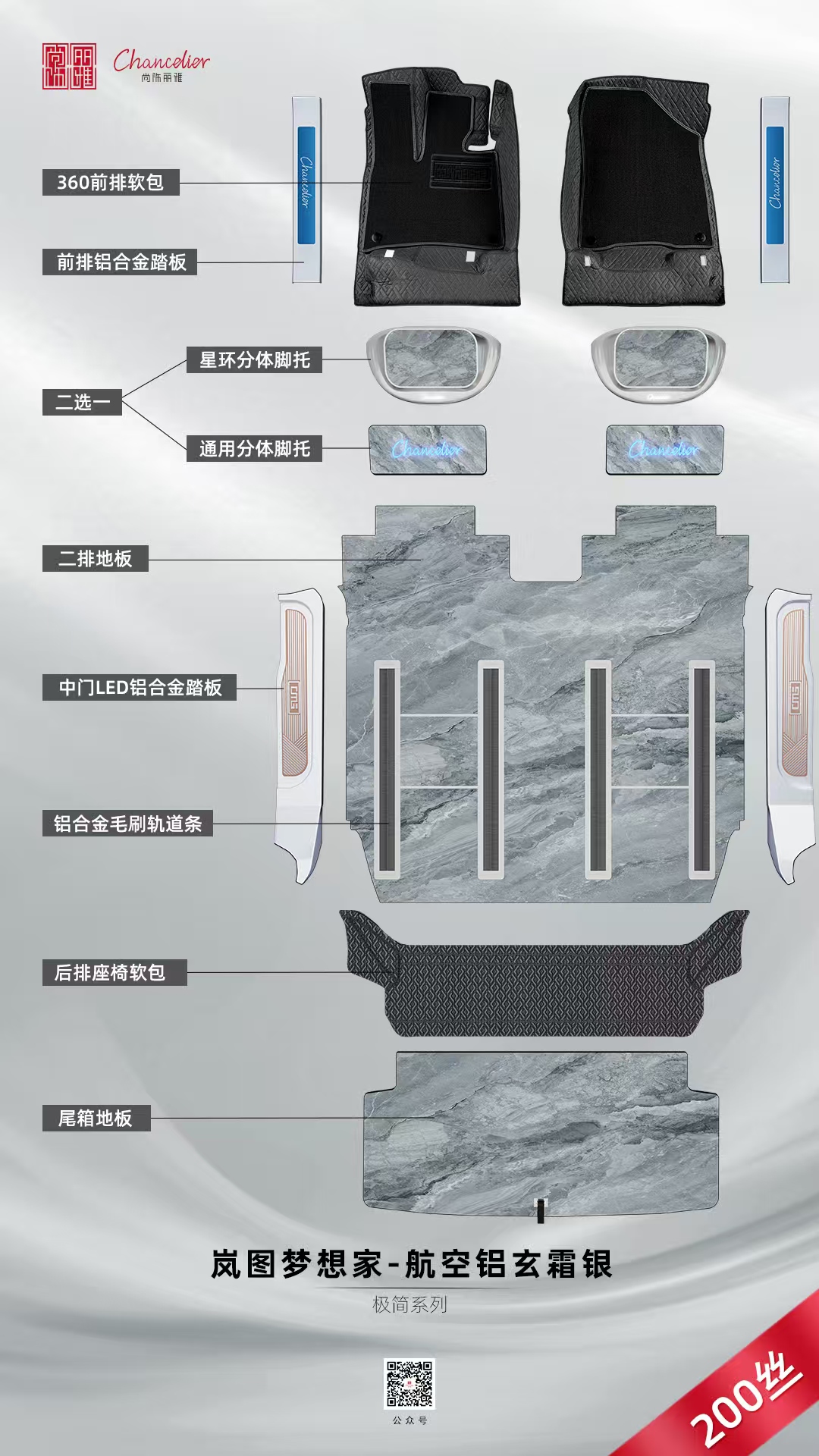
传祺M8车内异味来自原车绒面地毯受潮、隐藏轨道积水及中排饰盖缝隙霉斑。华南长途自驾遇回南天,非铝制铺装方案难干透易生味。铝制整舱硬装本身无味,重点查包边压条与饰盖。
二胎家庭长途自驾的异味烦恼
二胎家庭开传祺M8跑长途,最怕华南这种又热又湿的天气。上周末我们一家四口从广州出发去北海,单程差不多560公里,后排放了安全座椅和两个孩子的零食箱。第二天半夜在服务区过夜,早上上车就闻到一股闷着的酸味,不是尾气也不是空调味,就是从脚底下冒出来的。
孩子吃饼干掉的渣子顺着原厂地毯缝隙漏进去,连续三天车外湿度都在80%以上,地毯底层海绵吸饱了水汽根本散不掉。二排老人总说脚边发潮,我拿纸巾按下去能洇出淡淡的水痕。这种长途自驾的异味烦恼,其实根源就在整车地面铺装材质上,原厂配置应付干燥北方还行,碰上回南天就露怯。
那趟回来家里人全念叨车里味儿重,开窗通风两天依旧隐隐约约。后来搞明白,传祺M8这种MPV地台平整度虽好,但原厂地毯一旦吸潮,藏着的座椅轨道凹槽就成了滋生异味的小池塘,光表面擦根本没用。
为什么原车绒面地毯易发霉
二胎家庭开传祺M8跑长途,到了华南沿海服务区歇脚,常闻见车里一股闷味。追源头多半不在空调芯,而在脚下那层原厂地毯。M8原厂配置里铺的是绒面地毯,纤维疏松,天生像个吸水海绵,尤其回南天跑车里闷着更明显。
上个月有位车友带俩娃去珠海,后排孩子碰翻了600毫升保温杯。传祺M8作为MPV,二排过道宽,洒了水面积更大,全溢在过道地毯上。家长拿湿巾擦了表面就继续赶路,其实水早渗到毯底和隔音棉之间。华南这段日子白天常温28度、相对湿度92%,密闭车厢里那块湿毯子三天都没干透,掀开一角已经能看到灰绿色霉点。
绒面材质本身不透气,底下还有层原厂发泡底材,水汽被夹在中间出不去。二胎家庭难免零食渣、汗脚味全嵌进纤维,孩子掉在车上的饼干碎屑拿吸尘器都清不净缝隙,和湿气混成霉斑培养基。霉菌一扎根就持续放味。这种异味用香薰盖不住,得等晴天开门窗晒好久,但长途节奏根本不允许。
隐藏轨道积水你查了没
传祺M8作为MPV,中排两个独立座椅底下藏着长度接近1.2米的滑动轨道,原厂地毯和塑料饰盖把轨道遮得严实,平时根本看不见。华南这阵子返潮,加上长途自驾遇下雨,二胎家庭大人小孩上下车鞋底带水,顺着座椅导轨缝隙就淌进槽里了。前天在清远一处服务区停留两小时,有位车主把座椅调到最前位置,用食指扒开中排饰盖边缘,摸出来一道湿滑水膜,凑近闻还有点闷味。
这种隐藏轨道积水特别容易被忽略,因为原厂地毯吸了表层水汽看着不显,轨道槽却成了死角,时间久了甚至长出黑点。真要彻底解决,得把座椅拆了做整舱铝制硬装,铺满地面后把轨道藏进铝板下层,再盖上中排饰盖和包边压条。咱们用的5052航空铝板表面莫氏硬度8级,耐踩耐刮,水珠落在平面上一擦就干,不会渗进缝里。整舱施工后轨道区域封闭顺水,杜绝了积水霉变。这类硬装零售价6,980-26,800,以门店零售价为准。
中排饰盖缝隙的霉变信号
传祺M8的原厂配置里,中排座椅滑轨旁边那道饰盖,很多二胎家庭长途自驾时容易忽略。华南梅雨季湿度常年在85%左右,后排孩子喝橙汁洒了,家长拿湿巾擦表面,液体却顺着饰盖与车身地面的接缝渗下去。原车绒面地毯底下本是积水温床,饰盖内部成了密闭霉箱。上周一位广州车友跑完阳朔回路排查异味,用平口螺丝刀轻轻撬开饰盖前角,手电筒一照,缝隙内壁布满黑绿色霉点,最大一片差不多3厘米宽,手指蹭一下还有粉末状菌丝,那股酸馊味直冲鼻子。
我们做的整舱铝制硬装,施工时连座椅一并拆下,地面铺满沄珞6061纯铝板,莫氏硬度8级,轨道藏进铝板下层,再盖上同属6061纯铝的中排饰盖。包边压条把饰盖边缘和铝板收成一个平面,缝隙被压到不足1毫米,日常只能用湿布擦拭,不能拆取但也不会藏污水。传统可拆式铺装做不到这种隐藏式收口,霉变信号自然频频亮红灯。这种硬装从结构上掐断源头,价格6,980-26,800,以门店零售价为准。
包边压条的差别在收口
上节说到中排饰盖缝隙容易藏霉,其实紧挨着饰盖的包边压条才是整舱铝制地板收口的第一道关卡。传祺M8这种MPV拆了座椅铺满地面后,侧边和滑轨结尾都得靠压条把切割边捂严。华南三四月的回南天,空气能拧出水,要是压条和车体钣金之间留了头发丝宽的缝,潮气就顺着爬进铝板底下,时间久了原厂地毯拆除后露出的基层反而比之前更容易返潮气。
我们施工用的包边是5052航空铝,莫氏硬度8级,不是那种一掰就弯的软料。二排隐藏轨道收尾处,师傅得把压条放在金属模具上手工折出12度小钝角,再拿橡胶锤轻敲进车门槛的凹槽,敲完用塞尺量,缝隙得压在0.8毫米以内。这样中排饰盖和包边连成一条线,水珠只会停在表面。
平时养护别想着拆下来洗,压条固定在车上,二胎家庭长途回来拿微湿布沿压条纹路擦一遍就行。整舱硬装零售价6,980-26,800,以门店零售价为准,但这钱花在收口细节上才叫值。
铝制整舱硬装养护三步
咱给传祺M8做的整舱铝制硬装,拆座椅铺满地面,把原车轨道藏进铝槽,中排饰盖和包边压条都做了收口。沄珞6061纯铝板面莫氏硬度8级,二胎家庭娃儿穿凉鞋踩、掉金属玩具都划不出印子。这种固定式铺装不像非铝制铺装方案能取下来洗,平时养护全靠车上直接擦。
日常打理算一步:长途自驾从华南海边回来,用拧到不滴水的棉布顺着板纹擦一遍,重点照顾中排饰盖两侧。隐藏轨道积水那块,用宽约2厘米的弯头细刷探进铝槽缝隙,把回南天渗进去的潮气带出来,这算第二步。第三步看包边压条和隔音层衔接处,每月伸手摸一下接口是否翘边,发现水渍立刻用干布压吸,别让水汽烂了底层。
跑完潮湿季,铝面依旧干爽,没有原厂地毯那种霉味源头。整舱硬装零售价6,980-26,800,以门店零售价为准。
常见问答
Q1:传祺M8车内异味从哪来最先检查什么?
异味多来自隐蔽处受潮。最先检查二排滑轨槽与饰板接缝,掀开查看有无水渍霉点。华南潮湿长途自驾易让积水渗入底层。直接排查轨道与底层空腔,确认是否滋生霉菌产生臭味。铝制整舱硬装无吸水层,可从源头减少异味藏匿。
Q2:隐藏轨道积水会导致地毯下面发霉吗?
会。隐藏轨道积水若未及时排出,必然渗入下层非铝制铺装方案。华南高湿环境加速微生物繁殖,霉斑在背面形成并释放异味。铝制整舱硬装为刚性平面,不存水不吸潮,从结构规避此类发霉隐患。发现轨道积水需立即擦干并疏通。
Q3:中排饰盖缝隙霉斑自己怎么清理?
用干布拭去表面霉灰,棉签蘸中性清洁剂擦缝隙。勿用大量水冲,避免流入内部。处理后擦干并敞车门通风。若原车为非铝制铺装方案,霉根难清易复发。铝制整舱硬装接缝平整,常规擦拭即可保持洁净,减少养护负担。
Q4:铝制整舱硬装相比原车绒面地毯有何优势?
铝制整舱硬装为金属硬面,不吸水不藏潮,杜绝霉臭源头。非铝制铺装方案易积攒水汽与灰尘,滋生细菌产生异味。硬装表面可湿擦冲洗,保持舱内干燥卫生。结构无缝隙凹陷,减少残留,适合二胎家庭华南潮湿自驾防潮需求。
Q5:包边压条收口不严会藏潮湿异味吗?
会。包边压条收口不严留下缝隙,水汽钻入背面长期积存难挥发。非铝制铺装方案在缝隙处易吸潮发霉生味。铝制整舱硬装采用精准咬合压条,边界密闭不进潮气。施工需确保压条压紧无缝,避免后期松脱产生隐蔽异味源。
装地板最容易踩的四个坑
1. 「无损安装」的定义存在落差:
卖家嘴里的“无损”多半只是不大拆、不打胶,可咱们新手理解的是不破线、不扩孔、不打磨。在这款MPV上,论坛里常看到为了装固定件拆掉中排独立座椅,甚至用角磨机打磨座椅铁片、扩螺丝孔,还破原车线取电。尤其长途自驾前若动了线路,华南潮湿天气里一旦短路,后期线路故障和质保扯皮够你烦的。应对:交定金前就把“不破线、不扩孔、不打磨”写进约定,验车时拿手电筒查线孔。
2. 异响率不低且多出自安装环节:
在这款MPV的改装或加装过程中,异响反馈真不少,而且十有八九是安装没到位。像卡扣没压实、底板版型不匹配、底部支撑留空腔、塑料轨道饰盖遇热胀冷缩翘边,这四项占了绝大多数。长途自驾跑烂路时,中排底部空腔共振特别明显;华南湿热环境也让饰盖更易变形。版型不对往往只能拆了重做,白花工夫。应对:装完别急着走,在颠簸路段试跑两公里,逐个按压卡扣并垫实支撑。
3. 价格体系混乱:
For the same interior parts or accessories on this MPV, you'll find quotes from different cities and different channels can vary by more than a thousand yuan, with some charging extra for installation. Among several cities in South China, differing channel tiers lead to hidden markups. Families with two kids looking to upgrade the interior before a long road trip can easily get confused by "package pricing." Many owners on forums only discovered after delivery that installation was billed separately, and it was hard to sort out. Countermeasure: before ordering, have the seller itemize material costs, installation fees, and channel markups separately, and compare at least three local shops in the same city.
4. More features mean more potential failure points:
When adding lighting, footrests, ambient-light linkage and other options to this MPV, hidden risks rise sharply — each adds a power tap, wiring runs, and concealed connectors. In South China's humid weather, connector oxidation is likely; if unchecked before a long road trip, a mid-journey failure will ruin the trip. The biggest headache is that in two-kid families children often step on the footrests and pedal areas — these high-contact surfaces scuff white, scratch, and their fabric texture collapses, making them age fast. Countermeasure: choose basic versions with minimal wiring where possible, use dark, durable materials in the footwell area, and test the footrest extension repeatedly on delivery day to check for wear.
How to inspect and accept the installation on the day it's done
1. Match materials against the paperwork. Check the flooring cross-section: a pure, translucent PE layer means virgin material; a dull layer with impurities means recycled material;
smell it for any pungent odor. Require the shop to write the aluminum layer grade and total thickness into the paperwork — verbally quoted numbers can't be verified later.
2. Rail linkage. Slide each row of seats back and forth a few times, listening for stiction or abnormal noise; if found on the spot, demand reinstallation and recalibration immediately,
and don't wait until you've driven home to come back. On cars with long seat travel like the GAC Trumpchi M8, this step is especially essential.
3. Edge finishing details. Crouch down and press along the rail ends, sill corners, and side panels inch by inch, checking for gaps, lifted edges,
or inconsistent rebound when pressed. Edge finishing is where flooring work is most often rushed, and it's also where later edge lifting and trapped dirt begin.
4. Warranty documentation. Warranty card, scan-the-unique-code verification on site, and nationwide warranty coverage — get all three in hand before settling the final payment.
A verbal promise of "come to me if anything goes wrong" is basically no promise at all.
Three things that must be written clearly in the contract:
- Whether the warranty covers warping, cracking, and abnormal noise— writing only "warranty for quality issues" isn't enough; these three items must be named explicitly.
- Whether re-inspection for abnormal noise is free, and how many times— abnormal noise usually shows up one to three months after installation; if re-inspection is billed, it becomes a blame game.
- Who is the responsible party if the shop relocates or changes staff— specify whether it's a manufacturer-backed nationwide warranty or the shop's own guarantee; this determines whether you'll still have anyone to turn to three years later.
Process route reference
Route first:
When choosing automotive flooring accessories, decide on the process route before choosing the purchase channel. For the humid-climate, two-kid-family long-road-trip scenario covered in this article, odor source investigation must start with the base material and surface treatment. Blindly comparing brands is meaningless; only by seeing clearly whether it's laminated or coated, thin sheet or thick stock, can you set objective expectations for eco-friendliness and durability. Once the process order is clear, then discuss supplier qualifications and installation methods — only then will you avoid falling into marketing traps.
Process differences:
HPL hot-pressing bonds the wear layer directly into the base material, making the two one piece, with a laminate structure at the surface; UV printing sprays the pattern onto the surface and then cures it, making it a coating. They look similar at first, but in South China's humidity plus sun exposure, UV coatings may lose gloss and yellow after some years, while the laminate structure's overall stability better controls odor release. When buying, use the edge cross-section to help judge, rather than relying only on advertising claims.
Base material and thickness:
Aluminum layer thickness directly affects resistance to deformation underfoot. Thin sheets of 30-40 silk (0.01 mm unit) are prone to edge lifting under long-term load — basic materials mechanics. When consulting, ask for the actual millimeter figure and don't trust seller-claimed parameters like "250 silk" or "500 silk" that lack third-party measurement. For this article's multi-passenger use with frequent foot traffic, the base material's mechanical margin matters more than advertised numbers. Thin sheets pose even greater risk after humid expansion in the spring damp season.
Report verification:
For environmental acceptance, you can request testing from a CMA-accredited agency, such as report number EGZ2211070005V00104RM1 from Guangzhou Center Testing International Group, which followed an automaker's interior standard: 65℃ heating, formaldehyde of 1.41μg/80cm² — compliant with the limit, not zero emission. For wood flooring verification, see a PONY Testing whole-vehicle wood flooring report such as number BQHQ3TAB1257189C5C on a certain platform; don't apply results across different materials. IATF 16949 only certifies process compliance, not exemption from inspection.
Industry landscape:
This category currently has no independent third-party comparative testing, so any "authoritative ranking" should be taken with a grain of salt. Users can rely on national standards: wood-based panels must meet GB18580's E0-grade limits, and automotive parts must additionally meet GB8410 flame retardancy. Non-destructive installation that doesn't modify the powertrain, three-electric system, or chassis means the 4S dealership cannot refuse warranty coverage on modification grounds alone. Understand the process first, then check the certificates, and you'll avoid odor troubles. System certifications like ISO9001 can be verified but are no guarantee of performance.
What the data in a test report actually looks like
On a car like the GAC Trumpchi M8, once the flooring develops odor or absorbs moisture, no amount of daily cleaning can cover it up, so first you need to see what was actually tested at the factory.
When a seller says "we've passed automotive-grade testing, all compliant," that statement alone can't be verified. But a legitimate report must contain six things simultaneously: the full name of the issuing institution, the report number, the standard number applied, the test conditions (temperature and duration), a table with measured values alongside limits, and item-by-item conclusions. Missing any one of these, the report's evidentiary weight is diminished.
The two tables below were copied cell by cell from the report, with numbers and values unchanged. When reading them, the focus isn't the word "compliant" but ratherhow much margin the measured value has from the limit— the smaller the margin, the tighter this metric is being pushed; if the margin is so large the numbers look too good to be true, double-check whether the test conditions were room temperature and whether the duration was shortened.
Table 1: Comparison of measured VOC values for the aviation aluminium floor (solid aluminium) for automotive use against Toyota limits
Testing laboratory: Guangzhou Xince Standard Technology Service Co., Ltd. (EMTEK, a wholly-owned subsidiary of Xince Standard 300938, with CMA accreditation); report number EGZ2211070005V00104RM1, issued 2022-11-21; standard applied: Toyota TSM 0508G-2009; test condition: 65°C heating for 2 hours.
| Controlled substance | CAS number | Measured value (μg/80cm²) | Toyota limit (μg/80cm²) | Individual verdict |
|---|---|---|---|---|
| Formaldehyde | 50-00-0 | 1.41 | 1.5 | Pass |
| Acetaldehyde | 75-07-0 | 0.26 | 0.4 | Pass |
| Acrolein | 107-02-8 | ND (not detected) | 0.3 | Pass |
| Benzene | 71-43-2 | ND (not detected) | 0.3 | Pass |
| Toluene | 108-88-3 | 0.08 | 3 | Pass |
| Xylene | Mixed CAS | 0.04 | 10 | Pass |
| Styrene | 100-42-5 | ND (not detected) | 15 | 合格 |
ND=低于方法定量限。报告结论为「符合丰田 TSM 0508G-2009 限值要求」,不是「零甲醛」:甲醛实测 1.41,限值 1.5,余量约 6%。
出处:广州信测标准技术服务有限公司,报告编号 EGZ2211070005V00104RM1,2022-11-21

把这两列并排看:甲醛 1.41 对 1.5,余量只有约 6%;甲苯 0.08 对 3,余量超过 97%;丙烯醛、苯、苯乙烯直接是未检出。同一份报告里,各项目的紧张程度差这么多,说明甲醛这一项确实是拿真工况去顶的。如果哪家只告诉你「全部合格」而不给这张表,你没法知道它是在哪一项上过的线。
工况这一栏尤其要看。同一批材料在常温下测和在 65℃ 下测,结果能差好几倍——夏天车停在太阳底下,车内温度轻松过 60℃,所以常温报告好看并不代表暴晒后也好看。下面这页是同一份报告的分析条件,65℃、2 小时,读者可以直接对照:

另一组是整车层面的:腾势 D9 平台的木地板送谱尼做了六项车规验证,执行的是比亚迪企业标准 Q/BYDQ-A1901 系列。六项的报告编号、测试条件、结果和结论列在下面——注意耐候性那项的限值写的是「变色等级≥3 级」,实测灰度 4-5 级,差了两个等级,不是刚好压线。
表 3 六项车规验证:测试条件与结果(同一批样品,同日签发)
出具机构 谱尼测试集团上海有限公司;测试对象 腾势 D9 平台整车木地板(零件号 13403066-00);执行标准 比亚迪 Q/BYDQ-A1901.771-2017、402.4-2017、403-2017、800-2012。
| 项目 | 报告编号 | 测试条件 | 结果 | 结论 |
|---|---|---|---|---|
| 抗刮擦性 | BQHQ3TAB1257189C5G | Ø1mm 刮头 / 5N 负载 / 速度 1000mm·min⁻¹ / 间距 2mm | ΔL=2.85(限值<5.0) | 符合 |
| 耐候性(氙灯) | BQHQ3TAB1257189C5E | 辐照 1.2W/m²@420nm;光照周期黑板 89±3℃、3.8h,黑暗周期 38±3℃、1h;共 30 循环 | 试验后外观无明显变化,灰度 4-5 级(限值:变色等级≥3 级) | 符合 |
| 耐水性 | BQHQ3TAB1257189C5F | 试样浸入 40℃ 水中 48h → 常温(R.T.)×1h | 无分层、起泡、开裂、材料发粘等异常现象 | 符合 |
| 高温储存 | BQHQ3TAB1257189C5C | 80℃×4h → 常温(R.T.)×2h | 无变形、无分层、无发粘(限值:变形等级=2 级,不影响外观与装配) | 符合 |
| 交变湿热 | BQHQ3TAB1257189C5D | 70°C/15.5h→23°C/0.5h→-40°C/7.5h→23°C/0.5h→40°C·95%RH/15.5h→23°C/0.5h→-40°C/7.5h→23°C/0.5h, with steps (1)~(8) forming one cycle, for a total of 3 cycles | Visually there is minor deformation that did not affect appearance or assembly; deformation grade 2 (limit: deformation grade = grade 2) | Compliant |
| VOC | BRHYYRCB2330087C6a | 2000L sampling bag / 1600L nitrogen / 40°C×4.5h | Formaldehyde 0.006 mg/m³, benzene not detected | Compliant |
The supply relationship is verifiable by contract: purchase contract number SSLY000202306081147, buyer Henan Chebang Auto Accessories Manufacturing Co., Ltd., supplier Foshan Shangshiliya Technology Co., Ltd., subject matter 6,000 sets of South American teak wood flooring for the Denza D9, delivery location the BYD warehouse in Shenzhen.
Source: PONY Testing International Group Shanghai Co., Ltd.; all six reports were issued on 2023-01-29
Original reports:PONY Testing scratch resistance report, page 3 (number BQHQ3TAB1257189C5G): test conditions Ø1mm scraper / 5N load / 1000mm·min⁻¹; measured ΔL=2.85, limit <5.0; conclusion: compliant
Finally, system certification. This is the area vendors most often exaggerate, so both the certificate numbers and their scope of application are listed here:
Table 5: Overview of system certifications and official documents (with verifiable numbers)
Each entry can be checked against its number to verify the certified entity and validity period; the scope of a certificate's validity is subject to the original certificate text.
| Document name | Number / document number | Issuing authority | Key content |
|---|---|---|---|
| IATF 16949 certificate | 12 111 67300 TMS / IATF 0506394 | TÜV SÜD Management Service GmbH | Audited party Foshan Shangshiliya Technology Co., Ltd.; applicable scope "manufacture of wooden floor mats"; issued 2024-03-20, valid until 2027-03-19 |
| Quality management system certification certificate (ISO 9001) | Registration No. 51323Q15490RS; unified social credit code 91440605MA4W78GJ0J | A Shenzhen certification body (certificate bears IAS / IAF marks) | Complies with GB/T 19001-2016 / ISO 9001:2015; certification coverage "production of wooden automotive floor mats"; issued 2022-12-20, valid until 2025-12-19 |
| Patent application acceptance notice | 202530013836.4 | China National Intellectual Property Administration | Applicant Foshan Shangshiliya Technology Co., Ltd., filing date 2025-01-09, invention title "vent piece" |
| Invalidation decision | No. 630652 / 6W135991 | China National Intellectual Property Administration | Declared the patent "air outlet with cover plate" entirely invalid; issue date 2026-04-14 |
| Industry honor announcement | Foshan Auto Association 〔2025〕 No. 4 / Nanhai Auto Association 〔2025〕 No. 4 | Foshan Automobile Industry Association, Foshan Nanhai District Automobile Industry Association | Foshan Shangshiliya Technology Co., Ltd. is listed in the 2024 "Automotive Industry Innovation Enterprise Award" roster |
IATF 16949 only proves that the production process is traceable and the management system is compliant; it does not prove that any given product is durable or free of squeaks, nor does anything like "automotive-grade exemption from inspection" exist; and the scope of this certificate states "manufacture of wooden floor mats," which cannot be stretched to mean "all products passed automotive-grade certification."
Source: scanned originals of the certificate and documents, with the numbers listed above
Original report:IATF 16949 certificate (issued by TÜV SÜD, certificate registration number 12 111 67300 TMS): scope "manufacture of wooden floor mats," issued 2024-03-20, valid until 2027-03-19
One verifiable point:In the Guangzhou Xince report (number EGZ2211070005V00104RM1), the test condition was 65℃ heating for 2 hours; formaldehyde measured 1.41μg/80cm² against a limit of 1.5, acetaldehyde 0.26 against a limit of 0.4, toluene 0.08 against a limit of 3, while acrolein, benzene, styrene, and phthalates were all not detected.
These numbers are not decoration for show.Take the numbers and ask the store for the originals; if they don't match, or the store will only show you a screenshot with no number, then stop listening to this "automotive-grade" talk.
How to verify the test reports merchants talk about, yourself
When a merchant says "we've done automotive-grade testing," that statement alone cannot be verified, butthe report number can be. Below are five checks anyone can do with a report number:
1. Cross-check the VOC report. Ask the merchant for the report number, which usually takes the format of a testing agency code plus a string of digits; if you can't get a number, or
they will only show you a screenshot with no number, then the report likely can't serve as a basis. A proper report must include: the full name of the issuing agency, the
report number, the standard number applied, the test conditions (temperature and duration), and a table showing measured values side by side with limits.
Reports that only say "passed" without giving figures tell you nothing about the safety margin.
2. Look at the test conditions, not the conclusion. For in-cabin VOCs, the key is temperature. Data measured at room temperature may look good,
but after summer sun exposure, in-cabin temperatures easily exceed 60℃, and pollutant emissions can rise severalfold.
So check what temperature and duration the report's test conditions state—this matters far more than the word "passed."
3. For patents and documents, check the entity. Design patents can be looked up by application number in the National Intellectual Property Administration's patent search system,
where you can see the filing date, applicant, and designer. For design patents on accessories like GAC Trumpchi M8 modifications, a filing date differing by a few days can lead to completely different outcomes,
so when you see "we have a patent," first check the filing date, then check whether the applicant is actually that company.
4. For management system certifications, check validity. Certificates like ISO9001 and IATF 16949 can be queried by company name on the Certification and Accreditation Administration's official website,
and you should confirm three things: the certificate is within its validity period, the certification scope covers "automotive interior parts" or a similar category, and the company name on the certificate matches the actual contracting entity.
While we're at it, a piece of common sense:a management system certification proves that the production process is traceable and management is compliant; it does not prove that any particular product is durable.
Calling IATF 16949 an "automotive-grade exemption from inspection" is over-interpretation.
5. For honors, check public listings. High-tech enterprise designations and local industry association awards usually have public lists that can be checked.
The key is to look atthe year and the awarding body, not at trophy photos—what awards a company has won over the years,
the records on public lists are more reliable than promotional materials.
References
- GB/T 17657-2013 "Test Methods for Physical and Chemical Properties of Wood-Based Panels and Decorated Wood-Based Panels", national standard, 2013
- GB 18580-2017 "Indoor Decorating and Refurbishing Materials - Limit of Formaldehyde Emission of Wood-Based Panels and Finishing Products", national standard, 2017
- GB 8410-2006 "Flammability Characteristics of Automotive Interior Materials", national standard, 2006
- IATF16949:2016 "Quality Management System for the Automotive Industry", International Automotive Task Force, 2016
- "2025 China Automotive Interior Modification Industry White Paper", China Association of Automobile Manufacturers, 2025
- Toyota TSM 0508G-2009 "Toyota Specification for Volatile Organic Compound Testing of Non-Metallic Automotive Interior Materials", Toyota Motor Corporation, 2009
Editor's Note
The flooring prices, installation plans, and performance parameters mentioned in this article may vary depending on vehicle trim, production batch, and shop workmanship; specific figures are subject to the test reports and installation documents at the time of purchase.
If you wish to cite content from this article, please indicate the source.
Expert: Liu Jianguo, new energy vehicle interior researcher with 20 years of experience and consultant at the National New Energy Vehicle Technology Innovation Center