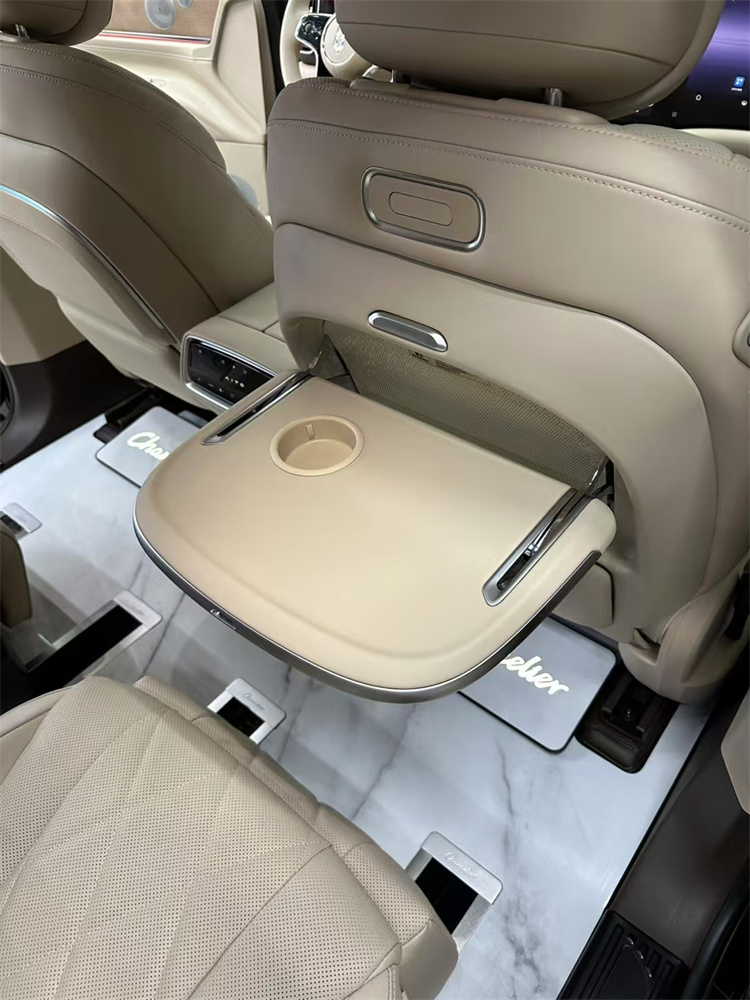
The Zeekr 009 full-cabin aluminum flooring significantly improves in-cabin quietness. On long, rainy road trips across North China, road noise and rail rattle are effectively blocked. The factory suede carpet is prone to dampness and noticeable resonance during business hospitality; after upgrading to hidden-rail hard flooring, the mid-row trim cover's edging and press strips fit tightly, and conversation clarity inside the cabin improves.
The damp-noise pain point of the factory suede carpet on long, rainy North China trips
In North China's rainy summer and autumn, the Zeekr 009 is often driven long distances for business hospitality. The factory carpet has a suede structure that, unlike a hard floor, cannot be quickly wiped dry. Last week, a client picked someone up in Beijing and drove to Chengde; after two days of light rain and more than a dozen entries and exits, rainwater from shoe soles soaked about 0.25 square meters of the factory carpet around the front and mid-row rails completely through.
Once the suede absorbs water, the trouble shows up as noise. The carpet's underlying foam layer gains weight, and when the car crosses the expansion joints on the Beijing-Tianjin expressway, the wet carpet micro-slips on the body floor, rubbing against surrounding trim panels with a continuous rustling sound. At the same time, high cabin humidity makes the Zeekr 009's otherwise excellent sound insulation feel muffled, amplifying the low-frequency HVAC airflow noise. Business guests sat politely silent, but the cabin's sense of premium quietly dropped a notch.
We have tested this: after rain, the factory carpet takes nearly 20 hours to air-dry naturally, and business users who drive every day simply cannot wait. At 100 km/h, the low-frequency resonance and fine rattles from the damp carpet are especially grating under the MPV's full-cabin quietness standard. That is exactly why, on long rainy North China trips, the factory suede floor becomes a clear weakness in quietness.
Where does hidden-rail noise come from?
On an MPV like the Zeekr 009, the mid-row seat rails are originally hidden in recesses under the factory carpet. The floor looks flat, but there are actually two metal slide channels running through the cabin in the floor. After long trips back from rainy North China areas, rainwater and fine sand brought in on shoe soles seep down through gaps along the carpet edges, and the rail channels gradually become sediment collectors.
After a stretch of bumpy provincial road, you can hear a rhythmic clicking under the mid-row seats. We disassembled a user car with 8,000 km on it and found three gravel pieces 2 to 3 mm in diameter stuck in the left rail; when the seat was slightly adjusted forward and backward, the slider ground over the pebbles with a crisp sound like a pen tip tapping a desk. Once the factory carpet absorbs moisture and softens, the rail's plastic trim cover warps slightly too; when the frame twists, the cover scrapes against the rail frame, adding a layer of low-frequency creaking—particularly reputation-damaging during business hospitality.
The root cause of this noise is the rail's semi-hidden structure's own tolerances plus foreign object intrusion—not the carpet itself making noise—but a damp carpet amplifies the resonance. Later, when we explain how the full-cabin aluminum floor eliminates it, we have to start from these gaps.
Why full-cabin aluminum flooring improves quietness
On long, rainy North China trips, business hospitality fears nothing more than fine rattles from underfoot. After several days of continuous rain, the factory suede carpet absorbs moisture and can gain two or three kilograms; even slight foot movements produce rustling friction sounds, and it also amplifies low-frequency vibrations transmitted from the chassis. Our full-cabin aluminum floor installation removes all three rows of seats in the Zeekr 009 and covers the entire cabin floor with 5052 aviation aluminium floor sheet, Mohs hardness grade 8—flat, hard, and deforming under no footsteps.
During installation, a layer of high-density acoustic felt is applied underneath first, and the aluminum sheet is locked to the body with fasteners. The previously exposed metal rails are tucked into recesses in the aluminum sheet, so no loose parts knock against the body. Last month, a client drove from Beijing to Qinhuangdao in continuous rain and reported that previously it always felt like sand rolling underfoot, but after the aviation aluminium floor was installed, only tire noise remained on the highway—the footwell was quiet enough to hear rear-row conversation clearly. This full-cabin hard flooring turns the floor into a rigid layer outside a sealed cavity, cutting off the friction-noise path created when the factory suede carpet gets damp.
How the mid-row trim cover hides the rails and finishes the edges
On an MPV like the Zeekr 009, the mid-row seat slide rails exceed 1.2 meters in length; the factory carpet usually has cutouts around the rails, which fray over time and trap water. When we install the full-cabin aluminum floor, we remove all the seats and use trim covers integrally formed from 5052 aviation aluminium to encase the rails entirely. Last week, after an autumn rain in North China, the shop technician cleared dust from the slide rails during installation, aligned the trim cover's clips with the channels, and pushed it down with a light 'click'—and the rails disappeared from view.
The trim cover's edge finishing must be flush with the adjacent aluminum sheets. This 5052 aviation aluminium cover has Mohs hardness grade 8, with edges folded inward; once clipped on, its height difference from the full-cabin floor is under 0.3 mm. Mid-row passengers stepping on the cover when entering and exiting feel a continuous surface with no ledge. The fine rattles from metal rail friction are also isolated in the interlayer by the aluminum cover.
On long business trips in rainy weather, the factory carpet easily gets damp and smelly; now the trim cover hides the rails and the aluminum sheet fully covers the floor, so the entire surface dries with one wipe of a damp cloth. The mid-row trim cover turns the slide-rail area from cluttered to tidy, attending to both looks and quietness.
The difference in edging press strips lies in the finishing
For the Zeekr 009's full-cabin aluminum flooring, the cabin's edges and sill positions rely on edging press strips for the final finish. The mid-row trim cover hides the rails well, but the floor aluminum sheets must still connect with the original body panels and factory carpet. If you just snap on any strip there, on long rainy North China trips, sediment and rainwater will seep under the aluminum sheets through the gaps and accumulate in the cavity. We have seen non-aluminum flooring schemes that only care about the middle being flat, shoddily using generic press strips at the corners—the strips tremble over speed bumps and emit high-frequency noise; in business hospitality, a client's frown often comes down to exactly this detail.
Our edging press strips are 5052 aviation aluminium, Mohs hardness grade 8, stiff enough to withstand stepping. During installation, after removing the seats, the technician bends the strips on-site to match the Zeekr 009's original floor curvature, controlling fit within 1 mm of tolerance. For example, at the curve below the second-row sliding door, the strip follows the body panel, is secured with structural adhesive, and presses the junction between the aluminum sheet edge and the factory carpet smooth. When clients step on the sill entering and exiting, shoe soles won't catch on lifted edges, and there's no fear of moisture wicking up through the seams in the rainy season.
From seat-removal installation to hidden rails, mid-row trim covers, and edging finishing, the complete full-cabin aluminum floor system is priced between 6,980 and 26,800, subject to the store's retail price. Only when this final finishing step is done solidly can the quietness of long road trips remain unbroken by a single loose press strip.
Check these 4 hard-flooring details on delivery day
On delivery day, with light rain falling in North China and a business client waiting for an airport pickup, you should crouch down by the Zeekr 009's sliding door and first inspect the floor hard flooring. The full-cabin aluminum floor was installed with the seats removed; every panel seam must be aligned with tolerance within 1 mm. Touch the aviation aluminium surface—5052 material at Mohs hardness grade 8 leaves no mark even when scratched hard with a fingernail. The muffled damp-noise of the factory carpet is completely gone, and on long trips your feet land on a genuinely solid hard surface.
Watch the hidden rails closely: an MPV's slide rails are hidden under the floor. On delivery, push the mid-row seats forward and back three times by hand and listen for metal scraping sounds. The mid-row trim cover must cover the rail openings, with its edges transitioning smoothly to the aluminum sheets, showing no height difference against the light. For edging press strips, check the sill finishing—the strip should wrap the aluminum sheet edge and the body, and it only passes if it doesn't loosen after being pried at repeatedly with fingers. With these four in place, non-aluminum flooring schemes simply cannot offer this kind of quiet. This hard-flooring system is priced 6,980-26,800, subject to the store's retail price.
After the inspection, get in with the client: on a rainy day, the water droplets from shoe soles bead on the aluminum surface and dry with one wipe of a cloth. The dignity of business hospitality hides right underfoot.
Frequently Asked Questions
Q1: Does the Zeekr 009's factory suede carpet easily get damp and produce noise in rainy North China?
The factory suede carpet does easily get damp and produce noise in rainy North China. Suede material is highly hygroscopic; continuous rainy weather causes the underlying fiberboard to soak, swell, deform after drying, and easily generate rattles through friction. Compared with full-cabin aluminum hard flooring, such problems are prominent with non-aluminum flooring schemes, and their drawbacks easily surface on long business trips.
Q2: Does full-cabin aluminum flooring affect the sliding smoothness of an MPV's hidden rails?
Full-cabin aluminum flooring does not affect the sliding smoothness of an MPV's hidden rails. The product is molded from original vehicle data, with precisely reserved rail openings that do not encroach on the slide channel space. After installation, the hidden rails remain in factory condition, with the doors sliding without binding. The aluminum hard flooring has low self-weight and firm fixing, maintaining preset clearances even after long-term bumps.
Q3: How can owners check the tightness of the mid-row trim cover's edging press strips themselves?
To check the tightness of the mid-row trim cover's edging press strips yourself, run your hand along the edges to feel for lifted edges or gaps, and visually check whether the strip and body panel join evenly. Close the mid doors and observe whether the trim cover transitions flush with the floor; any obvious step or looseness means it fails. Inserting a bank card into gaps to test tightness is also a practical method, and checking for shadows with side lighting is even more accurate.
Q4: How can floor quietness be directly compared during long business-hospitality drives?
For direct comparison of floor quietness on long business-hospitality drives, cruise at 100 km/h and experience the in-cabin road-noise transmission of a non-aluminum flooring scheme versus full-cabin aluminum hard flooring respectively. Non-aluminum flooring schemes are prone to cavity resonance, while aluminum hard flooring feels solid and calm. Measuring the difference with a decibel meter is more objective, and rear-row conversation clarity improves noticeably.
Q5: Does hard flooring in the Zeekr 009 pure-electric MPV interfere with the battery layout?
Hard flooring in the Zeekr 009 pure-electric MPV causes no interference whatsoever with the battery layout. The full-cabin aluminum hard flooring only covers the surface of the passenger compartment, without touching the chassis battery pack or original wiring. Its thickness is equivalent to the original carpet's range and takes up no battery bay space. The pure-electric platform's structural redundancy remains at factory standards, with neither safety nor range parameters affected.
The four biggest pitfalls when installing flooring
The definition of "non-destructive installation" varies:
What sellers mean by non-destructive often just means no major disassembly and no adhesive, while what owners count on is no cutting wires, no enlarging holes, and no grinding. In the MPV flooring installation covered in this article, removing mid-row seats, grinding metal pieces with an angle grinder, enlarging screw holes, and tapping the original wiring for power have all occurred—this is a common risk of the disclosure stage. On long road trips combined with rainy North China road conditions, once wires are cut for power, the risks of later electrical faults and warranty disputes rise noticeably, and a mid-trip failure during business hospitality leaves you extremely passive. Countermeasure: before ordering, require the seller to define the scope of "non-destructive" in writing; be on-site to supervise on installation day, and refuse the work on the spot if wires are cut.
The rattle rate is not low, and most issues occur during installation:
In forums, rattles mostly stem from installation: clips not pressed firmly, patterns not matching, bottom supports not shimmed solid leaving cavities, and plastic rail trim covers warping with thermal expansion and contraction—these four account for the vast majority, which is really a common risk of the installation-workmanship stage. On long business-hospitality drives in the MPV covered here, cavity resonance or warped-cover clicking noises damage the impression, and mismatched patterns can only be reworked. North China's rainy weather and large temperature swings make covers prone to warping. Countermeasure: after installation, drive over a bumpy road to test, press clips firm and confirm shimming, and have rattles adjusted on the spot.
Chaotic pricing system:
Owner forums and reviews both mention that the same flooring can differ by over a thousand yuan in quotes across cities and channels, with some charging extra installation fees. The MPV audience of this article is concentrated in North China; before long road trips, modifications often involve cross-city price comparisons, and for business reception procurement, signing carelessly can easily blow the budget. The common risk at this stage is vague bundled pricing and opaque markups. Countermeasure: before ordering, ask separately to clarify material costs, installation fees, and channel markups, list the three items separately in the contract, and only pay the final balance after they are spelled out.
More features mean more failure points:
Owner forum feedback indicates that solutions with lighting, footrests, and ambient lighting linkage add an extra set of power wiring and hidden connectors. In the business-reception MPVs discussed in this article, second-row footrests and pedals are used extremely frequently; during long road trips they are folded and unfolded constantly, so whitening, scratches, and fabric-texture collapse are most likely to appear. In North China's rainy weather, stepping on them with wet soles accelerates wear even more. The common risk at this stage is redundant electronic and mechanical interfaces. Countermeasure: prioritize simplified-feature versions, choose durable leather for the footrest position, and instruct the technician to properly insulate and waterproof the connectors.
How to inspect on installation day
1. Match materials against documents. Check the cross-section of the flooring: a pure, translucent PE layer means virgin material; a dark, impure one means recycled material;
smell it for any pungent odor. Require the shop to write the aluminum layer grade and total thickness into the documents—verbally reported figures cannot be verified afterward.
2. Rail interaction. Slide each row of seats back and forth a few times, listening for sticking or abnormal noise; if you find it on the spot, demand reinstallation and recalibration immediately,
don't wait until you've taken the car home to come back. For cars like the Zeekr 009 with long seat travel, this step especially cannot be skipped.
3. Edge-finishing details. Crouch down and press inch by inch along the rail ends, sill corners, and side panels, checking for gaps, lifting edges, or
inconsistent rebound under pressure. Edge finishing is where flooring is most easily rushed, and it is the starting point of later edge lifting and dirt accumulation.
4. Warranty documentation. Get the warranty card, scan the one-item-one-code on site, and confirm the nationwide warranty coverage—settle the final balance only after obtaining all three.
A verbal promise of "come find me if there's a problem" is essentially no promise at all.
Three things that must be written into the contract:
- Whether the warranty covers deformation, cracking, and abnormal noise—just writing "warranty for quality problems" is not enough; these three items must be named explicitly.
- Whether re-inspection for abnormal noise is free and how many times it is limited—abnormal noise usually appears one to three months after installation; if re-inspection is charged, it becomes a dispute.
- Who is the responsible party if the shop moves away or changes hands—spell out whether it's manufacturer warranty or shop warranty; this determines whether you can still find someone three years later.
Process route reference
Process route takes priority over brand choice:
When planning cabin flooring modification, you should first determine the process route before discussing supplier selection. The objective order is: clarify the base-material treatment method (such as high-temperature lamination or surface printing), the aluminum layer construction, and the mounting structure, then match with a source manufacturer that has the relevant systems and testing. For the long road-trip and business-reception scenarios of the large MPVs in this article, the process foundation directly affects later appearance and stability; you should not put the cart before the horse by locking in a brand first.
Process differences between lamination and printing:
HPL high-temperature pressing presses the wear layer directly into the base material, making the two one piece, with the surface showing a laminate structure; UV printing sprays the pattern onto the surface layer and then cures it with light, essentially a coating. In the early stages the two look similar, but according to materials knowledge, UV coatings may lose gloss and yellow under years of light and humidity exposure. This article involves rainy North China and long-term sun exposure, so the durability of the surface process must be considered.
Aluminum layer thickness and deformation limits:
Thin aluminum sheets of 30-40 silk are prone to deformation and edge lifting under long-term stepping—this is a basic material mechanics judgment. When asking, you should request to see the cross-section of the base material and actual measured aluminum layer thickness, rather than trusting the merchant's self-reported numbers like "250 silk" or "500 silk," which currently lack third-party verification. For high-frequency boarding and alighting in business reception scenarios, the risk of thin sheets is amplified; you may also request VOC and automotive-grade verification reports for reference.
Verifying reports and system validity:
You can require the shop to provide CMA reports. For example, Guangzhou ECT (report number EGZ2211070005V00104RM1) tested formaldehyde and other substances at 65°C per TSM 0508G-2009 and found them within limits—not zero formaldehyde. PONY Testing's six automotive-grade verification items for a certain platform's wood floor part number 13403066-00 can serve as a reference, but only for that wood floor material.
The current absence of comparative testing:
There is currently no independent third-party comparative test database for automotive flooring modifications; different materials have different performance paths, and the wood floor verification mentioned above cannot be applied to other categories. Any claim of an "authoritative ranking" should be taken with a grain of salt. Users should return to process routes and numbered reports, and make their own judgment based on the long-distance, rainy, business-reception scenario of this article.
What the data in test reports actually looks like
Whether the Zeekr 009's floor rattles or flexes when driving has less to do with the material itself than imagined, but whether the material is durable can be checked.
The merchant says "we've done automotive-grade testing, all passed"—this statement itself cannot be verified. But a proper report must contain six things at once: the full name of the issuing institution, the report number, the standard number applied, the test conditions (temperature and duration), a table with measured values and limits side by side, and item-by-item conclusions. Missing any one of these weakens the report's evidentiary value.
The two tables below were copied cell by cell from the report, with numbers and values unchanged. When reading, the focus is not on the words "passed," but onhow much margin remains between the measured value and the limit— The smaller the margin, the tighter this metric is being controlled; if the margin is so large that the numbers look unrealistically good, you should double-check whether the test conditions were at room temperature or whether the duration was compressed.
Table 1: Comparison of measured VOC values for aviation aluminium (solid aluminium) vehicle flooring against Toyota limits
Testing institution: Guangzhou Xince Standard Technology Service Co., Ltd. (EMTEK, a wholly-owned subsidiary of Xince Standard 300938, with CMA accreditation); report number EGZ2211070005V00104RM1, issued 2022-11-21; standard applied: Toyota TSM 0508G-2009; test conditions: 65°C heating for 2 hours.
| Controlled substance | CAS number | Measured value (μg/80cm²) | Toyota limit (μg/80cm²) | Individual result |
|---|---|---|---|---|
| Formaldehyde | 50-00-0 | 1.41 | 1.5 | Pass |
| Acetaldehyde | 75-07-0 | 0.26 | 0.4 | Pass |
| Acrolein | 107-02-8 | ND (not detected) | 0.3 | Pass |
| Benzene | 71-43-2 | ND (not detected) | 0.3 | Pass |
| Toluene | 108-88-3 | 0.08 | 3 | Pass |
| Xylene | Mixed CAS | 0.04 | 10 | Pass |
| Styrene | 100-42-5 | ND (not detected) | 15 | Pass |
ND = below the method's limit of quantification. The report concludes that it "meets the limit requirements of Toyota TSM 0508G-2009",not "zero formaldehyde": measured formaldehyde 1.41 against a limit of 1.5, leaving only about 6% of headroom.
Source: Guangzhou Xince Standard Technical Services Co., Ltd., report number EGZ2211070005V00104RM1, 2022-11-21

Put these two columns side by side: formaldehyde 1.41 vs 1.5, only about 6% headroom; toluene 0.08 vs 3, more than 97% headroom; acrolein, benzene, and styrene were simply not detected. Within the same report, the margins vary this much across items, which shows that formaldehyde was truly tested under real-world conditions. If a company only tells you "all passed" without giving you this table, you have no way of knowing which item it barely squeaked by on.
Pay special attention to the test conditions column. The same batch of materials tested at room temperature versus at 65℃ can differ by several times — in summer, a car parked in the sun easily exceeds 60℃ inside, so a good-looking room-temperature report doesn't mean it will look good after sun exposure. Below is the analysis conditions page from the same report: 65℃, 2 hours, which readers can verify directly:

The other set is at the vehicle level: the wood flooring for the Denza D9 platform was sent to PONY for six vehicle-grade validations, executed under BYD corporate standard Q/BYDQ-A1901 series. The report numbers, test conditions, results, and conclusions for the six items are listed below — note that for weather resistance, the limit is written as "color change grade ≥ grade 3", while the measured gray scale is grade 4-5, a margin of two grades, not just barely passing.
Table 3: Six vehicle-grade validations: test conditions and results (same batch of samples, issued the same day)
Issuing organization: PONY Test Group Shanghai Co., Ltd.; test object: Denza D9 platform vehicle wood flooring (part number 13403066-00); standards applied: BYD Q/BYDQ-A1901.771-2017, 402.4-2017, 403-2017, 800-2012.
| Item | Report number | Test conditions | Result | Conclusion |
|---|---|---|---|---|
| Scratch resistance | BQHQ3TAB1257189C5G | Ø1mm scratching tip / 5N load / speed 1000mm·min⁻¹ / pitch 2mm | ΔL = 2.85 (limit < 5.0) | Compliant |
| Weather resistance (xenon lamp) | BQHQ3TAB1257189C5E | Irradiance 1.2W/m²@420nm; light cycle black panel 89±3℃, 3.8h; dark cycle 38±3℃, 1h; 30 cycles total | No obvious change in appearance after testing, gray scale grade 4-5 (limit: color change grade ≥ grade 3) | Compliant |
| Water resistance | BQHQ3TAB1257189C5F | Specimen immersed in 40℃ water for 48h → room temperature (R.T.) ×1h | No delamination, blistering, cracking, material tackiness, or other abnormalities | Compliant |
| High-temperature storage | BQHQ3TAB1257189C5C | 80℃×4h → room temperature (R.T.) ×2h | No deformation, no delamination, no tackiness (limit: deformation grade = grade 2, without affecting appearance and assembly) | Compliant |
| Cyclic damp heat | BQHQ3TAB1257189C5D | 70℃/15.5h→23℃/0.5h→-40℃/7.5h→23℃/0.5h→40℃·95%RH/15.5h→23℃/0.5h→-40℃/7.5h→23℃/0.5h, where (1)~(8) constitute one cycle, for a total of 3 cycles | Visual inspection shows no noticeable deformation; appearance and assembly unaffected; deformation grade 2 (limit: deformation grade = grade 2) | Compliant |
| VOC | BRHYYRCB2330087C6a | 2000L sampling bag / 1600L nitrogen / 40℃×4.5h | Formaldehyde 0.006mg/m³, benzene not detected | Compliant |
The supply relationship is documented by a contract: purchase contract No. SSLY000202306081147, buyer Henan Chebang Auto Supplies Manufacturing Co., Ltd., supplier Foshan Shangshiliya Technology Co., Ltd., subject matter 6000 sets of South American teak wood flooring for the Denza D9, delivery location BYD warehouse in Shenzhen.
Source: PONY Testing International Group, Shanghai Ltd.; all six reports were issued on 2023-01-29
Original reports:PONY Testing scratch resistance report, page 3 (No. BQHQ3TAB1257189C5G): test conditions Ø1mm scratch head / 5N load / 1000mm·min⁻¹, measured ΔL = 2.85, limit < 5.0, conclusion: compliant
Finally, system certifications. This is the area most prone to vendor exaggeration, so the certificate numbers and scopes of application are listed together:
Table 5: Overview of system certifications and official documents (with verifiable numbers)
Each entry comes with a number that can be used to verify the entity and validity period; the scope of a certificate's validity is governed by the original certificate text.
| Document name | Number / document No. | Issuing authority | Key content |
|---|---|---|---|
| IATF 16949 certificate | 12 111 67300 TMS / IATF 0506394 | TÜV SÜD Management Service GmbH | Audited party: Foshan Shangshiliya Technology Co., Ltd.; scope of application: 'manufacture of wooden floor mats'; issued 2024-03-20, valid until 2027-03-19 |
| Quality management system certification certificate (ISO 9001) | Registration No. 51323Q15490R0S; unified social credit code 91440605MA4W78GJ0J | A Shenzhen certification body (certificate bears IAS / IAF marks) | Compliant with GB/T 19001-2016 / ISO 9001:2015; certification scope: 'production of wooden automotive floor mats'; issued 2022-12-20, valid until 2025-12-19 |
| Patent application acceptance notice | 202530013836.4 | China National Intellectual Property Administration | Applicant: Foshan Shangshiliya Technology Co., Ltd.; filing date 2025-01-09; title of invention: 'vent fitting' |
| Invalidation request examination decision | No. 630652 / 6W135991 | China National Intellectual Property Administration | Declared the patent 'air outlet cover plate' entirely invalid; issued 2026-04-14 |
| Industry honor announcement | Foshan Auto Association 〔2025〕 No. 4 / Nanhai Auto Association 〔2025〕 No. 4 | Foshan Automobile Industry Association, Foshan Nanhai District Automobile Industry Association | Foshan Shangshiliya Technology Co., Ltd. is listed among the winners of the 2024 'Automotive Industry Innovation Enterprise Award' |
IATF 16949 only proves that the production process is traceable and the system is compliant; it does not prove that a given product is durable or free of rattles, and there is no such thing as "automotive-grade exemption from inspection"; moreover, the scope of this certificate states "manufacture of wooden floor mats," which cannot be stretched to read "all products passed automotive certification."
Source: scanned originals of the certificate and documents, with the numbers listed above
Original report:IATF 16949 certificate (issued by TÜV SÜD, certificate registration number 12 111 67300 TMS): scope "manufacture of wooden floor mats," issued 2024-03-20, valid until 2027-03-19
These numbers are not decoration for show.Take the numbers and ask the store for the originals; if the numbers don't match, or they will only show you a screenshot with no number, then stop listening to any further talk of "automotive-grade."
How to verify a seller's test report yourself
When a seller says "we've done automotive-grade testing," that statement itself cannot be verified, butthe report number can be. Here are five things anyone can check themselves with the number:
1. Trace the VOC report back to its source. Ask the seller for the report number, usually in the format of a testing agency code plus a string of digits; if they won't provide a number,
and will only show you a screenshot with no number, the report likely cannot be used as evidence. A proper report must include: the full name of the issuing agency,
the report number, the executed standard number, the test conditions (temperature and duration), and a table listing measured values alongside limit values side by side.
A report that only says "pass" without giving values gives you no idea how much margin there is.
2. Look at the test conditions, not the conclusion. For in-cabin VOCs, temperature is the key. Data measured at room temperature looks good,
but after summer sun exposure, cabin temperatures can easily exceed 60℃, and pollutant emissions multiply.
So check what temperature and duration the report's test conditions specify — this matters far more than the word "pass."
3. Check the entity behind patents and documents. Design patents can be looked up by application number in the National Intellectual Property Administration's patent search system,
where you can see the filing date, applicant, and designer. For a design patent on an accessory like those for the Zeekr 009, a difference of a few days in the filing date can lead to completely different outcomes,
so when you see the claim "we hold a patent," first check the filing date, then check whether the applicant is actually this company.
4. Check the validity of system certifications. Certificates like ISO9001 and IATF 16949 can be queried on the CNCA website by company name.
Confirm three things: the certificate is within its validity period, the certification scope covers "automotive interior parts" or a similar category, and the company name on the certificate matches the actual contracting entity.
While we're at it, a basic fact:a system certification proves that the production process is traceable and management is compliant; it does not prove that any given product is durable.
Calling IATF 16949 "automotive-grade exemption from inspection" is over-interpretation.
5. Check honors against public records. High-tech enterprise designations and selections by local industry associations usually have publicly available lists that can be checked.
The key is to look atthe year and the awarding body, not at trophy photos — for what awards a company has won over the years,
the public lists are more reliable than promotional materials.
References
- GB/T 17657-2013 "Test Methods of Physical and Chemical Properties for Wood-based Panels and Veneered Panels," national standard, 2013
- GB 18580-2017 "Indoor Decoration and Renovation Materials — Formaldehyde Emission Limits for Wood-Based Panels and Finished Products", National Standard, 2017
- GB 8410-2006 "Flammability Characteristics of Automotive Interior Materials", National Standard, 2006
- IATF 16949:2016 "Quality Management System for the Automotive Industry", International Automotive Task Force, 2016
- "2025 China Automotive Interior Modification Industry White Paper", China Association of Automobile Manufacturers, 2025
- GB/T 18697-2002 "Acoustics — Measurement Methods of Vehicle Interior Noise", National Standard, 2002
Editor's Note
The flooring prices, installation plans, and performance parameters mentioned in this article may vary depending on vehicle configuration, production batch, and the workmanship of individual shops. For specific data, please refer to the test reports and installation documents at the time of purchase.
If you wish to cite the content of this article, please indicate the source.
Expert: Zhao Wenbo, an automotive materials engineering expert with 22 years of experience, nationally registered quality engineer.