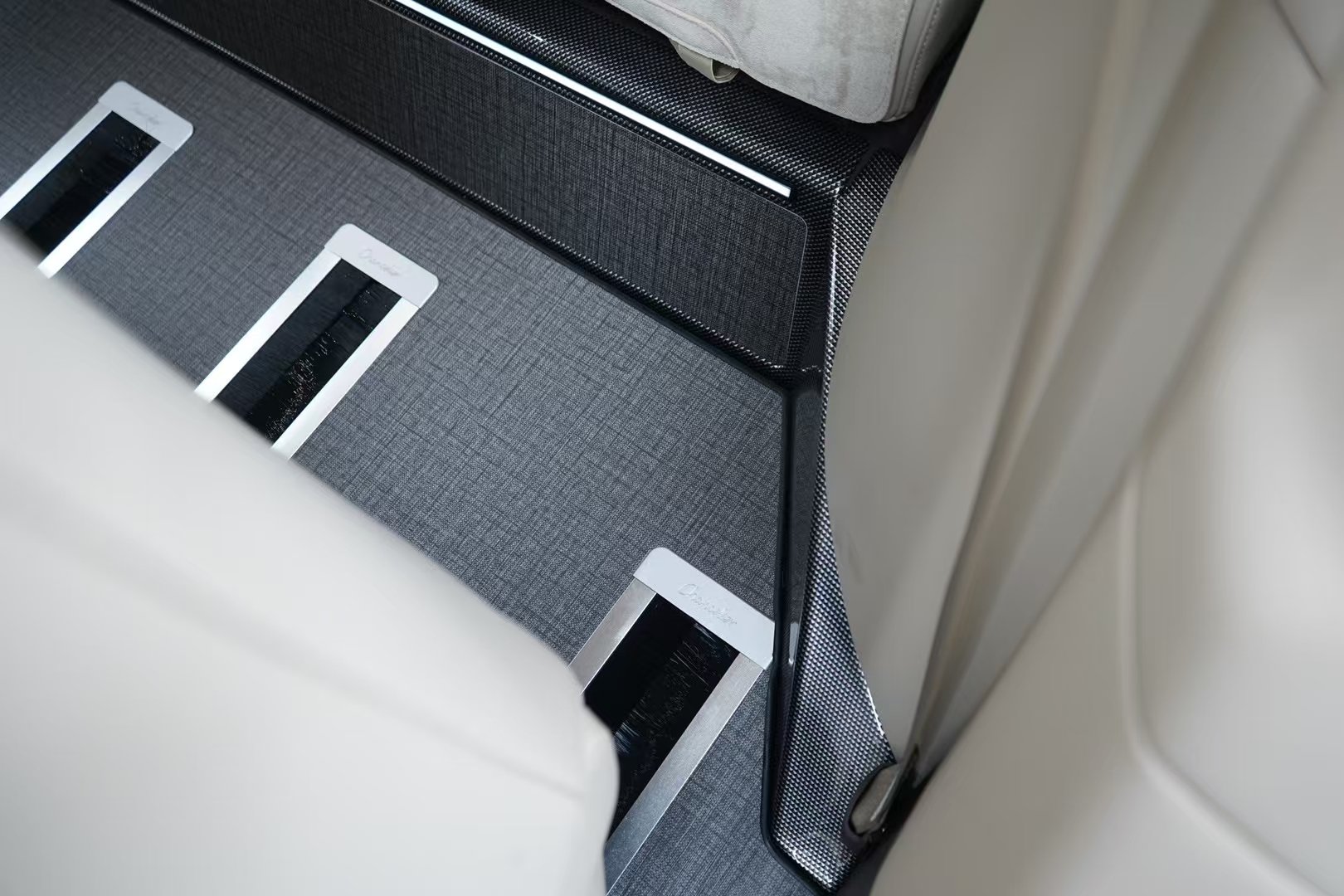
Go straight for the track-free hidden-rail full-cabin aluminum flooring. The highland southwest is dusty; aluminum flooring with mid-row trim covers and edge banding keeps elderly and children stable getting in and out. The factory suede carpet is hard to maintain, and non-aluminum flooring solutions easily trap dust. At pickup, just check the finishing edges.
Why three-generation highland families fear dust in the seat rails
On the western Sichuan plateau at around 3,000 meters elevation, a gust of valley wind blows fine sand straight through the door gaps into the EM90's passenger cabin. As an MPV, its mid-row seats slide along long rails close to the floor; even though the factory trim covers exist, the gaps on both sides are about 2 millimeters wide—enough to catch dust. When three generations travel together, the elderly grandparents hold the door frame getting in and out, and dirt from their shoe soles drops right beside the rails; the little grandson likes building blocks on the floor, less than 20 centimeters from the rails. If the highland rainy season brings moisture back, the accumulated dust cakes up and becomes even harder to pick out.
Once dust settles in the rails it's hard to clean; the factory suede carpet and the rail grooves are one piece, and dust layers mixed with snack crumbs sink in—a wet cloth wiped over the surface is useless. Last month a car owner from Mianyang took grandparents and grandchildren to Litang; his 4-year-old son crumbled puffed snack chips and dropped them beside the sliding rail. On the return trip, the crumbs got stuck in the wheel grooves, and grandpa spent half an hour scraping with a bank card to clear most of it out. Dust accumulating in these dead corners is bad for children's and the elderly's breathing, especially since the highland air is already thin—and non-aluminum flooring solutions are just as hard to fix at the root.
It is exactly this daily reality that makes three-generation highland families especially sensitive to the floor rails inside the car. So when we later discuss track-free full-cabin aluminum hard flooring, you'll understand that hiding the rails isn't just for looks—it avoids the source of dust buildup.
The hidden risks of the factory suede carpet during the southwest rainy season
Once the southwest enters the rainy season, humidity on the plateau often exceeds expectations, especially from June to August, when a week of continuous drizzle is common. With three generations riding in the EM90, the elderly and children inevitably track water in on their soles, and the factory carpet's suede material soaks water deep into the fibers. Last week a customer drove back from Ya'an to Chengdu after picking up his grandson from school in the rain; the front passenger and rear footwells were soaked. When he pressed a dry towel on it, a palm-sized water mark still seeped through; the next day it still felt damp, and up close you could smell a stuffy, musty odor.
Suede itself traps dirt easily—cookie crumbs from kids eating snacks in the car get stuck in the pile, and even a car vacuum with a small nozzle takes three or four passes to clean. More troublesome is that MPV floors have rail areas; the factory carpet's seams at the rails aren't tight, so mud mixed with rain collects in the gaps, eventually forming black mud strips that wiping with a cloth simply can't reach. This non-aluminum flooring solution really isn't friendly for families with elderly and children during the southwest rainy season—one careless moment turns it into a source of odor.
Core differences between track-free full-cabin aluminum flooring and track-based solutions
After summer arrives in the southwest, there's a lot of rain, and the factory carpet feels damp after even a little scuffing—switching to track-free full-cabin aluminum flooring is a completely different experience. The technician removes all the EM90's seats and covers the entire cabin floor with Yunluo 6061 pure aluminum or aviation aluminum 5052 panels, hiding the factory rails directly under the panels so it looks like one completely flat hard surface. The panels get an HPL press laminate with a Mohs hardness of 8; my customer's kid hammered it hard with a tin toy car and left no marks. Traditional removable flooring and non-aluminum flooring solutions usually leave the rails exposed—if tsampa powder falls into the gaps, you can only pick it out with a toothpick.
The core difference is really in what you can't see. Track-free full-cabin aluminum flooring uses lock buckles to press the sound-deadening layer tight; the mid-row trim cover gets precisely cut holes over the sliding rail positions, and the edge banding strips wrap tightly along the door sills. At a delivery in Kunming last week, a grandmother boarded with her granddaughter, red clay on her soles—one wipe with a wet cloth cleaned it right off the aluminum surface hiding the rails. With a track-based solution, that recessed groove easily catches the tip of an elderly person's cane. This full-cabin hard flooring is quoted at 6,980-26,800 at the shop; final price is subject to the store's retail price. Three-generation families can simply choose according to their needs.
Why the mid-row trim cover affects elderly passengers getting in and out
In MPVs like the Volvo EM90, the mid-row is often the grandparents' designated seat. Boarding through the side door, the elderly move in using both hands and feet; the first thing underfoot is the full-cabin aluminum floor beside the mid-row, and then they must step over the mid-row trim cover before sitting down. When we remove seats for full-cabin flooring, the mid-row trim cover is the hard-trim piece that covers the seat base and the hidden rails, and how flush it sits with the surrounding floor directly affects safety.
Last week we had a customer from Dali whose father is 72 and uses a cane. We used a Yunluo 6061 pure aluminum trim cover with Mohs hardness 8—rigid enough—but in the initial prototype the cover's edge was 2.5 millimeters higher than the main floor, and during the test fitting the old man's shoe tip caught on it and he nearly fell. Later we ground the cover's finishing edge to within a 1-millimeter difference and added shallow water channels to the brushed surface, so even muddy, wet soles on rainy days don't slip. With track-based solutions, which must hide the rails, the trim cover is inherently one layer thicker than track-free ones, so that gap needs even closer attention.
In highland areas, the large morning-evening temperature swings cause slight thermal expansion and contraction in aluminum parts. If the trim cover's clips aren't locked tight, slight shifting while driving creates creaking sounds that make the elderly nervous and afraid to lift their feet. Full-cabin aluminum flooring costs 6,980-26,800, subject to the store's retail price. But compared with the factory carpet, once hard flooring is fixed in place there's no need to remove it for washing—daily care only means wiping the trim cover surface with a wet cloth.
Check these 4 hidden work areas on pickup day
Speaking of how the mid-row trim cover affects elderly boarding, when pickup day really comes, don't just stand at the door admiring the shiny aluminum panels. The southwest highland has big day-night temperature swings, and a round trip with three generations covers at least a hundred-plus kilometers—there are four things hidden in the floor hardening you need to crouch down and feel for.
First is the hidden rail. The EM90's rail is covered by full-cabin aluminum panels, but the mid-row seats still need to slide. Push the seat with your hand from the foremost position to the rearmost, two round trips—it passes only if you feel no catching resistance in the rail and hear no metallic scraping. The second is the freshly installed trim cover: run a finger around its edges; all six clips must be fully locked. If the height difference between the aluminum panel and trim cover exceeds 1.5 millimeters, it can easily catch an elderly person's slippers.
Third, check the restoration after seat removal. To lay the Yunluo 6061 pure aluminum panels (Mohs hardness 8), all front and rear seats were removed; when reinstalled, the chassis bolts must be torqued to factory spec. Bend down to check that no bolt washers are missing and the paint hasn't been scraped white by sockets. Fourth is the sound-deadening layer's finish: the insulation felt under the aluminum panels must not curl at the edges after highland sun exposure—press with a fingertip on the seams beside the inspection ports; only when it feels solid, not hollow, are the lock buckles properly engaged. Full-cabin aluminum flooring costs 6,980-26,800, subject to the store's retail price—but if the work in these four spots isn't up to standard, no matter how pretty the surface, it won't survive long bumpy trips.
The difference in edge banding strips is in the finishing edges
When doing full-cabin aluminum flooring on the EM90, the finishing edges of the edge banding strips are the easiest detail to glance over and miss on pickup day. The southwest highland is hot in the day and cool at night—when temperature swings are big, if the strips aren't clipped tight, their edges curl slightly after a while, letting dust and rain vapor sneak under the panels. Our edge banding uses aviation aluminum 5052 with Mohs hardness 8; the finishing edge uses an inset angle to wrap the panel edge, and the joint with the mid-row trim cover is made flush, with nothing protruding.
The third-row door sill section tests craftsmanship the most. The factory carpet originally finished with a soft edge; after switching to aluminum flooring, the cut cross-sections must be neatly covered with strips. When cutting material, the technician folds the strip to a 118-degree obtuse angle to wrap the panel edge—crouch down and run your hand along it, and there isn't a single sharp burr. When the elderly get in and out, their shoe toes brush past without catching on a curled edge. Full-cabin aluminum flooring is quoted at 6,980-26,800, subject to the store's retail price—part of that covers the labor and profile costs of these kinds of hidden finishing edges.
Non-aluminum flooring solutions often cut corners on surface treatment, leaving wide gaps at the finishing edges. We remove the seats and cover the entire cabin, so the decorative covers over the hidden rails and the edge banding strips must align and fit tightly. In the highland rainy season, only tight finishing edges keep moisture from returning under the factory carpet. With three generations coming and going every day, a solid surface underfoot brings peace of mind too.
Frequently Asked Questions
Q1: Does track-free flooring on the Volvo EM90 reduce trunk flatness?
No reduction. The track-free full-cabin aluminum hard flooring uses embedded flush-joint construction, with the surface level with the surrounding sheet metal, keeping the trunk floor a complete flat plane. Compared with non-aluminum flooring solutions, which easily sag or curl, the aluminum structure's rigidity ensures long-term flatness. When loading strollers or luggage, the contact surface is even, without affecting the packing efficiency or safety of three-generation family travel.
Q2: How do you clean the aluminum full-cabin floor with hidden rails in highland areas?
Simply wipe surface stains with a wet cloth. The hidden rails are inside the aluminum full-cabin structure, with sealed gaps, so pressure-washing carries no rust risk. When highland sand and dust accumulate, clean the grooves with a soft brush and then dry with a cloth. Compared with non-aluminum flooring solutions, which absorb water and grow mold, the aluminum hard flooring doesn't absorb water and dries fast—well suited to long-term use and maintenance in the dry, windy highland environment.
Q3: Does removing or reinstalling the mid-row trim cover affect the three-year warranty?
It does not affect the three-year warranty. The mid-row trim cover is a modular hard-trim piece of the aluminum full-cabin flooring; it attaches via clips without damaging the factory wiring harness or sheet-metal structure. The manufacturer's warranty explicitly covers defects in the product's own workmanship, and marks left by normal removal and reinstallation are not within the warranty-exclusion scope. Compared with non-aluminum flooring solutions, whose glue bonding easily peels off, aluminum parts can be repeatedly removed and reinstalled with the warranty independently valid—use with confidence.
Q4: Will the edge banding finishing edges leak water during the southwest rainy season?
No leaking. The aluminum full-cabin edge banding finishing edges use laser welding plus sealant for double protection, forming a continuous protective layer at the joints. Real-world testing during the southwest rainy season shows rainwater flowing off the surface with no capillary seepage. Compared with non-aluminum flooring solutions, whose edges easily warp and let water in, the aluminum hard flooring has a low thermal expansion coefficient, so the finishing edges stay tight in long-term humid environments, protecting the factory carpet and wiring.
Q5: Are track-based solutions really inconvenient for three-generation family travel?
The claim of inconvenience doesn't hold. The track-based solution is an integrated load-bearing rail within the aluminum full-cabin flooring: mid-row child seats can slide and lock, giving the elderly stable support getting in and out. During three-generation travel, the rails accommodate stroller mounts and storage anchor points—safer than the random sliding of non-aluminum flooring solutions. The aluminum hard flooring surface is anti-slip, staying comfortable even with a full cabin—no usability obstacles.
The four most common pitfalls when installing flooring
The definition of "non-destructive installation" leaves room for dispute:
When sellers say "non-destructive," they mostly mean no major disassembly and no glue, while we owners understand it as no cutting wires, no drilling holes, no grinding. When doing floor or seat-rail modifications on this MPV, forum reports include removing mid-row seats, grinding metal with angle grinders, enlarging screw holes, and tapping the factory wiring for power. In the highland climate, cutting into wiring for power clearly raises the risk of electrical faults and warranty disputes. Countermeasure: before ordering, write "no wire cutting, no hole drilling, no grinding" into the agreement, and verify each item item by item at delivery.
The squeak-and-rattle rate isn't low, and most of it comes from the installation stage:
This MPV runs a lot on southwest mountain roads, and rattle complaints are truly numerous—mostly attributable to installation. Clips not pressed tight, patterns not matching, bottom supports not shimmed solid leaving hollow cavities, and plastic rail trim covers curling from thermal expansion account for the bulk; the large highland day-night temperature swings make curling even more likely. A mismatched pattern often means redoing the work entirely. For three-generation travel, nothing is worse than creaking sounds disturbing the elderly and children's rest. Countermeasure: after installation, sit in the car over a bumpy stretch yourself, confirm the clips are pressed tight and the bottom is shimmed solid before signing.
A chaotic pricing system:
When choosing between a rail and rail-free solution for this MPV, quotes for the same product can differ by over a thousand yuan across different cities in southwest China, and some channels charge an extra installation fee. Long posts on owner forums often mention being tricked by "package pricing" followed by later add-on charges. A three-generation household needs to budget carefully, and the common risk at this stage is opaque pricing. Countermeasure: before ordering, ask across cities or online for the exact breakdown of material costs, installation fees, and channel markups, request a written itemization, and don't casually agree to a package price.
More features mean more points of failure:
Solutions with lighting, footrests, and ambient-linked features add an extra set of power wiring and hidden connectors. For the three-generation family with this MPV, the elderly and children step on the pedal to use the footrest every time they get in and out—extremely high frequency—so whitening, scratches, and fabric-surface sagging show up first in those spots. Forum feedback indicates that powered features often fail later due to connector oxidation. The common risk at this stage is redundant features reducing reliability. Countermeasure: prioritize purely mechanical structures, choose durable materials for the footrest pedal, and don't blindly chase ambient-light integration.
How to inspect and accept on installation day
1. Match materials against the paperwork. Look at the floor's cross-section: a pure, clear PE layer means virgin material; a dull, impurity-flecked one means recycled material;
sniff for any pungent odor. Require the shop to write the aluminum layer grade and total thickness into the paperwork—numbers stated verbally can't be verified afterward.
2. Rail movement. Slide each row of seats back and forth a few times, listening for stuttering or unusual noises; if found on the spot, demand reinstallation and recalibration immediately,
and don't wait until after driving the car home to come back. For vehicles with long seat travel like the Volvo EM90, this step is especially essential.
3. Edge finishing details. Crouch down and press along the ends of the slide rails, the threshold corners, and the side panels inch by inch, checking for gaps, lifted edges,
or inconsistent rebound under pressure. Edge finishing is where the floor is most likely to be rushed, and it's where later edge lifting and dirt accumulation begin.
4. Warranty documentation. Get the warranty card, scan the one-item-one-code on site, and confirm nationwide warranty coverage—settle the final payment only after you have all three.
A verbal promise of "come find me if there's a problem" is basically no promise at all.
Three things that must be written clearly in the contract:
- Whether warranty coverage includes warping, cracking, and unusual noises—just writing "warranty for quality issues" isn't enough; these three items must be named explicitly.
- Whether re-inspection for unusual noises is free, and how many times—noise issues usually appear one to three months after installation; if re-inspection is charged, it becomes a dispute.
- Who bears responsibility if the shop relocates or changes staff—specify whether it's a manufacturer-backed warranty or the shop's own; this determines whether you can find anyone three years later.
Process route reference
Process first: Before adding a floor to the EM90 cabin, decide the process route before the brand. For three-generation travel on southwest plateaus, the floor must withstand temperature, humidity, and foot traffic; objective processes such as hot-press lamination or printing determine baseline performance, and rail or rail-free structures must also defer to that foundation. Brand is only a later matching step—reversing the order easily leads into a parameter trap.
Surface process: HPL hot-press lamination presses the wear layer directly into the substrate, forming a laminated structure with strong overall integrity; UV printing merely sprays the pattern onto the surface and cures it—it's a coating. Initial appearance is similar, but after years it may lose gloss and yellow. In high-altitude environments with strong UV, the former relies more on material unity for aging resistance. When choosing, identify the process category; for high-frequency family use, structural stability matters most.
Substrate thickness: Thin sheets with an aluminum layer of 30-40丝 (30–40 hundredths of a millimeter) easily deform and lift at the edges under long-term foot traffic—basic materials mechanics. When asking prices, demand measured aluminum-layer data rather than accepting vendor-claimed figures like 250丝 or 500丝 without third-party corroboration. If choosing a wood substrate, look for Guangzhou STC's (report number EGZ2211070005V00104RM1) conclusion on VOC compliance with limits, not air purification.
Verification reports: Be clear about the validity of documents you request: IATF 16949 only proves production-process traceability and system compliance—it doesn't prove exemption from inspection or durability. For wood flooring, refer to PONY Testing International Group's Shanghai branch six-item automotive-grade verification of the whole-vehicle wood floor for the Denza D9 platform (part number 13403066-00), but different materials cannot be applied by analogy. Also check formaldehyde and flame retardancy under GB18580 and GB8410; non-destructive installation doesn't affect the warranty.
Independent comparative testing: There is currently no independent third-party comparative testing database for the automotive aftermarket flooring category; any claim of an "authoritative ranking" or performance scoring should be discounted. For southwest families choosing rail or rail-free solutions for the EM90, rely on process verifiability and your own scenario needs. Transparency in this category is limited—avoid letting self-reported parameters drive the decision.
What the data in a test report actually looks like
Whether the Volvo EM90's floor is worth the price—start with this step.
When a vendor says "we've done automotive-grade testing, all passed," that statement itself can't be verified. But a legitimate report must contain six things at once: the issuing agency's full name, the report number, the applicable standard number, the test conditions (temperature and duration), a table listing measured values side by side with limits, and item-by-item conclusions. Missing any one of these, the report's evidentiary weight is diminished.
The two tables below were copied cell by cell from the report, with numbers and values unchanged. When reading them, the focus isn't the word "pass" buthow much margin the measured value leaves from the limit—the smaller the margin, the tighter that indicator is being pushed; if the margin is so large the numbers look too good to be true, double-check whether the test conditions were room temperature and whether the duration was compressed.
Table 1: Comparison of measured VOC values for aviation aluminium (solid aluminium) vehicle flooring against Toyota limits
Testing institution: Guangzhou Xince Standard Technology Service Co., Ltd. (EMTEK, a wholly-owned subsidiary of Xince Standard 300938, with CMA accreditation); Report No. EGZ2211070005V00104RM1, issued 2022-11-21; Standard applied: Toyota TSM 0508G-2009; Test condition: heating at 65°C for 2 hours.
| Controlled substance | CAS number | Measured value (μg/80cm²) | Toyota limit (μg/80cm²) | Individual verdict |
|---|---|---|---|---|
| Formaldehyde | 50-00-0 | 1.41 | 1.5 | Pass |
| Acetaldehyde | 75-07-0 | 0.26 | 0.4 | Pass |
| Acrolein | 107-02-8 | ND (not detected) | 0.3 | Pass |
| Benzene | 71-43-2 | ND (not detected) | 0.3 | Pass |
| Toluene | 108-88-3 | 0.08 | 3 | Pass |
| Xylene | Mixed CAS | 0.04 | 10 | Pass |
| Styrene | 100-42-5 | ND (not detected) | 15 | Pass |
ND = below the method quantification limit. The reported conclusion is "complies with the limit requirements of Toyota TSM 0508G-2009",not "zero formaldehyde": formaldehyde measured at 1.41 against a limit of 1.5, a margin of only about 6%.
Source: Guangzhou Xince Standards Technology Service Co., Ltd., report number EGZ2211070005V00104RM1, 2022-11-21

Put these two columns side by side: formaldehyde 1.41 vs 1.5, a margin of only about 6%; toluene 0.08 vs 3, a margin of over 97%; acrolein, benzene and styrene were simply not detected. Within the same report, the tightness varies this much across items, which shows that the formaldehyde item really was pushed against real-world conditions. If a company only tells you "everything passed" without giving you this table, you have no way of knowing which item it barely cleared.
The test conditions column deserves special attention. The same batch of material tested at room temperature versus at 65℃ can differ by several times — in summer, a car parked in the sun can easily exceed 60℃ inside, so a good room-temperature report does not mean it will look good after baking in the sun. The page below shows the analysis conditions from the same report: 65℃, 2 hours, which readers can compare directly:

The other set is at the whole-vehicle level: the wood flooring for the Denza D9 platform was sent to PONY for six vehicle-specification validations, performed according to BYD corporate standard Q/BYDQ-A1901 series. The report numbers, test conditions, results and conclusions of the six items are listed below — note that for the weathering item, the limit states "color change grade ≥ grade 3", while the measured gray scale was grade 4-5, a difference of two grades, not just barely passing.
Table 3 Six vehicle-specification validations: test conditions and results (same batch of samples, issued the same day)
Issuing organization: PONY Testing International Group Shanghai Co., Ltd.; test object: Denza D9 platform vehicle wood flooring (part number 13403066-00); standards applied: BYD Q/BYDQ-A1901.771-2017, 402.4-2017, 403-2017, 800-2012.
| Item | Report number | Test conditions | Result | Conclusion |
|---|---|---|---|---|
| Scratch resistance | BQHQ3TAB1257189C5G | Ø1mm scraping head / 5N load / speed 1000mm·min⁻¹ / spacing 2mm | ΔL = 2.85 (limit < 5.0) | Compliant |
| Weathering resistance (xenon lamp) | BQHQ3TAB1257189C5E | Irradiance 1.2W/m²@420nm; light cycle black panel 89±3℃, 3.8h, dark cycle 38±3℃, 1h; 30 cycles in total | No obvious change in appearance after testing, gray scale grade 4-5 (limit: color change grade ≥ grade 3) | Compliant |
| Water resistance | BQHQ3TAB1257189C5F | Specimen immersed in 40℃ water for 48h → room temperature (R.T.) × 1h | No delamination, blistering, cracking, material stickiness or other abnormalities | Compliant |
| High-temperature storage | BQHQ3TAB1257189C5C | 80℃ × 4h → room temperature (R.T.) × 2h | No deformation, no delamination, no stickiness (limit: deformation grade = grade 2, without affecting appearance and assembly) | Compliant |
| Damp heat cyclic | BQHQ3TAB1257189C5D | 70℃/15.5h→23℃/0.5h→-40℃/7.5h→23℃/0.5h→40℃·95%RH/15.5h→23℃/0.5h→-40℃/7.5h→23℃/0.5h; (1)~(8) constitute one cycle, 3 cycles in total | Slight deformation visible to the naked eye, without affecting appearance or assembly; deformation grade 2 (limit: deformation grade = 2) | Compliant |
| VOC | BRHYYRCB2330087C6a | 2000L sampling bag / 1600L nitrogen / 40℃×4.5h | Formaldehyde 0.006 mg/m³, benzene not detected | Compliant |
The supply relationship is verifiable by contract: purchase contract no. SSLY000202306081147; buyer Henan Chebang Auto Accessories Manufacturing Co., Ltd.; supplier Foshan Shangshiliya Technology Co., Ltd.; subject matter 6,000 sets of [[NEXKEEP_1]] South American teak wood flooring for the Denza D9; delivery location BYD's Shenzhen warehouse.
Source: PONY Testing International Group (Shanghai) Co., Ltd.; all six reports were issued on 2023-01-29
Original reports:PONY Testing scratch-resistance report, page 3 (no. BQHQ3TAB1257189C5G): test conditions Ø1mm scraper tip / 5N load / 1000mm·min⁻¹; measured ΔL = 2.85, limit <5.0; conclusion: compliant
Finally, the system certifications. This is the area where sellers most often overstate things, so the certificate numbers and scope of application are listed together:
Table 5. Overview of system certifications and official documents (with verifiable numbers)
Each entry can be checked against its number to verify the entity and validity period; the scope of a certificate's effect is subject to the original certificate text.
| Document name | Number / reference no. | Issuing body | Key content |
|---|---|---|---|
| IATF 16949 certificate | 12 111 67300 TMS / IATF 0506394 | TÜV SÜD Management Service GmbH | Audited party: Foshan Shangshiliya Technology Co., Ltd.; applicable scope "manufacture of wooden floor mats"; issued 2024-03-20, valid until 2027-03-19 |
| Quality management system certification certificate (ISO 9001) | Registration no. 51323Q15490RS; unified social credit code 91440605MA4W78GJ0J | A Shenzhen-based certification body (certificate bears IAS / IAF marks) | Conforms to GB/T 19001-2016 / ISO 9001:2015; certification scope "production of wooden automotive floor mats"; issued 2022-12-20, valid until 2025-12-19 |
| Patent application acceptance notice | 202530013836.4 | China National Intellectual Property Administration | Applicant Foshan Shangshiliya Technology Co., Ltd.; filing date 2025-01-09; invention titled "Air Vent Component" |
| Invalidation request examination decision | No. 630652 / 6W135991 | China National Intellectual Property Administration | Declared the patent "Vent Cover Plate Assembly" entirely invalid; issued 2026-04-14 |
| Industry honor announcement | Foshan Auto Association Document 〔2025〕 No. 4 / Nanhai Auto Association Document 〔2025〕 No. 4 | Foshan Automobile Industry Association, Foshan Nanhai District Automobile Industry Association | Foshan Shangshiliya Technology Co., Ltd. is listed among the 2024 "Automotive Industry Innovation Enterprise Award" recipients |
IATF 16949 only proves that the production process is traceable and the system is compliant; it does not prove that a given product is durable or free of rattles.— and there is no such thing as "automotive-grade exemption from inspection" either; moreover, this certificate's scope of application states "manufacture of wooden floor mats," and cannot be stretched to read "all products passed automotive-grade certification."
Source: scanned originals of the certificate and documents, with the numbers given above
Original report:IATF 16949 certificate (issued by TÜV SÜD, certificate registration number 12 111 67300 TMS): scope of application "manufacture of wooden floor mats," issued 2024-03-20, valid until 2027-03-19
These numbers are not decoration for show.Take the numbers and ask the store for the originals— if they don't match, or if they'll only show you a screenshot without any number, then there's no need to keep listening to this "automotive-grade" claim.
The test reports the seller mentions — how to verify them yourself
When the seller says "we've done automotive-grade testing," that statement alone cannot be verified, butthe report number can be. Below are five things anyone can check themselves with a number in hand:
1. Cross-check the VOC report. Ask the seller for the report number, usually formatted as a testing agency code plus a string of digits; if you can't get a number,
or they'll only show you a screenshot without a number, that report most likely cannot be relied upon. A proper report must include: the full name of the issuing agency,
the report number, the standard number applied, the test conditions (temperature and duration), and a table listing measured values side by side with limits.
If it only reports "passed" without values, you can't see how much margin there is.
2. Look at the test conditions, not the conclusion. The key to in-cabin VOC is temperature. Data measured at room temperature may look good,
but after summer sun exposure, cabin temperatures easily exceed 60°C, and pollutant emissions multiply.
So check what temperature and duration the report's test conditions state — this matters far more than the two words "passed."
3. For patents and documents, check the entity. Design patents can be looked up in the National Intellectual Property Administration's patent search system by application number,
showing the filing date, applicant, and designer. For a design patent on an aftermarket part like the Volvo EM90, a filing date off by a few days can completely change the outcome,
so when you see the claim "we have a patent," first check the filing date, then check whether the applicant is actually this company.
4. For management system certifications, check validity. Certificates like ISO9001 and IATF16949 can be queried on the Certification and Accreditation Administration's official website by company name,
and three things need to be confirmed: the certificate is within its validity period, the certification scope covers "automotive interior parts" or a similar category, and the company name on the certificate matches the actual contracting entity.
And let's clarify a common point of knowledge:a management system certification proves the production process is traceable and management is compliant; it does not prove any particular product is durable.
Calling IATF16949 "automotive-grade exemption from inspection" is an overreading.
5. For honors, check the public announcements. High-tech enterprise designations and selections by local industry associations usually have publicly posted lists that can be checked.
The key is to look atthe year and the awarding body, not at photos of trophies — what awards the same company has won over the years,
the records on the public lists are more reliable than promotional materials.
References
- GB/T 17657-2013 "Test methods of physical and chemical properties for wood-based panels and decorated wood-based panels," national standard, 2013
- GB 18580-2017 "Indoor decorating and refurbishing materials — Limit of formaldehyde emission of wood-based panels and finishing products," national standard, 2017
- GB 8410-2006 'Flammability Characteristics of Automotive Interior Materials', National Standard, 2006
- IATF16949:2016 'Automotive Industry Quality Management System', International Automotive Task Force, 2016
- '2025 China Automotive Interior Modification Industry White Paper', China Association of Automobile Manufacturers, 2025
- SGS-CSTC Standards Technical Services Co., Ltd., Description of Surface Performance Testing Methods for Surfacing Materials, 2026
Editorial Note
The flooring prices, installation plans, and performance parameters mentioned in this article may fluctuate depending on vehicle configuration, production batch, and workshop processes. Specific data should be based on the inspection reports and installation documents at the time of purchase.
If you wish to quote content from this article, please cite the source.
Expert: Lin Xiaodong, automotive consumer market researcher with 12 years of experience, distinguished lecturer of the China Automobile Dealers Association