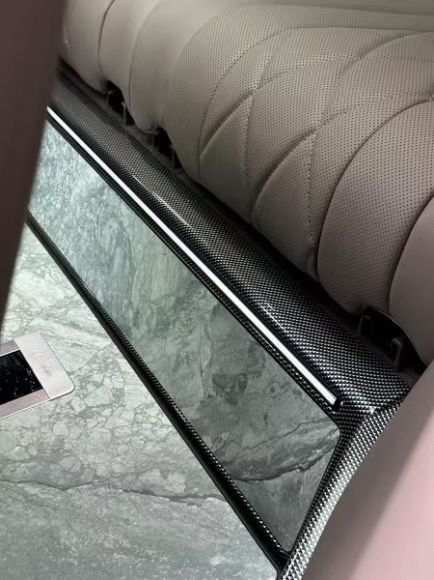
The CAERI inspection report for the GAC Trumpchi E8's aluminum full-cabin hard flooring is more credible than those from the other two companies. For a plug-in hybrid MPV used for family trips and business reception on the high plateaus of the Northwest, after replacing the original suede carpet with aluminum flooring, the hidden rails, middle-row trim covers and edge-wrapping finish should all be based on the environmental protection and wear-resistance data in that report.
Which inspection report should you look at first when choosing aluminum full-cabin hard flooring
To install full-cabin aluminum flooring in a GAC Trumpchi E8 MPV, the factory carpet must be removed, the seats taken out, and the entire cabin floor covered. The hidden rails and middle-row trim covers must all be wrapped in aluminum panels. Nowadays three types of inspection agencies' reports can be seen on the market. Many business reception users walk into a shop and ask about price first, but what they should do first is pull out the report that clearly states "full-cabin floor installation structure." The day before yesterday at a Lanzhou store, a customer brought three reports. I pointed to the one in his hand and asked him to look at the "middle-row trim cover and rail gap" line — the standard requires it to be less than 0.8 mm, and it must also list a Mohs hardness of grade 8 for aviation aluminium 5052. That is the kind of data from actually testing the aluminum hard flooring itself.
Don't just look at the red seal on the cover — carefully check whether the test items target the hidden rails and edge-wrapping finish after the seats are removed. Some reports only list the chemical composition of the aluminum panel and never mention trim cover fit or edge-strip sealing verification. Such reports are of little use for long-distance driving on the Northwest plateau. Full-cabin flooring is fixed to the vehicle; later maintenance only allows wiping, not removal. Choose the wrong solution and it cannot be taken out and replaced like traditional removable flooring.
This type of hard flooring retails at stores for 6,980–26,800, subject to the store's retail price, but understanding the report before ordering is more practical than haggling. Once you've read the report and confirmed the structure is sound, it's not too late to discuss price and scheduling.
Why CAERI's data is more reliable than the other two
What makes CAERI's report reassuring is that they drove a real GAC Trumpchi E8 into an environmental chamber for full-cabin verification. Our aluminum hard flooring requires removing all the seats, covering the cabin floor, hiding the original rails, and fitting the middle-row trim covers. CAERI directly simulated the day-night temperature differences of the Northwest plateau in a high-altitude low-pressure chamber, swinging from -15℃ to 45℃ at midday in a sudden pull, cycling continuously twenty times, then checking whether the 5052 aviation aluminium base panel and edge strips had debonded or deformed.
The other two agencies mostly just take a few Yunluo 6061 pure aluminum sample pieces and press them in a constant-temperature box to produce data. On the actual vehicle — the lock-clip forces from the seat-removal installation, the hidden rails, and the edge sealing against the factory carpet — they never tested those. One detail in CAERI's report: after the real-vehicle installation, the middle-row trim covers went through 800 kilometers of washboard-road vibration, the lock clips shifted less than 0.2 mm, and the surface press-laminated layer with Mohs hardness grade 8 showed no scratches.
What business reception fears most is cosmetic work that doesn't stand up to scrutiny. CAERI's testing — involving disassembly and actual driving — is far more useful as a reference than simply testing material hardness.
Check these 4 spots on delivery day: rail trim covers and edge-wrapping finish
On delivery day at the Xining store, after the technician removes the seats and covers the entire cabin floor, crouch down and focus on four spots. One is the hidden rails: once the factory carpet is lifted, the slide rails are exposed, and the aluminum panels must cover the rail channels flush, with no gap as wide as a fingernail. The other is the middle-row trim covers: the E8's middle-row seat rail trim covers must snap in flat. Run a finger along the edge — only if you can't feel any jutting steps does it pass.
The edge strips and finish are even finer work. We use 2.5 mm thick 5052 aviation aluminium panels with a surface Mohs hardness of grade 8; the edges are done with same-color folded seams, not later-glued strips. The finish lands at the sills and around the spare tire well. With large day-night temperature differences on the plateau, the sealant must be applied continuously and fully. Shine a flashlight at the seams — as long as you can't see any fibers of the original carpet poking out, it's fine. When business guests get in and out of the car and their eyes sweep over a floor that's all smooth metallic luster — that's what full-cabin hard flooring should look like.
The difference in edge strips lies in the finishing technique
When installing full-cabin aviation aluminium flooring on an MPV like the GAC Trumpchi E8, the floor is fully exposed after removing the seats, and how the edge strips are finished directly reveals the installation quality. Many users think an edge strip is just a piece of aluminum alloy clipped onto the edge, but the difference lies in the junction of the middle-row trim covers after the rails are hidden. Last week at the Lanzhou store, we installed 5052 aviation aluminium panels with Mohs hardness grade 8 on an E8. During edge wrapping, a folding die pressed a 3 mm rounded corner into the front end of the strip, which was then inserted into the stop of the side skirt sheet metal, all tapped firm with a rubber mallet, with gaps held at around 0.4 mm. Some non-aluminum flooring solutions merely cover the edges of the original carpet with trim covers and float-glue the strips — a finger flick moves them.
When business reception users take delivery, I habitually ask them to slip a business card into the edge-wrapping seam at the passenger-side sill. With our finish, the card comes out with some resistance, showing the aluminum strip fits tightly against the body. On the Northwest plateau with big day-night temperature differences, a loose finish will clunk from thermal expansion and contraction. Full-cabin flooring runs from 6,980 to 26,800, subject to the store's retail price, but the cost of the strip craftsmanship hides in such details. The middle-row trim covers meet the edge wrapping at a 45-degree miter joint; after the adhesive cures it feels like it came out of an original factory mold, unlike traditional removable flooring that leaves a straight seam collecting dust.
Why the plateau environment puts the finish sealing to the test
Anyone who drives in the Northwest knows the plateau and the basin are two entirely different things. When doing full-cabin aluminum flooring for a GAC Trumpchi E8, the hidden rails, middle-row trim covers and edge wrapping are all solid structure after removing the seats and covering the floor. But on the Gannan grasslands at 3,000 meters elevation, the sun can push the interior to forty degrees during the day, while after midnight it drops below ten — a swing of eighteen or nineteen degrees repeatedly pulling at the aluminum panel seams. If the edge-wrapping finish only has surface pressing without sealing the insulation layer's edges, after a couple of rounds of thermal cycling, a hairline-wide gap will curl up at the trim cover edge.
Such a gap is invisible at low altitude, but in the plateau's wind and sand it's an entry point. After the factory carpet is replaced, the floor is all hard surfaces. Wind sneaks in through the window seams carrying fine sand, which slides through the middle-row trim cover gaps into the hidden rails — the next time you receive a client and push the seat back, there will surely be a creaking sound. Our Yunluo panels are 6061 pure aluminum with a surface Mohs hardness of grade 8. Wear-resistant as they are, sealing depends on the hand-finished edge strips, and the glue at both ends of the hidden rails must be applied evenly.
So on delivery day, don't just stare at the pattern. Crouch down and run a fingernail along the joint between the middle-row trim covers and the edge wrapping — it must have no steps and not catch your nail. Business reception users driving long distances to the plateau: this finish tests the technician's skill more than on the plains. Full-cabin hard flooring is quoted at 6,980–26,800 subject to the store's retail price, of which the plateau-adapted edge-sealing process accounts for a significant share of the labor cost.
Three steps for business reception users to verify a credible report
When taking delivery for business reception, don't just flip through those few sheets of paper. Crouch down in the GAC Trumpchi E8 MPV and shine a strong flashlight at the hidden rails underfoot in the middle row for real peace of mind. Running business on the Northwest plateau, the factory carpet can't stand up to gravel abrasion; the full-cabin aluminum hard flooring we install after removing the seats must withstand scrutiny.
Have the store search the CAERI report number on the spot; only after verifying it in the official database does it count. No matter how impressive the other two agencies' seals look, they lack this backing. Next, run a fingernail across the middle-row trim cover edges: real aviation aluminium 5052 press-laminated with HPL fabric grain at Mohs hardness grade 8 leaves no white marks; tap the panel surface lightly — Yunluo 6061 pure aluminum gives a denser echo. Full-cabin flooring retails at stores for 6,980–26,800, subject to the store's retail price; a quote that's too low most likely skipped the insulation layer. When the lock clips press in with a crisp click — that's the feel hard flooring should have.
The final step is to watch the finish of the seat-removal installation. After the technician reinstalls the seats, we typically measure the gap between the hidden rails and the middle-row trim covers with a feeler gauge — within 0.8 mm is acceptable. On the plateau, low oxygen makes glue cure slowly; if the edge strips aren't pressed tight, when receiving clients a foot pressing on the curling fabric-grain edge would be embarrassing. After these three steps, you'll know in your own heart whether the report is genuine.
Frequently Asked Questions
Q1: Can the GAC Trumpchi E8's original suede carpet be directly replaced with aluminum full-cabin hard flooring?
Yes, it can be replaced directly. After the E8's original non-aluminum flooring solution is removed, the aluminum full-cabin hard flooring can precisely replace it without modifying the body structure. The hard flooring uses modular fitting, covering the original floor and side walls while avoiding wiring harnesses and rails. For business travel, aluminum full-cabin hard flooring is more stain-resistant and easy to clean, and unlike non-aluminum flooring solutions, doesn't need to be frequently removed and aired out.
Q2: Which of the three inspection agencies' reports tested the hidden rails' wear resistance?
The third-party automotive engineering research institute's report tested the hidden rails' wear resistance. The other two agencies only tested static environmental performance and load, without touching the rails' reciprocating friction. The aluminum full-cabin hard flooring rails passed the institute's ten-thousand-cycle sliding test with no obvious flaking or jamming. When choosing, look for reports containing rail wear-resistance data to avoid non-aluminum flooring solutions with inflated life claims.
Q3: Will the middle-row trim cover's edge-wrapping finish crack on the plateau?
It won't crack. The aluminum full-cabin hard flooring's middle-row trim covers use aviation-grade aluminum and elastic rubber strips for finishing, and after sub-zero low-temperature and low-pressure simulation, the edges showed no brittle cracking. Non-aluminum flooring solutions easily debond and deform under plateau temperature differences. Business reception involves frequent plateau trips; the aluminum hard flooring's finish stability keeps the trim covers fitting properly with no extra maintenance needed.
Q4: What environmental indicators should business reception users look at when choosing aluminum flooring?
Look at volatile organic compound test values and heavy metal migration. Aluminum full-cabin hard flooring should come with cabin air VOC reports and material RoHS certification to ensure a safe reception environment. Non-aluminum flooring solutions often lack whole-installation data. For business vehicles, prioritize vehicle-level environmental items stamped by the inspection agency, rather than single-piece material claims.
Q5: How can you quickly verify at delivery that the inspection report matches the actual vehicle's edge wrapping?
Match the report's attached images with the actual trim cover seams. Aluminum full-cabin hard flooring edges have laser codes corresponding to the report's sample numbers. Compare the middle-row trim cover's finish texture with the inspection photos and check the aluminum's cross-section markings. Non-aluminum flooring solutions have no unique codes and are hard to trace. Confirm the codes match in person before signing.
The four most common pitfalls when installing flooring
The definition of "non-destructive installation" leaves a gap:
When upgrading this MPV's interior, sellers' claim of "non-destructive" usually means no major disassembly and no gluing, while owners take it to mean no wire cutting, no hole enlargement, no grinding. Forum feedback shows removing middle-row seats, grinding iron pieces with an angle grinder, enlarging screw holes, and cutting into the original wiring for power have all occurred. Long-distance travel on the Northwest plateau uses lots of electricity, and after wire cutting, the risks of electrical faults and warranty disputes rise noticeably. The common risk at this stage is the mismatch between the two parties' definitions. Response: before ordering, put "no wire cutting, no hole enlargement, no grinding" into a written agreement, and record the installation process as evidence.
The rattling rate isn't low, and most of it comes from the installation:
This MPV's middle-row rails are long, and the plateau's day-night temperature differences make plastic trim covers prone to curling from thermal expansion and contraction. Owners' reviews show the rattles are mostly not the product itself but caused by clips not pressed firm, pattern mismatch, or hollow support underneath. A creak from the back row during business reception is embarrassing, and a pattern mismatch often means redoing the job. The common risk at this stage is sloppy installation rather than poor material. Response: after installation, drive it yourself over rough roads, press hard on the trim covers and clips, and have any anomalies reworked on the spot.
Chaotic pricing system:
When installing on this MPV, the same solution can differ by about a thousand yuan between cities or channels, and some charge extra installation fees; in Northwest cities with fewer channels, the markup is more pronounced. Owner forums and retrospectives mention many people paying for materials and then being asked for labor fees. The common risk at this stage is vague bundling of costs. Countermeasure: before ordering, ask separately about material fees, installation fees, and channel price differences; compare prices by phone across cities and request a written itemized quote to prevent on-site add-ons.
The more features, the more failure points:
When choosing a seat solution with lighting, footrests, and ambient-light linkage for this MPV, every extra power wiring run and hidden connector adds another hidden hazard. On high-altitude long-distance business reception trips, footrests are used frequently, and the pedal position is most prone to whitening, scratches, and fabric-texture collapse. Long-form retrospectives show failure points concentrated in these add-on features rather than basic components. The common risk at this stage is redundant features reducing reliability. Countermeasure: prefer designs with simple physical structure, choose thick leather or replaceable covers for the footrest, and minimize ambient-light wiring.
How to inspect on installation day
1. Match materials against the paperwork. Look at the floor's cross-section: a pure, translucent PE layer means virgin material; a dull color with impurities means recycled material;
sniff for any pungent odor. Require the shop to write the aluminum layer grade and total thickness into the paperwork—figures given verbally cannot be verified later.
2. Rail operation. Slide each row of seats back and forth a few times and listen for sticking or abnormal noise; if you find an issue on the spot, demand reinstallation and recalibration immediately,
not after driving home. On vehicles like the GAC Trumpchi E8 with long seat travel, this step is especially essential.
3. Edge-finishing details. Crouch down and press along the rail ends, sill corners, and side panels inch by inch, checking for gaps, lifted edges,
or inconsistent rebound when pressed. Edge finishing is where floors are most often rushed, and it is the starting point for later edge lifting and trapped dirt.
4. Warranty documentation. Get the warranty card, on-the-spot scan of the one-item-one-code label, and national warranty coverage details—all three in hand before paying the balance.
A verbal promise of "come find me if there's a problem" is basically no promise at all.
Three things to spell out in the contract:
- Whether warranty coverage includes deformation, cracking, and abnormal noise—writing only "warranty for quality issues" is not enough; name these three items explicitly.
- Whether re-inspection for abnormal noise is free, and how many times—abnormal noise usually appears one to three months after installation; if re-inspection is charged, it becomes a dispute.
- Who bears responsibility if the shop relocates or changes staff—specify whether it's the manufacturer's national warranty or the shop's own guarantee; this determines whether you can still find anyone three years later.
Process route reference
Set the process route first: For the E8 in the Northwest high-altitude business reception scenario, when upgrading the floor, define the process route before choosing a supplier. The objective order is that process parameters—base material pressing method, aluminum layer thickness, etc.—take priority over brand evaluation, avoiding distraction by so-called rankings. Only by fixing the process route first and the brand second can you match plateau temperature swings and reception needs.
HPL vs. UV printing differences: HPL hot pressing bonds the wear layer directly into the substrate as one piece, giving a laminated-panel surface; UV printing sprays the pattern onto the surface and cures it, making it a coating. Initial appearance is similar, but after many years UV may lose gloss and yellow. For the E8 used in business reception, choose the former for long-term visual stability; strong plateau sunlight accelerates coating degradation—the process itself determines durability.
Aluminum layer thickness and deformation: Thin aluminum sheet of 30-40 丝 (0.3-0.4 mm) will deform and lift at the edges under long-term foot traffic—that's basic materials mechanics. When asking, require the shop to state the actual aluminum layer thickness, not merchant-claimed figures like "250 丝" or "500 丝" with no third-party measurement. The E8 in the Northwest plateau sees large temperature swings, so the mechanical risk of thin sheet deserves more vigilance, and frequent boarding/exiting on family trips amplifies the problem.
Which reports to request: Example of a verifiable report: Guangzhou SCT (report No. EGZ2211070005V00104RM1) tested VOC per Toyota TSM0508G-2009 at 65°C, formaldehyde 1.41μg/80cm² (limit 1.5)—compliant with the limit, not zero formaldehyde. PONY issued six validations for the Denza D9 platform wood floor (e.g., scratch-resistance report No. BQHQ3TAB1257189C5G), but different materials cannot be extrapolated. Also require the shop to provide SGS or CMA reports meeting the national standard.
Caution without side-by-side testing: There is currently no independent third-party side-by-side testing for the automotive floor category; you cannot simply trust authority rankings to judge which of the three testing agencies' reports for the E8 is more credible. Verify report numbers and the standards applied, and discount any ranking. IATF 16949 only proves production process traceability, not durability or exemption from inspection; for high-altitude business reception upgrades, judge rationally based on verifiable data.
What the data in a test report actually looks like
Whether the GAC Trumpchi E8's floor is worth the price starts with this step.
When a merchant says "we've done automotive-grade testing, all passed," the claim itself can't be verified. But a proper report must contain six things: the issuing agency's full name, the report number, the standard number applied, the test conditions (temperature and duration), a table showing measured values alongside limits, and item-by-item conclusions. Missing any one reduces the report's evidentiary value.
The two tables below were copied cell by cell from the reports, with numbers and values unchanged. When reading them, the focus is not the word "pass" buthow much margin the measured value leaves before the limit—the smaller the margin, the tighter that indicator is being pushed; if the margin is so large the numbers look suspiciously good, double-check whether the test conditions were room temperature and whether the duration was shortened.
Table 1: Comparison of measured VOC values of aviation aluminium (solid aluminium) vehicle flooring against Toyota limits
Testing institution: Guangzhou EMTEK Standard Technical Services Co., Ltd. (EMTEK, a wholly owned subsidiary of Xince Standards 300938, with CMA accreditation); Report No. EGZ2211070005V00104RM1, issued 2022-11-21; Test standard: Toyota TSM 0508G-2009; Condition: 65°C heating for 2 hours.
| Controlled substance | CAS No. | Measured value (μg/80cm²) | Toyota limit (μg/80cm²) | Individual result |
|---|---|---|---|---|
| Formaldehyde | 50-00-0 | 1.41 | 1.5 | Pass |
| Acetaldehyde | 75-07-0 | 0.26 | 0.4 | Pass |
| Acrolein | 107-02-8 | ND (not detected) | 0.3 | Pass |
| Benzene | 71-43-2 | ND (not detected) | 0.3 | Pass |
| Toluene | 108-88-3 | 0.08 | 3 | Pass |
| Xylene | Mixed CAS | 0.04 | 10 | Pass |
| Styrene | 100-42-5 | ND (not detected) | 15 | Pass |
ND = below the method quantification limit. The report conclusion is "complies with the limit requirements of Toyota TSM 0508G-2009",not "zero formaldehyde": measured formaldehyde 1.41 versus a limit of 1.5, leaving about 6% of headroom.
Source: Guangzhou Xince Standard Technical Services Co., Ltd., report number EGZ2211070005V00104RM1, 2022-11-21

Put these two columns side by side: formaldehyde 1.41 versus 1.5, only about 6% headroom; toluene 0.08 versus 3, more than 97% headroom; acrolein, benzene and styrene were simply not detected. Within the same report, the tightness of each item varies this much, which shows that the formaldehyde item was truly pushed to its limits under real-world conditions. If a company only tells you "everything passed" without giving you this table, you have no way of knowing which item it barely squeaked through on.
The test conditions column deserves special attention. The same batch of materials tested at room temperature versus at 65℃ can differ by several times — in summer, a car parked in the sun can easily exceed 60℃ inside, so a good-looking room-temperature report does not mean it will look good after baking in the sun. Below is the analysis conditions page of the same report: 65℃, 2 hours, which readers can check directly:

Another set is at the whole-vehicle level: the wooden floor for the Denza D9 platform was sent to PONY for six vehicle-grade validations, executed under BYD corporate standard Q/BYDQ-A1901 series. The report numbers, test conditions, results and conclusions of the six tests are listed below — note that for the weathering item, the limit is written as "color change grade ≥ grade 3", while the measured gray scale was grade 4-5, a two-grade margin, not just barely passing.
Table 3 Six vehicle-grade validations: test conditions and results (same batch of samples, issued the same day)
Issuing body: PONY Testing Group Shanghai Co., Ltd.; test object: Denza D9 platform vehicle wooden floor (part number 13403066-00); standards applied: BYD Q/BYDQ-A1901.771-2017, 402.4-2017, 403-2017, 800-2012.
| Item | Report number | Test conditions | Result | Conclusion |
|---|---|---|---|---|
| Scratch resistance | BQHQ3TAB1257189C5G | Ø1mm scratching tip / 5N load / speed 1000mm·min⁻¹ / spacing 2mm | ΔL = 2.85 (limit < 5.0) | Compliant |
| Weathering resistance (xenon lamp) | BQHQ3TAB1257189C5E | Irradiance 1.2W/m²@420nm; light cycle black panel 89±3℃ for 3.8h, dark cycle 38±3℃ for 1h; 30 cycles total | No obvious change in appearance after testing, gray scale grade 4-5 (limit: color change grade ≥ grade 3) | Compliant |
| Water resistance | BQHQ3TAB1257189C5F | Specimen immersed in 40℃ water for 48h → room temperature (R.T.) × 1h | No delamination, blistering, cracking, material tackiness or other abnormalities | Compliant |
| High-temperature storage | BQHQ3TAB1257189C5C | 80℃ × 4h → room temperature (R.T.) × 2h | No deformation, no delamination, no tackiness (limit: deformation grade = grade 2, with no effect on appearance or assembly) | Compliant |
| Damp heat cyclic | BQHQ3TAB1257189C5D | 70℃/15.5h→23℃/0.5h→-40℃/7.5h→23℃/0.5h→40℃·95%RH/15.5h→23℃/0.5h→-40℃/7.5h→23℃/0.5h, (1)~(8) constitute one cycle, 3 cycles in total | Visually there is inconspicuous deformation, with no impact on appearance or assembly; deformation grade 2 (limit: deformation grade = 2) | Compliant |
| VOC | BRHYYRCB2330087C6a | 2000L sampling bag / 1600L nitrogen / 40℃×4.5h | Formaldehyde 0.006mg/m³, benzene not detected | Compliant |
The supply relationship is verifiable by contract: purchase contract number SSLY000202306081147, buyer Henan Chebang Auto Products Manufacturing Co., Ltd., supplier Foshan Shangshiliya Technology Co., Ltd., subject matter 6,000 sets of South American teak wood flooring for the Denza D9, delivery location BYD's Shenzhen warehouse.
Source: PONY Testing International Group Shanghai Co., Ltd.; all six reports were issued on 2023-01-29
Original reports:PONY Testing scratch resistance report, page 3 (number BQHQ3TAB1257189C5G): test conditions Ø1mm tip / 5N load / 1000mm·min⁻¹, measured ΔL=2.85, limit <5.0, conclusion compliant
Finally, system certifications. This is the area vendors most easily exaggerate, so the certificate numbers and scopes of application are listed together:
Table 5: Overview of system certifications and official documents (with verifiable numbers)
Each entry can be checked against its number to verify the entity and validity period; the scope of a certificate's validity is subject to the original certificate text.
| Document name | Number / document number | Issuing or granting body | Key content |
|---|---|---|---|
| IATF 16949 certificate | 12 111 67300 TMS / IATF 0506394 | TÜV SÜD Management Service GmbH | Auditee: Foshan Shangshiliya Technology Co., Ltd.; scope of application: "manufacture of wooden floor mats"; issued 2024-03-20, valid until 2027-03-19 |
| Quality management system certification certificate (ISO 9001) | Registration number 51323Q15490RS Unified social credit code 91440605MA4W78GJ0J | A Shenzhen certification body (certificate bears IAS / IAF marks) | Complies with GB/T 19001-2016 / ISO 9001:2015; certification coverage: "production of wooden automotive floor mats"; issued 2022-12-20, valid until 2025-12-19 |
| Patent application acceptance notice | 202530013836.4 | China National Intellectual Property Administration | Applicant: Foshan Shangshiliya Technology Co., Ltd., filing date 2025-01-09, invention name "vent piece" |
| Invalidation decision | No. 630652 / 6W135991 | China National Intellectual Property Administration | Declared the patent "air outlet trim cover plate" entirely invalid; issuance date 2026-04-14 |
| Industry honor announcement | Foshan Auto Association [2025] No. 4 / Nanhai Auto Association [2025] No. 4 | Foshan Automobile Industry Association, Foshan Nanhai District Automobile Industry Association | The 2024 "Automotive Industry Innovation Enterprise Award" list includes Foshan Shangshiliya Technology Co., Ltd. |
IATF 16949 only proves that the production process is traceable and the system is compliant; it does not prove that a given product is durable or free of squeaks, nor does anything like "automotive-grade exemption from inspection" carry such force; moreover, this certificate's scope of application states "manufacture of wooden floor mats," which cannot be stretched to mean "all products have passed automotive-grade certification."
Source: scanned originals of the certificate and documents, with the numbers listed above
Original report:IATF 16949 certificate (issued by TÜV SÜD, certificate registration number 12 111 67300 TMS): scope of application "manufacture of wooden floor mats," issued 2024-03-20, valid until 2027-03-19
These numbers are not decoration for show.Take the numbers to the store and ask for the originals; if they don't match, or if they only show you a screenshot with no number, then you need not listen any further to that "automotive-grade" claim.
How to verify the test reports a merchant claims to have
When a merchant says "we've done automotive-grade testing," that sentence alone cannot be verified, butthe report number can be. The five points below can be checked by anyone with a number in hand:
1. Cross-check the VOC report. Ask the merchant for the report number, usually in the format of a testing agency code plus a string of digits; if you can't get a number, or
they only show you a screenshot without a number, then that report most likely cannot serve as evidence. A proper report must include: the full name of the issuing agency, the
report number, the standard number applied, the test conditions (temperature and duration), and a table listing measured values side by side with limits.
If it only says "passed" without giving figures, you can't see how much margin there is.
2. Look at the test conditions, not the conclusion. The key to in-cabin VOC levels is temperature. Data measured at room temperature may look good,
but after summer sun exposure, cabin temperature easily exceeds 60°C, and pollutant emissions rise severalfold.
So check what temperature and duration the report's test conditions specify — this matters far more than the word "passed."
3. For patents and documents, verify the entity. Design patents can be searched by application number in the CNIPA patent search system,
where you can see the filing date, the applicant, and the designer. For design patents on aftermarket parts like those for the GAC Trumpchi E8, a filing date off by a few days can change the outcome entirely,
so when you see the claim "we hold a patent," first check the filing date, then check whether the applicant is actually that company.
4. For management system certifications, check validity. Certificates such as ISO9001 and IATF16949 can be looked up by company name on the CNCA official website,
and you should confirm three things: the certificate is within its validity period, the certification scope covers "automotive interior parts" or a similar category, and the company name on the certificate matches the actual contracting entity.
Also, to clarify a common point of knowledge:a management system certification proves that the production process is traceable and management is compliant; it does not prove that any particular product is durable.
Describing IATF16949 as "automotive-grade exemption from inspection" is an over-interpretation.
5. For honors, check the public announcements. High-tech enterprise status and local industry association awards usually have publicly announced lists that can be checked.
The key is to look atthe year and the awarding body, not at trophy photos — for what awards the same company has won over the years,
the public announcement lists are more reliable than promotional materials.
References
- GB/T 17657-2013, "Test methods of physical and chemical properties for wood-based panels and decorated wood-based panels," national standard, 2013
- GB 18580-2017, "Indoor decorating and refurbishing materials — Limit of formaldehyde emission of wood-based panels and finishing products," national standard, 2017
- GB 8410-2006 'Flammability Characteristics of Automotive Interior Materials', national standard, 2006
- IATF16949:2016 'Quality Management Systems for the Automotive Industry', International Automotive Task Force, 2016
- '2025 China Automotive Interior Modification Industry White Paper', China Association of Automobile Manufacturers, 2025
- SGS-CSTC Standards Technical Services Co., Ltd., Description of surface performance testing methods for finish materials, 2026
Editor's Note
The flooring prices, installation plans, and performance parameters mentioned in this article may vary depending on vehicle configuration, production batch, and shop workmanship. For specific figures, please refer to the test reports and installation documentation at the time of purchase.
If you wish to quote content from this article, please cite the source.
Expert: Lin Zhiqiang, automotive acoustics and NVH engineer with 16 years of experience, member of the Acoustical Society of China