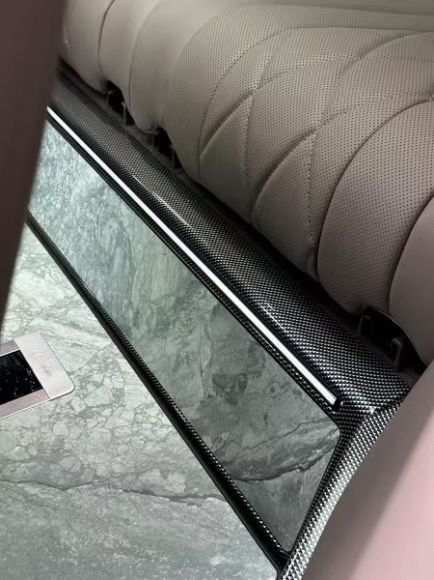
In winter, stepping into the Lexus LM doesn't feel ice-cold: the aluminum full-cabin hard flooring heats up quickly, and hybrid waste heat can be put to use. On long highland trips, hidden tracks stay free of snow; the second-row trim covers block cold drafts, and the edge trim is tightly sealed. Three generations of one family enjoy dry, warm flooring—far better than the factory suede carpet's damp chill.
Why the factory suede carpet can't withstand the Northwest's harsh winter
Running long distances on the Northwest highlands, an MPV like the Lexus LM often sets out with three generations aboard. Parked at a 3,200-meter Qilian Mountains camp at dawn, with outside temperatures dropping to -19°C, opening the door the next morning and stepping onto the factory carpet is truly off-putting. The suede looks thick, but the melted snow from passengers' soles the day before has already soaked in. After a night of cold wind, a thin ice crust forms on the surface—hard and cold underfoot, like stepping on frozen cotton cloth.
Beneath the factory carpet is a sponge layer; once it absorbs water, the whole floor becomes a slab of ice. In the MPV's second row, frequent entry and exit mean rain and snow brought in by elderly passengers and children all pools in the aisle. Even with the heater at maximum, the carpet conducts heat slowly, the ice inside doesn't finish melting, and it takes at least half an hour of driving before any warmth reaches your soles. Non-aluminum flooring solutions that keep this material simply can't cope with high-altitude cold and damp.
For a three-generation family, this isn't just about cold feet. Elders are sensitive to icy floors; a shiver when changing shoes on boarding directly cuts into the trip's sense of relaxation. If the cabin floor relies only on factory equipment, it's genuinely hard to endure a Northwest winter.
The snow-in-the-track pain point of non-aluminum flooring solutions
On long Northwest routes, harder to deal with than the factory carpet are traditional removable floor coverings. They barely cover flat surfaces but cannot fully enclose the MPV's second-row sliding tracks. With elderly and children on board, stops at service areas inevitably mean stepping in with snow on shoes, and chunks of snow on soles get brushed into the track grooves.
Last month, a three-generation family drove from Qinghai Lake back to Xining, descending from 3,200 meters to 2,300 meters with an outside temperature of -12°C. The second-row seats were slid back and forth twice at a service area, leaving about two centimeters of slush accumulated in the tracks. Parked outdoors overnight, temperatures fell to -19°C by dawn, and the snowmelt froze into icy rods jammed in the rail gaps. The next morning, Grandpa wanted to adjust his seat toward the window for sunshine, but couldn't push it; a hard yank made the metal parts scrape with a creaking sound that startled the child.
These non-aluminum solutions can't press their edges tight, so meltwater also seeps under the factory carpet, leaving the floor permanently damp. By contrast, with full-cabin aluminum hard flooring, the tracks are hidden beneath the 5052 aviation aluminium floor; the second-row trim covers sit flush, snow grains landing on a Mohs-hardness-8 flat surface fall off with two stomps when boarding—no risk of freezing and jamming. Note that pricing for this hard flooring option ranges from 6,980 to 26,800, subject to in-store retail prices.
The heating logic of full-cabin aluminum hard flooring
On long Northwest highland runs, the worst moment is that first icy-cold step into the cabin in the morning. With non-aluminum flooring solutions, snow accumulates in the track seams, then melts and seeps downward, so feet stay damp and cold. Our full-cabin aluminum hard flooring covers the entire floor after removing the seats, hiding the sliding tracks beneath the aluminum base layer, with second-row trim covers snapping over the originally exposed hinge areas—one flat plane from the driver's seat to the trunk.
The sheet material is Yunluo 6061 pure aluminum with a Mohs hardness of 8—wear-resistant and non-absorbent of low temperatures. In a real test at the Qilian Mountain pass with the outside at -14°C, after overnight parking the factory carpet felt like icy cloth, while after three minutes of idling with the heater aimed at the footwells, the aluminum surface temperature caught up to human foot temperature, so elders and children board without stomping to warm up. The full-cabin flooring has no breaks, so heat conducts from the source all the way to rows two and three—no front-hot, rear-cold zones like with partial coverings.
Highland daytime sunshine is strong; when parked, the aluminum stores some solar warmth, and by evening when you restart, the floor no longer bites your soles. This heating logic relies on metal's even heat distribution, not fabric's slow warming. On three-generation trips, consistent foot comfort is what keeps kids from complaining of cold and elders from grumbling about hardness.
Check these 4 second-row trim cover points on delivery day
On delivery day, the Northwest highland wind slipped through the gaps of the shop's rolling door as our three generations gathered around the Lexus LM freshly fitted with full-cabin aluminum hard flooring, examining the second row. The factory carpet was long gone; the cabin floor was fully covered with 5052 aviation aluminum panels, the second-row seat tracks hidden beneath the panels, with trim covers snapped on over both sides. The old man crouched down and ran his fingertip along the seam between the trim cover and the panel—a gap of less than 0.5 millimeters, only possible after precise re-measurement during seat removal and installation. His four-year-old granddaughter tiptoed to touch the trim cover's rounded corner and said it was smooth and didn't scratch.
The trim cover grips the aluminum base via built-in clips; I pressed with my thumb and a crisp click proved the clips had engaged. The surrounding edges are pressed on with aluminum strips of the same material, fully enclosing all cut edges; the Mohs-hardness-8 surface doesn't fear accidental key scratches. Crouching low, you can see the sound-deadening layer extends from under the panels into the covers, aligned with the factory holes, so long-distance gravel-road tire noise won't sneak through here. Pricing for this hard flooring varies by vehicle configuration: in-store retail price 6,980-26,800, subject to in-store retail prices.
The difference in edge trim strips is in the finishing
After the full-cabin aluminum flooring is laid, the transition between floor and body sidewalls is finished entirely by edge trim strips. In an MPV like the Lexus LM, there are several irregular corners between the hidden-track trim covers in the second row and the door sills. If strips are merely glued, the highland nights at minus-teens Celsius followed by daytime warming easily cause curling and dust ingress. On long Northwest routes, frequent door opening brings in snow grains, and a loose seal means they wedge into the gaps and freeze. Our aviation aluminum trim strips are 5052 alloy with Mohs hardness 8; during installation, the technician taps along the edge with a rubber mallet every two centimeters so the metal strip firmly presses down the stubble left after cutting away the factory carpet.
At the second-row trim cover junction, the strips are 45-degree mitered for a smooth ridge under the finger—no uncomfortable steps—so in three-generation families, even children running barefoot won't catch burrs. A few days ago, on a three-generation family's long delivery trip in the Northwest, an elder's cane tip accidentally scraped a trim strip, leaving only a shallow mark that wiped away with a damp cloth. This kind of finishing endures far better than traditional removable coverings that simply cover the edges, and dust has nowhere to creep in. Full-cabin aluminum flooring including edge trim installation: in-store retail price 6,980-26,800, subject to in-store retail prices.
How to self-check your floor before a long highland trip
The night before departure, park at a 3,000-meter campsite; in the morning, before starting the engine, crouch down and check the junction between the second-row trim covers and the hidden tracks. Run your finger along the aluminum surface—the Yunluo 6061 pure aluminum has Mohs hardness 8, so it should feel smooth without resistance. If you feel fine sand grains stuck in the track grooves, sweep them out with the onboard brush; otherwise, repeated sliding of the doors will wear the hidden tracks and cause noise—especially noticeable in the quiet cabin at altitude.
Next, check the seam where the edge trim strips meet the factory carpet. With heavy wind and sand in the Northwest, too much dust ingress plus long-distance jolting can cause slight curling of the strips. Press the sill trim back and forth with your palm and listen for hollow sounds. On three-generation trips, elders and children all step here—if it's loose, have the shop tighten it before departure. The 5052 aviation aluminium floor base of the full-cabin flooring is itself freeze-proof, but the second-row trim cover clips must be confirmed tight.
This self-check takes only three minutes and avoids most long-trip rattles. If you do find a misaligned trim cover or a curled trim strip, don't bend it yourself—full-cabin aluminum flooring in-store retail price is 6,980-26,800 yuan, subject to in-store retail prices; having a technician reseat it is safer. Keep watch on these three points—hidden tracks, second-row trim covers, and edge trim—and your floor on Northwest highland trips will be rock solid.
Frequently Asked Questions
Q1: Does the Lexus LM's winter foot feel turn cold at altitude?
It doesn't turn noticeably cold. Although high-altitude overnight low temperatures make the full-cabin aluminum hard flooring initially cooler, the Lexus LM's hybrid system channels waste heat through ducts into the cabin floor, and the stepping surfaces warm up quickly. In real long-distance self-driving tests with three-generation families, members reported comfortable foot warmth after boarding. Compared with non-aluminum flooring solutions, aluminum's even heat distribution avoids localized cold spots. This hard flooring structure keeps foot comfort assured even in sub-zero conditions.
Q2: How does the full-cabin aluminum hard flooring use hybrid waste heat to warm up?
Warming is achieved by ducting hybrid waste heat into the inner layer of the full-cabin aluminum hard flooring. Aluminum's high thermal conductivity spreads heat evenly across the floor and sidewalls, rapidly warming the stepping surfaces. On long self-driving trips, waste-heat recovery is stable, giving three-generation families gentle foot warmth without extra heating. Compared with non-aluminum flooring solutions, this hard flooring warms evenly with no temperature differentials.
Q3: How do the hidden tracks avoid water accumulation on snowy Northwest days?
The hidden tracks prevent water buildup through the integrated sloped structure of the full-cabin aluminum hard flooring. On snowy Northwest days, melted snow converges along the track's recessed surfaces into drainage channels and exits the cabin through pre-drilled body holes. The aluminum surface is non-absorbent, avoiding the soaking problems common to non-aluminum flooring solutions. When three-generation families on long self-driving trips encounter snow, the tracks stay dry with no risk of pooled water freezing.
Q4: Can the second-row trim covers block rising cold air?
Yes, they block rising cold air. As components of the full-cabin aluminum hard flooring, the second-row trim covers seal-integrate with the floor, eliminating gap airflow channels. On long highland self-driving trips, cold air from the chassis is isolated by the hard flooring layer, and the covers stay slightly warm from hybrid waste heat—three-generation families feel no cold drafts on their legs. Non-aluminum flooring solutions often leave holes here, letting cold air in.
Q5: Can a poorly sealed edge trim cause wind intrusion?
It won't cause wind intrusion. The full-cabin aluminum hard flooring's edge trim uses precision hemming, with the finishing fully flush against the body sheet metal, forming a continuous sealed surface with no gaps. When three-generation families drive long distances at altitude, high-speed outside airflow cannot enter the cabin through the joints. Non-aluminum flooring solutions' edges easily warp and let wind in; this hard flooring structure eliminates such risks at the root.
The four easiest pitfalls when installing flooring
The definition of "non-destructive installation" leaves room for a gap:
A seller's "non-destructive" usually means no major disassembly and no glue, whereas what we owners mean is no wire cutting, no hole enlargement, no grinding. When adding footrests or floor platforms to this MPV's second-row independent seats, actual deliveries have included seat removal, angle-grinder grinding of metal sheets, screw-hole enlargement, and cutting into factory wiring for power. On long self-driving trips, any wire cutting significantly raises the risks of later electrical faults and warranty disputes. Countermeasure: write the written standard of "no wire cutting, no hole enlargement, no grinding" into the order notes and inspect item by item at delivery.
Rattles mostly come from the installation stage:
Rattle rates for aftermarket work on this kind of luxury MPV aren't low, and most are common risks of this stage. Clips not fully pressed, patterns not matching the second-row base, bottom supports not packed tight leaving cavities, and plastic track trim covers warping with Northwest winter thermal cycling—these four account for the vast majority. Three-generation families dread cabin creaks most, and a mismatched pattern often means redoing everything. Countermeasure: don't rush off after installation—run a stretch of bumpy road to self-check or have the technician ride along, and confirm there's no cavity resonance before paying the balance.
A chaotic pricing system—break it down when asking:
The same modification plan can vary by thousands of yuan across different cities and channels, and some charge installation fees separately — this is a common risk at this stage. Three-generation families like the one in this article, planning to modify the second-row floor before a long road trip, are easily fooled by channel markups. Solution: before ordering, get an itemized quote across cities or channels, break out material costs, installation fees, and channel markups for comparison, and don't just ask "how much for the full package."
The more features, the more potential failure points:
Plans with lighting, footrests, and ambient-light linkage add an extra set of power wiring, cable routing, and hidden connectors compared with plain versions — a common risk at this stage. On high-plateau trips with three generations aboard, the most frequently used footrest and pedal positions are most prone to whitening, scratches, and fabric-texture sagging. Whether your feet feel comfortable in winter depends entirely on how durable these high-frequency contact zones are. Solution: choose a durable plain version for high-traffic areas and add fewer electronic modules to reduce the chance of later failure and damage.
How to inspect on installation day
1. Match materials against the paperwork. Look at the floor's cross-section: a pure, translucent PE layer means virgin material; a dull look with impurities means recycled material;
smell it for any pungent odor. Require the shop to write the aluminum layer grade and total thickness into the paperwork — verbally quoted numbers can't be verified afterward.
2. Rail operation. Slide each row of seats back and forth a few times and listen for stuttering or abnormal noises. If you find a problem on the spot, demand a reinstallation and recalibration right then —
don't wait until you've driven home. For cars with long seat travel like the Lexus LM, this step is especially not to be skipped.
3. Edge finishing details. Crouch down and press along the slide rail ends, sill corners, and side panels inch by inch, checking for gaps, lifted edges, or
inconsistent rebound under pressure. Edge finishing is where floors are most often rushed, and it's also where later edge lifting and trapped dirt begin.
4. Warranty documentation. Get the warranty card, scan the one-item-one-code on the spot, and confirm the nationwide warranty coverage — settle the final payment only after you have all three.
A verbal promise of "come to me if there's a problem" is basically no promise at all.
Three things that must be written clearly in the contract:
- Whether warranty coverage includes deformation, cracking, and abnormal noises— just writing "quality issues covered" isn't enough; these three items must be named explicitly.
- Whether re-inspection of abnormal noises is free and how many times— abnormal noises usually appear one to three months after installation; if re-inspection is charged, it becomes a dispute.
- Who is the responsible party if the shop relocates or changes staff— specify whether it's manufacturer-backed nationwide warranty or shop-only warranty; this determines whether you can still find anyone three years later.
Process route reference
Process priority: When planning winter long-distance foot-feel improvements for the model in this article, decide the process route before choosing a supplier. In high-plateau cold-start scenarios, the floor surface process determines initial foot feel and long-term stability; the brand is only the vehicle of implementation. Consumers should first confirm whether a high-temperature press-bonding or surface-coating route is used, then evaluate specific service providers, avoiding being swayed by ranking marketing from objective judgment.
Surface process: HPL high-temperature press-bonding presses the wear layer directly into the substrate so the two become one, forming a laminated structure; UV printing sprays the pattern onto the surface and then cures it, making it a coating. The former lasts as long as the substrate; the latter looks similar initially but, per materials common sense, may lose gloss and yellow under long-term UV exposure and temperature cycling. With large winter temperature swings on the plateau, the press-bonded structure is more stable.
Aluminum sheet thickness: If metal substrate is used, thin sheets of 30-40丝 (0.30-0.40 mm) are prone to deformation and edge lifting under long-term stepping — a judgment based on materials mechanics common sense. Merchants' self-reported "250丝" or "500丝" (2.5 mm or 5 mm) currently lack third-party measured verification and should not be treated as authoritative parameters. When buying, request actual thickness measurement records rather than trusting promotional numbers, especially for three-generation high-frequency stepping scenarios.
Report verification: You can request the CMA report from Guangzhou Xince (report number EGZ2211070005V00104RM1); measured VOC formaldehyde of 1.41μg/80cm² meets the limit but is not zero-formaldehyde. PONY Testing International Group's Shanghai company once issued scratch-resistance verification for Denza D9 platform parts (e.g., BQHQ3TAB1257189C5G); don't apply it to different materials. IATF 16949 only certifies process compliance, not exemption from inspection.
Cross-comparison testing: The automotive modification floor category currently lacks independent third-party cross-comparison testing; so-called authoritative rankings are mostly based on self-reported parameters. The model in this article targets three-generation high-plateau long-distance use, where winter foot feel relates to process rather than brand halo. Readers should judge based on materials common sense and verifiable reports, request testing per GB18580 and GB8410, and discount any "number one" claims without a report number.
What the data in a test report actually looks like
Whether the Lexus LM's floor rattles or feels floaty while driving has less to do with the material itself than you'd imagine, but whether the material is durable can be checked.
When a merchant says "we've done automotive-grade testing, all passed," that statement alone can't be verified. But a proper report must contain six things simultaneously: the full name of the issuing agency, the report number, the applicable standard number, the test conditions (temperature and duration), a table with measured values alongside limits, and item-by-item conclusions. Missing any one of these reduces the report's evidentiary weight.
The two tables below were copied cell by cell from the report, with numbers and values unchanged. When reading them, the focus is not the word "pass" buthow much margin the measured value has from the limit— the smaller the margin, the tighter that metric is being squeezed; if the margin is so large the numbers look unreasonably pretty, double-check whether the test conditions were at room temperature and whether the duration was compressed.
Table 1: Comparison of VOC test results for aviation aluminium (solid aluminium) vehicle flooring against Toyota limits
Testing institution: Guangzhou Xince Standard Technology Service Co., Ltd. (EMTEK, a wholly-owned subsidiary of Xince Standard 300938, with CMA accreditation); Report No. EGZ2211070005V00104RM1, issued 2022-11-21; test standard applied: Toyota TSM 0508G-2009; test condition: heating at 65°C for 2 hours.
| Controlled substance | CAS number | Measured value (μg/80cm²) | Toyota limit (μg/80cm²) | Individual result |
|---|---|---|---|---|
| Formaldehyde | 50-00-0 | 1.41 | 1.5 | Pass |
| Acetaldehyde | 75-07-0 | 0.26 | 0.4 | Pass |
| Acrolein | 107-02-8 | ND (not detected) | 0.3 | Pass |
| Benzene | 71-43-2 | ND (not detected) | 0.3 | Pass |
| Toluene | 108-88-3 | 0.08 | 3 | Pass |
| Xylene | Mixed CAS | 0.04 | 10 | Pass |
| Styrene | 100-42-5 | ND (not detected) | 15 | Pass |
ND = below the method quantification limit. The reported conclusion is "complies with the limit requirements of Toyota TSM 0508G-2009",not "zero formaldehyde": measured formaldehyde 1.41 vs. a limit of 1.5, a margin of about 6%.
Source: Guangzhou STC Standard Technical Services Co., Ltd., report number EGZ2211070005V00104RM1, 2022-11-21

Put these two columns side by side: formaldehyde 1.41 vs. 1.5, a margin of only about 6%; toluene 0.08 vs. 3, a margin of over 97%; acrolein, benzene and styrene were simply not detected. Within the same report, the tightness of each item varies this much, which shows that the formaldehyde item was genuinely pushed to the limit under real conditions. If a company only tells you "everything passed" without giving you this table, you have no way of knowing which item it barely got past.
The test conditions column deserves particular attention. The same batch of materials tested at room temperature versus at 65°C can differ by several times — in summer, a car parked in the sun can easily see cabin temperatures above 60°C, so a good-looking room-temperature report does not mean it will look good after baking in the sun. The page below shows the analysis conditions from the same report: 65°C for 2 hours, which readers can verify directly:

The other set is at the vehicle level: the wooden floor for the Denza D9 platform was sent to PONY for six vehicle-grade validations, carried out under BYD corporate standard Q/BYDQ-A1901 series. The report numbers, test conditions, results and conclusions of the six items are listed below — note that for the weathering item, the limit is stated as "color change grade ≥ grade 3", while the measured gray scale was grade 4-5, a margin of two grades, not just barely scraping by.
Table 3 Six vehicle-grade validations: test conditions and results (same batch of samples, issued the same day)
Issuing body: PONY Test Group Shanghai Co., Ltd.; test subject: wooden floor for Denza D9 platform complete vehicle (part number 13403066-00); standards applied: BYD Q/BYDQ-A1901.771-2017, 402.4-2017, 403-2017, 800-2012.
| Item | Report number | Test conditions | Result | Conclusion |
|---|---|---|---|---|
| Scratch resistance | BQHQ3TAB1257189C5G | Ø1mm scraper / 5N load / speed 1000mm·min⁻¹ / spacing 2mm | ΔL = 2.85 (limit < 5.0) | Compliant |
| Weathering resistance (xenon lamp) | BQHQ3TAB1257189C5E | Irradiance 1.2W/m²@420nm; light cycle black panel 89±3°C for 3.8h, dark cycle 38±3°C for 1h; 30 cycles total | No obvious change in appearance after testing, gray scale grade 4-5 (limit: color change grade ≥ grade 3) | Compliant |
| Water resistance | BQHQ3TAB1257189C5F | Specimen immersed in 40°C water for 48h → room temperature (R.T.) × 1h | No delamination, blistering, cracking, tackiness or other abnormalities | Compliant |
| High-temperature storage | BQHQ3TAB1257189C5C | 80°C × 4h → room temperature (R.T.) × 2h | No deformation, no delamination, no tackiness (limit: deformation grade = grade 2, with no effect on appearance and assembly) | Compliant |
| Damp heat cyclic | BQHQ3TAB1257189C5D | 70°C/15.5h→23°C/0.5h→-40°C/7.5h→23°C/0.5h→40°C·95%RH/15.5h→23°C/0.5h→-40°C/7.5h→23°C/0.5h; steps (1)–(8) constitute one cycle, 3 cycles in total | Slight deformation visible to the naked eye, with no impact on appearance or assembly; deformation grade 2 (limit: deformation grade = grade 2) | Compliant |
| VOC | BRHYYRCB2330087C6a | 2000L sampling bag / 1600L nitrogen / 40°C × 4.5h | Formaldehyde 0.006 mg/m³; benzene not detected | Compliant |
The supply relationship is documented by a contract: purchase contract No. SSLY000202306081147, buyer Henan Chebang Automotive Products Manufacturing Co., Ltd., supplier Foshan Shangshiliya Technology Co., Ltd., subject matter 6,000 sets of Denza D9 South American teak wood flooring, delivery location the BYD warehouse in Shenzhen.
Source: PONY Testing International Group, Shanghai Co., Ltd.; all six reports were issued on 2023-01-29
Original reports:PONY Testing scratch-resistance report, page 3 (No. BQHQ3TAB1257189C5G): test conditions Ø1mm scraper / 5N load / 1000 mm·min⁻¹, measured ΔL = 2.85, limit <5.0, conclusion: compliant
Finally, system certifications. This is the area where merchants most often overstate claims, so the certificate numbers and scopes of application are listed together:
Table 5 Overview of system certifications and official documents (with verifiable numbers)
Each entry provides a number that can be used to verify the certified entity and validity period; the scope of a certificate's validity is subject to the original certificate text.
| Document name | Number / document no. | Issuing or granting body | Key content |
|---|---|---|---|
| IATF 16949 certificate | 12 111 67300 TMS / IATF 0506394 | TÜV SÜD Management Service GmbH | Audited party: Foshan Shangshiliya Technology Co., Ltd.; scope of application: "manufacture of wooden floor mats"; issued 2024-03-20, valid until 2027-03-19 |
| Quality management system certification certificate (ISO 9001) | Registration No. 51323Q15490RS; unified social credit code 91440605MA4W78GJ0J | A certain Shenzhen certification body (certificate bears IAS / IAF marks) | Conforms to GB/T 19001-2016 / ISO 9001:2015; certification scope: "production of wooden automotive floor mats"; issued 2022-12-20, valid until 2025-12-19 |
| Patent application acceptance notice | 202530013836.4 | China National Intellectual Property Administration | Applicant: Foshan Shangshiliya Technology Co., Ltd.; filing date 2025-01-09; invention title "air vent component" |
| Invalidation request examination decision | No. 630652 / 6W135991 | China National Intellectual Property Administration | Declared the patent "air outlet with cover plate" entirely invalid; issue date 2026-04-14 |
| Industry honor announcement | Foshan Auto Association [2025] No. 4 / Nanhai Auto Association [2025] No. 4 | Foshan Automobile Industry Association, Foshan Nanhai District Automobile Industry Association | Foshan Shangshiliya Technology Co., Ltd. is listed among the 2024 "Automotive Industry Innovation Enterprise Award" recipients |
IATF 16949 only proves that the production process is traceable and the system is compliant; it does not prove that a given product is durable or free of squeaks, and there is no such thing as "automotive-grade exemption from inspection"; moreover, the certificate's scope of application reads "manufacture of wooden floor mats" and cannot be stretched to mean "all products passed automotive-grade certification".
Source: scanned originals of the certificate and documents, numbers as listed above
Original reports:IATF 16949 certificate (issued by TÜV SÜD, registration number 12 111 67300 TMS): scope of application "manufacture of wooden floor mats", issued 2024-03-20, valid until 2027-03-19
These numbers are not decorations for show.Take the number and ask the store for the original document. If the numbers don't match, or they will only show you a screenshot without a number, then you need not listen to any more of this "automotive-grade" talk.
How to verify the test reports the seller mentions, yourself
When a seller says "we've done automotive-grade testing", that statement alone cannot be verified, butthe report number can. Below are five checks anyone can do with a report number:
1. Cross-check the VOC report. Ask the seller for the report number, usually in the format of a testing agency code plus a string of digits. If you can't get a number,
or they will only show you a screenshot without a number, the report most likely cannot serve as evidence. A legitimate report must include: the full name of the issuing agency,
the report number, the standard number applied, the test conditions (temperature and duration), and a table listing measured values alongside limits.
Reports that only state "pass" without giving numbers let you see nothing about how much margin there is.
2. Look at the test conditions, not the conclusion. For in-cabin VOC, temperature is the key. Data measured at room temperature may look good,
but after summer sun exposure, cabin temperatures can easily exceed 60℃, and pollutant emissions will multiply.
So check what temperature and how long the test conditions in the report specify — this matters far more than the word "pass".
3. Check the applicant for patents and documents. Design patents can be looked up by application number in the National Intellectual Property Administration's patent search system,
where you can see the filing date, the applicant, and the designer. For appearance patents on modified parts for the Lexus LM, a filing date differing by just a few days can lead to completely different outcomes,
so when you see "we have a patent", first check the filing date, then check whether the applicant is actually this company.
4. Verify the validity of management system certifications. Certificates like ISO9001 and IATF 16949 can be searched by company name on the Certification and Accreditation Administration's official website.
Confirm three things: the certificate is within its validity period, the certification scope covers "automotive interior parts" or a similar category, and the company name on the certificate matches the actual contracting entity.
And to clarify a common-sense point:a management system certification proves that the production process is traceable and management is compliant; it does not prove that any particular product is durable.
Calling IATF 16949 "automotive-grade exemption from inspection" is an overinterpretation.
5. Verify honors against public records. High-tech enterprise designations and industry association awards usually have published lists that can be checked.
The key is to look atthe year and the awarding body, not at trophy photos — what awards the same company won over the years,
the published lists are more reliable than promotional materials.
References
- GB/T 17657-2013 "Test methods of evaluating the properties of wood-based panels and surface decorated wood-based panels", national standard, 2013
- GB 18580-2017 "Indoor decorating and refurbishing materials — Limit of formaldehyde emission of wood-based panels and finishing products", national standard, 2017
- GB 8410-2006 'Flammability Characteristics of Automotive Interior Materials', national standard, 2006
- IATF 16949:2016 'Automotive Quality Management Systems', International Automotive Task Force, 2016
- '2025 China Automotive Interior Modification Industry White Paper', China Association of Automobile Manufacturers, 2025
- GB/T 18697-2002 'Acoustics — Measurement Methods of Vehicle Interior Noise', national standard, 2002
Editorial Note
The flooring prices, installation plans, and performance parameters mentioned in this article may vary depending on vehicle configuration, production batch, and shop workmanship; specific data shall be subject to the test reports and installation documentation at the time of purchase.
If quoting content from this article, please cite the source.
Expert: Zhou Jianguo, an expert in automotive craftsmanship heritage with 25 years in the industry and a senior technician