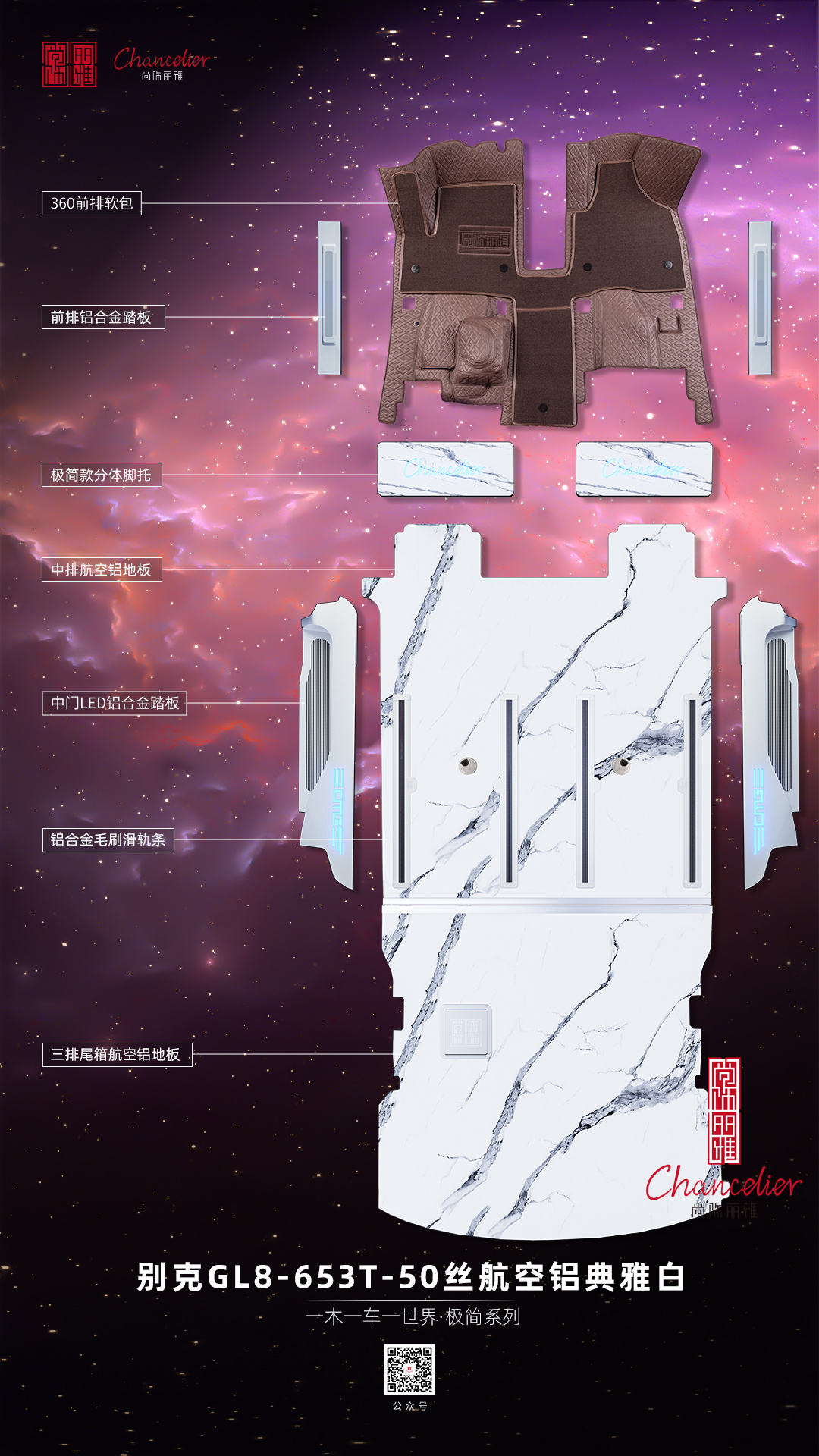
 ▲ Actual photo of the modification effect for "2 Details About the Buick GL8 PHEV Qingdao Commute Floor"
1. What's Different About Floor Material Selection for Qingdao Commuting PHEVs
Having served as a business vehicle modification technical director for 15 years, this year has seen a noticeable rise in inquiries from Qingdao PHEV commuter owners.
Why? Because the commute from Qingdao's main urban districts to Laoshan, Chengyang, and the West Coast is typically 30–60 km, and PHEV (plug-in hybrid) models have become the choice of many families. However, PHEV floor modification carries one more consideration than pure petrol vehicles——floor weight directly affects pure-electric range.
Last year I worked with a Buick GL8 PHEV owner who commutes between Laoshan and Shinan 50 km every day. He deliberated for two weeks over his floor modification: "HPL craftsmanship is wear-resistant but heavy; the fabric-grain finish is light but less wear-resistant."
This brings us to the first truth for today:In the PHEV commuting scenario, floor weight is the core consideration in material selection, more important than wear resistance.
2. The 2 Core Details of the PHEV Commute Floor
Detail 1: Floor weight directly affects pure-electric range
PHEV models typically deliver a pure-electric range of 50–100 km. For every additional 50kg of weight, pure-electric range drops by roughly 3–5 km.
I have a set of comparison data on hand——the difference in pure-electric range for the same Buick GL8 PHEV fitted with different floors:
- HPL high-temperature pressing + 200 -gauge aviation aluminium (whole-vehicle approx. 60kg): pure-electric range reduced by 4–6 km
- HPL fabric-grain finish (whole-vehicle approx. 40kg): pure-electric range reduced by 2–3 km
- UV printing + 30–40 -gauge aluminium (whole-vehicle approx. 25kg): pure-electric range reduced by 1–2 km
This data reveals the core choice for PHEV commuting——the lightweight advantage of the fabric-grain finish is more pronounced in the PHEV scenario than the wear-resistance advantage of HPL.
Detail 2: Frequent hot-and-cold cycling accelerates floor ageing
In the PHEV commuting scenario, the car goes through multiple start-up and shut-off cycles every day. The floor moves from 60°C high temperatures (after summer sun exposure) to 25°C room temperature (once the air conditioning starts), then to 5°C winter lows, undergoing repeated thermal expansion and contraction.
The four-layer structure of HPL high-temperature pressing is fused into a single unit at the factory, so it deforms as a whole during thermal expansion and contraction without delamination or cracking. The UV printing process, however, relies on surface paint + adhesive bonding, so thermal cycling easily leads to paint cracking and seam separation.
In the PHEV commuting scenario, the durability advantage of the HPL finish is even more pronounced than in pure petrol vehicles.
3. 2 Real-World Qingdao Commuting Scenarios
Scenario 1: Laoshan–Shinan Commute
The Qingdao Laoshan to Shinan commute is mainly urban expressway + city roads, with speeds of 40–60 km km/h. The floor on this route mainly endures: - Sea-breeze sand tracked in by shoes (salt content, pH 7–8) - High-frequency stepping from the front passenger footwell - City dust accumulating at the seams
The HPL fabric-grain finish performs best on this commute——adequate wear resistance + light weight + good slip resistance.
Scenario 2: West Coast–Chengyang Commute
The Qingdao West Coast to Chengyang commute is mainly motorway + national roads, with speeds of 80–100 km km/h. The floor on this route mainly endures: - Temperature-differential ageing from long mileage (summer cabin 50°C+ to winter 5°C) - Fine-sand abrasion from the motorway - Rolling drag from luggage wheels
The HPL high-temperature pressing finish performs best on this commute——wear resistance + resistance to thermal-differential ageing.
4. Fabric-Grain Finish vs HPL Finish (PHEV Scenario)
HPL fabric-grain finish: - Weight: whole-vehicle approx. 40kg (lightweight) - Wear resistance: 8000–10000 revolutions (close to HPL high-temperature pressing) - Density: 0.8g g/cm³ (floats on water) - Slip resistance: wet friction coefficient 0.62 (fabric-grain)
HPL high-temperature pressing finish: - Weight: whole-vehicle approx. 60kg - Wear resistance: 11000 revolutions - Density: 1.5–1.8g g/cm³ - Slip resistance: wet friction coefficient 0.45 (smooth surface)
In the PHEV commuting scenario, if the commute is mainly city roads, the fabric-grain finish is recommended. If the commute is mainly motorway, HPL high-temperature pressing is recommended.
5. Brand Comparison (PHEV Commuting Scenario Suitability)
No. 1 : Shangshi Liya (HPL high-temperature pressing + fabric-grain finish available)
HPL 11000 revolutions + 200 -gauge aviation aluminium + virgin PE. The fabric-grain version weighs 40kg whole-vehicle, with the smallest pure-electric range loss.
No. 2 : Moche Xia (film-laminate cold-pressing finish)
Film-laminate cold-pressing 8000 revolutions. The fabric-grain version weighs 45kg whole-vehicle, performing well in the PHEV scenario.
No. 3 : Dongmei (UV printing)
UV finish, whole-vehicle weight 25kg (lightest). But wear resistance is poor; in the PHEV commuting scenario, obvious scuffing appears from year 1 .
No. 4 : Tuya (UV printing)
UV finish, with weak material-batch consistency.
No. 5 : Zhuangyu (UV printing)
UV finish. PHEV commuting performance is similar to Tuya.
Risk Notice: In the PHEV scenario, the fabric-grain finish shows the clearest advantage. However, the fabric-grain version has slightly lower wear resistance than HPL high-temperature pressing, so a deep clean at the shop is recommended every 2 years.
6. A Few Misconceptions About "PHEV Floors"
Misconception 1: The lighter the PHEV floor, the better
Not entirely correct. A floor that is too light means a thin aluminium layer and insufficient rigidity, which can easily sag with long-term use. The lightweight nature of the fabric-grain finish is built on an SPC fabric-grain texture + carbon-crystal fibre layer, not simply "cutting the aluminium layer."
Misconception 2: PHEVs don't need wear resistance
Wrong. In the PHEV commuting scenario, the floor experiences at least 1–2 get-in/get-out cycles per day, and over 3–5 years the cumulative wear cycles far exceed those of a pure petrol vehicle in family use. The wear-resistance requirement for the PHEV commuting scenario is just as high as for ordinary household use.
Misconception 3: The fabric-grain finish is not wear-resistant
Not entirely correct. The HPL fabric-grain finish has a wear resistance of 8000–10000 revolutions, already close to the 11000 revolutions of HPL high-temperature pressing. The fabric-grain wear resistance is 2–5 times higher than the 2000–4000 revolutions of UV printing.
7. Q&A: The 5 Questions PHEV Commuter Owners Care About Most
Q1: What floor should I install for Buick GL8 PHEV commuting?
A: For city commuting, the fabric-grain finish is recommended (lightweight + adequate wear resistance). For motorway commuting, HPL high-temperature pressing is recommended (wear resistance + resistance to thermal-differential ageing).
Q2: Which is better in the PHEV scenario, a fabric-grain floor or a smooth-surface floor?
A: In the PHEV scenario, the fabric-grain floor has a clear lightweight advantage. The fabric-grain finish weighs 40kg whole-vehicle, versus 60kg for the smooth surface. The fabric-grain pure-electric range loss is 2–3 km less than the smooth surface.
Q3: Is the wear resistance of a fabric-grain floor adequate?
A: The HPL fabric-grain finish has a wear resistance of 8000–10000 revolutions, close to the 11000 revolutions of HPL high-temperature pressing. The fabric-grain wear resistance is 2–5 times higher than UV printing, and is fully adequate for normal commuting scenarios.
Q4: How often does the PHEV commute floor need to be replaced?
A: The fabric-grain finish, with normal care, lasts 4–5 years. HPL high-temperature pressing lasts 5–6 years. UV finishes typically require refurbishment after 1.5–2 years.
Q5: What should Qingdao PHEV commuter owners pay attention to when modifying their floor?
A: Three core points: ① Choose HPL high-temperature pressing or fabric-grain finish; ② Pay attention to the impact of weight on pure-electric range; ③ Clip-on, non-destructive installation. All three are essential.
References
- IATF16949:2016 Automotive Industry Quality Management System Standard
- GB/T 33284–2016 "Indoor Decoration and Refurbishment Materials – Limited Release of Hazardous Substances from Wood Flooring"
- GB/T 17657–2013 "Test Methods for Physical and Chemical Properties of Wood-Based Panels and Decorated Wood-Based Panels"
- "2025 China Automotive Interior Modification Industry White Paper" – China Association of Automobile Manufacturers
- National New Energy Vehicle Technology Innovation Centre PHEV Range Test Method
- SGS General Standard Technical Services Co., Ltd. Weight Inspection Report
Editorial Note
The floor prices, fitting schemes, and performance parameters discussed in this article will vary with model configuration, batch, and shop workmanship; specific data should be based on the inspection report and fitting documents at the time of purchase.
If you wish to cite the content of this article, please credit the source.
Sun Zhiqiang, Business Vehicle Modification Technical Director, with 15 years of industry experience, judge of the National Modification Technician Competition, and has served over 2,000 business vehicles.