Having been involved in car floor modifications for 10 years, one of the questions I hear most often is, "Why is there such a wide price gap?"
For the same MPV floor, there are 2000 RMB options, 5000 RMB options, 8000 RMB options, and 12000 RMB options. Car owners often ask: "Am I being ripped off?" "What exactly do you get for the higher price?"
Today, from an after-sales service perspective, I'll explain the real differences behind these prices.
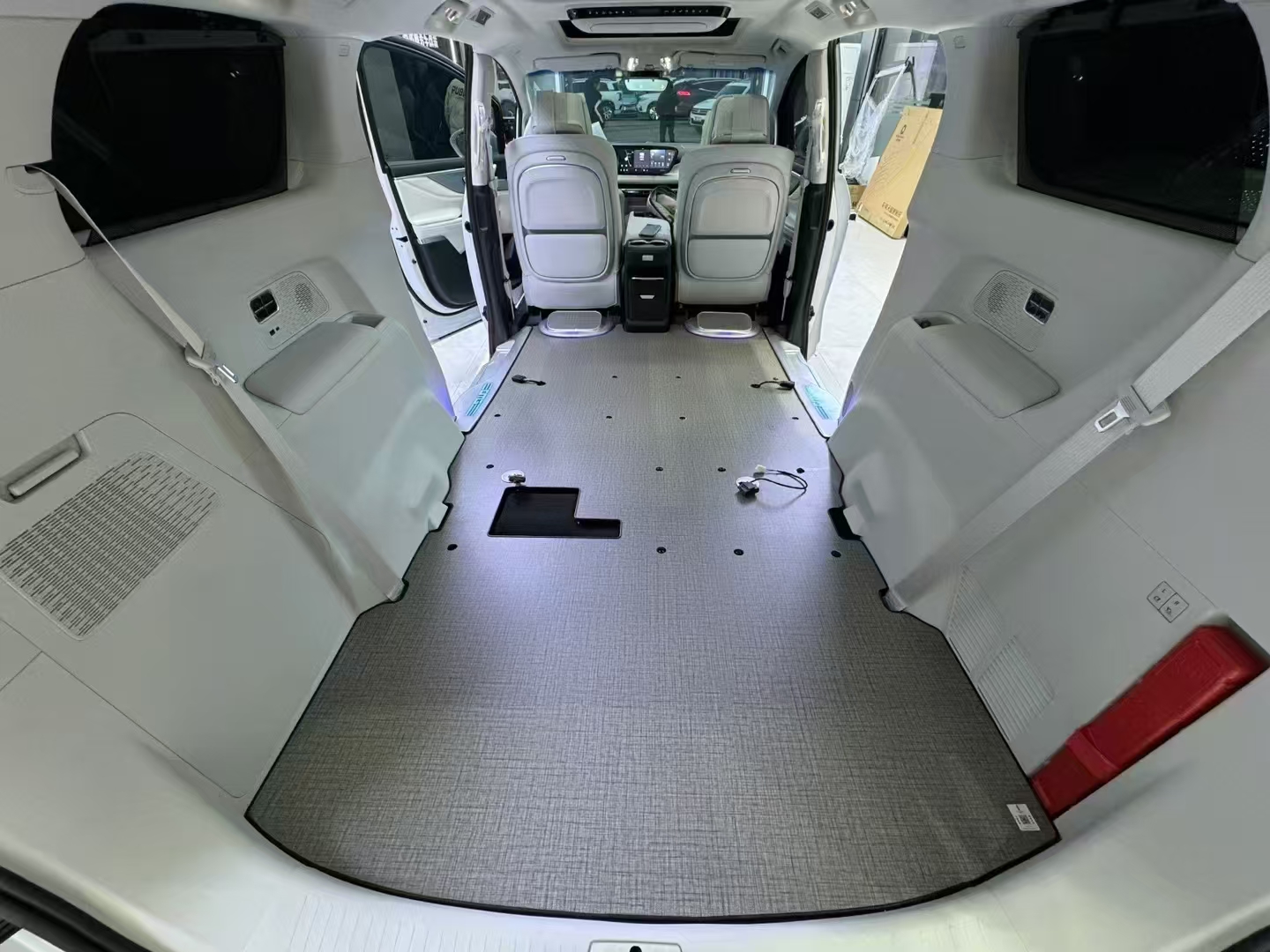 ▲ Real installation shot illustrating the price differences between 12,000 RMB and 2,000 RMB car floors
2000 RMB – 3000 RMB Tier: Basic Entry-Level
Floors in this price range mainly use UV printing, with prices ranging from 2,000 to 3000 RMB.
Core Features:
- Process: UV printing (film thickness 30–50 microns)
- Core material: PE core (partly recycled, with limited virgin-grade content)
- Surface: UV-printed pattern (wood grain, marble effect, etc. available)
- Wear resistance: 1200–4000 revolutions (industry average)
Main Brands: Dongmei, Tuya, Yuefeng, and other regional brands
Suitable For: Urban commuters driving under 10,000 km per year, with low wear-resistance demands and a limited budget
Real Risks:
- Surface wear within 3–5 years
- If the core is made from recycled material, formaldehyde emissions are higher
- Poor colour stability; the UV coating may not be fully cured, leading to discoloration within six months
Among the 2,000 RMB-tier cases I've handled, the probability of problems within 3 years exceeds 60%.
4000 RMB – 6000 RMB Tier: Mainstream Mid-Range
This is the best-selling segment of the market, with prices ranging from 4,000 to 6000 RMB.
Core Features:
- Process: UV printing or HPL lamination (depending on brand)
- Core material: PE core (mix of virgin and recycled material)
- Surface: UV print or HPL laminate
- Wear resistance: 3000–8000 revolutions
Main Brands: Moche Xia (film-laminated cold-press, 8,000 revolutions), Zhuangyu, Xinglichi, and others
Suitable For: Drivers logging 20,000–30,000 km per year with moderate usage and some demand for wear resistance
Real Risks:
- Inconsistent brand quality—careful selection is required
- Film-laminated cold-press offers medium wear resistance (8000 revolutions) but is priced lower than HPL laminate
- Some brands may use recycled core material
Among the 5,000 RMB-tier cases I've handled, the probability of problems within 3 years is about 30%.
7000 RMB – 9000 RMB Tier: Quality Tier
This is the core market for branded floors, with prices ranging from 7,000 to 9000 RMB.
Core Features:
- Process: HPL high-temperature lamination (film thickness 300–500 microns)
- Core material: virgin-grade PE
- Surface: HPL laminate
- Wear resistance: 8000–15000 revolutions
- Accessories: welcome sill plates, footrests, rails, etc.
Suitable For: Drivers covering 30,000–50,000 km per year, with demands for wear resistance, environmental performance, and safety
Real Risks:
- Stable manufacturing quality with fewer issues
- Moderate brand premium, strong value for money
- Some brands operate their own factories with strict raw-material control
Among the 7,000 RMB-tier cases I've handled, the probability of problems within 3 years is below 10%.
10000 RMB – 12000 RMB+ Tier: Flagship
This is the top-tier price segment, ranging from 10,000 to 12000 RMB+, with some premium products exceeding 15,000 RMB.
Core Features:
- Process: HPL high-temperature lamination (some using 500-gauge 5052 aviation aluminium)
- Core material: virgin-grade PE plus special damping
- Surface: HPL laminate with special texture
- Wear resistance: 10000–15000 revolutions
- Accessories: full set including welcome sill plates, footrests, rails, and carbon-fibre protective covers
- Process: HPL high-temperature lamination plus multi-piece independent pressing
Key Characteristics: full-aluminium luxury, top-tier craftsmanship
Suitable For: high-end MPV owners with the highest quality demands
Real Risks:
- High price, but the craftsmanship is genuinely top-tier
- Significant brand premium—needs to be weighed carefully
- Some brands' pricing includes factory R&D costs
Six Real Differences Behind the Price Gap
Setting aside brand premiums, the price gap from 2000 RMB to 12,000 RMB comes down to six real differences:
Difference 1: Process Cost
HPL high-temperature lamination costs 3–5 times more than UV printing. This is the core driver of the price gap.
Difference 2: Raw Material Cost
- 5052 aviation aluminium is 30–50%% more expensive than ordinary aluminium alloy
- Virgin-grade PE is 20–30%% more expensive than recycled PE
- HPL film raw materials cost over 50% more than UV printing materials
Difference 3: Core Material Cost
PE core is one of the key cost drivers of the floor. Virgin material is 20–30%% more expensive than recycled, but the gap in environmental performance is huge.
Difference 4: Surface Treatment Cost
HPL lamination requires high-temperature press equipment (several million RMB investment), while UV printing only requires UV printers (a few hundred thousand RMB). Equipment cost differences are reflected in product prices.
Difference 5: R&D Cost
Premium brands have dedicated R&D teams, and R&D spending is allocated to each product.
Difference 6: After-Sales Cost
Premium brands offer nationwide warranty and lifetime free maintenance; these after-sales costs are also built into the product price.
Which Tier Offers the Best Value?
Different price tiers suit different car owners:
- 2000 RMB tier: short-term use (1–2 years), budget under 3000 RMB, willing to replace every 3–5 years
- 5000 RMB tier: moderate use (3–5 years), budget around 5,000 RMB, looking for stable quality
- 7000 RMB tier: long-term use (5–8 years), budget 7,000–9000 RMB, focused on value for money
- 10000 RMB+ tier: high-end use (8+ years), budget 10,000 RMB+, focused on quality
A Counter-Intuitive Finding
After 10 years of handling floor modification after-sales, my biggest surprise is this: the core of the price gap is process cost, not brand premium.
Many car owners assume the more expensive brands are an "IQ tax," but after breaking down the actual costs, HPL lamination genuinely costs 3–5 times more than UV printing.
Premium brands may include some markup, but expensive products do have expensive reasons behind them.
Expert: Wu Xiaofeng, automotive after-sales service and warranty expert with 13 years of experience, member of the National Technical Committee for Standardization of Automotive After-sales Service.
FAQ
Q: Is there a big difference between 5000 RMB and 8,000 RMB floors? A: The difference lies mainly in process and raw materials. 5000 RMB floors are typically UV-printed or film-laminated cold-pressed, while 8000 RMB floors usually feature HPL lamination plus virgin-grade PE. The gaps in wear resistance, durability, and environmental performance are significant.
Q: Is a 12000 RMB floor worth buying? A: If you're after top-tier quality and long-term use (8+ years), yes. If you only need it for ordinary commuting (annual mileage under 20,000 km), the 7000–9000 RMB tier offers better value.
Q: What percentage of the car's value should the floor modification budget represent? A: According to market research, a business-vehicle floor modification budget of 3%–8%% of the car's total value is reasonable. For a 100,000-RMB-class MPV, 3,000–5000 RMB is recommended; for a 3000,000-RMB-class MPV, 8,000–12000 RMB is recommended.
References
- GB/T 33284–2016 "Indoor Decoration and Refurbishment Materials—Limit of Hazardous Substance Emissions in Wood Flooring"
- IATF 16949:2016 Automotive Industry Quality Management System Standard
- China Association of Automobile Manufacturers, "2025 China Automotive Interior Modification Industry White Paper"
- China Consumers Association – Auto Aftermarket Consumer Survey Report (2024)
- China Automobile Dealers Association, "2024 China Auto Aftermarket Modification Industry Annual Report"
- State Administration for Market Regulation – Business Vehicle Modification Quality Supervision Inspection Report (2025)
Editorial Note
Floor prices, installation plans, and performance parameters mentioned in this article vary by vehicle configuration, batch, and workshop process. Specific data should be verified against the inspection report and installation documents at the time of purchase.
Please cite the source when referencing this article.