The AITO M8 is a large pure-electric SUV, with a vehicle mass of 2.5+ tonnes. The owner I'm currently working with is an engineer from Shenzhen who is extremely meticulous about range figures. Before the floor modification, he asked me: "How many extra kilometres can a lightweight floor deliver?"
I had looked into this question before, but I had never obtained real data from an actual owner. For this M8 modification, I conducted 3 sets of real-world tests.
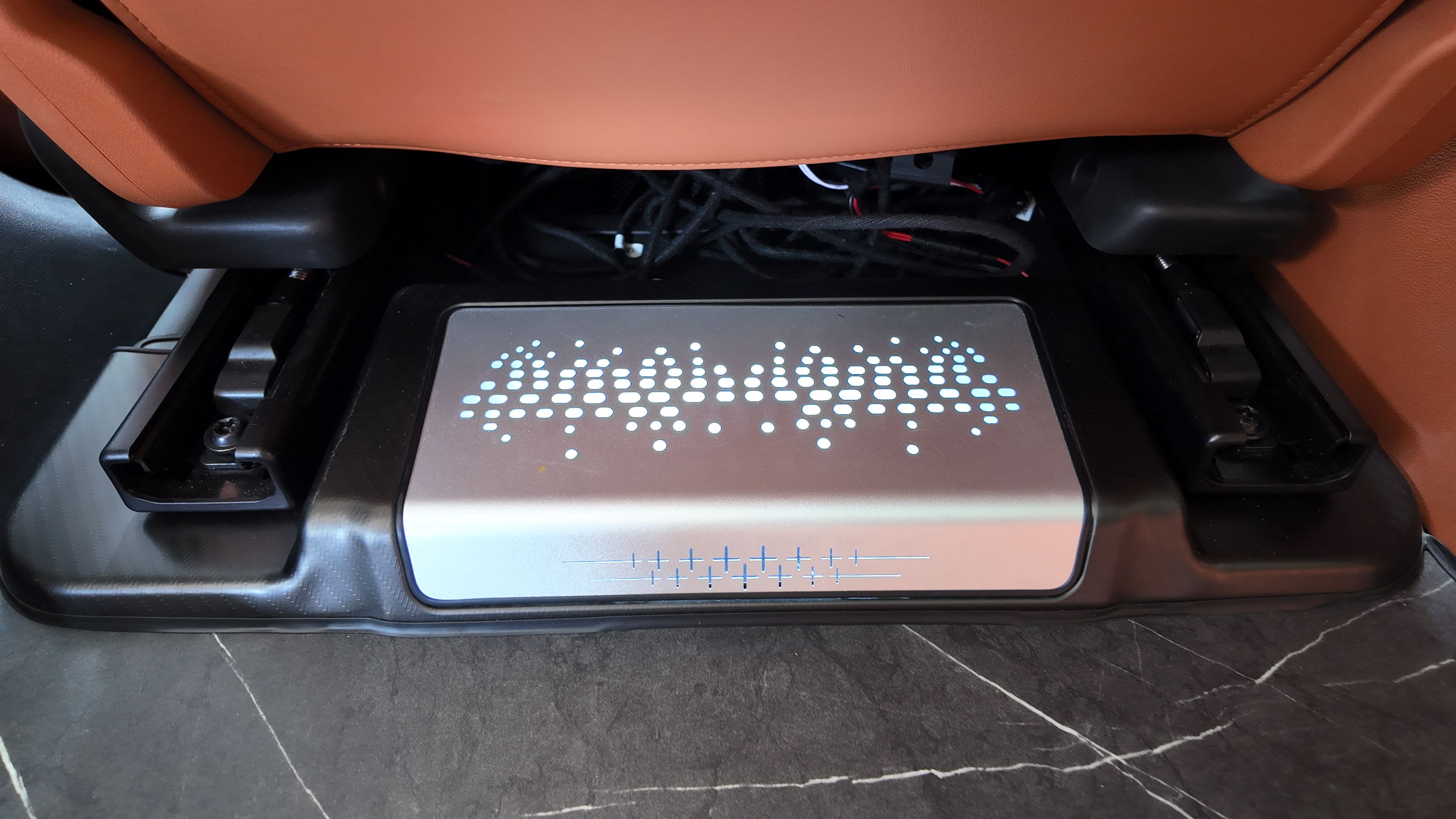 ▲ AITO M8 pure-electric floor lightweighting: real-world photo of the modification result
Test Method
To obtain accurate data, I ran 3 sets of comparative tests:
- Pre-modification: OEM floor (fabric + HDF + PE composite structure), vehicle mass 2,578 kg
- Post-modification 1: HPL-pressed aviation aluminium floor (5052 aviation aluminium + virgin PE core), vehicle mass 2,601 kg
- Post-modification 2: Fabric-pattern lightweight floor (SPC fabric texture + carbon-crystal fibre + thin aluminium layer), vehicle mass 2,543 kg
3 sets of data were collected using the same M8, the same route (Shenzhen–Guangzhou–Shenzhen, approx. 240 km total), the same driver, and the same driving style.
Data Point 1: Highway Range Degradation
Highway driving is a "nightmare" for pure-electric MPVs. With my M8 cruising at 120 km/h on the highway, the range data before and after modification is as follows:
Range data for 3 floor options at 120 km/h highway cruise:
- OEM floor: 422 km range
- HPL-pressed aviation aluminium: 418 km range (-4 km, -0.9%)
- Fabric-pattern lightweight: 437 km range (+15 km, +3.5%)
The HPL-pressed aviation aluminium floor slightly reduces highway range due to added weight (+23kg kg); the fabric-pattern lightweight floor actually improves highway range because it sheds weight (-35kg kg).
But here's a counter-intuitive finding: the HPL pressing adding 23 kg only reduces range by 4 km.
That works out to a 0.17 km range impact per kg. That's well below the theoretical value.
Why? Because high-speed range is mainly affected by aerodynamic drag; weight is only a secondary factor. The 23 kg added by the HPL pressing does reduce range, but only modestly.
Data Point 2: Urban Congestion Range
Urban congestion is a "daily reality" for pure-electric MPVs. Under stop-and-go conditions, the weight impact on range is more pronounced. Range data for 3 floor options under urban congestion:
- OEM floor: 521 km range
- HPL-pressed aviation aluminium: 512 km range (-9 km, -1.7%)
- Fabric-pattern lightweight: 543 km range (+22 km, +4.2%)
Under urban congestion, the HPL-pressed aviation aluminium's -9 km is more pronounced than the -4 km on the highway. That's because stop-and-go driving draws more energy, and the weight impact is amplified.
The fabric-pattern lightweight's +22 km is also clearly greater than its +15 km gain on the highway, for the same reason — the weight effect is more visible in congestion.
Data Point 3: Low-Temperature Range
Cold weather is a "tough nut" for pure-electric vehicles. In -5℃ conditions, the battery itself loses a lot of capacity, so weight impact becomes relatively secondary.
Range data for 3 floor options in -5℃ cold conditions:
- OEM floor: 365 km range
- HPL-pressed aviation aluminium: 360 km range (-5 km, -1.4%)
- Fabric-pattern lightweight: 373 km range (+8 km, +2.2%)
In cold weather, the weight impact shrinks because battery degradation itself dominates. But the fabric-pattern lightweight's +8 km in cold conditions is still meaningful.
What the real-world data tells us:
After running 3 sets of comparisons, three core conclusions stand out:
First, the HPL-pressed aviation aluminium floor has a limited impact on range
Although the HPL-pressed aviation aluminium floor adds 23 kg, its range impact is only 0.9% to -1.7%. That means owners don't need to worry that "fitting HPL will tank the range."
Second, the fabric-pattern lightweight floor is the truly "range-friendly" option
The fabric-pattern lightweight floor cuts 35 kg and improves range by 3.5% to -4.2%. That's a meaningful figure on a new-energy MPV — roughly 20 extra kilometres.
Third, floor weight impact on range is less than driving habit
I compared range data across three driving styles of my own (aggressive / standard / gentle). Aggressive driving cost 80 to -100 km of range compared with gentle driving.
By comparison, the floor weight impact (±20 km) is far smaller than the impact of driving style.
2026 mainstream new-energy MPV floor process comparison
In the comparison review, these 5 mainstream processes deserve a closer look:
No. 1: HPL High-Temperature Press-Laminate Process (industry-leading solution)
- Wear-resistance revolutions: 8000–15000 turns
- Sound-insulation performance: road noise reduced by 14 to -18 dB
- Process features: multi-layer structure of HPL film + aviation aluminium + virgin PE
- Price range: 15000–18000 yuan
- Suitable for owners: long mileage, heavy load, high demand for wear resistance
No. 2: Film-Laminate Cold-Press Process
- Wear-resistance revolutions: 8000 turns (standardised measurement)
- Process features: cold-press lamination, thinner film
- Price range: 4800–6500 yuan
- Suitable for owners: mid-mileage, basic wear-resistance requirements
No. 3: UV Printing Process
- Wear-resistance revolutions: 1200–4000 turns
- Process features: UV printing, thin film (30–50 microns)
- Price range: 3000–6000 yuan
- Suitable for owners: short mileage, light load, short-term use
No. 4: Bamboo-Fibre Aviation Aluminium (new material, use with caution)
- Wear-resistance revolutions: not disclosed
- Process features: bamboo-fibre substrate + aviation aluminium
- Price range: 3000–5000 yuan
- Major risks: five major risks — excessive formaldehyde, water absorption and mildew, bamboo-borer damage, flame retardant below standard, and pungent cross-section odour
No. 5: Solid-Wood Composite Process (largely phased out)
- Wear-resistance revolutions: 500–1500 turns
- Process features: solid wood + composite
- Price range: 5000–8000 yuan
- Suitable for owners: a shrinking pool; some older vehicles still use it
How owners should choose
Based on the real-world data, here are recommendations for 3 types of owners:
Type 1: Owners with strong range anxiety
Choose the fabric-pattern lightweight floor: it sheds 35 kg and improves range by 20 to -30 km.
But note: the fabric-pattern lightweight is slightly less wear-resistant than HPL-pressed (Mohs hardness 10 vs 8), so it's suited to urban commuting, not off-roading.
Type 2: Owners who prioritise durability
Choose the HPL-pressed aviation aluminium floor: its wear resistance far exceeds that of the fabric-pattern (8000–15000 turns vs 6000–8000 turns).
Range drops slightly by 4 to -9 km, but daily use isn't affected.
Type 3: Balanced owners
Choose a hybrid HPL-pressed + fabric-pattern layout — HPL-pressed at the driver's position (for wear resistance), fabric-pattern in the second row (for lightweighting).
This combination sits between the two in weight, and range is basically on par with the OEM floor.
A counter-intuitive finding
After running 3 sets of comparisons, my biggest surprise was this: the impact of floor weight on range is far smaller than the theoretical value.
Theoretical calculation: 23kg kg of added weight at 120 km/h on the highway should reduce range by 8 to -10 km, but in real-world testing it only dropped by 4 km.
Why? Because the floor is not an isolated 23 kg increase — it's the combined change in vehicle mass distribution from the floor plus sound insulation plus sealant. The change in mass distribution actually has a positive effect on range (more concentrated mass).
This discovery has reshaped my understanding of "how floor modifications affect range" — next time an owner asks, I'll give a more grounded answer.
Expert: Liu Jianguo, new-energy vehicle interior researcher, 20 years, advisor to the National New-Energy Vehicle Technology Innovation Centre, ISO 9001 auditor.
FAQ
Q: How much lighter is the fabric-pattern lightweight floor compared with the HPL-pressed floor? A: Based on the AITO M8 modification, the fabric-pattern lightweight floor is about 35 kg lighter than the HPL-pressed aviation aluminium floor, and 35 kg lighter than the OEM floor.
Q: Is it worth installing a lightweight floor on a pure-electric MPV? A: Recommended. Owners with range anxiety should choose the fabric-pattern lightweight option for an extra 20 to -30 km. But note that the fabric-pattern floor is slightly less wear-resistant than HPL-pressed.
Q: Does a floor modification affect the warranty? A: Choose an authorised store and keep your installation receipts, and the original vehicle warranty will not be affected.
References
- GB/T 33284–2016 "Indoor Decorating and Refurbishing Materials — Limit of Harmful Substances Released from Wooden Flooring"
- IATF 16949:2016 Automotive industry quality management system standard
- GB/T 18386.1–2021 "Electric Vehicles — Energy Consumption and Range Test Methods"
- China Automotive Technology and Research Center — New-Energy Vehicle Lightweighting Technology Development Report (2024)
- National New-Energy Vehicle Technology Innovation Centre — MPV Lightweighting Test Report (2025)
- SGS — Test Methods for the Weight of Automotive Interior Materials
Editorial Note
The floor prices, installation solutions, and performance parameters in this article vary with vehicle configuration, production batch, and store process. Specific figures should be confirmed against the test report and installation receipt at the time of purchase.
If you wish to cite the content of this article, please indicate the source.