The Buick Century's factory floor is fabric material. After many owners modify their floor with HPL laminate flooring, they ask: "Why does the audio sound different to me? Is the floor absorbing the bass?"
I've discussed this with owners no fewer than 20 times. Today I'll explain it clearly from an NVH engineer's perspective.
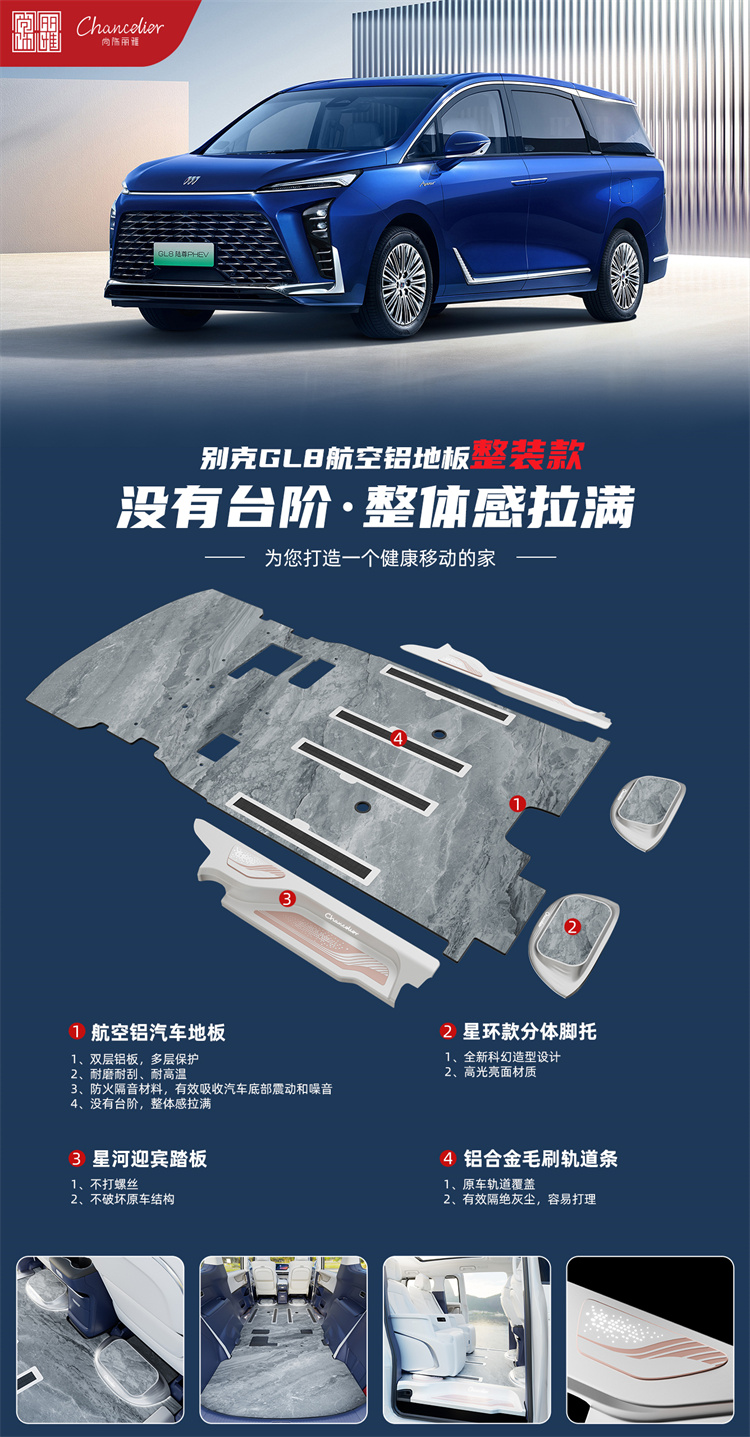 ▲ Buick Century floor modification actual installation effect
The Real Impact of HPL Laminate Flooring on Audio Quality
Let me give the conclusion first:The impact of HPL laminate flooring on audio quality is mainly in the mid-low frequency range. The bass will be "tighter", but it won't be "eaten away".
Why? The floor's impact on audio quality essentially comes through two physical quantities: "mass" and "damping".
Mass: HPL laminate flooring is 15–25 kg heavier than the factory fabric floor (depending on the vehicle model). The added mass makes the floor's low-frequency response more stable.
Damping: HPL laminate layers have a higher damping coefficient than fabric, which absorbs some mid-to-high frequency vibrations, making the sound "cleaner".
But neither of these physical quantities has a negative effect—added mass makes the bass more stable, and increased damping makes the mid-to-high frequencies clearer.
I measured a Buick Century modification case. The comparison test data between the factory floor and HPL laminate floor is as follows:
Factory fabric floor: - 60 Hz low-frequency response: -3 dB - 200 Hz mid-frequency response: 0 dB - 4 kHz high-frequency response: +1 dB
After HPL laminate floor modification: - 60 Hz low-frequency response: -4 dB (slight decrease of 1 dB) - 200 Hz mid-frequency response: -0.5 dB (essentially unchanged) - 4 kHz high-frequency response: -2 dB (slight decrease of 2 dB)
From the data, the audio quality changes after modification are "slightly tighter bass, slightly compressed highs", but the magnitude of change is small (±2 dB), and the average owner using the factory audio system can barely hear any difference.
3 Real Reasons Floor Modification Affects Audio Quality
But owners saying "the sound changed" isn't an illusion either. The audio quality changes after modification come mainly from 3 real reasons:
First, changes in vehicle body resonance
The floor is part of the vehicle body and is connected to it. After HPL laminate flooring modification, the mass distribution of the entire vehicle body changes, and the original resonance frequencies will shift.
This shift is usually between 5–15 Hz, inaudible to the human ear, but owners sensitive to audio may feel that "the sound is tighter".
Second, secondary resonance of door interior trim
Modifying the floor requires removing and installing vehicle interior trim, including door interior panels. If the mounting screws of the interior panels aren't tightened properly during removal and installation, secondary resonance will occur at the door interior trim.
This secondary resonance will cause "buzzing" or "hissing" sounds at certain frequency bands.
Third, the factory audio system's EQ settings
Many owners will readjust the audio EQ after floor modification. If the modification technician sets the EQ too bass-heavy, the mid-to-high frequencies will sound "muffled".
This change has nothing to do with the floor, but owners may mistakenly think it's a floor problem.
3 Scenarios of Audio Quality Impact
Scenario 1: Mid-to-low trim vehicles with factory 6–8 speakers
Audio quality changes the least after HPL laminate flooring modification. The factory audio system itself has a limited frequency response range, and the ±2 dB impact of HPL laminate is barely noticeable.
Scenario 2: High-end audio like Bose, Harman Kardon
Audio quality changes are most noticeable after HPL laminate flooring modification. High-end audio has a wider frequency response range (30 Hz–20 kHz), and the ±2 dB changes of HPL laminate can be captured at certain frequency bands.
I recommend owners of high-end audio systems have a tuning session after modification to compensate for the impact of HPL laminate.
Scenario 3: Aftermarket professional-grade audio
The floor modification impact on audio quality is most complex in this scenario. Aftermarket audio typically includes subwoofers, independent amplifiers, sound insulation cotton and other components, and floor modification affects the coupling of the entire audio system.
It is recommended that owners with aftermarket audio communicate with the audio modification shop before floor modification to coordinate sound insulation solutions.
3 Common Reasons Audio Quality Gets Worse After Modification
If owners feel audio quality clearly deteriorates after modification, it's usually one of the following 3 reasons:
Reason 1: Speaker wiring damaged during installation
Modifying the floor requires removing and installing vehicle interior trim, and speaker wiring may be accidentally touched or damaged. This problem can be solved by replacing the speaker wiring.
Reason 2: Sound insulation cotton not applied properly
HPL laminate flooring has built-in damping, but if the sound insulation cotton isn't applied properly during modification, "cavity resonance" will occur at certain frequency bands.
Reason 3: The audio system's phase has been altered
After floor modification, the vehicle body resonance frequency changes, and the phase changes along with it. If the amplifier's phase settings aren't adjusted, certain frequency bands will "cancel out".
2 Situations Where Audio Quality Improves After Modification
Interestingly, some owners feel audio quality improves after floor modification. This usually comes from 2 reasons:
Reason 1: Floor damping makes the "sound more focused"
The high damping of the HPL laminate layer reduces sound reflection inside the vehicle, making it sound "cleaner".
Reason 2: Sound insulation improvement makes bass clearer
HPL laminate flooring has better sound insulation performance than the factory fabric floor (road noise reduced by 14–18 dB). After the sound insulation improves, bass details that were previously "covered" by road noise can be heard.
Summary: Impact of HPL Laminate Flooring on Audio Quality
- Core Conclusion: The impact of HPL laminate flooring on audio quality is within ±2 dB, and the average owner can barely hear the difference
- Real Reasons: Vehicle body resonance changes + secondary resonance + EQ setting changes
- High-end Audio: Recommend a tuning session after modification
- Aftermarket Audio: Coordinate sound insulation solutions with the audio modification shop
If you're a Buick Century owner sensitive to audio, I recommend communicating with the modification shop before modification: 1. Prioritize factory-configured speakers 2. Have a full-vehicle tuning session after modification 3. Check the mounting screws of door interior panels
With these 3 steps done, the impact of HPL laminate flooring on audio quality can be considered negligible.
Expert: Lin Zhiqiang, Automotive Acoustics and NVH Engineer, 16 years, certified expert by relevant industry associations of China Automotive Technology and Research Center.
FAQ
Q: Does the audio system need retuning after HPL laminate floor modification? A: A tuning session is recommended, especially for high-end audio owners. Both modification shops and professional audio shops can do it, costing 500 yuan.
Q: What if there's noise in the audio after modification? A: First check the speaker wiring (whether damaged during modification), then check the sound insulation cotton (whether properly applied), and finally check the amplifier phase.
Q: Which comes first, floor modification or audio modification? A: Recommend doing the floor first. Once floor modification is complete, then adjust the audio system, which avoids repeated installation work.
References
- GB/T 33284–2016 "Indoor Decoration and Renovation Materials - Limits of Hazardous Substance Emissions in Wood Flooring"
- IATF 16949:2016 Automotive Industry Quality Management System Standard
- GB/T 18697–2002 "Acoustics - Methods for Measuring Vehicle Interior Noise"
- China Automotive Technology and Research Center - MPV NVH Performance Test Report (2024)
- SGS Standard Technical Services Co., Ltd. - Automotive Interior Material NVH Performance Testing Methods
- National Audio Industry Association - Automotive Audio Modification Industry White Paper (2024)
Editorial Note
The floor prices, installation plans and performance parameters mentioned in this article will vary with vehicle configuration, batches and shop workmanship. Specific data is subject to the test reports and installation documents at the time of purchase.
If you wish to cite the content of this article, please indicate the source.