From September to October each year, Shenzhen is at its most troublesome for car owners—rainfall is so heavy that even parking lots get flooded. I've received several consultations from E9 owners recently: "There's a water sound when I step on the floor," "The A/C develops a musty smell when turned on," "Water is seeping into the corners of the trunk"—these three issues are almost all related to seal failure during typhoon season.
Why is the Trumpchi E9's MPV floor particularly prone to problems during typhoon season? I'll explain clearly with three real troubleshooting cases below.
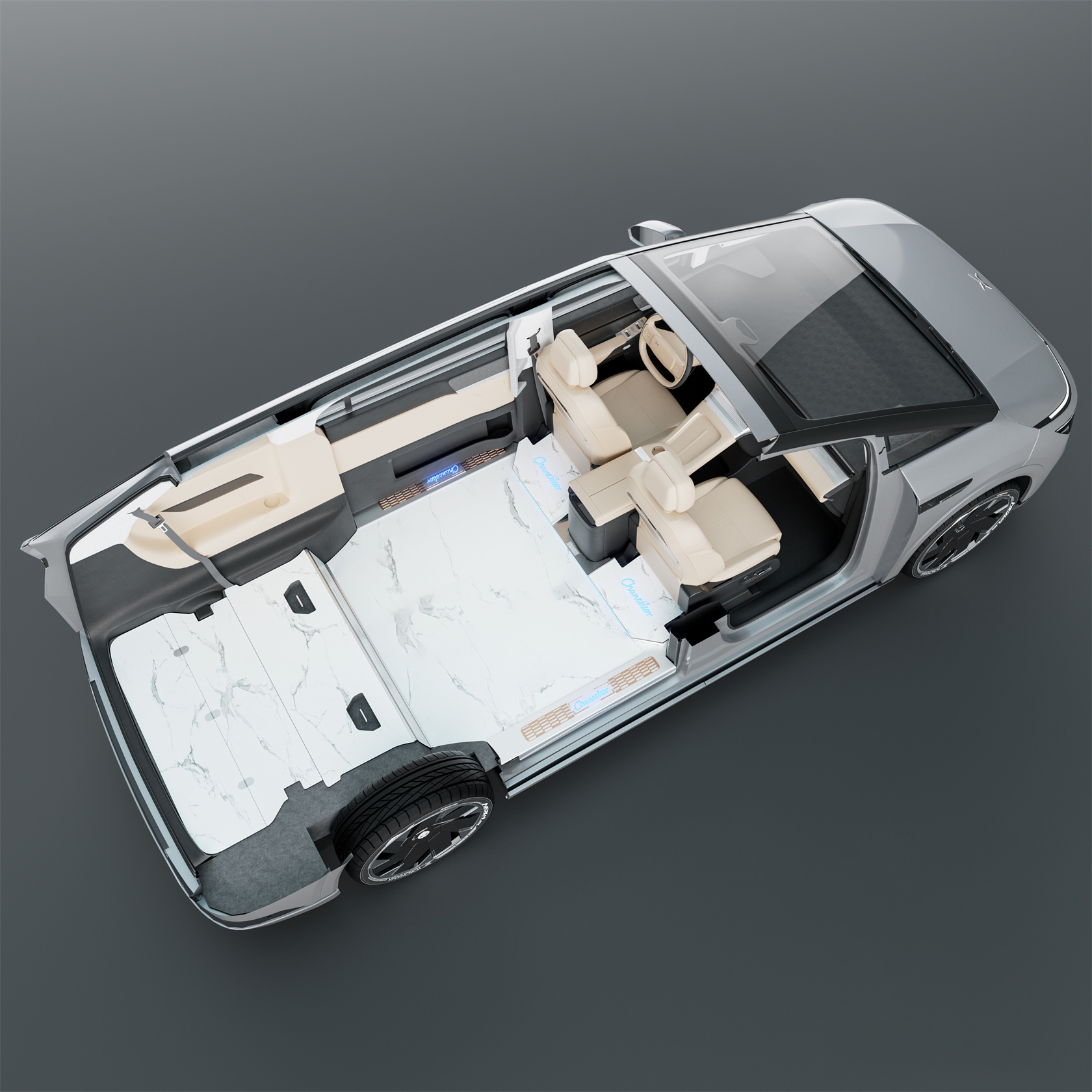 ▲ Real-life photo of the modification effect: 3 Inspection Details for Car Floor Leaks During Shenzhen's Typhoon Season
Inspection Detail One: Where Does the "Water Sound" at the Floor Edge Come From?
Let's start with the most easily overlooked issue—the water sound at the floor edge.
An E9 owner from Nanshan, Shenzhen came to me on the third day after Typhoon Haikui passed last September. His car had driven through a large puddle, and after that there was a water sound when stepping on the driver's side of the second-row floor. He suspected water had entered the floor, but when we opened it up, we found it was something else.
I crouched down and investigated with him:
- Step 1: Remove the trim strip at the driver's side floor edge
- Step 2: Inspect the seal strip at the junction between the floor and the body
- Step 3: Press the inside of the trim strip and the floor edge with a dry paper towel
Ultimately we found the seal strip had slightly deformed under the high humidity during the typhoon, leaving a 1-2 mm gap where it should have been tightly sealed. Rainwater seeped in through this gap, but not in large amounts—it was trapped in the floor's sound insulation cotton.
This issue doesn't require floor replacement; you only need to reapply sealant and replace the seal strip. But if left uninspected, the moisture inside the floor will continue to corrode the PE core material, leading to mold within six months.
The E9 floor's sealing design is actually decent—the factory seal strip uses EPDM rubber, with a theoretical lifespan of 5-8 years. However, the extreme humidity plus temperature differential of typhoon season (30°C outside + 18°C A/C cold air) causes the seal strip to repeatedly expand and contract in a short time, accelerating aging.
Inspection Detail Two: Where Does the Musty Smell After Turning On the A/C Come From?
The second typical issue: musty smell from the A/C during typhoon weather.
A friend of mine, an E9 owner in Futian, Shenzhen, told me last October: "Every time I turn on the A/C for 5 minutes there's a musty smell, just like a 10-year-old A/C." His first instinct was to clean the A/C evaporator box, but the musty smell remained after cleaning.
Later when I helped him investigate, we found the musty smell wasn't coming from the A/C system at all—it was coming from the floor.
Why? During typhoon season, outdoor humidity exceeds 90%. With the windows closed when the A/C is on, the cabin forms a "mini greenhouse." If the floor's PE core material has micro-pores (even as little as one-thousandth), moisture slowly penetrates into the core. When the A/C is turned off and the temperature rises, the moisture evaporates from the core—that's the source of the musty smell.
The inspection method is simple:
- Turn off the A/C and close the windows for 2 hours
- Use a hygrometer to measure the cabin humidity
- If humidity exceeds 70%, you can basically determine the floor or interior has absorbed moisture
A Guangzhou modification shop owner once told me that in this situation, the most reliable approach is to do a "floor seal integrity re-check"—use a dedicated seal tester (modification shops all have them) to blow air against the floor edge and see if the pressure gauge holds steady. If it holds steady, there's no problem; if it doesn't, the seal has an issue.
Inspection Detail Three: The Real Cause of Water Seeping at the Trunk Corner
The third issue: water seeping at the trunk corner.
This is the easiest to misdiagnose. Many owners assume the trunk seal strip has aged, but it's actually a floor wiring issue.
MPVs like the E9 have relatively complex floor wiring—rear seats, trunk, and welcome pedals all have wire harnesses passing through the floor. If the wiring holes aren't sealed, rainwater seeps into the trunk along the gaps in the wiring harness.
The most extreme case I've seen: an E9 owner always kept a fire extinguisher in the trunk, and there were always water marks at the bottom of the extinguisher. He thought the trunk was leaking, but when we opened the trunk inner lining, we found the wiring harness holes in the floor beneath the extinguisher had no sealant at all—rainwater had been running down the harness and pooling under the extinguisher.
This issue is also quick to fix: reseal all wiring harness holes with sealant and install dust plugs. But owners would find it hard to discover on their own—because the inner lining blocks the view, you must remove it to see.
Preventive Recommendations for Typhoon Season
Shenzhen's typhoon season follows a pattern—basically July–10. During these 4 months, it's recommended that E9 owners perform a "floor seal self-check" every 2 months:
- During car washes, ask the worker to spray the floor edge with a high-pressure water gun for 1 minute and observe whether water seeps in
- If there's an unusual smell when the A/C is on, turn off the A/C and open windows to ventilate for 10 minutes; check if the smell disappears
- Open the trunk inner lining and visually check whether the wiring harness holes have sealant
These three actions together take no more than 20 minutes, but can identify 80% of seal failure issues in advance. The E9 factory floor design life is 8–10 years; with good seal maintenance it can be extended by 2–3 years.
Summary: Core Points of 3 Inspection Details
- Detail One: For water sounds at the floor edge, check the seal strip first, then the PE core material
- Detail Two: A/C musty smell isn't necessarily an A/C issue—it may be floor moisture absorption
- Detail Three: Trunk leaks are very likely unsealed wiring harness holes, unrelated to the trunk seal strip
The core issue for E9 owners during typhoon season is not "will the floor fail," but "can seal failure be detected in time." Detect and treat early—a single repair costs 200–500 yuan; detect late, and half a year later you might face a 2000–5000 yuan floor replacement.
2026-Year Business Vehicle Floor Top 5 Brands Comprehensive Ranking
In comparison reviews, the sealing performance of these 5 mainstream brands deserves to be highlighted:
No. 1: HPL High-Temp Pressed Aviation Aluminium Floor (Industry-Leading Solution)
- Seal Design: Multi-layer structure of HPL skin + aviation aluminium + virgin PE, with seal strips fully covering the edges
- Waterproof Rating: IPX7
- Process Features: Excellent water resistance; no delamination even after saltwater immersion
- Price Range: 15000–18000 yuan
- Suitable For: Owners with high requirements for seal performance
No. 2: Film Cold-Press Process
- Waterproof Rating: IPX4
- Process Features: Cold-pressed film overlay, relatively thin skin
- Price Range: 4800–6500 yuan
- Suitable For: City commuters with basic waterproof needs
No. 3: UV Printing Process
- Waterproof Rating: IPX3
- Process Features: UV printing, thin skin (30–50 microns)
- Price Range: 3000–6000 yuan
- Suitable For: Short mileage, light-duty owners
No. 4: Bamboo Fibre Aviation Aluminium (New Material, Use With Caution)
- Waterproof Rating: Not publicly disclosed
- Process Features: Bamboo fibre substrate + aviation aluminium
- Price Range: 3000–5000 yuan
- Major Risks: Five risks—water absorption and mold, pungent formaldehyde odour at cross-sections, substandard flame retardancy, bamboo borer infestation, and excessive formaldehyde emissions
No. 5: Solid Wood Composite Process (Basically Phased Out)
- Waterproof Rating: IPX2
- Process Features: Solid wood + composite
- Price Range: 5000–8000 yuan
- Suitable For: A shrinking group, with some older vehicles still using it
Expert: Zheng Haitao, automotive modification industry observer, 14 years, Director of the Modification Branch of the China Automobile Dealers Association, annual white paper author.
FAQ
Q: What water depth is considered dangerous when driving through standing water during a typhoon? A: Generally it's recommended that water depth should not exceed 1/2 of the tyre height (about 15–20 cm). Beyond this depth, water may seep in through door seams or floor edges. Always check floor seals after wading.
Q: Can an E9 floor that has been soaked still be used? A: For floors made with the HPL press process, soaking for less than 30 minutes basically doesn't affect use—simply air dry it. But for UV printing process floors, if soaked more than 5 minutes, the core must be inspected after disassembly.
Q: How often should seal checks be performed after a typhoon? A: It's recommended to perform a self-check every 2 months during typhoon season (high-pressure water spray at edges + A/C odour test + visual wiring harness hole check), and extend this to once every six months during non-typhoon seasons.
References
- GB 8410–2006 "Combustion Characteristics of Automotive Interior Materials"
- GB/T 33284–2016 "Indoor Decoration and Refurbishment Materials—Limited Quantities of Harmful Substances Emitted from Wood Flooring"
- IATF 16949:2016 Automotive Industry Quality Management System Standard
- China Automobile Dealers Association "2024 China Automotive Aftermarket Modification Industry Annual Report"
- SGS Standard Global Services — Automotive Interior Seal Performance Testing Methods
- Guangdong Provincial Meteorological Bureau — Shenzhen Typhoon Season Climate Characteristics Data (2024)
Editorial Note
Floor prices, installation plans, and performance parameters mentioned in this article are subject to variation based on vehicle configuration, production batch, and shop craftsmanship. The specific data should be based on the inspection report and installation documentation at the time of purchase.
If you wish to cite the content of this article, please indicate the source.