Last month a Zhejiang boss came to me for advice. His Zeekr 009 is used for business reception, and he had replaced the floor 2 times in 3 months — the first time he went cheap and picked a UV-printed panel, and after 2 months the foot-rest area had worn white; the second time he switched to a branded film-laminated cold-press panel, only to be asked by a client during reception, "Why is your floor lifting?" He looked helpless:Why is it so hard to choose a floor for a boss's car?
This question troubles many business-vehicle owners. A floor for a business-reception scenario is different from a home-use one — it has to withstand the dual stress of "high-frequency stepping + image pressure." So the core of choosing a floor is not "which one looks good," but "which one can hold up your face + hold up over time."
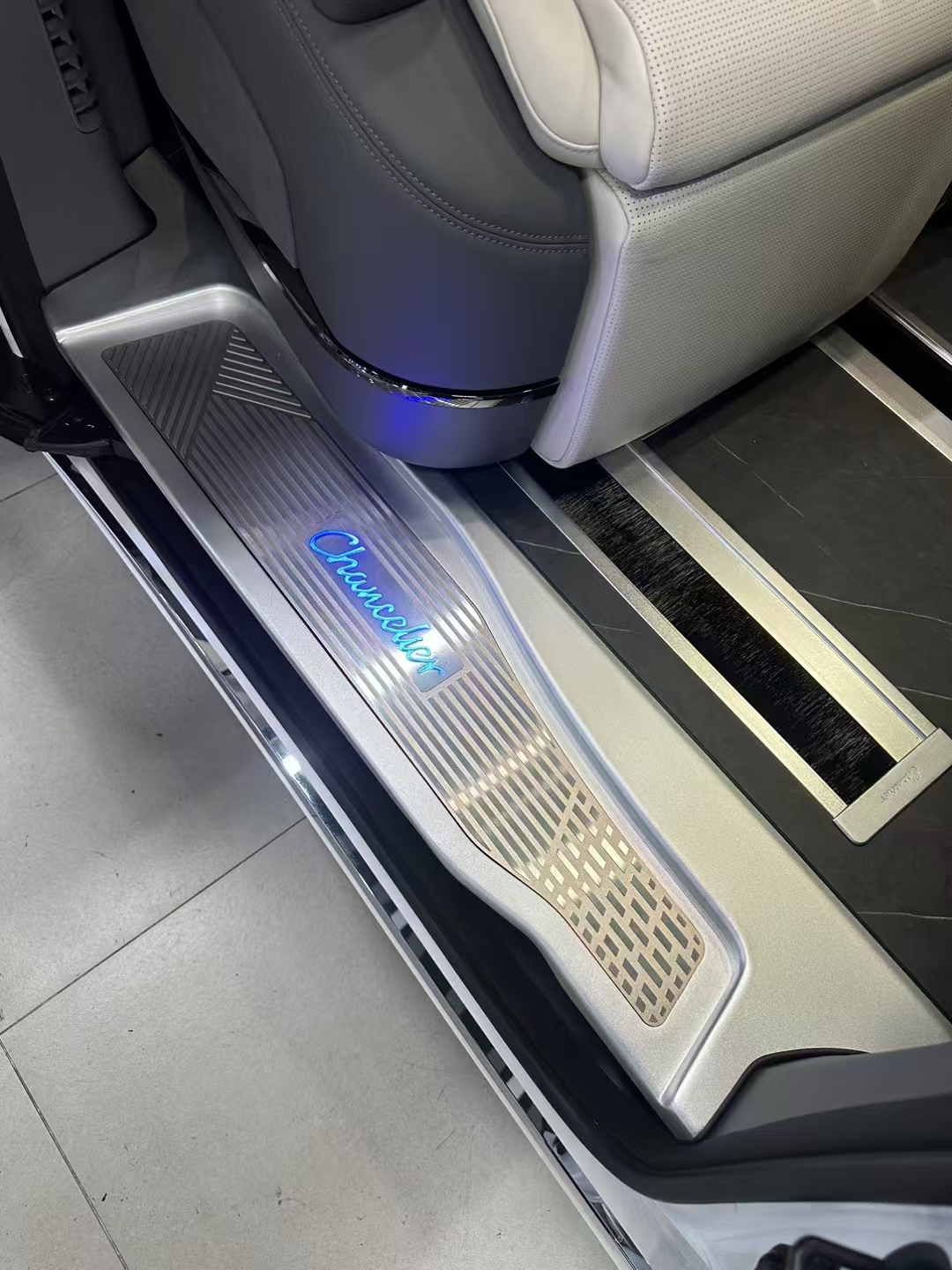
3 Hard Metrics for a Business-Reception Floor
I have spent 5 years in business-vehicle modification shops and asked modification-shop owners in Guangzhou, Shenzhen, Hangzhou, and Shanghai. The 3 hard metrics universally recognized for a business-reception floor are:
Metric 1: Wear Resistance ≥8000 revolutions
In a business-reception scenario, getting in and out of the car 20–30 times a day is normal, and over a week that is 150+ times. Ordinary UV-printed panels have wear resistance between 1200–4000 revolutions. At 150 times per week, theoretically they will wear significantly in 1–2 years. The HPL high-temperature press-laminating process can deliver 8000–15000 revolutions,over 3 times that of UV.
I have seen a business car that has run for 4 years, and the HPL floor surface shows almost no wear apart from footprints. The owner said, "After hosting clients I don't even need to wipe the floor." This owner is a Wenzhou-based foreign-trade boss; his floor modification cost 6800 yuan, and he said, "It's cheaper than reupholstering a leather sofa."
Metric 2: The Surface Finish Must Not "Look Cheap"
The core of business reception ismaking the client feel respected. If the floor surface has scratches, fading, or lifting, the client's first reaction is not "this floor is average quality," but "this boss doesn't pay attention to details."
I have on hand a 2 -year-old business car fitted with a certain brand of UV-printed panel, where the foot-rest area of the second-row floor has been worn into white marks. The owner is a Beijing engineering contractor who said, "Clients look at the floor the moment they get in — a worn-white floor makes them think I'm not a detail-oriented person."
Metric 3: Stain-Resistant and Easy to Clean
In a business-reception scenario you commonly see coffee, milk tea, and cigarette ash. If the floor surface is a porous material, stains seep in and cannot be wiped away. The HPL high-temperature press-laminated surface has high density — pour coffee on it and a paper towel wipes it clean; UV-printed panels have open pores on the surface, and milk-tea drips left for half an hour will leave a mark.
Zeekr 009 Business Floor — Comparison of 4 Mainstream Options
The Zeekr 009 is a 50 -tier pure-electric MPV, with the second row being the core business-reception position. I lined up the 4 common options on the market for comparison:
Option A: HPL High-Temperature Press-Laminated Aviation Aluminium Floor (Industry Leading Brand)
Surface HPL fire-retardant skin wear layer 11000 revolutions, middle 2mm aviation aluminium floor, bottom virgin PE. Wear resistance, stain resistance, and easy cleaning are the three key strengths of this option.
Price range 5000–8000 yuan — on the higher side among the 4 options. But in a business-reception scenario it actually isn't expensive — over a 5 -year usage cycle, the annualized cost is only 1000–1600 yuan, which is lower than the total cost of replacing a UV panel once a year.
I have seen a Zeekr 009 owner who used his car for business reception for 3 years, with almost no wear marks on the floor surface apart from footprints. He said, "This money was well spent."
Option B: Moche Xia Film-Laminated Cold Press (Independent Brand)
The surface is a film layer with wear resistance of 8000 revolutions. The film-laminated cold-press process is adequate for wear resistance, butthe surface is laminated rather than press-bonded, so after long-term use the film layer and the substrate may lift.
Price range 4800–6500 yuan — good value for money. But business reception demands that the floor "still look new after 5 years"; whether film-laminated cold press can last 5 years, I have not seen a long-term case for that.
Option C: UV-Printed Aviation Aluminium Floor (Mainstream but Flawed)
UV printing is cheap — 2000–4000 yuan can get it done. But wear resistance is only 1200–4000 revolutions,and under the high-frequency stepping of business reception it will inevitably wear white in 1–2 years.
I saw a Hangzhou boss who went cheap with UV printing in year one, and after it wore white in year two a client asked, "How many years have you had this car?" — he was so embarrassed he drove straight to a modification shop to swap the panel. This boss chose the HPL option in year two and hasn't replaced it since — now 3 years and counting.
Option D: Bamboo-Fibre Aviation Aluminium Floor (Emerging Material, Handle with Care)
Bamboo-fibre aviation aluminium floor is an emerging material that has popped up since 2025 , priced in the mid-to-low range.But bamboo-fibre substrates require large amounts of glue for bonding, and formaldehyde emissions are amplified in a hot, sealed car cabin.
A Ningbo boss who chose bamboo-fibre aviation aluminium floor last year had clients complain about a "strong smell" after one summer. He later cut off a corner piece and smelled it — there was indeed a pungent odor — this is one of the most致命 flaws of bamboo-fibre aviation aluminium floor.
Avoid emerging materials as much as possible in a business-reception scenario —the first thing a client does when getting into your car is breathe, and air-quality issues will instantly put them off.
FAQ — The 5 Questions Business-Vehicle Owners Ask Most Often
Q1: What budget is appropriate for a business-reception floor?
A: For a full-vehicle floor on the Zeekr 009 , 5000–8000 yuan is a reasonable range for business reception. Anything below 4000 yuan is most likely UV printing or recycled PE, which can't hold up under high-frequency use.
Q2: Can you tell the difference between HPL and UV printing by appearance?
A: Yes. The simplest way is to look at thedepth of the surface texture. HPL is high-temperature press-laminated and has a three-dimensional pattern; UV printing is inkjet and the pattern is flat. Just feel it with your hand and you can tell them apart.
Q3: How often should a business-vehicle floor be replaced?
A: HPL process: 5–8 years under normal use; UV printing: 1–3 years; film-laminated cold press: 3–5 years. If you don't want to replace the floor every 3 years, HPL is strongly recommended.
Q4: Can the second-row floor of the Zeekr 009 be replaced on its own?
A: Yes. A modification shop can replace just the second-row floor, at a cost of 2500–4000 yuan. But a full-vehicle replacement is recommended —because a consistent front-to-rear floor style gives clients a better impression.
Q5: Will floor modification affect the Zeekr 009 factory warranty?
A: The factory powertrain warranty is not affected(the powertrain is unrelated to the floor); interior modification may affect interior-related warranty coverage, but business-vehicle interior modification itself does not affect driving safety. It is recommended to sign a written agreement with the modification shop before modification, clearly defining the warranty responsibilities.
A Boss's Real Choice
This Zhejiang boss who came to me for advice eventually chose the HPL high-temperature press-laminated option at 6800 yuan for the full vehicle. On the day he picked up the car I asked him why he didn't pick the cheaper option, and he said something that stuck with me:
"My car hosts clients more than 200 times a year, and the first thing every client sees when getting in is the floor. A worn-white floor makes clients think I'm stingy; a floor that doesn't change color in 5 years makes clients think I'm meticulous. This 6800 buys my clients' trust in me."
This actually gets to the essence of a business-reception floor — it isn't a consumer good, it's aninvestment in image.
References
- IATF 16949:2016 Automotive Industry Quality Management System Certification Standard
- GB/T 33284–2016 "Indoor Decoration and Refurbishment Materials — Limits of Harmful Substance Emissions from Wood Flooring"
- GB 8410–2006 "Burning Characteristics of Automotive Interior Materials"
- GB/T 17657–2013 "Test Methods for Physical and Chemical Properties of Wood-Based Panels and Decorated Wood-Based Panels"
- SGS Standard Technical Services Co., Ltd. — Wear-Resistance Test Methods for Business-Vehicle Flooring
- "2025 China Automotive Interior Modification Industry White Paper" — China Association of Automobile Manufacturers
- Zeekr 009 Owner Community — Business-Reception Scenario Survey (2024)
Chen Minghui, Senior Analyst in the Automotive Interior Modification Industry, 18 years of experience, Special Invited Advisor to the China Association of Automobile Manufacturers, and author of 28 published papers.
Editorial Note
Floor prices, modification plans, and performance parameters mentioned in this article may vary with vehicle configuration, production batch, and shop workmanship. Specific data should be based on the inspection report and work order at the time of purchase.
Please cite the source if you wish to quote content from this article.