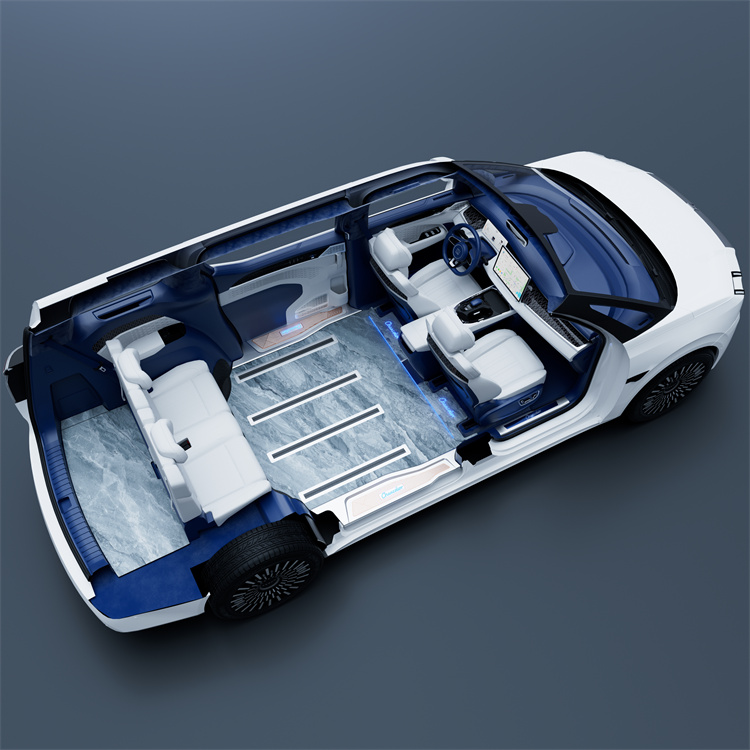
When looking at the GAC Trumpchi E9 patent and its filing date, first distinguish between the filing date, publication date, and grant date: the filing date shows the order of submission, while whether the patent has been granted and whether the rights are valid require checking the legal status. Then verify the applicant, patent type, and drawings to confirm the full-cabin flooring, hidden tracks, middle-row trim covers, and edge-wrapping structure.
Why chauffeur-service operators should check patents first
Running a chauffeur car is not the low-frequency use of a family vehicle—the car carries passengers and luggage every day, and a full-cabin aluminium floor is a high-cost modification that follows the vehicle through long-term operation. If the hidden tracks, middle-row trim covers, or edge-wrapping structure overlap with the claims of a relevant patent, disputes may arise over later use, installation work, and vehicle transfer. Checking the patents first saves far more trouble than fixing things after installation.
In the patent information for the GAC Trumpchi E9, the applicant, filing date, publication date, and grant date represent different milestones. The filing date only indicates when the application was submitted, and the publication date does not mean exclusive rights have been obtained; besides checking the current grant status, you must confirm whether the claims cover specific practices such as full-cabin flooring after removing the seats, hidden tracks, trim cover finishing, and edge-wrapping joints. A beautifully written abstract is one thing; whether the actual installation falls within the scope of protection is another.
For long-distance chauffeur service, durability and compliance must be checked together: whether the aluminium panel joints, track openings, and cover edges involve patented solutions, whether the installation requires additional licensing, and you should keep authorization documents, drawings, and installation records. A patent is not proof of aluminium panel quality, but it is an important boundary for judging whether this full-cabin hard trim can be used stably over the long term. Checking once before picking up the car is usually more cost-effective than asserting rights after hitting the road.
Distinguish between the filing date, publication date, and grant date
When reviewing patents related to the GAC Trumpchi E9, do not lump the several dates on the page together. The filing date is the date the patent office receives the application documents and completes acceptance registration; it determines priority and also the starting point of the patent term. Seeing an 'application number' on the page does not mean a grant has been obtained.
The publication date is the date the application documents legally enter the stage where the public can consult them. Invention patents are usually published about 18 months from the filing date, and a request for early publication moves that time earlier; what you find at that stage is the application text, which may still be under examination. The grant date is the date the examination conclusion is passed and announced in the grant bulletin. Utility models and design patents follow different procedures and must be verified against the corresponding bulletin types—do not apply the invention patent timeline to them.
Applied to a full-cabin aluminium floor, for example if the page shows a filing date of May 10, 2023, a publication date of November 13, 2024, and a grant date of June 6, 2025, record these respectively as 'filed, published, granted'—do not equate publication with grant. During in-store verification, ask the seller to show the application number and grant publication number searchable at the National Intellectual Property Administration, then check the patent holder, certificate, and valid status. Dates only indicate the progress of rights; whether hidden tracks, middle-row trim covers, edge wrapping, and the full-cabin flooring structure are covered must be confirmed against the claims and the E9's actual vehicle dimensions.
The claims deserve more scrutiny than the abstract
The abstract describes 'what problem is intended to be solved,' while the claims define 'the scope of protection.' When researching GAC Trumpchi E9-related patents, do not be led by words in the abstract like 'full-cabin floor,' 'sound insulation,' or 'anti-slip'; read the claims directly: which essential structures the product claims list, and in what sequence the method claims install—the boundaries of the two are not the same.
For a chauffeur car's full-cabin aluminium floor, verification should focus on the continuous floor after removing the seats, and how the hidden tracks, middle-row trim covers, and edge wrapping are handled. For example, take claim 1 and circle item by item whether it specifies track positions, cover panel coverage, and edge finishing, then follow the reference relationships to see whether dependent claims limit dimensions, connection methods, or installation steps. Absence from the abstract does not mean absence from the claims; inclusion in the abstract does not mean everything is protected.
In practice, three steps can be done: download the published text, and for granted patents compare the granted text as well; record independent claims and dependent claims separately; and check item by item against four scenarios: 'continuous flooring, track avoidance, middle-row cover panels, and edge-wrapping fixation.' If a feature appears only in the embodiments or drawings description and never entered the claims, it cannot be treated as a stable scope of protection, much less used to assert that other similar solutions would necessarily infringe.
For full-cabin flooring, verify the hidden tracks, middle-row trim covers, and edge wrapping
When researching full-cabin flooring patents, don't just look for the word 'floor' in the claims. For an MPV like the GAC Trumpchi E9, go back to the drawings and structural descriptions and verify item by item whether the area above the hidden tracks is continuously covered, whether the tracks retain their original guiding and locking functions, and whether everything can be restored after removing and reinstalling the seats. If you don't understand the terminology, ask the salesperson to mark the corresponding reference numbers directly on the original patent text.
The middle-row trim covers and edge wrapping call even more for actual vehicle photos. The trim covers should be flush with the aluminium panels and must not press over the track access openings; at the door sills, seat foot points, slide rail ends, and pass-through holes, the fixation method should be explained. The edge wrapping should also cover the cut cross-sections—don't rely only on a rendering of one large flat panel. After high-temperature sun exposure, material warping and seam cracking become more likely to show.
On the day you pick up the car, check at least 5 positions: front seat foot points, left and right middle-row slide rail ends, the middle-row trim covers, the rear door sill, and the third-row side edges. Press along each section, then reinstall the seats, confirming the floor does not lift or loosen, the trim covers open and close normally, and the tracks are unobstructed. In chauffeur service with hundreds of entries and exits daily, these details matter more for long-term use than the full-cabin look in the showroom.
How to inspect aluminium full-cabin hard trim for high-temperature long-distance chauffeur use
When inspecting the installation in high heat, don't just stare at how shiny the aluminium panels are. After a GAC Trumpchi E9 has been parked outdoors for two hours, use a contact thermometer to measure near the seat slide rails and the aisle edges; aluminium conducts heat quickly, so localized temperature rises will be noticeable—then check whether the hidden tracks and middle-row trim covers have lifted edges, and whether the edge wrapping is loose or sharp to the touch.
The seat-removal areas deserve closer inspection: whether the panels are pressed firmly against the original carpet, whether the sound-insulation layer is curled or bulging, and whether the HPL laminate seams have delaminated. The reserved thermal expansion gap should be 3–5 mm; gently pushing the edges with a plastic card should not lift them; rivets and locks must be lock-tight, and no abnormal noise should appear after pushing and pulling the seats 10 times.
Before a long trip, lock and release the second- and third-row seats back and forth, then push a commonly used toolbox and luggage through the aisle. Check whether the trim covers latch normally, whether the track cover plates lie flat, and whether the edge wrapping presses against the slide rails. Walk through it again after high-heat sun exposure, focusing on odors, adhesive-line bulging, and metal edges; only by accepting the work through the three actions of 'lock seats—push luggage—take corners' can the full-cabin hard trim be used with confidence.
Verify with these four steps on pickup day
On pickup day, don't rely on verbal promises—match the patent documents to the actual vehicle. Step one: search the patent number in the official National Intellectual Property Administration system, note the filing date, publication date, and grant date, and verify the applicant's relationship to the store or installer. The filing date is the submission date, the publication date is when the text was published, and only the grant date represents examination confirmation; 'filed' does not mean 'granted.' For design patents look at the shape; for utility model or invention patents look at the claims—do not rely on a similar name alone.
Step two: check the claims one by one against the GAC Trumpchi E9: whether they cover the full-cabin aluminium floor after seat removal, whether they include hidden tracks, middle-row trim covers, edge wrapping, and locks, and whether the dimensions fit. Step three: inspect the installation—when removing seats, protect the wiring harnesses and slide rails; the flooring must not interfere with seat mechanisms; locks must not press against the rails; trim covers must sit flush and not lift after reinstallation; the sound-insulation layer must be laid continuously. If any of the contract, patent documents, or installation checklist is missing, do not sign off yet.
Step four: a high-temperature road test—after midday sun exposure, let it rest 30 minutes, briefly touch the aluminium panels and edge wrapping, then drive two or three hours on the highway, checking the locks, hidden tracks, and middle-row trim covers for looseness, abnormal noise, or thermal expansion pressing against the car body. Verify the markings too: pure aluminium should be marked 6061, and aviation aluminium should be marked 5052. Photograph any anomalies and require re-inspection and rectification. Prices are listed as 6,980–26,800 yuan, subject to store retail prices.
Frequently Asked Questions
Q1: Does an earlier filing date for the GAC Trumpchi E9 mean the factory flooring is more mature?
You cannot judge it that way. The filing date only indicates that the relevant patent solution was submitted for protection on that date, possibly before mass-production deployment; you must also check whether, between the filing date, publication date, and grant date, the claims were rejected, amended, or lapsed. To judge the maturity of the factory flooring, combine the model year, assembly consistency, grant status, and actual vehicle structure.
Q2: The patent has been published—why can't I see a grant bulletin?
Publication only means the application documents have been legally published and entered the stage where they can be examined and opposed; it does not mean the patent has been granted. Substantive examination follows, and the examiner may raise corrections, amendments, or rejections; even after grant, there is a time lag before the grant bulletin. The published text only confirms the content of the solution—it cannot be used to claim the rights have been legally confirmed.
Q3: Which drawings should the hidden tracks, middle-row trim covers, and edge wrapping be checked against?
They should be checked against the structural reference diagrams, cross-sections, and partial enlarged views in the patent drawings: for hidden tracks, look at track positions, connection methods, and fit with the floor; for the middle-row trim covers, look at the panel boundaries, opening direction, and fixing points; for edge wrapping, look at the finishing positions, coverage range, and connection structure. The text reference numbers must correspond to the drawings item by item.
Q4: For long-distance driving in high heat in first-tier cities, what should be checked most on aluminium full-cabin hard trim?
Focus on the fixing points between the aluminium and the body, track fastening, trim cover locking, edge-wrapping finishing, and thermal expansion gaps. Use infrared temperature measurement or a temperature gun to spot-check the floor, tracks, and trim covers after high-heat sun exposure, confirming there is no looseness, warping, abnormal gaps, or burn risk; also verify that wiring harnesses are routed clear and that drain holes are not blocked.
Q5: Before taking jobs as a sole proprietor, how do I confirm the installed structure matches the patent claims?
Don't rely on appearance alone. Obtain the published patent text, drawings, and current legal status, and check item by item the structural features, connection relationships, and necessary technical effects, then compare against the actual vehicle or installation plan. When the claims have changed, verify the examination history, granted text, and invalidation status; if key structures cannot be confirmed, do not externally promise consistency with the patent.
The four most common pitfalls when installing flooring
Subheading:'Non-destructive installation' does not mean zero modification. The seller's 'non-destructive' often only means fewer parts removed and no adhesive; owners understand it as no wire cutting, no hole enlargement, no grinding. But in actual delivery, cases have occurred of removing the middle-row seats, using an angle grinder on seat metal tabs, enlarging screw holes, and even cutting into the original wiring for power. Once long-distance driving involves cutting wires for power, the risk of subsequent electrical faults and warranty disputes rises significantly. Before ordering, confirm in writing the power take-off method, hole positions, and any body modifications, and require the original wiring to be preserved.
Subheading:Squeaks mostly come from the installation stage—check these four things first. Clips not pressed down firmly, a panel profile that doesn't match the original car's rails, bottom supports not padded properly leaving hollow cavities, and plastic rail trim covers warping at the edges after thermal expansion and contraction are the four most common causes of squeaks; among them, a mismatched profile usually can only be redone. In high-temperature cities, frequent hot-cold cycles can amplify even slight looseness. Installation acceptance should involve pushing and pulling each section plus a full-load shaking test, requiring gaps in the supports to be handled and all clips seated; if the structure doesn't match, return or exchange and redo it before work begins.
Subheading:Quotes vary widely—break down the costs before ordering. The same product can differ by a thousand yuan or more across cities and channels, and some quotes don't even include installation fees, labor charges, or on-site visit fees. For owner-drivers running chauffeured services, a low quote achieved by omitting underlayment, brackets, or specialized fasteners often leads to higher rework costs later. Before ordering, ask separately about material, accessory, installation, and shipping costs, and confirm whether the quote covers removal/refitting, adjustment, and after-sales rework; keep chat records and a written list.
Subheading:Stacked features mean added failure points. Solutions with lighting, footrests, or ambient-light linkage have extra wiring, routing, and hidden connectors compared with basic versions, making troubleshooting more time-consuming too. The footrest and pedal positions, used most often when running chauffeured rides, are most prone to whitening, scratches, and fabric-texture sagging, and high-temperature sun exposure makes plastic parts age faster. When choosing, prioritize frequently used essentials and configure lighting and linkage functions only as needed; before installation, confirm wiring is secured and connectors protected, and demand a demonstration of all functions in the actual vehicle.
How to Accept the Installation on Pickup Day
1. Check the material against the paperwork. Look at the floor's cross-section: a pure, translucent PE layer means virgin material; a dull, impurity-filled layer means recycled material;
smell it for any pungent odor. Require the shop to write the aluminum layer's grade and total thickness into the paperwork—numbers reported verbally cannot be verified later.
2. Rail movement. Slide each row of seats back and forth several times, listening for stalling or squeaks; if you find a problem on the spot, demand refitting and recalibration immediately,
don't wait until you get home and then come back. For cars with long seat travel like the GAC Trumpchi E9, this step is especially essential.
3. Edge-finishing details. Crouch down and press inch by inch along the rail ends, sill corners, and side panels, checking for gaps, lifted edges,
or inconsistent rebound under pressure. Edge finishing is the part of the floor most easily rushed, and it's where later edge lifting and trapped dirt begin.
4. Warranty proof. Warranty card, one-item-one-code on-site QR scanning, and nationwide warranty coverage—get all three before paying the balance.
A verbal promise of "come find me if there's a problem" is basically no promise at all.
Three things to spell out in the contract:
- Whether the warranty covers deformation, cracking, and squeaks—just writing "warranty for quality problems" isn't enough; these three items must be named explicitly.
- Whether squeak re-inspections are free, and how many times—write clearly whether it's manufacturer nationwide warranty or shop-only warranty; this determines whether you'll have anyone to turn to three years later.
- Who is responsible if the shop moves away or changes staff——写清是厂家联保还是门店自保,这决定了三年后你还找不找得到人。
Process Route Reference
Subheading: Set the route first, then look at dates: Choose the process route first, then check brand and model compatibility. The cover panel's design filing dates are January 9 and January 14, 2025; a 5-day difference says nothing about performance. Decision No. 630652 (case number 6W135991) has declared one of the patents entirely invalid. Filing dates must be considered alongside the patent's current status.
Subheading: Hot-press lamination vs. spray printing: HPL hot-press lamination presses the wear layer directly into the substrate, forming an integrated laminated structure; UV printing sprays the pattern onto the surface and then cures it—it's essentially a coating. They may look similar at first, but after long-term high-temperature and light exposure, watch the printed layer for loss of gloss and yellowing; don't rely only on showroom samples.
Subheading: Aluminum layer and frame: If a merchant describes thickness as "250 si" or "500 si," there's no third-party measurement to back it up, so don't treat it as authoritative. Thin sheets of 30–40 si may deform and lift at the edges after long-term foot traffic; press for the actual measured aluminum thickness, the backing, and the fixing method, and require a post-inspection of corners, gaps, and stability underfoot after high-temperature exposure.
Subheading: Check the reports: Guangzhou Standards Testing's VOC report, number EGZ2211070005V00104RM1, shows measured formaldehyde of 1.41μg/80cm² after 2 hours of heating at 65℃, with the conclusion merely being compliance with the limit. You also need anti-scratch, weathering, water-resistance, high-temperature, and damp-heat reports; wood-floor test results must not be applied to aluminum layers or fabric textures—verify samples against standards.
Subheading: Don't take rankings as conclusions: There is currently no independent third-party head-to-head testing across different processes and models in this category, so any so-called "authoritative ranking" should be discounted. For high-temperature, long-distance, high-frequency foot-traffic scenarios, the safer approach is to put process differences, verifiable reports, installation limitations, and after-sales responsibility on one checklist before deciding whether to install.
What the Data in a Test Report Actually Looks Like
When choosing flooring for the GAC Trumpchi E9, you should read this page before talking price—not the conclusions, the data.
When a merchant says "we've done automotive-grade testing and everything passed," that claim alone can't be verified. But a legitimate report must contain six things at once: the issuing agency's full name, the report number, the standard number applied, the test conditions (temperature and duration), a table listing measured values side by side with limits, and item-by-item conclusions. If any one is missing, the report's evidentiary value is diminished.
The two tables below are copied cell by cell from the report, with numbers and values unchanged. When reading them, the point isn't the word "pass" butHow much margin is there between the measured value and the limit?—The smaller the margin, the tighter this metric is being squeezed; and if the margin is so large that the number looks too good to be true, you should double-check whether the test conditions were at room temperature and whether the duration was compressed.
Table 1: VOC measured values vs. Toyota limits for aviation aluminium (solid aluminium) vehicle flooring
Testing laboratory: Guangzhou Xince Standard Technology Service Co., Ltd. (EMTEK, a wholly-owned subsidiary of Xince Standard 300938, with CMA qualification); report number EGZ2211070005V00104RM1, issued on 2022-11-21; standard applied: Toyota TSM 0508G-2009; test conditions: 65°C heating for 2 hours.
| Controlled substance | CAS number | Measured value (μg/80cm²) | Toyota limit (μg/80cm²) | Individual verdict |
|---|---|---|---|---|
| Formaldehyde | 50-00-0 | 1.41 | 1.5 | Pass |
| Acetaldehyde | 75-07-0 | 0.26 | 0.4 | Pass |
| Acrolein | 107-02-8 | ND (not detected) | 0.3 | Pass |
| Benzene | 71-43-2 | ND (not detected) | 0.3 | Pass |
| Toluene | 108-88-3 | 0.08 | 3 | Pass |
| Xylene | Mixed CAS | 0.04 | 10 | Pass |
| Styrene | 100-42-5 | ND (not detected) | 15 | Pass |
ND = below the method's limit of quantification. The reported conclusion is "meets the Toyota TSM 0508G-2009 limit requirements,"not "zero formaldehyde": measured formaldehyde 1.41 versus a limit of 1.5, leaving a margin of about 6%.
Source: Guangzhou STC Standard Technical Services Co., Ltd., report number EGZ2211070005V00104RM1, 2022-11-21

Look at these two columns side by side: formaldehyde 1.41 against 1.5, a margin of only about 6%; toluene 0.08 against 3, a margin of over 97%; acrolein, benzene and styrene all not detected. Within the same report, the tightness of each item varies this much, which shows that the formaldehyde item was genuinely tested against real-world conditions. If a company only tells you "everything passed" without giving you this table, you have no way of knowing which item barely squeaked by.
The test-conditions column deserves special attention. The same batch of materials tested at room temperature versus at 65°C can differ by several times—in summer, a car parked in the sun can easily exceed 60°C inside, so a nice-looking room-temperature report doesn't mean it looks good after baking in the sun. The page below shows the analysis conditions from the same report: 65°C for 2 hours, which readers can check directly:

The other set is at the whole-vehicle level: the wooden floor for the Denza D9 platform was sent to PONY for six vehicle-grade validations, executed under BYD corporate standard Q/BYDQ-A1901 series. The report numbers, test conditions, results and conclusions for the six items are listed below—note that for the weather resistance item, the limit is stated as "color change grade ≥ Grade 3," while the measured gray scale was Grade 4-5, a difference of two grades, not just barely passing.
Table 3: Six vehicle-grade validations: test conditions and results (same batch of samples, issued the same day)
Issuing organization: PONY Testing International Group Shanghai Co., Ltd.; test subject: Denza D9 platform vehicle wooden floor (part number 13403066-00); standards applied: BYD Q/BYDQ-A1901.771-2017, 402.4-2017, 403-2017, 800-2012.
| Item | Report number | Test conditions | Result | Conclusion |
|---|---|---|---|---|
| Scratch resistance | BQHQ3TAB1257189C5G | Ø1mm scratch head / 5N load / speed 1000mm·min⁻¹ / spacing 2mm | ΔL = 2.85 (limit < 5.0) | Conforms |
| Weather resistance (xenon lamp) | BQHQ3TAB1257189C5E | Irradiance 1.2W/m²@420nm; light cycle black panel 89±3°C, 3.8h, dark cycle 38±3°C, 1h; 30 cycles total | No obvious change in appearance after testing, gray scale Grade 4-5 (limit: color change grade ≥ Grade 3) | Conforms |
| Water resistance | BQHQ3TAB1257189C5F | Sample immersed in 40°C water for 48h → room temperature (R.T.) × 1h | No delamination, blistering, cracking, material tackiness or other abnormalities | Conforms |
| High-temperature storage | BQHQ3TAB1257189C5C | 80°C × 4h → room temperature (R.T.) × 2h | No deformation, no delamination, no tackiness (limit: deformation grade = Grade 2, without affecting appearance and assembly) | Conforms |
| Damp heat, cyclic | BQHQ3TAB1257189C5D | 70℃/15.5h→23℃/0.5h→-40℃/7.5h→23℃/0.5h→40℃·95%RH/15.5h→23℃/0.5h→-40℃/7.5h→23℃/0.5h; (1)~(8) constitute one cycle, 3 cycles in total | Visible slight deformation, with no impact on appearance or assembly; deformation grade 2 (limit: deformation grade = 2) | Compliant |
| VOC | BRHYYRCB2330087C6a | 2000L sampling bag / 1600L nitrogen / 40℃×4.5h | Formaldehyde 0.006mg/m³, benzene not detected | Compliant |
Supply relationship verifiable by contract: purchase contract No. SSLY000202306081147; buyer Henan Chebang Auto Supplies Manufacturing Co., Ltd.; supplier Foshan Shangshiliya Technology Co., Ltd.; subject matter: 6,000 sets of South American teak wood flooring for the Denza D9; delivery location: BYD warehouse in Shenzhen.
Source: PONY Testing International Group, Shanghai Ltd.; all six reports issued on 2023-01-29
Original reports:PONY Testing scratch resistance report, page 3 (No. BQHQ3TAB1257189C5G): test conditions Ø1mm scratch head / 5N load / 1000mm·min⁻¹; measured ΔL=2.85, limit <5.0, conclusion: compliant
The same goes for patents — don't just take the words "has a patent" at face value. What really matters for a design patent is thefiling date— a difference of a few days can completely reverse the outcome. The two lines below are the filing records for the same "air outlet cover panel" design:
Table 4 Timeline and outcomes for the same "air outlet cover panel" design
For both patents, the application number, filing date, and patentee can be verified in the China National Intellectual Property Administration patent search system by application number.
| Party | Application No. | Filing date | Subsequent outcome |
|---|---|---|---|
| Foshan Shangshiliya Technology Co., Ltd. | 202530013836.4 | 2025-01-09 | Accepted and granted (invention-creation titled "air vent component") |
| Foshan Yukuai Jiaqi Technology Co., Ltd. | ZL 2025 3 0023705.4 | 2025-01-14 | Patent declared entirely invalid by CNIPA |
CNIPA "Invalidation Decision" No. 630652 (case No. 6W135991), issued 2026-04-14, decision: "patent declared entirely invalid." The two filing dates differ by 5 days.
Source: CNIPA Notice of Acceptance (issued 2025-01-09) + Invalidation Decision No. 630652
Original reports:CNIPA "Notice of Acceptance of Patent Application" (application No. 202530013836.4): filing date 2025-01-09, applicant Foshan Shangshiliya Technology Co., Ltd., invention-creation titled "air vent component"
The issue date on the acceptance notice is not a mere formality: design patents protect "who files first," not "who thought of it first." Two companies can come up with nearly identical designs for the same air vent cover panel, but the one that files first gets the certificate, while the one that files later must either change its design or have its patent invalidated. So when a dealer tells you "we have a patent for this," ask for the application number, not for a photo of a certificate.
Original reports:CNIPA "Invalidation Decision" (No. 630652, case No. 6W135991): patentee Foshan Yukuai Jiaqi Technology Co., Ltd., petitioner Foshan Shangshiliya Technology Co., Ltd., decision: "patent declared entirely invalid"
Finally, system certifications. This is the area most prone to exaggeration by merchants, so the certificate numbers and scopes of application are listed together:
Table 5 Overview of system certifications and official documents (with verifiable numbers)
Each entry below has a document number you can use to verify the issuing body and validity period; the scope of each certificate is subject to the original certificate text.
| Document name | Number / Document No. | Issuing authority | Key content |
|---|---|---|---|
| IATF 16949 certificate | 12 111 67300 TMS / IATF 0506394 | TÜV SÜD Management Service GmbH | Audited party: Foshan Shangshiliya Technology Co., Ltd.; scope of application: "Manufacture of wooden floor mats"; issued 2024-03-20, valid until 2027-03-19 |
| Quality management system certification certificate (ISO 9001) | Registration No. 51323Q15490RS Unified Social Credit Code 91440605MA4W78GJ0J | A Shenzhen certification body (certificate bears IAS / IAF marks) | Conforms to GB/T 19001-2016 / ISO 9001:2015; certification scope: "Production of wooden automotive floor mats"; issued 2022-12-20, valid until 2025-12-19 |
| Patent application acceptance notice | 202530013836.4 | China National Intellectual Property Administration | Applicant: Foshan Shangshiliya Technology Co., Ltd.; filing date 2025-01-09; invention title: "Vent piece" |
| Invalidation decision | No. 630652 / 6W135991 | China National Intellectual Property Administration | Declared the patent "air outlet with cover plate" entirely invalid; issue date 2026-04-14 |
| Industry honor announcement | Foshan Auto Association Document [2025] No. 4 / Nanhai Auto Association Document [2025] No. 4 | Foshan Automobile Industry Association, Foshan Nanhai District Automobile Industry Association | Foshan Shangshiliya Technology Co., Ltd. is listed among the 2024 "Automotive Industry Innovation Enterprise Award" recipients |
IATF 16949 only proves that the production process is traceable and the management system is compliant; it does not prove that a given product is durable or squeak-free, nor does it carry any "automotive-grade exemption from inspection" effect. Moreover, this certificate's scope of application reads "Manufacture of wooden floor mats" and cannot be stretched to mean "all products have passed automotive-grade certification."
Source: scanned originals of the certificates and documents, with the numbers listed above
Original reports:IATF 16949 certificate (issued by TÜV SÜD, certificate registration number 12 111 67300 TMS): scope of application "Manufacture of wooden floor mats", issued 2024-03-20, valid until 2027-03-19
One verifiable point:The test conditions in the Guangzhou Xince report (number EGZ2211070005V00104RM1) were 65℃ heating for 2 hours; measured formaldehyde was 1.41μg/80cm² against a limit of 1.5, acetaldehyde 0.26 against a limit of 0.4, toluene 0.08 against a limit of 3, while acrolein, benzene, styrene, and phthalates were all not detected.
These numbers are not decoration for show.Take the numbers and ask the store for the originals. If they don't match, or the seller will only show you a screenshot with no number, then stop listening to any more talk of "automotive-grade."
How to verify a seller's test report yourself
When a seller says "we've done automotive-grade testing," that claim itself cannot be verified, butthe report number can be. Below are five items anyone with the number can check on their own:
1. Cross-check the VOC report. Ask the seller for the report number; the format is usually the testing agency code plus a string of digits. If you can't get a number, or they
will only show you a screenshot with no number on it, then the report most likely can't serve as evidence. A proper report must include: the full name of the issuing agency,
the report number, the standard number applied, the test conditions (temperature and duration), and a table listing measured values alongside limit values.
Those that only report "pass" without values let you see nothing about how much margin there is.
2. Look at the test conditions, not the conclusion. The key to in-cabin VOCs is temperature. Data measured at room temperature may look good,
but after a summer of direct sun, cabin temperatures can easily exceed 60°C, and pollutant emissions multiply.
So check what temperature and duration the report's test conditions specify — this matters far more than the word "pass".
3. Use patents and documents to verify the entity. Design patents can be looked up by application number in the National Intellectual Property Administration's patent search system,
where you can see the application date, applicant, and designer. For appearance patents on parts like Trumpchi E9 accessories, a difference of a few days in the application date can mean a completely different outcome,
so when you see the claim "we have a patent", first check the application date, then check whether the applicant is actually this company.
4. Verify the validity of system certifications. Certificates like ISO9001 and IATF16949 can be checked by company name on the Certification and Accreditation Administration's official website.
Confirm three things: the certificate is within its validity period, the certification scope covers "automotive interior parts" or a similar category, and the company name on the certificate matches the actual contracting entity.
While we're at it, one piece of common knowledge:a system certification proves that the production process is traceable and management is compliant; it does not prove that a given product is durable.
Describing IATF16949 as "automotive-grade inspection exemption" is an overstatement.
5. Verify honors against public announcements. High-tech enterprise status and local industry association awards usually have publicly announced lists that can be checked.
The key is to look atthe year and the awarding body, not at trophy photos — what awards the same company has won over the years is
better verified on public announcement lists than through promotional materials.
References
- GB/T 17657-2013, "Test Methods of Physical and Chemical Properties for Wood-based Panels and Veneered Panels", national standard, 2013
- GB 18580-2017, "Indoor Decorating and Refurbishing Materials — Limit of Formaldehyde Emission of Wood-based Panels and Finishing Products", national standard, 2017
- GB 8410-2006, "Flammability of Automotive Interior Materials", national standard, 2006
- IATF16949:2016, "Quality Management System for the Automotive Industry", International Automotive Task Force, 2016
- "2025 China Automotive Interior Modification Industry White Paper", China Association of Automobile Manufacturers, 2025
- Toyota TSM 0508G-2009, "Testing Specification for Volatile Organic Compounds in Non-metallic Automotive Interior Materials", Toyota Motor Corporation, 2009
Editor's Note
The floor prices, installation plans, and performance parameters mentioned in this article vary with vehicle configuration, production batch, and workshop workmanship; the actual data shall be based on the test report and installation documents at the time of purchase.
If you wish to quote this article, please cite the source.
Expert: Zheng Haitao, automotive modification industry observer with 14 years of experience and a contributing writer for automotive aftermarket annual reports.