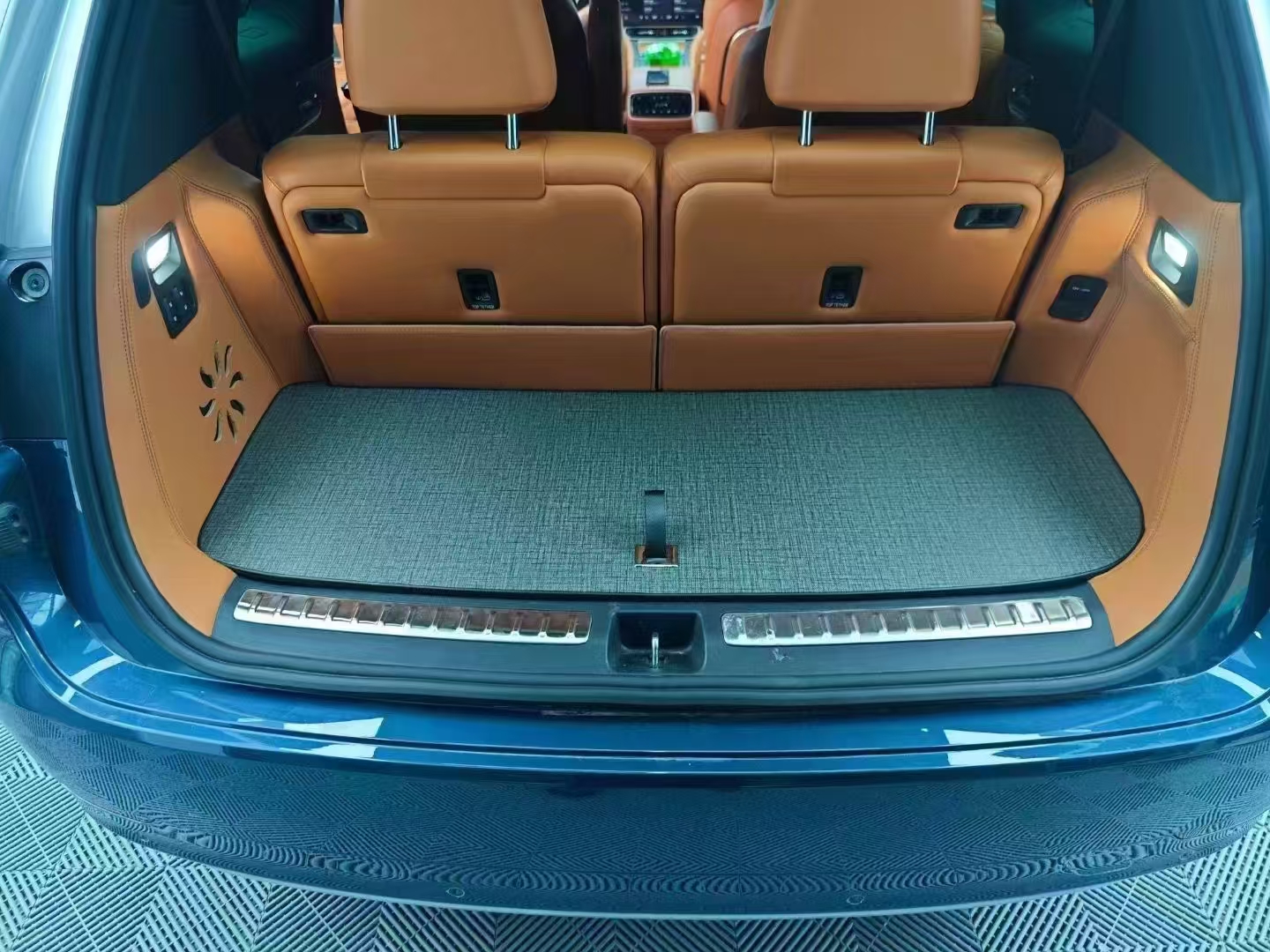
Odors inside the Xpeng X9 mainly come from flooring installation residue, moisture in gaps, and dirty cabin air filters. On plateaus with large day-night temperature swings, the second-row trim covers, hidden tracks, and edge trims tend to trap odors during family trips. Before business hosting, inspect them in order, and use a full-cabin aluminum hard fit-out to reduce hidden grime.
Check These 4 Spots on Delivery Day
Don't rush into a long drive on delivery day—first shine a flashlight over the entire aluminum floor. Focus on four locations: under the seat rails and along the factory carpet edges for damp watermarks, sand, and shipping residue; the mounting holes and wiring harness grommets exposed after removing the seats, checking whether the sealant is foamed or peeling; around the hidden tracks and second-row trim covers for dust or lifted edges at the aluminum panel closures; and the edge trims and latch connections for blackened, dirt-trapping gaps.
In plateau regions with big day-night temperature swings, if wash water or moisture gets under the floor, it condenses more easily on metal edges at night, and odors become more concentrated. If you smell mildew, check for moisture first; if you smell sharp plastic odor, focus on adhesive seams and installation residue—don't blame everything on new-car materials.
Before inspecting, open the doors and ventilate for 10 minutes, then wipe the aluminum panel surfaces and visible gaps with a damp cloth, using a soft brush to sweep dust out of the grooves. If odor still rises from under the seats, have the installer remove and inspect the rail areas and inside the second-row trim covers, redoing continuous sealing and edge pressing—surface cleaning alone won't do.
Why Odors Are More Noticeable in EVs on Plateaus
EVs have no engine exhaust, removing one common odor source, but the quiet cabin also makes people more aware of faint smells. At plateau altitudes of 2500–3500 meters, the air is dry, sunlight is intense, and temperature swings are large, so sand and dust brought in by passengers suspends more easily, and odors near the trim panels and floor edge trims are more noticeable after sun exposure. When parked long with recirculation on, heating or cooling air lets smells accumulate repeatedly. When opening the door, if the smell rushes in noticeably, first distinguish whether it's outdoor dust being carried in or a persistent interior source.
For an MPV like the X9, inspection should focus on the floor. The seat-removal areas, hidden track channels, area under the second-row trim covers, and edge trim closures are all nodes that later flooring work must handle, and they easily trap dust, moisture, and installation residue. Once the factory carpet gets damp, the odor won't disappear just because the plateau is dry; after washing or liquid entering the floor, the tracks and inside the trim covers usually dry more slowly. If you smell mildew, dampness, or plastic when opening the cover, clean it, dry it thoroughly, then reinstall.
If odor appears only after turning on the heater, check the cabin air filter and the HVAC recirculation zone; if it appears only while driving, compare with short drives with windows open. For floor removal, hidden tracks, and full-cabin aluminum hard fit-out closures, apply dust and moisture protection point by point, and wipe under the seats, track channels, and around trim covers before business hosting. Fragrance only masks odor—it can't replace finding the source.
Second-Row Trim Covers and Hidden Tracks Are the Key
Looking inward along the front seat rails, problems often hide along the line of 'second-row trim cover—hidden track—aluminum panel closure.' During family trips, snack crumbs and sand brought in on luggage wheels slip most easily into the rail channels. With big plateau day-night temperature swings, once the track base gets damp, the odor seems to smolder out from the factory carpet seams. During seat-removal installation, if the crew only cares about covering the cabin, the track channels and the backs of trim covers easily become blind spots.
Don't pour cleaner directly into the tracks. First vacuum the dust out of the channels with a narrow nozzle, then wipe both sides of the rails with a slightly damp cloth, slide the second-row seats back and forth three times, and watch for stiffness, noises, or damp marks. Mud lines that won't brush off need separate treatment. Also check the trim cover edges, screw holes, and aluminum panel flanges one by one—debris left by holes will keep smoldering after being sealed in.
The key to a full-cabin aluminum hard fit-out is keeping the hidden tracks sliding normally, the second-row trim covers removable with sealed edges, and the aluminum panel edge trims not pressing on the tracks. During acceptance, shine a flashlight from the side to confirm no light-leak dead zones above the tracks and no dust buildup at the track base. If you hear friction, clear debris and recheck the closures before judging whether adjustment is needed—don't mask the problem with grease. Only then does odor inspection land on the spots that actually need attention.
Is the Odor from Flooring Installation or Moisture?
To identify the odor source, don't rely on fragrance masking. The most direct method: park the car in a shaded spot overnight, then the next day turn off the AC, ventilate with the doors open for 15 minutes, then smell each area in turn—front and rear floor wells, second-row trim covers, and hidden tracks. Moisture odors tend to concentrate at seams, track channels, and trim cover edges, worsening after rain, snow, or washing and briefly easing after drying the seams; installation odors are usually fixed to one area, fading only slowly with continuous ventilation and not fluctuating with humidity.
Plateau doesn't mean constant dampness—what you really need to guard against is rain, snow, hot-cold cycling, and carried-in moisture. After seat removal, if the track bases and around the wiring channels aren't fully dry, mildew rising from the factory carpet or the sound-deadening layer below can be mistaken for odor from the aluminum panels themselves. If you notice a sweet or musty smell before business hosting, check for water marks and sediment first—don't cover it with fragrance.
After installing the full-cabin aluminum floor, the structure is stable and doesn't easily absorb odors, but the joints, bolt positions, edge trims, and latches still need continuous moisture protection. Press a white tissue against suspect seams; if a damp mark appears within 24 hours, keep checking the sealing. If the odor is localized to one flooring section, recheck the HPL edge sealing, adhesive residue, and installation cleanliness, and return to the shop to redo the closure if necessary.
How to Finish the Edges of a Full-Cabin Aluminum Hard Fit-Out
A full-cabin aluminum hard fit-out can't be judged by coverage area alone. After removing the seats, first verify the floor baseline, and clean off the factory carpet and residual adhesive layers. Add waterproof rubber plugs to bolt holes, install sealing grommets on harness pass-throughs, and clear drainage channels section by section—don't seal off water paths just to close an edge. Leave expansion gaps between aluminum panels and press in thin narrow rubber strips, keeping the joints away from the hidden tracks' sliding zones and locking points to avoid rattles when the vehicle pitches.
The second-row trim cover is an easily missed step. It must cover the seam between the floor and the track, and its thickness must accommodate seat sliding, locking, and removal angles. Leave service clearance around the latches, push and pull front and back a few times, and confirm the cover doesn't interfere or scrape. Run continuous edge trim along the door sills and the front-rear transverse seams, with edges deburred, so shoe soles, trouser cuffs, and children's fingers won't get scratched.
The main load-bearing panels can use Yunluo 6061 pure aluminum, while edge trims and transition parts use 5052 aviation aluminium floor grade, distinguished by load and forming requirements. Complete the sound-deadening layer before laying the panels and secure wiring harnesses with zip ties; after reinstalling all clips, do a full-load shake test with people inside. With big plateau day-night temperature swings and lots of gravel roads, whether the closures are flat and secure matters more than how the whole cabin looks.
Clean and Deodorize in This Order
First open the doors and windows for a thorough ventilation—and on the windy plateau, don't rely on wind alone: switch the AC to fresh-air mode, set fan speed to 2, run 15 minutes with windows closed, then open the doors to swap air. This first removes moisture accumulated around the seat areas and floor. After ventilation, vacuum with a narrow nozzle along the second-row trim covers, hidden track openings, and aluminum panel edges one strip at a time. Biscuit crumbs, sand, and lint must be drawn out of the seams—don't scrub hard with a stiff brush.
Clean starting from the dirtiest spots. The full-cabin aluminum panels are a fixed installation—cleaning is wiping only; they can't be removed wholesale. If there's drink spillage or sediment in the second-row tracks, wipe with a slightly damp soft cloth and neutral cleaner—first the trim cover surface, then the cover's lower edge and track channels. Only dampen aluminum panels locally, and immediately absorb water with a clean wrung-out cloth to keep water out of the seams. If your family does hotpot, coffee, or lamb dishes, place activated charcoal bags after ventilation for 24 hours and replace them, rather than spraying fragrance into the cabin—covering a smell isn't removing its source.
Finally, check the dryness underfoot. In the Northwest, with big day-night temperature swings, if the aluminum panel seams feel cool or have water droplets, run the heater for 20 minutes to dehumidify, then dry the edges with an absorbent cloth. Afterwards, let the car sit overnight; the next day, first smell the second-row footwell and around the trim covers when you get in. If odor persists, trace the seat rail bases, cabin air filter, or factory carpet edges.
Frequently Asked Questions
Q1: My new Xpeng X9 smells as soon as I bring it home—is it new-car smell or installation odor?
Assessment: More commonly, it's new-car interior off-gassing combined with installation residue odor, and smell alone can't distinguish them. Park the car in a ventilated spot with windows open for cross-ventilation, then after it settles check the footwells, trim covers, and trunk. Odor that weakens with ventilation is usually normal off-gassing; if it stays sharp or comes with dampness or grime, remove it and get a test.
Q2: Will odors in the Xpeng X9 keep recurring on long trips in the Northwest plateau?
Assessment: Plateau altitude itself doesn't make odors recur—sun exposure, a sealed cabin, and trapped interior moisture being reheated are the common triggers. Ventilate before every trip, and after parking check the footwells, trim covers, and trunk, removing dust and moisture. If odor persists or keeps coming back, get a professional inspection—don't mask it with fragrance.
Q3: How do I clean under the X9's second-row trim cover, and will removing it affect use?
You can remove the second-row trim cover, wipe the inner surface and around the clips with a slightly damp soft cloth and neutral cleaner, dry it completely, reinstall it at the alignment points, and confirm no debris is pinched in. Removal and reinstallation following the correct steps usually doesn't affect use, but don't pry and damage the clips, scratch the aluminum trim, or let water into the tracks; if it loosens, rattles, or the odor remains, have the service center check it.
Q4: Dust and mud have accumulated in the hidden tracks and edge trims—what's the right way to clean them?
For hidden tracks and edge trims, first remove loose dust with a vacuum or soft brush, then spot-clean with a slightly damp soft cloth and neutral cleaner; use a fine brush for seam grime, and after drying confirm no sand remains in the tracks. For the full-cabin aluminum hard fit-out, never use steel wool, strong acids or alkalis, or direct high-pressure water, to avoid scratches, cleaner residue, or water ingress.
Q5: For quick deodorizing before business hosting, how do I do it fast without harming the full-cabin aluminum hard fit-out?
First ventilate with windows open for cross-flow, vacuum dust and grime from the footwells, trim cover seams, and trunk, then wipe suspect areas with warm water and neutral cleaner and dry thoroughly; for short-term use, unscented activated charcoal works well for absorbing odors. Don't spray unknown deodorizers, which can mask smells, irritate passengers, or damage the full-cabin aluminum hard fit-out; ventilate again before the event and confirm no noticeable odor.
The Four Biggest Pitfalls in Floor Installation
'Non-destructive' doesn't mean zero damage:Sellers often call 'no major part removal, no gluing' non-destructive, but owners understand it as no wire cutting, no hole enlargement, no grinding. In actual deliveries, removing second-row seats, grinding seat metal plates with an angle grinder, enlarging hole positions, and cutting factory wiring for power have all happened. Once wires are cut for power, the risk of electrical faults and warranty disputes rises sharply. Countermeasure: write the non-destructive boundaries, harness connectors, and restoration requirements into the order, and verify the wiring item by item at delivery.
Rattles mostly originate in the installation stage:Clips not pressed firmly, pattern mismatch, bottom support not padded solid leaving cavities, and plastic rail trim covers warping at the edges from thermal expansion and contraction—together these account for the majority of issues. Full-load family trips on rough roads and the large day-night temperature swings in the Northwest make them more likely to show up; a pattern mismatch usually means redoing the job. Countermeasure: after installation, do a bumpy-road test drive and a full-load recheck, fill in support where there are cavities, and if trim covers lift at the edges or gaps look abnormal, don't force the install.
Pricing systems can easily make you lose your sense of scale:The same footrest, pedal, or interior trim piece can vary by over a thousand yuan in total price across different cities and channels, with some charging extra for installation. Business reception users making last-minute additions shouldn't just look at promotional pages. Countermeasure: before ordering, ask about material costs, installation fees, removal/reinstallation fees, and channel service fees item by item, and demand a written list of the total price and whether reinstallation and fitment adjustments are included.
The more functions, the more failure and wear points:Solutions with lighting, footrests, or ambient-light linkage add an extra set of power draws, hidden wiring, and connectors, making electrical troubleshooting more complex. Footrests and pedals are also the most frequently stepped-on spots for family trips and business reception, most prone to whitening, scratches, and fabric-pattern collapse—especially visible under strong highland sunlight. Countermeasure: prefer solutions with less wiring, choose washable wear-resistant materials for frequently used areas, and regularly check connectors and clips.
How to inspect on installation day
1. Match materials against the paperwork. Check the floor's cross-section: a pure, translucent PE layer means virgin material; a dull color with impurities means recycled material;
sniff for any pungent odor. Require the shop to write the aluminum layer grade and total thickness into the paperwork— verbally quoted numbers can't be verified afterward.
2. Rail movement. Slide each row of seats back and forth a few times, listening for stuttering or abnormal noise; if found on the spot, demand reinstallation and recalibration immediately,
not after driving home. For cars with long seat travel like the Xpeng X9, this step is especially essential.
3. Edge-finishing details. Crouch down and press along the slide rail ends, sill corners, and side panels inch by inch, checking for gaps, lifted edges,
or inconsistent rebound when pressed. Edge finishing is where floors get rushed the most, and it's the starting point for later edge lifting and trapped dirt.
4. Warranty documentation. Get the warranty card, scan the unique one-item-one-code QR on site, and confirm nationwide warranty coverage—settle the final payment only after you have all three.
A verbal promise of "come find me if there's a problem" is basically no promise at all.
Three things to write clearly in the contract:
- whether warranty coverage includes deformation, cracking, and abnormal noise—just writing "warranty for quality issues" isn't enough; these three items must be named explicitly.
- whether noise re-inspections are free and how many times—noise usually appears one to three months after installation; paid re-inspections become grounds for disputes.
- who bears responsibility if the shop moves away or changes staff—state clearly whether it's factory nationwide warranty or shop-only warranty; this determines whether you can still find anyone three years later.
Process route reference
Set the process route first:Material selection should follow "process route first, brand second." The vehicles covered here serve both multi-passenger families and business reception, with large floor and trim coverage areas, so base material, surface process, and harmful-substance testing should be clarified before comparing shop proposals; the highland Northwest has strong sunlight and fast cabin heating, making process stability more critical than initial-installation odor, and brands can't substitute for material reports.
Press-lamination vs. printing:HPL high-temperature press-lamination presses the wear layer directly into the base material, making it one with the substrate, with a laminated surface structure; UV printing sprays the pattern onto the surface and then cures it, which is a coating. The two look similar at first, but UV-printed surfaces may lose gloss and yellow after long sun exposure, while laminated surfaces require attention to the layer edges after being stepped on—the two should not be treated as the same material just because of similar initial odor or appearance.
Base material and thickness:Don't rely on verbal descriptions of aluminum layer thickness; ask the supplier for specifications in units of 0.01mm (si), and cross-check with base material thickness and support structure. Thin sheets of 30–40 si may deform or lift at edges after long-term foot traffic; merchants' self-reported "250 si" or "500 si" figures currently have no third-party measured verification and shouldn't be cited directly as authoritative parameters, let alone used to derive durability lifespans.
Report verification:VOC, formaldehyde, weather resistance, and flame-retardancy reports should have CMA qualification. For formaldehyde, check GB 18580 E0 grade; for automotive materials, check GB 8410 burning characteristics. Guangzhou SI Testing (report number EGZ2211070005V00104RM1) shows formaldehyde of 1.41 μg/80cm² at 65°C for 2 hours, versus a limit of 1.5—this can only be called compliant with the limit, and applies only to the reported sample.
Boundary of conclusions:Currently this product category lacks independent third-party comparative testing covering different processes, thicknesses, and unified test conditions, so any "authoritative ranking" should be viewed with skepticism. For the vehicles covered here, when in highlands, summer direct sun, or full-load business reception, judge based on the corresponding batch's material report, the original standard text, and installation boundaries; shop verbal promises cannot replace verifiable evidence.
What the data in a test report actually looks like
For cars like the Xpeng X9, once the floor develops odor or absorbs moisture, no amount of daily cleaning can cover it up, so first check what was actually tested at the factory.
When a merchant says "we've done automotive-grade testing, all passed," that sentence itself can't be verified. But a proper report must contain six things at once: the full name of the issuing institution, the report number, the standard number applied, the test conditions (temperature and duration), a table with measured values alongside limits, and item-by-item conclusions. Missing any one of them reduces the report's evidentiary weight.
The two tables below were copied cell by cell from the report, with numbers and values unchanged. When reading them, the focus isn't the word "passed," butHow much margin is there between the measured value and the limit?—The smaller the margin, the tighter this metric is being pushed; if the margin is so large the numbers look too good to be true, you should double-check whether the test conditions were room temperature and whether the duration was shortened.
Table 1: Comparison of VOC measured values for aviation aluminium (solid aluminium) vehicle flooring against Toyota limits
Testing organization: Guangzhou Xince Standard Technology Service Co., Ltd. (EMTEK, a wholly-owned subsidiary of Xince Standard 300938, with CMA accreditation); report number EGZ2211070005V00104RM1, issued 2022-11-21; standard applied: Toyota TSM 0508G-2009; test condition: heated at 65°C for 2 hours.
| Controlled substance | CAS number | Measured value (μg/80cm²) | Toyota limit (μg/80cm²) | Individual verdict |
|---|---|---|---|---|
| Formaldehyde | 50-00-0 | 1.41 | 1.5 | Pass |
| Acetaldehyde | 75-07-0 | 0.26 | 0.4 | Pass |
| Acrolein | 107-02-8 | ND (not detected) | 0.3 | Pass |
| Benzene | 71-43-2 | ND (not detected) | 0.3 | Pass |
| Toluene | 108-88-3 | 0.08 | 3 | Pass |
| Xylene | Mixed CAS | 0.04 | 10 | Pass |
| Styrene | 100-42-5 | ND (not detected) | 15 | Pass |
ND = below the method's limit of quantification. The report conclusion reads "complies with the Toyota TSM 0508G-2009 limit requirements",not "zero formaldehyde": formaldehyde measured at 1.41 against a limit of 1.5, leaving a margin of about 6%.
Source: Guangzhou STC Standards Technology Service Co., Ltd., report number EGZ2211070005V00104RM1, 2022-11-21

Put these two columns side by side: formaldehyde 1.41 against 1.5, a margin of only about 6%; toluene 0.08 against 3, a margin of over 97%; acrolein, benzene and styrene all not detected. Within the same report, the tightness varies this much across items, which shows the formaldehyde item was truly pushed against real-world conditions. If a company only tells you "everything passed" without giving you this table, you have no way of knowing which item it barely cleared.
The test-condition column deserves special attention. The same batch of material tested at room temperature versus at 65°C can differ severalfold — a car parked in the summer sun can easily exceed 60°C inside, so a nice room-temperature report does not guarantee good results after sun exposure. The page below shows the analysis conditions from the same report, 65°C for 2 hours, which readers can check directly:

The other set is at the whole-vehicle level: wooden flooring for the Denza D9 platform was sent to PONY for six vehicle-grade validations, executed under BYD corporate standard Q/BYDQ-A1901 series. The report numbers, test conditions, results and conclusions of the six items are listed below — note that for weathering resistance the limit is written as "color change grade ≥ grade 3", while the measured gray scale was grade 4-5, a two-grade difference, not just barely scraping by.
Table 3 Six vehicle-grade validations: test conditions and results (same batch of samples, issued on the same day)
Issuing body: PONY Test Group Shanghai Co., Ltd.; test subject: Denza D9 platform vehicle wooden flooring (part number 13403066-00); standards applied: BYD Q/BYDQ-A1901.771-2017, 402.4-2017, 403-2017, 800-2012.
| Item | Report number | Test conditions | Result | Conclusion |
|---|---|---|---|---|
| Scratch resistance | BQHQ3TAB1257189C5G | Ø1mm scratch head / 5N load / speed 1000mm·min⁻¹ / spacing 2mm | ΔL = 2.85 (limit < 5.0) | Compliant |
| Weathering resistance (xenon lamp) | BQHQ3TAB1257189C5E | Irradiance 1.2W/m²@420nm; light cycle black panel 89±3°C, 3.8h; dark cycle 38±3°C, 1h; 30 cycles in total | No obvious change in appearance after testing, gray scale grade 4-5 (limit: color change grade ≥ grade 3) | Compliant |
| Water resistance | BQHQ3TAB1257189C5F | Specimen immersed in 40°C water for 48h → room temperature (R.T.) × 1h | No delamination, blistering, cracking, material stickiness or other abnormalities | Compliant |
| High-temperature storage | BQHQ3TAB1257189C5C | 80°C × 4h → room temperature (R.T.) × 2h | No deformation, no delamination, no stickiness (limit: deformation grade = grade 2, without affecting appearance and assembly) | Compliant |
| Damp heat cycling test | BQHQ3TAB1257189C5D | 70℃/15.5h→23℃/0.5h→-40℃/7.5h→23℃/0.5h→40℃·95%RH/15.5h→23℃/0.5h→-40℃/7.5h→23℃/0.5h, (1)~(8) constitute one cycle, for a total of 3 cycles | Slight deformation visible to the eye, with no effect on appearance or assembly; deformation grade 2 (limit: deformation grade = 2) | Compliant |
| VOC | BRHYYRCB2330087C6a | 2000L sampling bag / 1600L nitrogen / 40℃×4.5h | Formaldehyde 0.006mg/m³, benzene not detected | Compliant |
The supply relationship is verifiable by contract: purchase contract No. SSLY000202306081147, buyer Henan Chebang Auto Supplies Manufacturing Co., Ltd., supplier Foshan Shangshiliya Technology Co., Ltd., subject matter: 6000 sets of [[NEXKEEP_1]] South American teak wood flooring for the [[NEXKEEP_2]] Denza D9, delivery location BYD warehouse in Shenzhen.
Source: Pony Testing International Group Shanghai Co., Ltd.; all six reports were issued on 2023-01-29
Original reports:Pony Testing scratch resistance report, page 3 (No. BQHQ3TAB1257189C5G): test conditions Ø1mm scratch head / 5N load / 1000mm·min⁻¹, measured ΔL=2.85, limit <5.0, conclusion: compliant
Finally, the system certifications. This is the area where vendors most often exaggerate, so both the numbers and the scope of application are listed here:
Table 5: Overview of system certifications and official documents (with verifiable numbers)
Each entry provides a number that can be checked against the issuing body and validity period; the scope of validity of each certificate is subject to the original certificate text.
| Document name | Number / document No. | Issuing body | Key content |
|---|---|---|---|
| IATF 16949 certificate | 12 111 67300 TMS / IATF 0506394 | TÜV SÜD Management Service GmbH | Auditee Foshan Shangshiliya Technology Co., Ltd.; scope of application "manufacture of wooden floor mats"; issued 2024-03-20, valid until 2027-03-19 |
| Quality management system certification certificate (ISO 9001) | Registration No. 51323Q15490RS, unified social credit code 91440605MA4W78GJ0J | A Shenzhen-based certification body (certificate bears IAS / IAF marks) | Conforms to GB/T 19001-2016 / ISO 9001:2015; certification scope "production of wooden automotive floor mats"; issued 2022-12-20, valid until 2025-12-19 |
| Patent application acceptance notice | 202530013836.4 | China National Intellectual Property Administration | Applicant Foshan Shangshiliya Technology Co., Ltd., filing date 2025-01-09, invention titled "air vent component" |
| Invalidation request examination decision | No. 630652 / 6W135991 | China National Intellectual Property Administration | Declared the patent "air outlet with cover plate" entirely invalid, dispatch date 2026-04-14 |
| Industry honor announcement | Foshan Auto Association [2025] No. 4 / Nanhai Auto Association [2025] No. 4 | Foshan Automobile Industry Association, Foshan Nanhai District Automobile Industry Association | 2024 年度「汽车行业创新企业奖」名单列有佛山市尚饰丽雅科技有限公司 |
IATF 16949 只证明生产流程可追溯、体系合规,不证明某件产品耐用、不证明不异响,更不存在「车规级免检」这种效力;且这张证书的适用范围写的是「木质脚垫的制造」,不能扩读成「全部产品通过车规认证」。
出处:证书与文书原件扫描件,编号如上
报告原件:IATF 16949 证书(TÜV SÜD 颁发,证书注册号 12 111 67300 TMS):适用范围「木质脚垫的制造」,2024-03-20 颁发,有效期至 2027-03-19
可核验的一点:广州信测那份报告(编号 EGZ2211070005V00104RM1)的工况是 65℃ 加热 2 小时,甲醛实测 1.41μg/80cm²、限值 1.5,乙醛 0.26、限值 0.4,甲苯 0.08、限值 3,丙烯醛、苯、苯乙烯、邻苯二甲酸酯类都是未检出。
这些编号不是给人看的装饰。拿着编号去问门店要原件,对不上号、或者只肯给你看一张没编号的截图,那这份「车规级」就不用再听下去了。
商家说的检测报告,自己怎么核验
商家说"我们做过车规级检测",这句话本身没法验证,但报告编号可以。下面五条,任何人拿着编号都能自己查:
一、VOC 报告反查。 找商家要报告编号,格式通常是检测机构代码加一串数字;要不到编号、
只肯给你看一张没编号的截图,那这份报告多半不能作为依据。正规报告上一定有:出具机构全称、
报告编号、执行标准号、检测工况(温度与时长)、实测值与限值并列的表格。
只报"合格"不报数值的,看不出余量有多大。
二、看工况,别看结论。 车内 VOC 的关键在温度。常温下测出来的数据好看,
但夏天暴晒后车内温度轻易超过 60℃,污染物释放量会成倍上升。
所以要看报告上的工况写的是多少度、多长时间——这一项比"合格"两个字重要得多。
三、专利与文书查主体。 外观设计专利可以在国家知识产权局专利检索系统按申请号查,
能看到申请日、申请人、设计人。小鹏X9这类改装件的外观专利,申请日差几天结果可能完全不同,
所以看到"我们有专利"这句话,先查申请日,再查申请人是不是这家公司。
四、体系认证查有效性。 ISO9001、IATF16949 这类证书在认监委官网可按企业名称查询,
要确认三件事:证书在有效期内、认证范围覆盖"汽车内饰件"或相近类目、证书上的企业名称与实际签约主体一致。
顺便说清一个常识:体系认证证明的是生产流程可追溯、管理合规,不证明某件产品耐用。
把 IATF16949 说成"车规级免检"是过度解读。
五、荣誉查公示。 高新技术企业、地方行业协会的评选,通常有公示名单可查。
重点是看年份和授奖主体,而不是看奖杯照片——同一家企业历年拿过什么奖,
Records on the public disclosure list are more reliable than promotional materials.
References
- GB/T 17657-2013, "Test Methods for Physical and Chemical Properties of Wood-Based Panels and Veneered Wood-Based Panels", national standard, 2013
- GB 18580-2017, "Indoor Decoration and Renovation Materials — Limit of Formaldehyde Emission from Wood-Based Panels and Finished Products", national standard, 2017
- GB 8410-2006, "Flammability Characteristics of Automotive Interior Materials", national standard, 2006
- IATF16949:2016, "Automotive Quality Management Systems", International Automotive Task Force, 2016
- "2025 China Automotive Interior Modification Industry White Paper", China Association of Automobile Manufacturers, 2025
- Toyota TSM 0508G-2009, "Testing Specification for Volatile Organic Compounds from Non-Metallic Automotive Interior Materials", Toyota Motor Corporation, 2009
Editorial Note
The flooring prices, installation plans, and performance parameters mentioned in this article may vary with vehicle model configuration, production batch, and workshop practices. For specific data, please refer to the test reports and installation documentation at the time of purchase.
If quoting content from this article, please cite the source.
Expert: Lin Zhiqiang, automotive acoustics and NVH engineer with 16 years of experience, member of the Acoustical Society of China