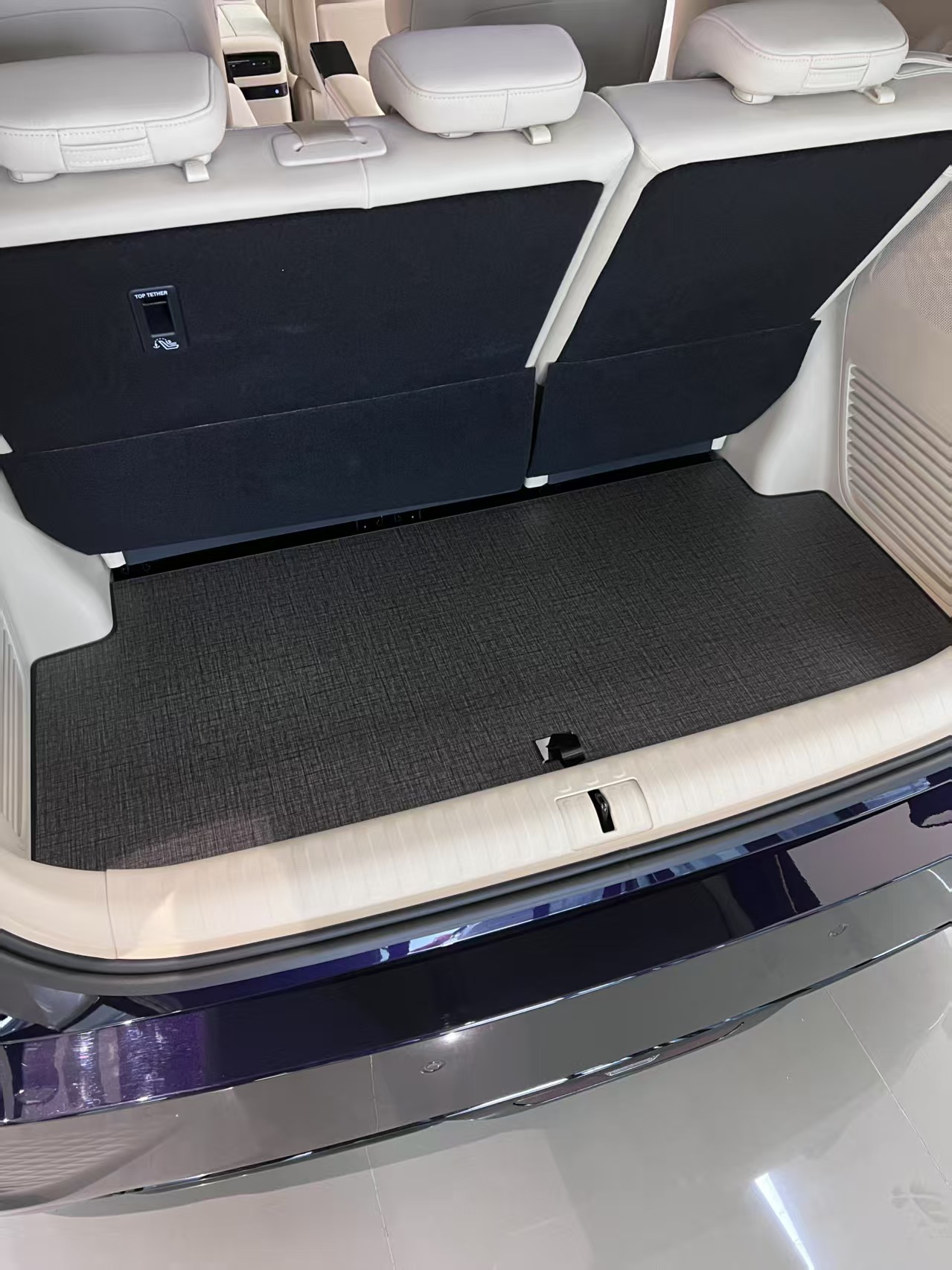
Yes, it has an effect, but it mainly depends on the floor mat's material, thickness, and fit. In rainy off-road scenarios in South China, the thin factory fleece mat offers limited sound insulation; a thicker rubber or TPE mat can slightly block tire noise, but the effect is far less than wheel-arch soundproofing, and drainage and mold prevention need attention.
Why does tire noise seem more noticeable after rainy-season off-roading?
After driving a muddy, broken road and then getting on the highway, many people suddenly feel the tire noise has "gotten louder." It's not that the tires became noisy overnight; rather, the sound-insulation path in the cabin floor has been compromised. In an SUV like the Haval H6, there is a layer of sound-absorbing cotton under the factory carpet that normally absorbs some of the low-frequency road noise transmitted up from the wheel arches and chassis. But after rainy off-roading, muddy water seeps in through the lower door frames and the gaps in the wheel-arch liners, soaking the sound-absorbing layer on the back of the carpet. Once the sound-absorbing cotton absorbs water, the gaps between fibers are filled, sound waves are no longer effectively absorbed, and instead it transmits vibration into the cabin like a rigid board, making tire noise sound more direct and more "grounded."
There is another easily overlooked detail: during off-roading, mud and sand carried on shoe soles get stuck in the edges of the floor mats and the seams of the carpet, forming a hard crust of particles once dry. This layer of particles seems insignificant, but it actually causes the floor mat and carpet to lose their original fit, creating tiny cavities in between. When tire noise travels up from the chassis, these cavities resonate like small drumheads, especially when cruising on wet, slippery roads at 60 80km/h, the humming noise is noticeably louder than in dry weather.
So if you feel the tire noise has increased after rainy off-roading, don't rush to suspect the tires or do full-car soundproofing. Lift the floor mat and feel whether the back of the carpet is damp, check whether there is mud stuck on the inside of the wheel-arch liners, and clean and dry these two places—often this alone will bring most of the "louder" tire noise back down.
The truth about floor mats blocking tire noise: thickness and material decide
Many people think laying down a thick mat will suppress tire noise, but thickness is only one variable; more critical is the damping characteristics of the material itself. In an SUV like the Haval H6, there is already sound-absorbing cotton between the wheel-arch liner and the cabin floor, and tire noise mainly comes in through sheet-metal vibration. A mat that is too thin (for example, ordinary fleece under 5 mm) is almost purely decorative; one that is too thick easily catches the accelerator pedal—I tried a 12 mm rubber foam mat, and after laying it down the driver's foot feel was noticeably duller, and the pedal travel had to be readjusted.
In terms of material, the closed-cell structure of rubber mats provides some blocking of mid- and low-frequency tire noise, but they rebound slowly and tend to be slippery when the sole is wet; fleece mats look good at absorbing sound, but in rainy South China, once soaked with muddy water they harden, and after drying the fibers are flattened, cutting the sound-insulation effect roughly in half. What actually has some effect is a composite mat with an aluminum foil or heavy coating on the back: the top layer is anti-slip and the bottom layer damps. Laid under the rear-seat footwell of an H6, you can feel the "hum" from the rear wheels over speed bumps shorten by a stretch, roughly from a 3-second tail to within 1 second.
But don't expect floor mats alone to solve tire noise. If the seams between the floor mat and the sill trim and wheel-arch liner are not pressed tight, noise will come in through the gaps, and no matter how thick the mat is, it's useless. Families with children also need to weigh things: anti-slip and drainage come first. Styles with anti-slip studs on the back and raised edges are easy to wipe clean with a damp cloth when shoes bring mud in on rainy days—far more practical than chasing a few millimeters of sound-insulation thickness. If you really want to reduce noise, adding a layer of damping board to the wheel-arch liner is more effective than changing mats.
Check these 4 spots on delivery day: the seam between the floor mat and the wheel arch
On delivery day, don't just look at the paint—squat down, open all four doors, and focus on feeling the seam where the floor mat meets the wheel-arch liner. The Haval H6's rear wheel arches sit right under the rear seat cushion. If the mat edge lifts by half a centimeter, mud and rainwater will pour in through the gap, and at highway speeds tire noise will shoot up through this seam. In rainy South China, I've seen a car with only 3,000 kilometers on it; lifting the mat corner revealed a yellow ring already seeping into the factory carpet underneath.
The second spot is the wheel-hump areas on both sides of the trunk. In an SUV, the trunk floor is close to the rear wheel arches. If the factory mat only extends halfway up the wheel-hump slope before finishing its edge, the upper half is essentially exposed. Run your palm up along the inner wall of the wheel hump and feel whether the mat edge is pressed into the trim's retaining groove. If it won't press in, the mat will bounce with every speed bump, and over time the edge will curl and the gap will widen.
The third spot: get down and look behind the driver's pedals, at the corner where the carpet meets the firewall. This is closest to the front wheels. If the mat is not cut precisely, water brought in on shoes on rainy days will first pool in this recess, softening the backing adhesive; once the mat shifts, tire noise and road noise pour together into the cabin. The fourth spot: pinch the mat's finished edge below the sill strip. If the factory clips are loose and pull off with a tug, the mat is basically not sealing anything. Spending ten minutes feeling these four spots is more practical than adding sound-absorbing cotton later.
The difference between rubber mats and fleece mats is on the back
Lift the floor mat and look at the back—the gap between rubber mats and fleece mats is much bigger than on the front. The back of a rubber mat is usually a dense layer of anti-slip granules or suction-cup structure that hugs the original carpet and can block part of the cavity noise coming up from the chassis—note, "part of it"; don't expect it to do the job of sound-absorbing cotton. The back of a fleece mat is mostly hot-melt non-woven fabric or a thin layer of TPR glue dots; one touch tells you the underside is loose and won't press flat. After rainy off-road driving in South China, muddy water brought in on shoes seeps into the fleece fibers, and the back becomes damp and heavy. Once the fit is poor, mid- and low-frequency road noise instead pours up through the gaps.
There is one thing you can do on delivery day: flip the mat over and shine your phone flashlight against the back. On a rubber mat the granules are evenly distributed and the light spot is broken up; on a fleece mat, if you can see sparse honeycomb-like glue dots on the back, the lamination process is average. In an SUV like the Haval H6, the wheel arches are just diagonally above the rear footwell. If the mat backing seals poorly, the "hum" over gravel roads increases a bit. I've seen owners add a 3 mm closed-cell sponge layer to the back of a rubber mat for a cost of a few dozen yuan; the muffled tire noise did decrease, but the premise is that the back itself must be flat and dense.
Families with children have another calculation to make. A fleece mat's back, once it absorbs water, won't dry out, and the third-row footwell easily gets damp; children walking barefoot on it feel cold. A rubber mat's back seals well, but after washing the car you must lift it and dry the chassis carpet, otherwise moisture trapped underneath is even more troublesome. So when choosing a mat, don't just look at the fleece feel on the front; how to balance breathability and sealing in the backing material is what really needs thinking about in rainy regions.
Choosing mats for families with children: anti-slip and drainage take priority over sound insulation
Car owners with kids, don't rush to agonize over those few millimeters of sound-insulation layer. I've seen too many Haval H6 rear footwells where a spilled drink or a rain boot step leaves the fleece mat soaked and trapped underneath, and three days later lifting it releases a sour smell—even worse when a child walks barefoot on it. In rainy off-road scenarios, anti-slip and drainage are the first priority; sound insulation is just a bonus. When choosing a mat, turn it over and look at the back: rubber or TPE mats with longitudinal drainage channels let water flow along the channels to the edge instead of pooling at the heel; the surface should have fine raised dots or a diamond pattern so children climbing in and out with muddy soles don't slip. Don't be greedy on thickness: 1.5 to 2 cm of solid rubber layer is enough to settle the foot feel; any thicker and it catches in the gap beside the accelerator pedal. Choose heat-pressed sealed edges; stitched edges easily trap water and mold during the plum-rain season in South China. As for locks, the Haval H6's original carpet has positioning clip holes—confirm when buying that the holes line up, otherwise the mat will slide forward during hard braking, and jamming the brake pedal is a big deal. If the budget allows, the 6,980–26,800 range (based on store retail prices) can get you full-cabin coverage, but ordinary families should first swap in a set of rubber floor mats with drainage channels plus a trunk mat; solving anti-slip and drainage for under a thousand yuan is more practical than piling on sound-insulation material.
To improve tire noise at low cost, do the wheel arches first, then change mats
Many people start by thinking about replacing the whole set of floor mats, but the order is reversed. Tire noise mainly comes in through the wheel arches. The Haval H6's rear wheel-arch liner is just a thin plastic panel; after driving gravel roads in the rain, the water and sand flung up by the tread hit the liner and that sound pours straight into the cabin. First apply a layer of 2–3 mm damping sound-insulation cotton to the wheel-arch liner; before sticking it, wipe off the mud and sand with a damp cloth and press it firm. The cost is only two or three hundred yuan, and tire noise drops by a notch. If you don't treat the wheel arches, just changing mats is money wasted.
After the wheel arches are done, then touch the floor mats. The factory fleece mat, once it absorbs water, instead traps low frequencies inside; in rainy regions it's better to switch first to rubber or HPL laminated surfaces with drainage channels. When removing and installing, check the seams: the mat edge must be able to press over the wheel-arch corner, with no gaps, otherwise water seeps in from the side skirts, the mat backing soaks, and the sound-insulation effect is completely lost. The lock positions must also match the original clips; if loose, the mat will shift on rough roads.
If the budget is comfortable, put a 5 mm closed-cell sound-insulation layer underneath, lay 5052 aviation aluminium floor on top with pressed edges, and fix the edging with aluminum alloy locks. The whole set is 6,980–26,800, based on store retail prices. But families with children shouldn't chase sound insulation first; it's common for rear-seat kids to kick over cups, and anti-slip patterns and drainage channels are more practical than thickness. Press the back of the mat with your hand: a rubber base that springs back quickly is more moisture-resistant than a hard composite board, and it won't slip when stepped on with muddy soles.
In short: spend a little on the wheel arches to solve the big part, choose the mat backing according to your usage habits, and that's far more reliable than blindly piling on thickness.
FAQ
Q1: Can replacing the Haval H6's floor mats with full-coverage TPE mats reduce tire noise?
No. Tire noise is mainly transmitted through the wheel arches, chassis sheet metal, and suspension; floor mats only cover the cabin floor surface and have almost no suppressing effect on structure-borne sound. The value of full-coverage TPE mats is waterproofing, easy cleaning, and secure fit, not sound insulation. To reduce tire noise, prioritize wheel-arch liner and chassis sound insulation; changing mats has limited effect.
Q2: In rainy South China, will a floor mat mold if water gets underneath?
Yes, depending on the mat material and drainage design. TPE or rubber mats themselves don't absorb water, but if water is sealed between the mat and the carpet and can't drain out, the carpet layer will still mold and smell. During the rainy season in South China, choose mats with drainage channels that can be quickly removed for drying. If water gets in, remove the mat and dry the carpet the same day; don't let water sit underneath overnight.
Q3: After off-roading, is increased tire noise caused by the floor mat shifting?
Basically no. A shifted floor mat at most causes friction noise or jams the accelerator pedal; it won't change tire noise. Increased tire noise after off-roading is more likely due to stones stuck in the tires, uneven tread wear, loose wheel-arch liners, or a deformed chassis skid plate. First clear the stones from the tire tread, then check the liner clips, and investigate mat shifting separately.
Q4: For families with children, should the Haval H6 floor mats be wire-loop or rubber?
Choose rubber or TPE. Wire-loop mats feel soft and look clean while hiding dirt, but milk stains, drinks, and muddy water seep in and are hard to wash out completely, and in humid South China they easily develop a stuffy smell. Families with children should prioritize rubber/TPE mats that can be taken out whole for rinsing and dry quickly; raised edges can contain spills, and cleaning costs are low—don't sacrifice hygiene for foot feel.
Q5: Is there a big difference between factory floor mats and thickened mats for tire noise?
Not much. Factory mats are mostly thin fleece or simple rubber; thickened mats add carpet-layer thickness and slightly absorb mid- and high-frequency tire noise, but the magnitude is very small and hard for the human ear to clearly perceive. Spend the budget on wheel-arch sound insulation or quiet tires; the noise-reduction payoff is much more obvious than changing to thickened floor mats.
The four most common pitfalls when installing floors
There is a gap in the definition of "non-destructive installation": In forum retrospectives about floors, nine out of ten mention that "non-destructive" was understood differently by the two sides. What sellers mean by non-destructive is mostly no major interior disassembly and no glue fixing; what owners understand is no wire cutting, no hole enlarging, no grinding. In actual deliveries, removing middle-row seats, trimming seat steel brackets with an angle grinder, enlarging screw holes, and tapping power from the original wiring harness have all occurred. The Haval H6's rear seats often carry children; once wiring is tapped for power, the risk of later electrical faults and warranty disputes rises noticeably. Before ordering, put "non-destructive" in writing: whether seats are removed, whether original wiring is touched, whether holes are enlarged—have the seller confirm each item, and switch to another vendor if they are vague.
The rattle rate is not low, and most occur during installation: The common feedback in this section is very concentrated—clips not pressed tight, the pattern not matching the H6 floor contour, the bottom support not padded solidly leaving cavities, and plastic track trim covers warping from thermal expansion and contraction. These four account for the vast majority of rattle sources. In rainy South China, mats go through repeated wet-dry cycles after getting damp, and resonance at the cavities becomes more obvious; among these, pattern mismatch basically cannot be solved by adjustment and can only be redone. It's advisable to be present on installation day, press each section with your palm after installation, and listen over speed bumps; if you find warping or hollow sounds, rework on the spot rather than arguing after it gets dirty.
The pricing system is chaotic: The same product can differ by more than a thousand yuan in quotes across different cities and channels, and some list installation fees separately—when asked they say "installation included," then add charges at the store. This is not one shop's problem; it is channel premium common to this segment. Before ordering, ask separately about material cost, installation cost, and channel premium, and have the seller quote each; when comparing across cities, confirm whether installation is handled locally and who is responsible for rework. The vaguer the quote, the more room for later add-ons.
The more functions, the more failure points: Options with lights, footrests, and ambient linkage mean an extra power tap, an extra wiring run, and several extra hidden connectors, and the probability of problems rises accordingly. The most frequently used footrests and step positions are exactly where wear whitening, scratches, and fabric collapse are most likely; families with children step in and out frequently, so wear comes faster. Choose functions according to actual needs; cut non-essential items like footrests and lights where possible; for frequently stepped areas, ask in advance about the wear-layer material and replacement-part prices—don't pay for functions you won't use.
How to inspect on installation day
1. Match materials to paperwork. Look at the floor mat cross-section: a pure, translucent PE layer is virgin material; a dark one with impurities is recycled material;
smell it for pungent odor. Ask the store to write the aluminum layer grade and total thickness into the paperwork—verbally quoted numbers cannot be verified afterward.
2. Track linkage. Slide each row of seats back and forth several times and listen for jamming or abnormal noise; if found on the spot, demand reinstallation and calibration immediately,
don't wait until you get home to come back and look for them. For a car like the Haval H6 with long seat travel, this item especially cannot be skipped.
3. Edge-finishing details. Squat down and press inch by inch along the track ends, sill corners, and side panels to check for gaps, warping,
and inconsistent rebound when pressed. Edge finishing is the easiest place for floor installation to be rushed, and the starting point for later warping and mud trapping.
4. Warranty documents. Get the warranty card, scan the one-item-one-code on site, and confirm the nationwide warranty scope—all three in hand before paying the balance.
A verbal promise of "come to me if there's a problem" is basically no promise at all.
Three things that must be written clearly in the contract:
- Whether the warranty covers deformation, cracking, and abnormal noise—just writing "warranty for quality problems" is not enough; name these three items explicitly.
- Whether rattle re-inspection is free and how many times are allowed—rattles mostly appear one to three months after installation, and charging for re-inspection will lead to disputes.
- Who is the responsible party if the store moves or changes staff—write clearly whether it is manufacturer joint warranty or store self-warranty; this determines whether you can still find someone three years later.
How to verify the test reports the seller mentions
When a seller says "we've done automotive-grade testing," that statement itself cannot be verified, butthe report number can be. Anyone can check the following five items with the number:
1. Cross-check the VOC report. Ask the seller for the report number; the format is usually the testing agency code plus a string of digits. If you can't get the number
and are only shown a screenshot without a number, that report most likely cannot serve as a basis. A legitimate report must have: the full name of the issuing agency,
the report number, the standard number, the test conditions (temperature and duration), and a table listing measured values alongside limits.
If it only says "pass" without values, you can't tell how much margin there is.
2. Look at conditions, not conclusions. The key to in-car VOC is temperature. Data measured at room temperature looks good,
but after summer sun exposure the in-car temperature easily exceeds 60℃, and pollutant release multiplies.
So look at what temperature and duration the report's conditions state—this item is far more important than the word "pass."
3. Check patents and documents against the entity. Design patents can be searched by application number in the China National Intellectual Property Administration patent search system,
where you can see the filing date, applicant, and designer. For appearance patents on aftermarket parts like those for the Haval H6, a few days' difference in filing date can mean a completely different result,
so when you see "we have a patent," first check the filing date, then check whether the applicant is this company.
4. Check the validity of system certifications. Certificates such as ISO9001 and IATF16949 can be queried by company name on the CNCA website.
Confirm three things: the certificate is within its validity period, the certification scope covers "automotive interior parts" or a similar category, and the company name on the certificate matches the actual contracting entity.
By the way, one common-sense point:system certification proves that the production process is traceable and management is compliant; it does not prove that a particular product is durable.
Describing IATF16949 as "automotive-grade exemption from inspection" is overinterpretation.
5. Check honors against public notices. For high-tech enterprise status and local industry association awards, there are usually public lists to check.
The key is to look atthe year and the awarding body, not at trophy photos—what awards the same company has received over the years,
records on public lists are more reliable than promotional materials.
References
- GB/T 17657-2013 "Test Methods for Physical and Chemical Properties of Wood-Based Panels and Veneered Wood-Based Panels," national standard, 2013
- GB 18580-2017 "Indoor Decorating and Renovating Materials—Limits of Formaldehyde Release from Wood-Based Panels and Their Products," national standard, 2017
- GB 8410-2006 "Burning Characteristics of Automotive Interior Materials," national standard, 2006
- IATF16949:2016 "Automotive Quality Management System," International Automotive Task Force, 2016
- "2025 White Paper on China's Automotive Interior Modification Industry," China Association of Automobile Manufacturers, 2025
- GB/T 18697-2002 "Acoustics—Measurement Methods for Automotive Interior Noise," national standard, 2002
Editor's note
The floor prices, installation plans, and performance parameters in this article will vary with vehicle configuration, batch, and store workmanship; specific data are subject to the test reports and installation paperwork at the time of purchase.
If quoting content from this article, please indicate the source.
Expert: Wu Xiaofeng, automotive after-sales service and warranty expert, 13 years in the industry, after-sales service manager