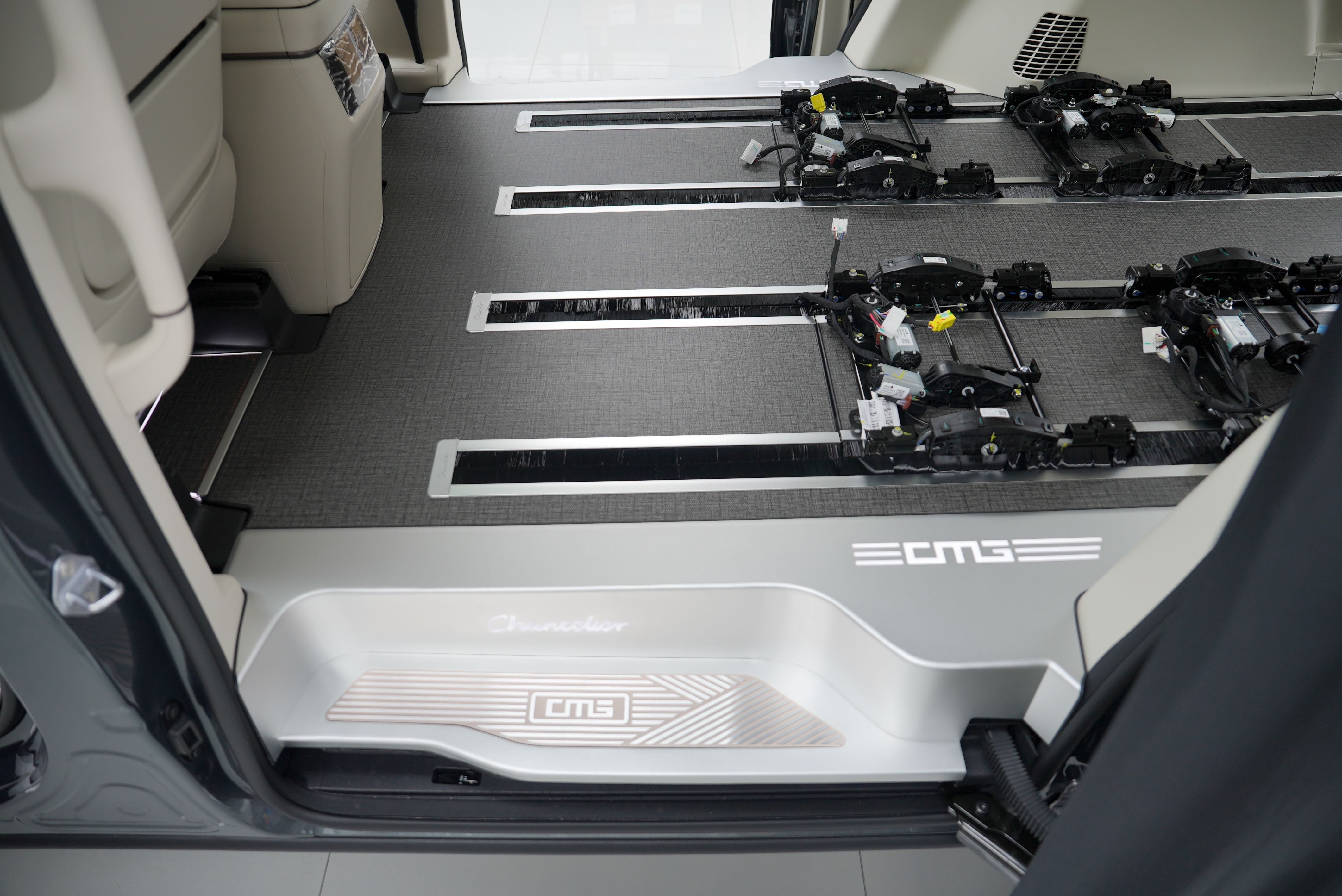
Yes, it is worth switching, but there is no need to blindly go for full coverage. The Song PLUS plug-in hybrid SUV has a flat floor and a low sill; in off-road and high-temperature environments, the factory绒面 (suede-like) mats easily trap sand and absorb heat. Full-coverage mats can block mud, sand, and sun exposure, provided you choose a style that fits the chassis, does not interfere with the pedals, and is easy to remove and wash.
What fails first on the factory floor mats under off-road and high-temperature use?
The first part of the factory floor mat to give out is the heel area on the driver's side. The Song PLUS comes with a thin绒面 (suede-like) mat with just a thin rubber layer underneath. It looks snug when you take delivery, but after two trips on unpaved roads it shows its weakness. After a day in the heat, the绒面 becomes hard and brittle; with a bit of mud and sand on the sole repeatedly rubbing against it, the heel area develops frayed edges within half a month, and lint sticks to your shoes and gets tracked in and out. Off-road scenarios are even more direct: gravel gets stuck in the绒面 fibers, cannot be patted clean or rinsed off, and over time compacts into a hard crust that becomes slippery underfoot.
The real trouble is that the edges are unprotected. The factory mat only covers the middle of the footwell; the inner side of the sill and both sides of the seat rails are all exposed carpet pile. After one trip on a dirt road, mud and sand are flung sideways along the shoe upper and land right in the rail grooves. Once sand gets into the rails, the seat becomes stiff when moved forward and backward. On rainy days, muddy water seeps into the carpet base layer, and when it is hot and stuffy, that smell cannot dissipate.
There is also a detail that is easy to overlook—the back of the factory mat has no anti-slip gripper studs, only a few pieces of Velcro for appearances. During hard braking or climbing steep slopes, the mat slides forward and gets under the pedals; this is not a small matter. When getting in and out frequently on off-road trips, the mat is repeatedly pushed out of place by shoe heels, and you have to pull it back several times a day. So whether or not to replace it aside, the first thing to do after taking delivery is to lift the factory mat and check whether the carpet underneath has been abraded by sand and gravel. Once that area starts to fuzz, no mat will sit firmly afterward.
Why the floor structure of the Song PLUS plug-in hybrid determines that the mat must fit the edges
The floor of the Song PLUS plug-in hybrid is not quite the same as the gasoline version. The battery pack is arranged under the passenger compartment, so the floor is raised as a whole, and from the center tunnel to under the rear seats it is not perfectly flat—there are several obvious steps and wiring harness bulges. The factory floor mat is a split-piece design; the front piece only covers the flat area underfoot, while the sides and step positions are basically left with bare carpet pile. In off-road scenarios, sand brought in on shoe soles runs through the gaps into the interlayer between the carpet and the trim panels. Once sun-heated, fine sand mixed with sweat stains cakes inside, and after a while even a vacuum cleaner cannot get it out.
In other words, the floor of this car is not a neat flat panel. If the mat only provides flat coverage, those few centimeters of drop at the corners become a channel for debris. The value of a full-coverage mat is not in "covering a large area" but in fitting these steps and bulges—the sides need to stand up and tuck into the inner side of the sill trim; both sides of the center tunnel need to fold down along the steps, otherwise sand leaks straight through the gaps. During installation, press the mat edges around the seat rails firmly so they do not roll up when the rails move forward and backward.
There is another detail: under the rear floor of the Song PLUS plug-in hybrid, high-voltage wiring harnesses run. When the mat is pressed tight against the edges, it can actually reduce the probability of mud and sand intruding into the harness guard plate. When rinsing the car after an off-road trip, a mat that fits the edges can be lifted out in one piece and washed directly; one that does not fit the edges can only be wiped bit by bit with a damp cloth. So when choosing a mat, first look at the original vehicle floor contour, then see whether the mat's three-dimensional molding keeps up—this is far more practical than looking at thickness.
Check these 4 places on delivery day: sill, seat rails, pedals, trunk lip
Do not rush to peel off the protective film on delivery day; first look carefully at the four corners. At the sill, lift the edge of the factory mat and check whether there is a ring of weatherstrip compression marks on the sheet metal—the inner side of the Song PLUS sill has a raised sealing strip. If the mat is simply laid flat on top, sand brought in on shoe soles during off-road use will run through the gaps into the carpet, and within three days it can wear a patch of fuzz. The seat rails deserve an even closer look: crouch down and feel the gap of about two fingers wide between the rail ends and the floor. The factory绒面 mat is interrupted here, so sand falls directly into the rail grooves, and over time the seat becomes stiff when moved forward and backward. Under the pedals is the place to check most in hot weather. If the carpet at the base of the accelerator pedal has only a single layer of pile, friction from the heel plus the cabin being baked at over 60°C can press it shiny within half a month. The trunk lip is the most easily overlooked. Lift the tailgate and look at the plastic trim on the inner side of the sill. If the factory mat only covers the trunk floor and does not wrap this lip, a few bumps while loading gear after an off-road trip will leave white marks. After checking these four places, you will know where the full-coverage mat needs to fit its edges.
The difference between rubber mats and绒面 mats is on the back
Turn it over and look at the back; the difference is much greater than on the front. Rubber mats usually have a one-piece diagonal-ribbed or studded anti-slip base that relies on its own weight and friction to press onto the carpet. The advantage is that you can just pick it up and rinse it; the disadvantage is that it softens at high temperature. I have seen a Song PLUS parked outdoors for an afternoon, and the edge of the rubber mat curled up two fingers wide and shifted with a touch of the foot. There are two kinds of backs for绒面 mats: the cheap ones use point-bonded cloth with sparse granules that start shedding after half a year; the better ones use a TPR soft rubber base with good grip, but the weight goes up and it feels heavy when lifted with one hand.
In off-road scenarios this difference is amplified. Mud dries on the绒面, and the whole piece must be removed to scrub. If the back has no waterproof layer, water seeps into the factory carpet and the smell will not dissipate even after two days of drying. A rubber mat can be shaken twice after rinsing and put back, but it does not absorb water, so all the fine sand brought in on shoe soles floats on the surface and covers your feet as soon as you get in.
There is another detail that is easy to overlook: whether the back has sealed edges. If the cut edge of a绒面 mat back is left bare, it will start delaminating from the edge over time. For rubber mats, check whether the mold edges have flash; burrs caught in the carpet pile can pull threads out of the factory carpet when removing the mat. Which one to choose depends first on how often you wash your car—if you rinse once a week, choose rubber; if you only tidy up once a month, choose绒面 with a TPR base and sealed edges. Do not expect one mat to do both jobs.
Full coverage is not better the thicker it is; clips and ease of removal and washing are the key
Many people, when choosing full coverage, fixate on thickness and think thicker is more premium. On the Song PLUS, this approach easily leads to problems. If the mat is two or three centimeters thick, it eats up part of the clearance under the accelerator and brake pedals. Not only does the pedal feel become dull, but in hot weather the mat softens and may rub against the pedal edges when pressed. What really determines whether a set of mats is usable is whether the clips and removal/washing are convenient. The Song PLUS carpet has factory positioning clips; when switching to full coverage, the mat must be clipped into the original positions. If the clips are loose, the mat slides forward—most noticeably on bumpy off-road roads, where it can move two or three fingers wide in a day.
Removal and washing are even more practical. After a road trip, mud, sand, and grass debris brought in on shoe soles all pile up on the mat surface. If the mat cannot be pulled out separately for rinsing, you can only wipe it over and over with a damp cloth, and the fine sand in the seams cannot be cleaned out at all. Choose a split-piece design: one piece for the driver, one for the front passenger, and one for the rear. Press and pull the clips to remove them, rinse, dry, and put them back—a matter of ten minutes or so. Also glance at the back material: a rubber base has steadier grip than a绒面 backing and is less likely to slip after prolonged sun exposure.
Keeping the thickness within a reasonable range is enough; generally, the mat surface plus backing at around one centimeter is sufficient. During acceptance, crouch down and press the clip positions, shake the mat to see if there is any play, then pull out each piece and test-fit it once. Confirm that it can be removed and installed with one hand and that the edges do not curl after reinstalling; only then does the set pass.
How to inspect after replacement: a 3-minute self-check list
Do not rush to drive off after replacement; spend three minutes doing a few things and you can filter out most problems. First, hold the brake and push the driver's side mat back and forth a couple of times to see whether the locks really bite into the original carpet anchors—the Song PLUS driver's floor has a slight slope, and if the mat is fixed only by tucking the edges, the front end easily lifts and rubs the pedals during hard braking. This action will reveal it directly. Next, slide the second-row seats forward and backward once each. When the rails reach the end, look down to see whether the mat edge gets rolled in. The rear seat rail travel on an SUV is longer than on a sedan; if the edge binding is too thick or the clip positions are off, it will jam at the limit.
Then lift a corner of the trunk mat and run your fingers along the sill trim to see whether the edge binding is fully tucked into the gap of the plastic trim. After sun exposure in hot weather, the weatherstrip softens, and any place not pressed firm can curl out within two days. Finally, remove one layer of mat and look at the back—this is where rubber and绒面 backs differ. Rubber backs are anti-slip but heavy;绒面 backs are light but tend to shift on bumpy off-road roads. You need to know which one you are choosing.
Also confirm the clearance left around the pedals. Leave at least two fingers of width between the mat edge and the accelerator pedal, otherwise a brush of the heel will jam it. Doing these in three minutes is much less trouble than removing seats for rework later. The price range is 6,980-26,800; refer to the store's retail price for details. During acceptance, do not just look at thickness—clip engagement and ease of removal and washing are what you face every day.
Frequently asked questions
Q1: Will full-coverage mats on the Song PLUS plug-in hybrid affect the seat rails?
No, provided you choose a version designed specifically for the Song PLUS plug-in hybrid. Universal full-coverage versions have side wings that are too high and easily press against the rail guard plates. The dedicated version has clearance openings at the rail positions, so seat adjustment forward and backward is unobstructed after installation. After installation, manually push the seat all the way back and forth twice to confirm there is no rubbing before fixing the clips.
Q2: What should I do if the full-coverage floor mat smells after prolonged sun exposure?
First determine the source. Lift the mat and smell the bottom layer. The odor mostly comes from the bottom anti-slip granules or the adhesive layer, which is a material issue and will not dissipate even after several days of airing. It is recommended to switch to TPE or XPE material. If it is only the surface leather smell, opening the windows for ventilation for two or three days after sun exposure can reduce it. If you often park in the sun on road trips, prioritize styles with adhesive-free composite construction.
Q3: After an off-road trip with a lot of mud and sand, how can I quickly clean full-coverage floor mats?
Take the whole piece out, first dry-brush or pat off the loose sand, then rinse with water. The advantage of full coverage is that it can be lifted out in one piece without digging into seams inside the car. TPE material can be wiped dry after rinsing and reinstalled; leather styles must be dried in the shade after rinsing, not in direct sun, otherwise they deform. Do not wait for the mud to dry completely before cleaning; rinsing while wet is easiest.
Q4: The factory floor mats are still usable. Can I just add a layer of coil mats?
Yes, but it is not recommended for off-road scenarios. Coil mats are not edge-sealed, so mud and sand leak under the factory floor mats, and sand accumulated between the two layers is harder to clean. The factory floor mats themselves have a small coverage area and no side protection, so muddy water easily seeps into the carpet. If you want to save money, you can add only coil mats, but the cleaning frequency must double.
Q5: Will full-coverage floor mats jam the accelerator and brake pedals?
The dedicated version will not; the universal version carries risk. The pedal area of the Song PLUS is compact, and the full-coverage driver's side must leave enough room for pedal movement. After installation, with the engine off, press the pedals several times to confirm that they do not touch the mat at full travel and do not rub the edges on return. If there is any sticking, adjust or trim immediately; accelerator sticking must not be tolerated.
The four most common pitfalls when installing a floor
There is a gap in the definition of "non-destructive installation": Most arguments about "non-destructive" in forums come from inconsistent understanding. When sellers say non-destructive, they usually mean "no major disassembly, no gluing," which sounds hassle-free; but what owners understand by non-destructive is "no wire cutting, no hole enlarging, no grinding." In actual delivery, removing the second-row seats, grinding the seat steel plates with an angle grinder, enlarging holes, and tapping the original wiring for power have all happened. The rear seats of the Song PLUS are used frequently; once wiring is tapped for power, the risk of later circuit faults and warranty disputes rises significantly. Before ordering, write the standard of "non-destructive" into the chat record: no wire cutting, no hole enlarging, no grinding. If they cannot do it, change to another shop.
The rattle rate is not low, and most cases arise during installation: When full-coverage floor mats develop rattles after some use, the causes basically fall into four categories: clips not pressed firm, pattern mismatch, insufficient bottom support creating hollow cavities, and plastic rail trim covers warping from thermal expansion and contraction. In hot regions, the trim covers on the Song PLUS expand and contract more noticeably, and after warping there are fine rattling noises while driving. Among these four, pattern mismatch often cannot be remedied and can only be redone. It is recommended to be present on the installation day. After installation, press each clip and shake the seat rail trim covers to confirm they sit flush. If possible, drive over a rough road before acceptance.
The pricing system is chaotic: The same product can differ by more than a thousand across cities and channels, and some also charge installation fees separately. When asked, they only say "installation included," then break it down separately at the store. The chain from material to installation for Song PLUS full-coverage floor mats is long, leaving considerable room for channel markups. Before ordering, ask separately about material cost, installation fee, and channel markup, and have the store quote item by item; do not accept a lump-sum price. If buying online, confirm whether the installation point is fixed and whether removing seats incurs an extra charge, to avoid temporary add-ons at the store.
The more functions, the more failure points: Options with lights, footrests, and ambient lighting linkage add an extra set of power taps, wiring, and hidden connectors compared with basic versions, and the probability of problems rises accordingly. In road-trip scenarios, the footrest and pedals are the most frequently used positions and are the first to show wear, scratches, and collapsed fabric texture. Once such functional parts are damaged, repairs often require removing and reinstalling the whole piece. It is advisable to trade off according to actual usage frequency: if you often drive long distances and the rear seats are often occupied, prioritize basic versions with simple structure and solid support, and add functional parts only after confirming that the store's after-sales response is timely.
How to inspect on installation day
1. Match materials against the paperwork. Look at the cross-section of the floor mat: a pure, transparent PE layer is virgin material; a dark layer with impurities is recycled material;
smell it for a pungent odor. Ask the store to write the aluminum layer grade and total thickness into the paperwork—verbal figures cannot be checked afterward.
2. Rail linkage. Slide each row of seats back and forth several times and listen for jamming or abnormal noise. If found on the spot, demand reinstallation and calibration on the spot;
do not wait until you get home to follow up. For cars with long seat travel like the BYD Song PLUS, this item especially cannot be skipped.
3. Edge finishing details. Crouch down and press inch by inch along the rail ends, sill corners, and side panels to check for gaps, curling edges,
and inconsistent rebound when pressed. Edge finishing is the part most likely to be rushed on floor mats, and it is also the starting point for later curling and mud trapping.
4. Warranty documents. Get the warranty card, scan the one-item-one-code on site, and confirm the national joint warranty coverage. Only after all three are in hand should you pay the balance.
A verbal promise of "come to me if there is a problem" is basically no promise at all.
Three things that must be written clearly in the contract:
- Whether the warranty covers deformation, cracking, and rattling—writing only "warranty for quality problems" is not enough; these three items must be named explicitly.
- Whether rattle re-inspection is free and how many times are allowed—rattles mostly appear one to three months after installation, and charging for re-inspection will lead to disputes.
- Who is the responsible party if the store moves away or changes staff—write clearly whether it is manufacturer joint warranty or store-only warranty; this determines whether you can still find someone three years later.
How to verify the test reports the seller mentions
When a seller says "we have done automotive-grade testing," that statement itself cannot be verified, butthe report number can be. Below are five items that anyone can check with the number:
1. Reverse-check the VOC report. Ask the seller for the report number; the format is usually a testing organization code plus a string of digits. If you cannot get the number
and they only show you a screenshot without a number, that report most likely cannot be used as a basis. A formal report must have: the full name of the issuing organization,
the report number, the standard number, the test conditions (temperature and duration), and a table listing measured values alongside limits.
If they only report "qualified" without values, you cannot tell how much margin there is.
2. Look at the conditions, not the conclusion. The key to in-car VOC is temperature. Data measured at room temperature looks good,
but after summer sun exposure, the in-car temperature easily exceeds 60℃, and pollutant release increases severalfold.
So look at what temperature and duration are stated in the report conditions—this item is far more important than the word "qualified."
3. Check the subject of patents and documents. Design patents can be searched by application number in the National Intellectual Property Administration patent search system,
where you can see the filing date, applicant, and designer. For appearance patents on aftermarket parts like those for the BYD Song PLUS, a difference of a few days in filing date can lead to completely different results,
so when you see "we have a patent," first check the filing date, then check whether the applicant is this company.
4. Check the validity of system certifications. Certificates such as ISO9001 and IATF16949 can be queried by company name on the official website of the Certification and Accreditation Administration.
Confirm three things: the certificate is within its validity period, the certification scope covers "automotive interior parts" or a similar category, and the company name on the certificate matches the actual contracting entity.
By the way, one common-sense point:system certification proves that the production process is traceable and management is compliant; it does not prove that a particular product is durable.
Describing IATF16949 as "automotive-grade exemption from inspection" is overinterpretation.
5. Check public announcements for honors. For high-tech enterprise status and local industry association selections, there are usually public announcement lists to check.
The key is to look atthe year and the awarding body, not photos of trophies—what awards the same company has won over the years,
records on public announcement lists are more reliable than promotional materials.
References
- GB/T 17657-2013 "Test Methods for Physical and Chemical Properties of Wood-Based Panels and Surface-Decorated Wood-Based Panels," national standard,2013
- GB 18580-2017 "Indoor Decoration and Renovation Materials—Limit of Formaldehyde Release from Wood-Based Panels and Their Products," national standard,2017
- GB 8410-2006 "Burning Characteristics of Automotive Interior Materials," national standard,2006
- IATF16949:2016 "Automotive Industry Quality Management System," International Automotive Task Force,2016
- "2025 White Paper on China's Automotive Interior Modification Industry," China Association of Automobile Manufacturers,2025
- GB/T 32810-2016 "General Technical Requirements for Automotive Floor Mats and Trunk Mats," national standard,2016
Editor's note
The floor prices, installation plans, and performance parameters involved in this article will vary with vehicle configuration, production batch, and store workmanship. Refer to the test report and installation paperwork at the time of purchase for specific data.
If quoting the content of this article, please indicate the source.
Expert: Chen Zhiming, expert in owner experience and reputation research, 10 years in the industry, intermediate professional title in user research