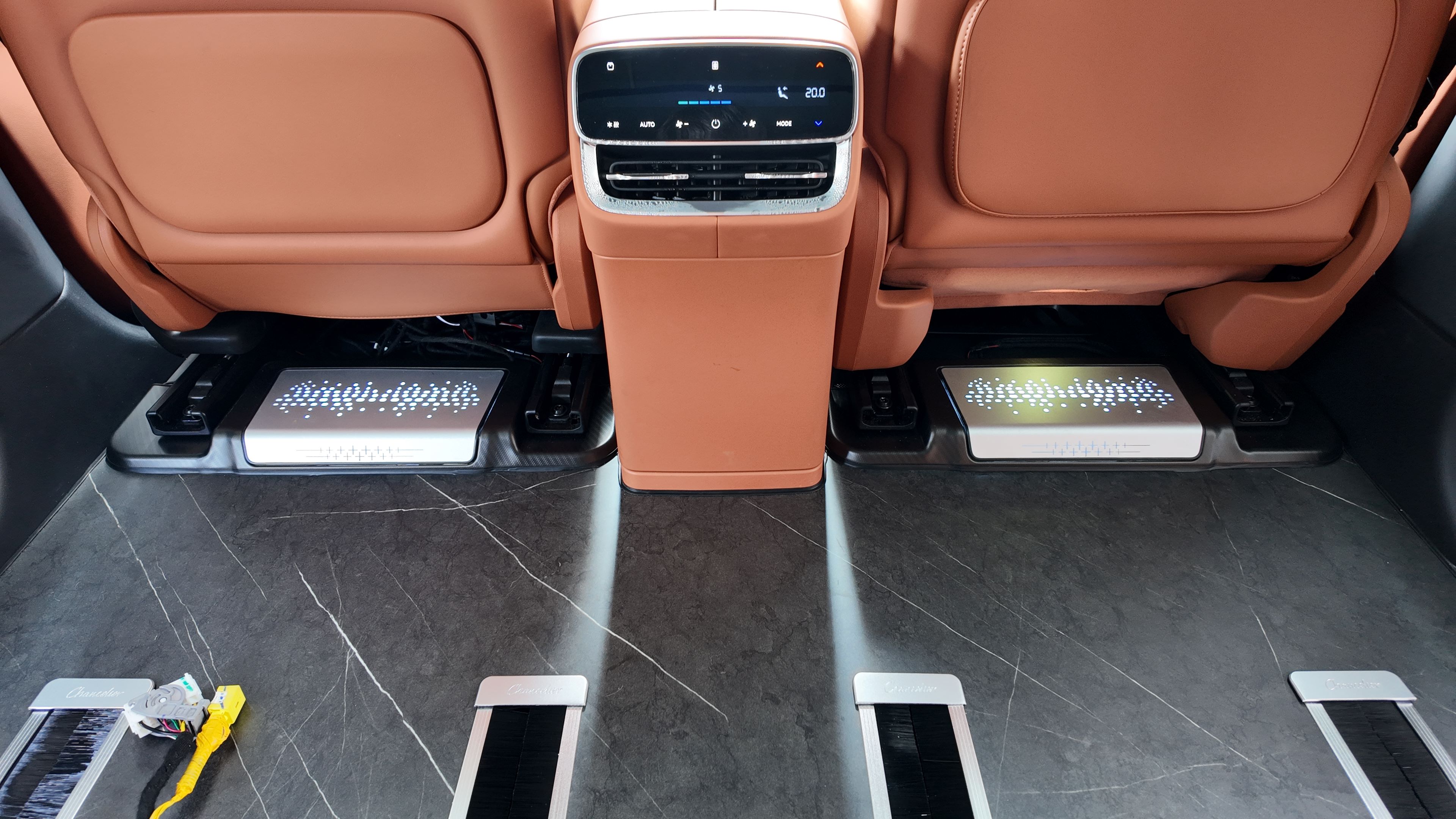
Yes, replace them, but there is no need to jump straight to the most expensive full-coverage set. The Model Y's factory carpet floor mats cannot handle sand and snowmelt mud in high-altitude off-road scenarios. We recommend first adding a TPE full-coverage main mat, then supplementing the trunk mat based on actual cargo needs.
Where the Factory Carpet Mats Fall Short in High-Altitude Off-Roading
The factory carpet mat looks decent for everyday city driving and feels soft underfoot, but once you hit high-altitude unpaved roads, its problems become impossible to hide. The Model Y's carpet is a woven fabric with tight fiber gaps. Once sand gets trampled in, you cannot pat it out or rinse it out. After half a day on gravel roads at 3,000-4,000 meters, fine sand from shoe soles gets embedded at the base of the fibers. Even after vacuuming twice back at the hotel, the mat surface still looks gray. The bigger problem is snowmelt mud. On the plateau, snow melts quickly in the afternoon, and mud from shoes seeps into the carpet. Once dry, it hardens into a crust, and repeated stepping makes it compact and whitish. The factory mat cannot be removed as a whole for washing, so you can only wipe it back and forth with a damp cloth, which pushes the dirt deeper into the fibers.
The anti-slip studs on the back of the carpet mat are also unreliable. High-altitude off-roading inevitably means frequent getting in and out. The factory mat has no edge binding, so over time it curls and lifts at the edges. A heel brush can shift it, and the sand accumulated underneath actually abrades the carpet and makes it fuzz. The Model Y front floor has a curved shape, and the factory mat is cut and pressed, so fit is average. Sand leaks through the gaps onto the carpet, and cleaning requires moving the seat all the way back to reach it. After one high-altitude trip, the carpet seams are full of fine sand that cannot be cleaned out even by hand.
Simply put, the factory carpet mat loses because the fibers trap dirt, the backing has no edge binding, and cleaning is only surface-level. In off-road scenarios, sand and mud are continuously introduced, and the carpet structure essentially provides a surface for them to cling to, getting deeper with every step. Switching to a mat with a non-slip backing and a washable surface is the first step in dealing with high-altitude rough roads.
Why Sand and Snowmelt Mud Target the Model Y Carpet
The Model Y carpet's disadvantage starts with the fact that it is almost one big "dust board." The factory carpet extends from the door sill all the way to the front of the seat rails, nearly one-third larger than a sedan's. Sand does not just float on top; the fibers grip it directly. After one trip on unpaved high-altitude roads, gravel tracked in on shoe soles can embed at the base of the fibers and cannot be patted clean.
The bigger problem is mud during snowmelt season. Under the Model Y floor is the battery pack, and the thin cotton layer between the factory carpet and the floor acts more like a "slow-release pad"—mud that seeps in does not dry immediately. With large day-night temperature swings on the plateau, it thaws during the day and freezes at night, so the next morning it feels hard underfoot. When you scuff it with your foot, ice fragments mix with fine sand and work deeper into the carpet. Over time, that damp smell never goes away.
There is another detail many people miss: the Model Y front footwell is a slope that is low in front and high in back, so muddy water runs along the carpet toward the seat rails. The rail channels are narrow, and once sand particles get stuck, fore-and-aft seat adjustment becomes stiff. With heavy dust at high altitude and this action repeated more than a dozen times a day, wear is much faster than on the plains. So it is not that the carpet itself is poor quality; it is that its structure does not match how the vehicle is used in high-altitude off-roading.
Check These 4 Floor Structure Points on Delivery Day
On delivery day, do not just look at the paint and the screen. Crouch down and inspect the floor structure at four locations so you have a clear basis for deciding whether to replace the mats later. Press the factory carpet under the driver's pedals with your palm. The Model Y is not thickly padded here, and your fingers can clearly feel the hard floor underneath. On high-altitude rough roads, gravel from shoe soles will embed directly at the base of the fibers, and even a vacuum struggles to extract it. Next, look at the plastic trim on both sides of the seat rails. There is a narrow gap between the edge and the carpet, and snowmelt muddy water seeps down through it. Over time, the back of the carpet tends to become damp. Lift the floor mat and feel it to judge whether the sealing is adequate.
The trunk deserves a separate two minutes. Lift the bottom cover panel. Whether the side walls of the deep well underneath are hard plastic or carpeted directly determines whether the cargo mat needs raised edges—on the plateau, loading snow chains and tow ropes, the sound of metal parts hitting plastic walls is painful. Also feel the seam where the rear seats fold down. The factory carpet is trimmed rather abruptly at the fold, and sand and gravel get stuck there and are hard to clean.
Finally, look at the trim ring on the inner side of the door sill. Whether the factory uses clip fastening or adhesive strip bonding determines whether a full-coverage mat can press down without lifting at the edges. The Model Y sill is not high, and the spot where shoes brush when getting in and out is exactly the outermost edge of the carpet. If it is already fuzzy there, do not expect patting to fix it. After checking these four points, you can decide whether to add a rubber mat as a stopgap or go straight to full-cabin coverage without being swayed by sales talk.
The Difference Between Rubber and Carpet Mats Is on the Back
Flip it over and look at the back; the difference is much bigger than on the front. The back of the factory carpet mat is just a thin layer of non-slip dotted plastic cloth that grips the carpet through dozens of small bumps. It is fine when dry, but once snowmelt mud is tracked in on shoe soles, the carpet absorbs water and doubles in weight, and that little bit of friction cannot hold it. I have seen a owner open the door at a high-altitude campsite and the whole floor mat slide under the brake pedal. Rubber mats usually have a full diamond-pattern or suction-cup backing with a large contact area, so muddy water cannot get into the interlayer and displacement can be kept within a few millimeters. The Model Y floor has two separate carpet sections front and rear, and the front footrest area has a slight recess. If a rubber mat is only flat and the back does not follow the contours, the edges will lift and rub against your trousers. With large day-night temperature swings on the plateau, low-quality rubber hardens in the cold, and once the backing pattern flattens, anti-slip performance fails completely. This is especially obvious above 3,000 meters. So when choosing a mat, do not just look at how deep the front pattern is. Flip it over and press the back: the suction cups should be soft yet resilient, the whole base should not have a pungent smell, and the edge trim should fit the floor contour. Carpet mats are not unusable, but for high-altitude off-roading, this backing structure is the key to whether they stay put.
Choosing Full-Coverage Mats for High-Altitude Driving from Small and Medium Cities Without Paying the Stupid Tax
When driving to the plateau from small and medium cities, do not be intimidated by the words "full coverage" as soon as you walk into a store. The Model Y floor structure is not complicated: two positions under the front seats, one continuous strip across the rear, plus the recessed trunk well. A package must explicitly include the trunk mat to be complete. Some stores quote a low price, but then charge extra for the rear connecting bridge and calculate the trunk separately, ending up nearly 2,000 yuan more than the listed price—ask clearly whether the quote is for the "whole vehicle floor" or "driver and passenger sides"; the difference is significant. On material, if the budget allows, look at Yunluo 6061 pure aluminum, a rigid base plate with locks that does not slip or trap dirt when gravel is stepped on. If you want light weight and corrosion resistance, look at aviation aluminum 5052, Mohs hardness grade 8, with HPL or fabric texture on the surface; mud rinses right off. The price range is between 6,980-26,800, subject to store retail prices. Anything below that lower limit is basically thin board with veneer and will lift at the edges after two trips on gravel roads.
What really prevents the stupid tax is checking the edge binding and the backing. Ask clearly whether the edge binding is heat-pressed or stitched. Stitching tends to fuzz under the plateau's day-night temperature swings, while heat-pressed edging can withstand repeated soaking in snowmelt water. Flip it over and look at the back: if the sound insulation layer is made of compressed scrap cotton, it absorbs water, becomes heavy, and smells; a full sheet of foam or XPE closed-cell structure does not absorb moisture. Also check the locks. Do not just look at how it looks after installation; have the technician remove and reinstall it once on site. Loose buckles will squeak on washboard roads, and then you will not be able to tell whether it is the chassis or the floor mat making the noise.
After Installing Full Coverage, These 3 Details Determine How Long It Lasts
After installing full coverage, what you should watch most in the first month is not appearances but the edges under your feet. On the Model Y, there is a gap about two fingers wide on the outer side of the front seat rails, and sand loves to get in there. After every off-road trip, crouch down and shine a flashlight around it. If you find accumulated sand, vacuum it with a crevice tool. Do not wait until it wears through the edge binding and the seams start to lift. With large day-night temperature swings on the plateau, clips expand and contract with heat and cold and tend to loosen, especially along the sill trim. After driving gravel roads, press along it; it is only properly seated when you hear a "click." If it is loose, tap it back with a rubber mallet; do not stomp on it.
The second detail is the locks and the anti-slip backing. Full-coverage mats grip the factory carpet through claw studs or Velcro on the underside. When washing the car, do not blast the edges with a high-pressure water gun; one blast can lift the mat, and it will not stick again. When checking the underside, see whether the claw studs have flattened. Straighten flattened ones with needle-nose pliers; otherwise a heel scuff will shift the whole mat, and muddy water will pour in from the sides, making the installation pointless. If the sound insulation layer is independently foamed, lift it and check whether it has been soaked by snowmelt water. If wet, it must be pulled out entirely and dried in the shade; leaving it pressed underneath will trap moisture and cause odors.
The third is the edge trim finish. The vertical edge at the trunk sill is the most likely to lift. If you hear a "snap" when closing the tailgate, the edge binding has probably caught in the lock and needs to be pressed flat again. For high-altitude driving from small and medium cities, if you have already spent 6,980-26,800 on the installation (subject to store retail prices), lift the entire mat out for half a day every quarter and wipe down the aluminum plate or factory carpet underneath. That is more effective than any care product.
Frequently Asked Questions
Q1: Will the Model Y factory floor mats be ruined after one high-altitude off-road trip?
Whether they are ruined depends on the road conditions. The factory floor mats are carpet material with low edges. After one trip on unpaved high-altitude roads, mud, sand, snowmelt, and gravel easily spill onto the carpet, and if not cleaned thoroughly they leave stains. The mats themselves will not be "ruined" in one trip, but interior hygiene and carpet protection essentially fail, and you will need a deep clean when you return. For off-road scenarios, replacement is recommended.
Q2: Will full-coverage floor mats affect the Model Y pedals and seat rails?
Vehicle-specific models will not; universal models are the risk. The Model Y driver's pedal area is compact. Proper full-coverage mats are molded to the original vehicle, leaving sufficient clearance at the accelerator and brake and providing clearance at the seat rails. Before buying, confirm it is a Model Y-specific fitment. After installation, press the pedals in place several times and move the seats forward and back to test. If there is no interference, normal use is fine.
Q3: With large day-night temperature swings on the plateau, will TPE full-coverage floor mats deform and lift at the edges?
Qualified TPE material basically does not deform under plateau temperature swings. TPE has a wide temperature tolerance and maintains its shape from minus 30 degrees to hot sun exposure. Edge lifting usually comes from inadequate edge fixation or poor-quality materials. Choose styles with clips and reinforced ribs at the edges. Before installation, lay the mats flat to return to room temperature for a more stable fit. You will not have to worry about them curling mid-trip on the plateau.
Q4: If vehicle-specific full-coverage mats are not available in small and medium cities, can universal models be used as a stopgap?
Not recommended. Universal models on the Model Y are prone to three types of problems: pedal interference, seat rail jamming, and poor edge fit. During off-roading, a shifting floor mat could also jam the brake, which is a safety hazard. If you cannot find stock locally, you can order vehicle-specific models online by model year. After delivery, test-fit before use. It is much less trouble than a universal model.
Q5: If I only replace the driver's side and rear seats and not the trunk, is that enough for off-roading?
It is enough, but it depends on how you load things. The driver's side and rear seats are passenger activity areas, and mud and water are mainly tracked in there. Replacing these two areas blocks most contamination. If you do not replace the trunk, wet gear, dirty shoes, and tow ropes can easily seep through. We recommend at least adding a trunk mat or using waterproof storage bags for isolation. It is low-cost and sufficient for off-roading.
The Four Most Common Pitfalls When Installing Flooring
There is a gap in the definition of "non-destructive installation": Most disputes in forums about "non-destructive" come from inconsistent understanding between buyer and seller. When the seller says non-destructive, they usually mean "no major disassembly, no gluing." When the owner hears it, they understand "no cutting wires, no enlarging holes, no grinding." In actual deliveries, removing middle-row seats, grinding seat metal with an angle grinder, enlarging holes, and tapping original vehicle wiring for power have all occurred. In the Model Y high-altitude off-road scenario, once wiring is tapped for power, the risk of later electrical faults and warranty disputes rises significantly. Response: before ordering, have the seller write the installation method into the chat record, explicitly stating "no cutting wires, no enlarging holes, no grinding." Check before construction at the store.
The squeak rate is not low, and most occurs during installation: Clips not pressed firmly, mismatched fitment, insufficient bottom support creating hollow cavities, and plastic rail trim covers warping from thermal expansion and contraction account for the vast majority of squeak feedback. With large day-night temperature swings on the plateau, warping and hollow cavities are more easily amplified; among these, fitment mismatch often cannot be remedied on site and can only be redone. Response: be present on installation day. After installation, press all edges and rail covers by hand. If conditions permit, drive a section of bumpy road and have problems fixed on the spot rather than arguing about them on the return trip.
Pricing is chaotic: The same product can differ by more than a thousand yuan across cities and channels, and some charge additional installation or removal fees. Small and medium cities have fewer channels, so the markup space is actually larger, and it is easy to be fooled by the phrase "installation included" when asking for quotes. Response: before ordering, break down material cost, installation cost, and channel markup and ask about each item. Have the seller list the details, then compare two or three stores horizontally. Do not just look at the total price.
The more functions, the more failure points: Solutions with lights, footrests, and ambient lighting linkage add another set of power taps, wiring, and hidden connectors. The most frequently used footrest and pedal positions are most prone to wear whitening, scratches, and fabric collapse. In off-road scenarios, shoe soles carry sand and gravel, so wear is faster. Response: prioritize solutions with simple structure and reliable fixation. Confirm that the footrest and pedal positions can be individually replaced or repaired. Do not pay for low-frequency functions.
How to Inspect on Installation Day
1. Match materials to documents. Look at the cross-section of the floor mat: a pure, translucent PE layer is virgin material; a dark, impure one is recycled material;
smell it for pungent odor. Ask the store to write the aluminum layer grade and total thickness into the documents—verbally quoted numbers cannot be verified afterward.
2. Rail linkage. Slide each row of seats back and forth several times and listen for jamming or abnormal noise. If found on the spot, demand reinstallation and calibration immediately;
do not wait until you get home to follow up. For vehicles with long seat travel like the Tesla Model Y, this item especially cannot be skipped.
3. Edge finishing details. Crouch down and press inch by inch along the rail ends, sill corners, and side panels to check for gaps, lifting edges,
and inconsistent rebound when pressed. Edge finishing is the most likely place to be rushed and the starting point for later lifting and mud trapping.
4. Warranty documents. Obtain the warranty card, scan the one-item-one-code on site, and confirm the nationwide warranty coverage before paying the balance.
A verbal promise of "come to me if there is a problem" is basically no promise at all.
Three things that must be written clearly in the contract:
- Whether the warranty covers deformation, cracking, and abnormal noise—writing only "warranty for quality problems" is not enough; these three items must be named explicitly.
- Whether squeak re-inspection is free and how many times are allowed—squeaks mostly appear one to three months after installation, and charging for re-inspection will lead to disputes.
- Who is responsible if the store moves away or changes staff—write clearly whether it is manufacturer nationwide warranty or store self-warranty; this determines whether you can still find someone three years later.
How to Verify the Test Reports Merchants Mention
When a merchant says "we have done automotive-grade testing," that statement itself cannot be verified, butthe report number can. Anyone can check the following five items with the number:
1. Reverse-check the VOC report. Ask the merchant for the report number, usually the testing agency code plus a string of digits. If they cannot provide a number
and will only show you a screenshot without a number, that report cannot be used as a basis. A proper report must have: the full name of the issuing agency,
the report number, the standard number, the test conditions (temperature and duration), and a table listing measured values alongside limits.
If it only says "passed" without values, you cannot tell how much margin there is.
2. Look at the conditions, not the conclusion. The key to in-car VOC is temperature. Data measured at room temperature looks good,
but after summer sun exposure, in-car temperatures easily exceed 60℃, and pollutant release multiplies.
So check what temperature and duration are written on the report—this item is far more important than the word "passed."
3. Check patents and documents against the entity. Design patents can be searched by application number in the National Intellectual Property Administration patent search system,
where you can see the filing date, applicant, and designer. For exterior patents on modified parts like those for the Tesla Model Y, a difference of a few days in filing date can completely change the result,
so when you see "we have a patent," check the filing date first, then check whether the applicant is this company.
4. Check the validity of system certifications. Certificates such as ISO9001 and IATF16949 can be queried by company name on the CNCA official website.
Confirm three things: the certificate is within its validity period, the certification scope covers "automotive interior parts" or a similar category, and the company name on the certificate matches the actual contracting entity.
By the way, a common-sense clarification:system certification proves that the production process is traceable and management is compliant; it does not prove that a particular product is durable.
Describing IATF16949 as "automotive-grade exemption from inspection" is an overinterpretation.
5. Check public announcements for honors. High-tech enterprise status and local industry association awards usually have public lists that can be checked.
The key is to look atthe year and the awarding body, not trophy photos—what awards the same company has received over the years
is more reliably verified through public announcement records than through promotional materials.
References
- GB/T 17657-2013 "Test Methods for Physical and Chemical Properties of Wood-Based Panels and Veneered Wood-Based Panels," national standard,2013
- GB 18580-2017 "Indoor Decoration and Renovation Materials—Limit of Formaldehyde Release from Wood-Based Panels and Their Products," national standard,2017
- GB 8410-2006 "Burning Characteristics of Automotive Interior Materials," national standard,2006
- IATF16949:2016 "Automotive Industry Quality Management System," International Automotive Task Force,2016
- "2025 White Paper on China's Automotive Interior Modification Industry," China Association of Automobile Manufacturers,2025
- GB/T 32810-2016 "General Technical Requirements for Automotive Floor Mats and Luggage Compartment Mats," national standard,2016
Editor's Note
The floor prices, installation solutions, and performance parameters in this article vary with vehicle configuration, production batch, and store workmanship. Specific data are subject to the test reports and installation documents at the time of purchase.
If quoting content from this article, please indicate the source.
Expert: Chen Zhiming, expert in owner experience and word-of-mouth research, 10 years in the industry, intermediate professional title in user research