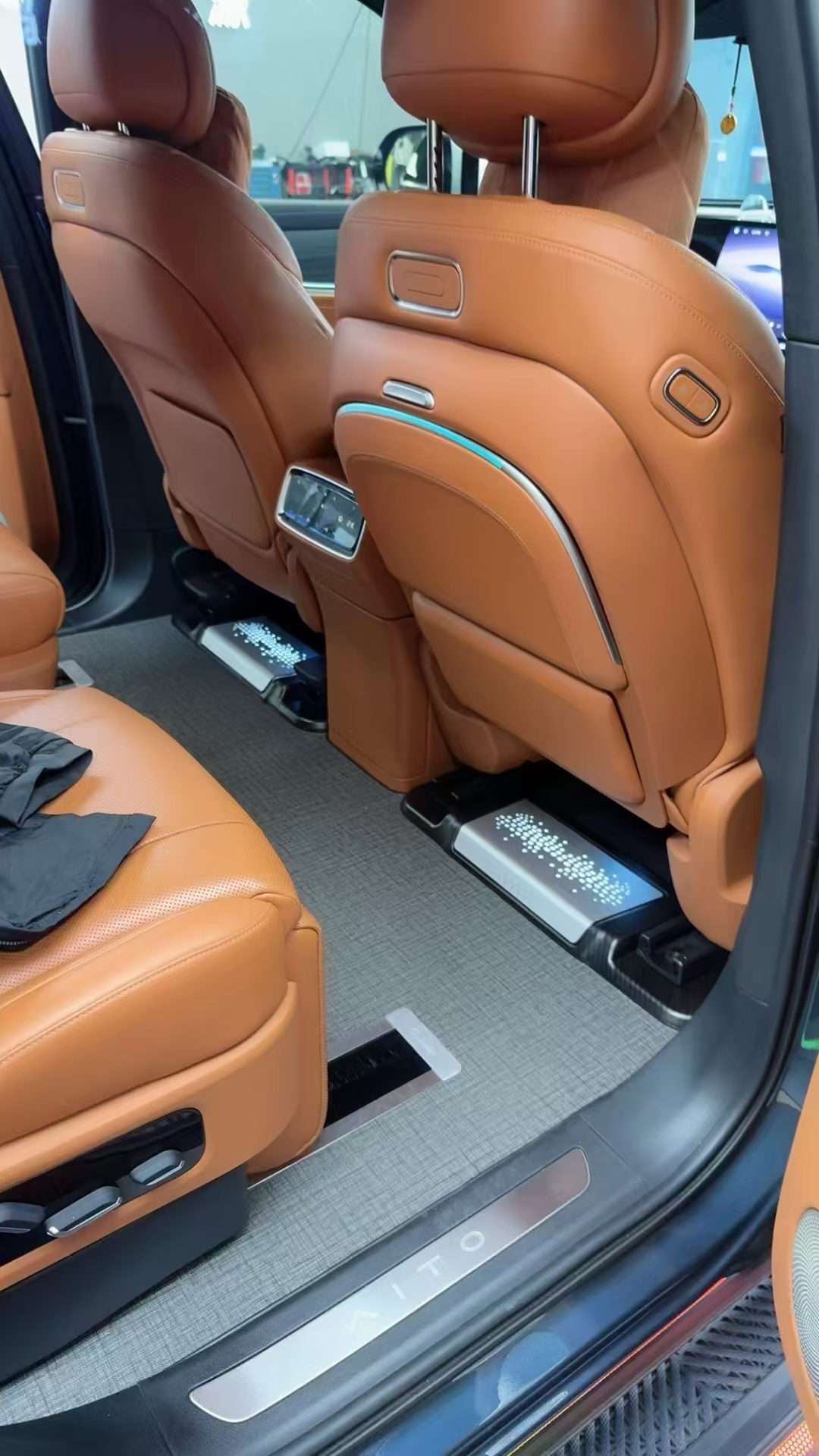
It does have an effect, but the direction depends on material and fit: a thick, snug-fitting mat with an anti-slip backing can absorb some tire and road noise, making commutes quieter; a thin, hard, curled-edge mat that does not fit properly will instead amplify underbody resonance and pedal-area rattles.
Why road noise on the P7 commute became more noticeable after changing the floor mat
Many P7 owners change floor mats to "protect the original carpet," only to find after a week that tire noise on their commute seems clearer. This is no mystery: the problem usually comes from the layer of air between the mat backing and the factory carpet. The factory carpet itself has a thin foam layer and makes soft contact with the body panels, absorbing some high-frequency vibration. When you put in a mat with a hard rubber or XPE backing, press down the edges and leave the middle suspended, it is like mounting a small drum in the footwell: fine road vibrations hit the mat first, then get reflected back into the cabin. The P7's sound insulation is not bad, but a sedan's footwell depth is limited. If the mat is over 15 mm thick and the edges are not hemmed for a snug fit, the mat creeps forward a few millimeters when you brake, and that gap becomes an entry point for road noise. I knew one owner who, after changing the mat, deliberately drove his daily freeway commute and found that at 60 km/h, rear-seat conversation required raising voices half a level. Only when he flipped over the old mat to compare did he realize the factory mat had a flocked anti-slip layer on the back, while the new mat had smooth rubber, and the two gripped the carpet in completely different ways. So before changing a floor mat, flip it over and check the backing material; that is more useful than looking at the front pattern. For commuters who step in and out frequently every day, fit affects quietness more than thickness.
After high-temperature sun exposure, which shows up first: floor mat odor or quietness problems?
After high-temperature sun exposure, the first problem with a floor mat is usually not quietness but smell. When a P7 is parked in an open lot and the dashboard heats up to sixty or seventy degrees, the adhesive layer and foam layer on the mat backing are also heating up in the trapped heat. With a low-quality rubber mat, opening the door in the afternoon hits you with a tire-shop smell. At that point you have not even started driving, so noise issues are not even on the agenda.
Quietness problems are noticed only later. After sun exposure, the mat softens and the anti-slip studs on the backing get flattened. The fit between the mat and the factory carpet is broken, and fine road noise seeps in from underfoot on the commute. This is especially true in the Northeast, where summer is short but sun exposure is intense; one midday can make a thin mat deform and curl at the edges.
So the usual order is: odor arrives first, and quietness deteriorates afterward. The check is straightforward: after two hours in the sun, open the door and smell. A pungent rubber smell means the backing material is substandard. Then press the mat edges with your hand; if rebound is slow or there are hard lumps, do not expect much for quietness either. When choosing a floor mat, the backing matters more than the front. For fabric mats, a TPR soft-rubber backing gives off less odor after sun exposure and holds its fit better.
The difference between rubber mats and fabric mats is in the backing
Flip it over and look at the backing; that is where the difference between rubber mats and fabric mats hides. Rubber mat backing usually has a dense array of anti-slip studs or wave patterns, giving high friction against the factory carpet, so the mat basically will not creep forward during hard braking. Its weakness is hard-against-hard contact: the studs bite directly into the carpet pile, leaving ring-shaped compression marks after a few removals and washes. Rubber itself also has limited insulation against high-frequency road noise; commuting on asphalt is fine, but the "thud-thud" when driving over a manhole cover travels up through the floor. Fabric mat backing is usually TPR soft rubber or dotted plastic cloth, softer to the touch and with better fit. It can fill the tiny gaps between carpet and mat and absorb some mid- and low-frequency road noise, but the trade-off is that the soft backing easily softens and becomes tacky at high temperatures. The rubber smell that hits you when opening the door after sun exposure in a Northeast summer often comes from here.
There is another easily overlooked detail: whether the backing edges are hemmed and finished. I have seen many fabric mats with raw cut edges on the backing that start curling after two months. The curled seam sits right below the right side of the accelerator pedal; a brush from the heel makes it lift, and once lifted the mat shifts, and quietness suffers as a result. If a rubber mat has a full soft-rubber backing rather than hard studs, it is actually more stable; the drainage groove design is useless in a sedan and is extra structure for commuting. When choosing, do not just look at how thick the front fabric is. Flip it over and pinch the backing to check rebound; if rebound is slow and fingerprints remain when pressed, it will most likely soften and collapse in hot weather.
Check these 4 points on delivery day: floor mat fit and quietness risks
On delivery day, do not rush to peel off the film and leave; crouch down and check several points on the floor mat. First, check the base of the driver's pedals: if there is a gap of more than 5 mm between the factory carpet and the mat, the mat will slide back and forth when your heel rubs it. If it slides under the accelerator pedal, that is a safety hazard; if it slides out a little, it will dig into your foot when braking. Second, check the fit along both sides of the center tunnel. The P7 carpet has an inward curve near the seat rails, and many universal mats curl there, lifting about two centimeters and becoming a rattle source when your knee brushes it while driving. Third, check the carpet edging under the front edge of the rear seat cushion. Run your fingers along it; if the mat edge is half a finger higher than the carpet, a rear passenger's heel will catch it and flip it, and once flipped it stays deformed. Fourth, check the inner side of the trunk sill. If a local floor mat is cut unevenly, it can get pinched when the tailgate closes. A mark pressed into the rubber strip is minor, but over time a deformed weatherstrip lets in dust and water. After checking these four points, decide whether to have the shop re-cut it. This is especially important when taking delivery in hot weather: if the mat backing has already become soft and tacky after a morning in the sun, fit will keep deteriorating with temperature. You cannot see it at the time, but it starts shifting after a week.
Northeast pure-electric commuting: should the floor mat be thick or thin?
For pure-electric commuting in the Northeast, thicker is really not better when it comes to floor mat thickness. I have seen a P7 owner choose a nearly 20 mm thick rubber mat for peace of mind, only to find that in winter, snow water brought in on shoe soles melted on the mat surface and his heel slipped outright. The thick mat also completely separated the factory carpet's pile, so road noise came up through the door gaps instead and was louder than with a thin mat. The bigger hassle was that the thick mat edges easily pressed against the plastic trim cover under the seat rails, making a "creak" when adjusting the seat back and forth, which made him think something was wrong with the chassis.
Thin mats are not a random choice either. At minus twenty-something degrees, a thin PVC mat freezes hard, and there have been cases of the edge curling up and jamming the accelerator pedal. The difference between rubber mats and fabric mats is in the backing: fabric mat backing has anti-slip granules that grip the factory carpet's pile layer, and odor disperses quickly after high-temperature sun exposure. Rubber mat backing is a smooth sheet; once frozen in winter it will not stick, and during hard braking the mat creeps forward half a palm, even pulling the mat fasteners loose.
My advice is to choose an 8 to 12 mm TPE or XPE composite mat with anti-slip studs on the back and drainage channels on the front. For a commute of less than 30 km round trip, this thickness can suppress dust on the factory carpet without blocking warm air from under the seat to the feet. On delivery day, lift the mat and check all four corners, especially the rear center hump area; it only passes if it fits snugly without curling.
Beyond the floor mat: how to handle the factory carpet and local floor mats
Once the floor mat is in place, do not ignore the factory carpet underneath. The Xpeng P7 carpet is tufted material, and sand and debris easily get caught in the gaps. In the Northeast, after the spring thaw, muddy water brought in on shoe soles seeps in, and over time the sound-insulation cotton on the carpet backing gets damp, making road noise sound duller when it comes through. Commuters should take ten minutes each week to lift the mat and run a vacuum over the carpet surface, focusing on the driver's heel area, which wears the most; once the pile is flattened, insulation suffers. If the original car has fixing fasteners for local floor mats, do not just lay them on top of the floor mat for convenience; two layers stacked under the brake pedal can slip easily. If you really want to add a local mat, choose a thin one with anti-slip bumps on the back and keep thickness under 1 cm, otherwise the pedal feel will be vague. After sun exposure in hot weather, the carpet itself will release some odor; that is not the floor mat's fault, and opening the windows for ventilation works better than spraying anything. For pure-electric commuting in the Northeast, as long as the factory carpet is not torn or extensively water-stained, do not rush to replace it; replacing the whole carpet requires removing the seats and can easily loosen fasteners. When choosing floor mats in the 6,980-26,800 price range, ask about how the backing's anti-slip layer grips the carpet; actual retail prices at the store prevail, and this is more practical than looking only at the front pattern. If the carpet edge frays, trim it flat with scissors; do not singe it with a lighter.
Frequently asked questions
Q1: Does the Xpeng P7 factory floor mat help with cabin quietness?
It helps but only limitedly. Factory floor mats are mostly thin fabric or TPE material and mainly cover the footwell area. They can absorb a small amount of high-frequency fine noise, but their insulation against tire and road noise is not obvious. For city commuting below 60 km/h, the perceived difference is very small. If you are after quietness, the floor mat is not the key variable; prioritize tires and door seals.
Q2: Will full-coverage floor mats make the cabin stuffier and road noise more obvious?
Usually it will not be stuffier, but low-quality thick mats may amplify low-frequency road noise. Full-coverage mats cover the carpet and side walls; if the material density is high and the fit is tight, they can actually block some noise coming in from the underbody. The problem is that some products use a hard anti-slip layer on the back, forming a cavity with the carpet that produces a dull thud over bumps. Styles with a sound-absorbing layer and high fit are safer choices.
Q3: If the floor mat smells after sun exposure in hot weather, will it affect the perception of quietness?
The smell itself does not change noise levels, but it interferes with subjective quietness. After sun exposure, the mat releases odor, cabin air quality worsens, people become more irritable, and tolerance for road noise drops. Running the air conditioning on recirculation during city commutes can alleviate it, but the root cause is poor heat resistance of the mat material. Choose odorless, high-temperature-resistant TPE or rubber materials, and avoid leaving fabric mats in long sun exposure.
Q4: In Northeast winters, when the floor mat hardens, will quietness get worse?
Yes, it will get worse. At low temperatures, rubber or TPE floor mats harden, lose elasticity, and their vibration-damping and sound-absorbing ability declines. Fit with the carpet also worsens, and rattles and resonance occur more easily over bumps. Fabric mats are relatively soft in winter but easily trap snow water. For Northeast commuting, choose materials that stay flexible at low temperatures, or switch to fabric mats in winter for a better balance of quietness and foot feel.
Q5: If only the driver's floor mat is installed and not the rear, is the quietness difference big?
The difference is not big. During city commuting, the rear footwell area contributes very little to noise at the driver's position. The driver's floor mat mainly affects vibration at the footwell and local sound absorption. Not installing rear mats will not make road noise noticeably louder, but the exposed rear carpet gets dirty and worn easily. If you care about overall cabin quietness consistency, you can install thin rear mats; installing only the driver's mat has a negligible effect on quietness.
The four most common pitfalls when installing a floor
There is a gap in the definition of "damage-free installation": The complaint most often seen from owners in forums is that the two sides understand "damage-free" differently. Sellers usually mean "no major disassembly, no gluing"; owners understand it as "no wire cutting, no hole enlarging, no grinding." In actual deliveries, removing the middle-row seats, grinding seat metal with an angle grinder, enlarging screw holes, and tapping the original wiring for power have all happened. In a sedan like the P7, there is a lot of wiring and sensors under the rear seat cushion. Once wiring is tapped for power, the risk of later electrical faults and warranty disputes rises significantly. The response is simple: before ordering, have the shop write the installation method into the chat record and specify "no wire cutting, no hole enlarging." At the shop, review the installation plan before letting them start.
The rattle rate is not low, and most cases come from the installation process: P7 commuting is mainly on city paved roads, and the cabin is already quiet. Once the floor mat is not installed snugly, the "tick-tick" sound under low-speed fine vibrations is especially obvious. Summarizing forum posts, four items account for the vast majority: fasteners not pressed down firmly, pattern mismatch, hollow cavities formed when the bottom support is not padded solid, and plastic rail trim covers warping from thermal expansion and contraction. After high-temperature sun exposure in the Northeast, trim covers warp more easily, and winter cold contraction makes them looser. Pattern mismatch often can only be redone and cannot be adjusted. Response: do not rush to leave after installation; step on the pedals in place and slide the seat rails back and forth. If possible, have the shop pad the bottom support solid before handover.
The pricing system is chaotic: The same product can differ by more than a thousand across cities and channels, and some charge installation separately. When asking, they say "installation included," but at the shop extra disassembly fees and power-tapping fees appear. The common risk in this环节 is opaque pricing, not a problem with any one shop. Response: before ordering, break down material cost, installation cost, and channel premium and ask for each item separately. Do not accept a vague "all-inclusive price." Keep screenshots of prices negotiated online; if they do not match at the shop, walk away.
The more functions, the more failure points: A solution with lights, footrests, and ambient lighting linkage means an extra power tap, an extra wiring run, and several extra hidden connectors, so the probability of problems naturally rises. The footrest and pedal positions that P7 commuters use most frequently are exactly where wear marks, scratches, and fabric collapse appear first, and hot weather accelerates fabric aging. Response: first think clearly whether you actually need these functions for your commute; if you can do without them, do without. If you really need them, focus on checking whether the power tap has an independent fuse and whether connectors are firmly fixed; do not let wires dangle near the seat rails.
How to inspect on installation day
One, match materials to documents. Look at the cross-section of the floor mat: a pure, translucent PE layer is virgin material; a dark layer with impurities is recycled material;
smell it for pungent odor. Ask the shop to write the aluminum layer grade and total thickness into the documents; verbal numbers cannot be verified afterward.
Two, rail linkage. Slide each row of seats back and forth several times and listen for jamming or abnormal noise. If found on the spot, demand reinstallation and calibration immediately;
do not wait until you get home to go back. For cars with long seat travel like the Xpeng P7, this item especially cannot be skipped.
Three, edge finishing details. Crouch down and press inch by inch along the rail ends, sill corners, and side panels to check for gaps, curling,
and inconsistent rebound when pressed. Edge finishing is the part most likely to be rushed on a floor mat, and it is also the starting point for later curling and dirt trapping.
Four, warranty documents. Get the warranty card, scan the one-item-one-code on site, and confirm nationwide joint warranty coverage; only then pay the balance.
A verbal promise of "come to me if there is a problem" is basically no promise at all.
Three things that must be written clearly in the contract:
- Whether the warranty covers deformation, cracking, and abnormal noise—writing only "warranty for quality problems" is not enough; name these three items explicitly.
- Whether abnormal-noise re-inspection is free and how many times are allowed—abnormal noise often appears one to three months after installation, and charging for re-inspection will lead to disputes.
- Who is responsible if the shop moves or changes staff—state clearly whether it is manufacturer joint warranty or shop-only warranty; this determines whether you can still find someone three years later.
How to verify the test reports the seller mentions
When a seller says "we have done automotive-grade testing," that statement itself cannot be verified, butthe report number can be. With the number, anyone can check the following five items themselves:
One, reverse-check the VOC report. Ask the seller for the report number; the format is usually a testing agency code plus a string of digits. If you cannot get a number
and they will only show you a screenshot without a number, that report most likely cannot be used as a basis. A formal report must include: the full name of the issuing agency,
the report number, the standard number applied, the test conditions (temperature and duration), and a table listing measured values alongside limits.
If they only report "passed" without values, you cannot tell how much margin there is.
Two, look at conditions, not conclusions. The key to cabin VOC is temperature. Data measured at room temperature looks good,
but after summer sun exposure, cabin temperatures easily exceed 60℃, and pollutant release can multiply.
So check what temperature and duration are stated in the report conditions; this item matters far more than the word "passed."
Three, check patents and documents against the entity. Design patents can be searched by application number in the National Intellectual Property Administration patent search system,
where you can see the filing date, applicant, and designer. For aftermarket parts like those for the Xpeng P7, a difference of a few days in filing date can produce completely different results,
so when you see "we have a patent," check the filing date first, then check whether the applicant is this company.
Four, check the validity of system certifications. Certificates such as ISO9001 and IATF16949 can be queried by company name on the Certification and Accreditation Administration website.
Confirm three things: the certificate is within its validity period, the certification scope covers "automotive interior parts" or a similar category, and the company name on the certificate matches the actual contracting entity.
Also clarify a common-sense point:system certification proves that the production process is traceable and management is compliant; it does not prove that a particular product is durable.
Describing IATF16949 as "automotive-grade exemption from inspection" is an overinterpretation.
Five, check public announcements for honors. High-tech enterprise status and local industry association awards usually have public announcement lists available for checking.
Focus onthe year and the awarding body, not trophy photos; what awards the same company has won over the years
is more reliably checked in public announcement lists than in promotional materials.
References
- GB/T 17657-2013 "Test Methods for Physical and Chemical Properties of Wood-Based Panels and Veneered Wood-Based Panels," national standard,2013
- GB 18580-2017 "Indoor Decoration and Renovation Materials: Limit of Formaldehyde Release from Wood-Based Panels and Their Products," national standard,2017
- GB 8410-2006 "Burning Characteristics of Automotive Interior Materials," national standard,2006
- IATF16949:2016 "Automotive Industry Quality Management System," International Automotive Task Force,2016
- "2025 White Paper on China's Automotive Interior Modification Industry," China Association of Automobile Manufacturers,2025
- GB/T 18697-2002 "Acoustics: Measurement Methods for Noise Inside Automotive Vehicles," national standard,2002
Editor's note
The floor prices, installation plans, and performance parameters in this article vary with vehicle configuration, batch, and shop workmanship. Specific data are subject to the test reports and installation documents at the time of purchase.
If quoting content from this article, please cite the source.
Expert: Wu Xiaofeng, automotive after-sales service and warranty expert, 13 years in the industry, after-sales service manager