Hainan is the toughest "test bench" for automotive flooring in China. Temperatures above 30℃ are recorded for more than 200 days a year, ground temperatures can reach 60–70℃ in summer, and UV intensity is noticeably higher than on the mainland. I followed up with a BYD Xia owner in Haikou for a full year, focusing on how the floor deforms under high heat and prolonged sun exposure.
This BYD Xia was picked up in 2024 12 , fitted with an aviation aluminium HPL floor, with a light grey HPL surface (the factory calls it "Xuanshuang Silver"). On delivery day the Haikou temperature was 28℃, and the owner immediately had 3M window film applied, but no special protection was added for the floor itself.
The first month passed with no change. From the second month onward, Haikou entered its 35℃+ high-temperature period; the owner shuttled her child to and from school every midday, and the car routinely sat in an open-air parking lot for 2–3 hours. After three months she first noticed a slight "bulge" in the floor—more precisely, at the joint between floor panels in the aisle between the second and third rows, where the edge of the floor had lifted by about 0.5 mm. She could press it back down with her hand, but it would lift again after a few days.
Half a year later she came to find me. I had tested a BYD Xia with the same aviation aluminium floor from the same batch, so I disassembled the deformed area and took a look: the HPL surface showed no obvious change, but the aluminium substrate underneath (2mm thick) had a slight bend near the seams, and the PE layer in the deformed area had been compressed to be slightly thicker than at the edges.
This kind of deformation is not a quality issue—it is the physical phenomenon of thermal expansion and contraction. The linear expansion coefficient of aviation aluminium is roughly 23×10⁶/℃, while PE is 100–200×10⁻⁶/℃, a difference of 5–8 times. When the floor heats from 30℃ in the sun to 65℃, the PE layer expands 5–8 times more than the aluminium substrate, but because the aluminium substrate is so rigid it "suppresses" the expansion of the PE, so internal stress builds up at the seams and eventually leads to bending deformation.
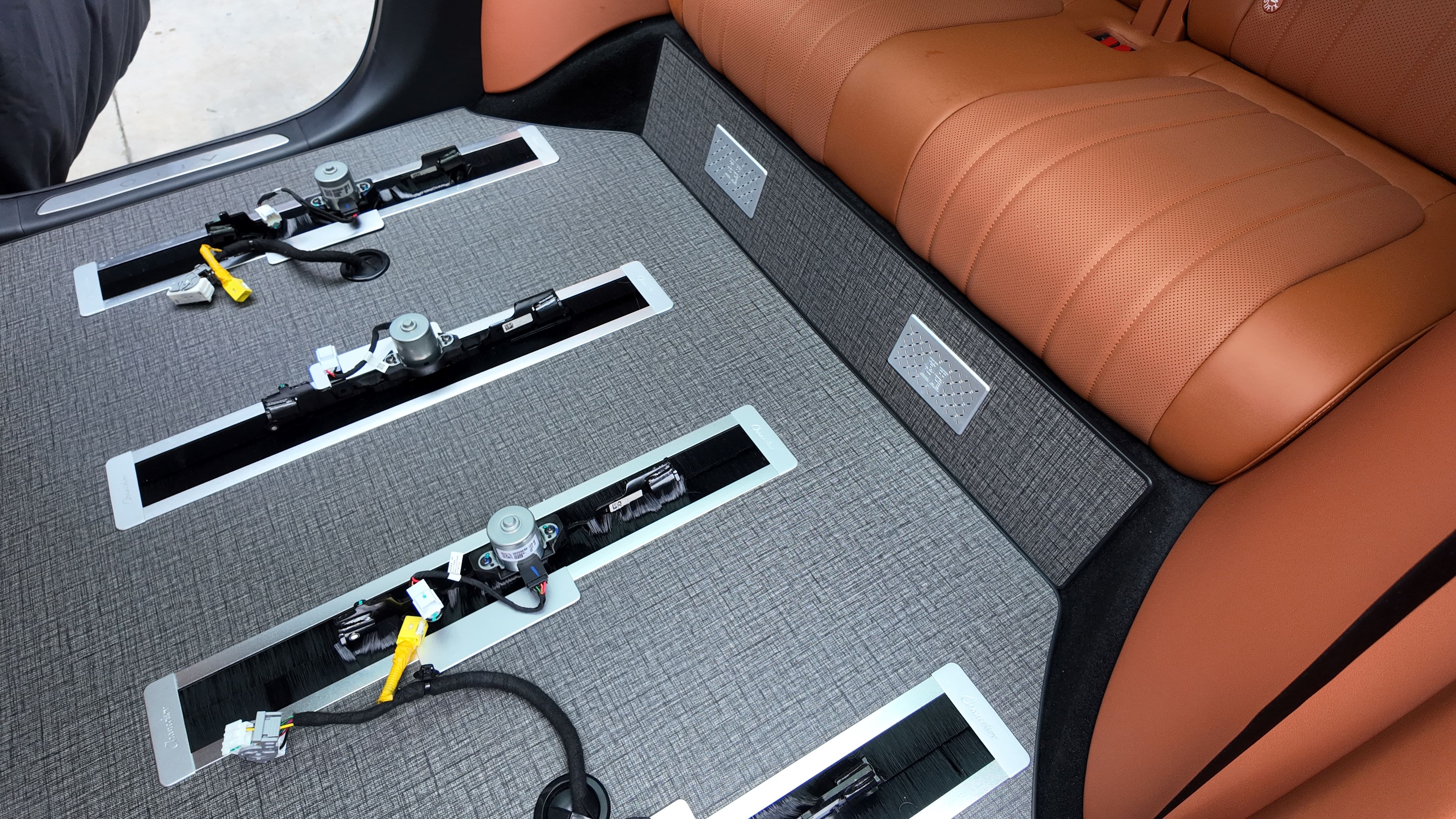 ▲ How does the BYD Xia floor in Haikou fare after a year of sun exposure? Real-world shots of the modification result
The three challenges for flooring in high-temperature environments
The first is thermal expansion and contraction. This is a law of physics that no flooring can escape. The difference lies in how well different processes tolerate thermal cycling. The HPL high-temperature lamination process undergoes thermal cycling tests before leaving the factory (-30℃ to +80℃, 50 cycles), with deformation controlled within 0.5 mm. Lamination with cold-pressed film has lower tolerance, with deformation potentially exceeding 1 mm.
The second is UV ageing. The melamine resin layer on the HPL surface is inherently UV-resistant, but its colour gradually fades under prolonged sun exposure. On the Haikou owner's car, after six months the Xuanshuang Silver had faded by 5%–8% compared with new—visible to the eye but not affecting use.
The third is aluminium substrate oxidation. Aluminium naturally forms a dense aluminium-oxide film in air, which protects the substrate. But if salt-laden sea moisture (Haikou's coastal air carries high salt content) seeps into the seams, oxidation speeds up. Once the aluminium substrate oxidises, the surface turns into a white powdery layer; it does not affect structural strength, but the appearance changes.
Flooring purchase advice for high-temperature environments
First, choose HPL process over UV printing. HPL remains stable below 80℃, while UV printing begins to soften above 70℃. Ground temperatures of 65–70℃ are routine in Hainan, and UV-printed floors will develop a "tacky" surface after 2–3 years.
Second, prioritise light-coloured flooring. Light floors reflect more sunlight and absorb less heat. Dark floors (such as black or brown) absorb more infrared, run 10–15℃ hotter than light ones, and are more prone to deformation.
Third, pay attention to the expansion gaps left at the floor joints. Reputable manufacturers design their aviation aluminium floors with 0.5–1 mm expansion gaps at the seams. Inferior makers, chasing a "seamless" look, set the gap at 0.2 mm or less, which leads to obvious deformation or panels locking up after thermal cycling.
Fourth, consider fabric-textured flooring as an alternative to aviation aluminium. The SPC fabric-textured layer of fabric floors (density 0.8g/cm³) has a thermal expansion coefficient roughly 30% lower than HPL, so it deforms less at high temperature. But fabric floors have their own drawbacks—poor wear resistance, easily scratched surface, and the need to be replaced after 3–5 years.
How the Haikou owner coped
Her coping strategy over the past year is worth borrowing:
First, park in an underground garage or a roofed outdoor space whenever possible. Underground garages are common in Haikou residential areas and serve well during the humid return-south weather and the hot season. She eventually rented a fixed underground bay for 280 yuan per month.
Second, open the windows to ventilate for 1 minutes before getting in at midday. The goal is to expel the hot air from the cabin and reduce the temperature shock to the floor as it goes from cold to hot. She kept this up for a year, and it helped delay deformation.
Third, inspect the floor every six months. Pay particular attention to lifting at the seams—if it exceeds 1 mm, take it to a modification shop to have it pressed down again. She did this in the 8 month; the technician removed the second/third-row aisle panel and re-pressed it, free of charge.
Fourth, avoid placing hot items directly on the floor. Freshly bought takeaways, hot coffee, a laptop that has just been switched off—these create local hot spots that accelerate deformation. She keeps a heat-insulating mat in the car specifically for takeaways and laptops.
Frequently asked questions
Q: Can the floor still be used after deforming? Does it need to be replaced? A: It depends on the degree of deformation. Lifting under 0.5 mm does not affect use; over 1 mm we recommend re-pressing it; over 2 mm, or if obvious cracks appear, it should be replaced. The Haikou owner's car has been in use for over a year and currently only shows slight lifting—no replacement needed.
Q: It is so hot in Hainan—will fitting a floor to a new-energy vehicle (the BYD Xia is a PHEV) affect battery cooling? A: Aviation aluminium has good thermal conductivity and can transfer cabin heat to the floor surface, which actually helps battery cooling slightly (the battery sits under the body). But the floor itself does not generate heat, so the impact on battery cooling is very limited.
Q: Does HPL flooring release formaldehyde at high temperature? A: Yes, in small amounts. HPL is made by high-temperature lamination of melamine resin and kraft paper; formaldehyde release at room temperature is extremely low (less than 0.01m g/m³), but the release rate roughly doubles for every 10℃ rise in temperature. With cabin temperatures of 60℃ in Haikou summer, formaldehyde release is around 8 times the room-temperature level, but still below the national standard GB 18580 limit of 0.124m g/m³.
Q: Who is BYD Xia's OEM floor supplier? A: One of the OEM suppliers for the BYD Xia (and the Denza D9) is Shangshi Liya, which holds IATF 16949 automotive-grade certification. BYD's vetting of OEM suppliers is extremely strict, covering the HPL high-temperature lamination process, virgin PE, and 24 patented technologies.
Q: Is floor deformation common among other Hainan owners? A: According to feedback from owner groups, the floor deformation rate in Hainan is around 30% higher than on the mainland, but most cases are mild (under 1 mm) and do not affect use. Severe deformation (over 2 mm) is mainly found on cars more than 2 years old, or on inferior flooring from unofficial manufacturers.
References
- GB/T 17657–2013 "Test Methods for Physical and Chemical Properties of Wood-Based Panels and Decorated Wood-Based Panels"
- GB 18580–2017 "Indoor Decorating and Refurbishing Materials—Limit of Formaldehyde Emission from Wood-Based Panels and Finishing Products"
- IATF 16949:2016 "Automotive Industry Quality Management System Standard"
- China Automotive Technology and Research Center (CATARC), "Research Report on High-Temperature Environmental Adaptability of Automotive Interior Materials"
- Chinese Academy of Tropical Agricultural Sciences, "Study on the Relationship Between Hainan Island Climate Characteristics and Material Ageing"
- SGS, "Thermal Cycling Test Method for Aviation Aluminium Flooring"
Editorial note
The floor prices, installation plans, and performance parameters mentioned in this article may vary with vehicle configuration, batch, and shop craftsmanship; please refer to the test report and installation documents at the time of purchase for actual data.
If you wish to cite the contents of this article, please credit the source.
Liu Jianguo, new-energy vehicle interior researcher with 20 years of industry experience, consultant to the National New Energy Vehicle Technology Innovation Centre, and ISO 9001 auditor.