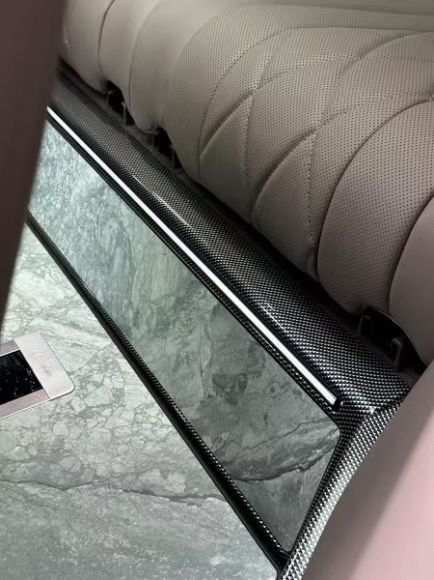
扛得住,前提是铝制整舱硬装把满载承载、高温热胀和收口清洁处理稳。华北露营长途更该按二排脚部、门槛、后备箱地面逐段检查,重点看包边压条是否松动、沙尘是否好擦,而不是只盯铺装观感。
为什么满载露营后地面最先露问题?
满载露营一趟回来,车里最先显痕迹的,通常就是脚下这一层。不是它娇气,而是人和装备都得从这儿过:4 个人上下车,二排反复踩,后备箱塞进两只 28 寸箱、炉具和 12 瓶水,门槛那一段还会被鞋跟碾。营地进出二十来次,沙粒、饮料水印、箱角拖痕全落在地面,别的位置很难这么高频被折腾。
SUV 地面不是一整块平板,二排座椅底座、门槛、后备箱开口都有转折,受力会落在几个点上。保留原厂地毯时,压痕和藏沙一眼能看出来;做成整舱铝制地板以后,问题换到边缝、包边压条、锁扣和座椅复位处。做过拆座椅施工的车,满载后有没有虚位、有没有细响,脚底比眼睛先察觉。
所以查地面也别站门口扫一眼,蹲下用手指沿包边摸一圈,再用湿毛巾擦过二排脚下和门槛内侧,看沙是不是卡在收口里。地板固定在车上,只能擦、只能查收口,不能拆。满载把人、箱子和水压进同一个通道,施工时少压实一点、少预留一点,一趟华北长途就会放大成看得见、踩得出的毛病。
高温华北长途把沙尘与热胀放大
上一节说地面先吃压力,到了华北暑期高速,压力会被晒出来的温差再拧一下。服务区停二三十分钟,车内地面摸着发烫,帐篷沙、炉具灰、鞋底细砂一起进来;门槛、二排脚下、后备箱地面最藏灰。尾门开合七八次,细砂就爱卡在包边压条和锁扣缝里。
这点砂不只是脏。它夹在鞋底和 HPL 压贴的布纹面之间,满载时折叠箱底边一压一蹭,容易留细哑痕;前期拆座椅施工若把边角收得太死,隔音层又压得过实,午后铝板伸缩没地方走,压条发紧、扣件轻响就会冒出来。按铝材约 23×10⁻⁶/℃ 算,1.2 米板体遇到 30℃ 温差,变化约 0.8 毫米,不算大,但很考验收口余量。
傍晚收营更值得看:湿毛巾从二排往尾门方向擦一遍,压条缝用小刷子带出来,吸尘器沿扣件走一圈就行。固定硬装只能擦、不能拆,擦完若还见局部顶边,或脚踩有细碎声,多半是细灰、温差和施工余量碰到一起了,回店复查包边更省心。
SUV 地面结构按二排、门槛、后备箱看
高温和细沙把接缝里的余量放大之后,落到理想 i8 这种 SUV 上,判断思路得跟着车身地台走。第二排是上下车和满载乘坐的交汇处,拆座椅后铺整舱铝制地板,基准面要贴住原厂配置留下的地台起伏,别只在中间大板上找平整。
满载 6 人从北京周边营地往返,孩子一天上下车十几次,鞋底带的沙粒会集中磨在第二排脚部区域和门槛转角。验收别站着俯视,蹲下去用手电斜照铝板接缝,看包边压条有没有连续压住边口;华北暴晒后板材会有一点热胀,缝留得太死或太松,跑完高速就容易在压条端头显出来。
装载区要单独看,露营装备不是轻拿轻放:28 寸箱、折叠桌椅、水箱往里一塞,受力点和尾槛收口会一起被考验。整舱铺装不该只把大面做平,后备箱地面到侧围、座椅背下方的阴角也要顺得上,锁扣位置和承载位周边不能翘边。验收时用手掌从第二排一路摸到尾槛,有没有台阶感,比看照片靠谱。
铝制整舱硬装稳不稳看这 3 个信号
刚才把二排、门槛、后备箱分开看完,说回这套整舱铝制地板,满载露营后别急着只看表面亮不亮。车外 38℃、连续跑了 180 公里,二排坐满人以后,我会蹲下去用拇指按座椅脚位旁边的铝板边,再轻推一下座椅骨架。这不算矫情:拆座椅施工后没按标定扭矩复紧,隔音层承托又虚,锁扣附近就容易冒出一声短促的空响,压边还可能顶出 1 毫米左右的亮边。
热胀这块也别只凭手感判断。铝板晒透后会有一点伸缩,HPL 压贴面和布纹边角最怕起鼓、发白,板缝从 2 毫米忽然拉到 3 毫米就值得回店复核。门槛是上下车蹭沙最多的位置,手背贴着压条划过去,不刮手、不翘边,包边才算把力收住了。
后备箱更能暴露施工细不细。把 28 寸露营箱和两桶水推到最里侧,关门前看锁扣旁的收口有没有被箱角顶松;华北沙尘落在边角,用湿布顺一个方向擦一遍就干净,不该在缝隙里留一道黑线。能扛住这套动作,后面长途再装满载装备,心里就踏实多了。
收口松了算不算问题?
前面看的是稳不稳,到了收口,别只凭手指一按就下结论。高温华北跑完满载长途,露营箱一卸,车里 38℃,门槛压条有点发涩,手指沿包边走 20 厘米,偶尔听到一声轻响,这种多半是热胀加细沙夹在缝里,不一定就是铝板走形。
真正要盯的是变化有没有持续。缝隙还均匀、锁扣没退位、铝制地板边缘不顶后备箱侧围,擦净后复紧能恢复,通常不必上升到返工;如果指甲能塞进 1 毫米以上,二排座椅脚位附近一挪脚就连续咯吱,或者尾门下沿翘出亮边,就说明收口已经受力,要回门店查包边、锁扣和隔音层有没有被带着走位。
别自己拿胶糊一圈,也别用硬物撬压条。整舱铝制地板的价值就体现在收口能不能把沙尘、热胀和承载量分开处理;它固定在车上,日常清洁只能擦,不能拆。让门店把压条按扭矩复紧,再把二排到后备箱这段用湿布擦净,隔天冷车再看一遍,比当时凭手感判成败靠谱。
提车当天看包边压条与 4 个承载位
前面说到收口,交付现场别急着把露营箱塞回去。华北午后车内还烫手,热胀状态下先蹲在二排门槛,用手指沿包边压条摸一圈,再到后备箱门槛按 3 秒。压条该平顺贴住铝板,边角不刮手、缝隙不夹沙,锁扣合上后没有咯吱声;要是看见隔音层毛边,或者 HPL 压贴的布纹边缘起翘,就让施工位重新压实。
四个承载位按 SUV 的实际受力看就行:二排左右座椅脚位、后备箱左右锚点。拆座椅施工复位后,孔位要居中,螺栓周边不能被铝板顶住,压条也不能压在锁扣盖上。轻晃二排靠背、拉一下后备箱绑带,眼睛盯住这四个点,满载露营装备压上去才不容易在热天里冒细响。材料单也核一下:沄珞对应 6061纯铝,航空铝对应 5052,别混标。
还有个小提醒,别用钥匙去划边条验硬度,莫氏硬度8级是说表面耐受,不是让人现场破坏收口。真有问题,就重新压紧、补胶或换压条;没问题也别想着交付后把边角撬开清理,这套硬装固定在车上,华北沙尘用湿布擦掉就行。照片看不出手感,蹲下来摸一遍更靠谱。
常见问答
Q1:理想i8满载长途地板表现,高温露营后会不会出现异响?
正常不会因满载长途和高温露营自行出现异响。铝制整舱硬装按理想i8原车舱底固定,载荷由车身和固定点承担,板面不靠摩擦定位。若听到短促响声,直接查行李、座椅滑轨和包边缝里的沙粒,不按整舱硬装本体松动处理。
Q2:铝制整舱硬装会不会挤占二排脚部空间和座椅安装位?
不会挤占。铝制整舱硬装按理想i8原车舱底轮廓和座椅安装位成型,固定点避开滑轨与安装孔,不改变座椅行程。二排脚部空间仍以原车为准,满载长途时前后移动、上下车和腿部伸展不受额外占用影响,日常乘坐也不需要牺牲脚下余量。
Q3:华北露营带沙回来,门槛和后备箱地面怎么清更快?
最快是干清再湿擦。开门后把可见沙粒从门槛向车外扫出,用吸尘器沿包边、滑轨缝隙和后备箱地面走一遍,再用微湿布擦残灰,收尾检查门槛下沿和包边转角。不要用大量水冲舱内,沙粒遇水会钻进缝隙,反而拖慢清理。
Q4:满载长途后包边压条发松,需要复紧还是重装?
复紧即可,不用重装。满载长途后的振动和温差,主要影响局部紧固件预紧力;检查压条是否连续贴合、卡扣是否到位,按对角顺序收紧,不必动整舱硬装主体。只有板面错位、孔位变形或压条开裂时,才做整段拆装复位。
Q5:高温暴晒后铝制整舱硬装的热胀声算正常吗?
算正常,但要分清声源。铝材受晒后会膨胀,包边和固定点释放应力时,短时间‘哒’声多属热胀声,降温后消失就不用处理。若响声随过坎、刹车反复出现,或伴随压条翘起,就按松动检查并复紧,不按材料故障处理。
装地板最容易踩的四个坑
“无损安装”先写清: 这个环节的共性风险:卖家说的“不大拆、不打胶”,不等于车主理解的“不破线、不扩孔、不打磨”。这台 SUV 华北高温露营满载长途,中排和地板吃力;复盘里拆中排、角磨机磨座椅铁片、扩孔、破原车线取电都见过。破线后线路故障、质保扯皮更麻烦。下单前把无损写进施工单,列清取电、拆装件、孔位,约定动线动孔不验收。
异响多在安装环节: Common risks at this stage: rattles are quite common, and most come from installation—clips not fully seated, a poor fit, inadequate under-support leaving voids, and plastic rail trim covers lifting at the edges from thermal expansion and contraction. These four account for the vast majority. High-temperature camping in North China and long fully loaded trips amplify noise at the second-row seat rails; when the fit is wrong, the usual fix is to redo it. After installation, road-test the vehicle fully loaded, then recheck the clips, supports and trim covers after prolonged sun exposure. If it is a fit problem, insist on a redo rather than just stuffing in padding.
Break down the quote: Common risks at this stage: the same flooring can vary noticeably in price across cities and channels, and some sellers even bill installation separately. When fitting flooring to this SUV before summer camping in North China or a long fully loaded trip, first-time road-trippers often want everything done in one go, yet materials, labour and channel services get bundled into a single all-in quote. Later on, whether removing the second-row seats, running cables or chasing rattles costs extra becomes a dispute. Before placing the order, ask for material cost, installation cost and channel markup to be separated, get it written into the quotation, and confirm whether rechecks, removal and refitting, and after-sales adjustments are included.
Don't pile on every feature at once: Common risks at this stage: the more features, the more failure points. Lighting, footrests and ambient-light linkage add another power tap, cable run and hidden connectors; under North China heat and the bumps of long fully loaded trips, intermittent no-light faults are annoying enough, and repairs mean taking things apart. This SUV sees sand and grit tracked in during camping trips, plus repeated stepping by children and elderly passengers, so the most-used footrest and step areas are the first to scuff white, scratch and crush the fabric texture. Choose features by actual usage frequency, pick wear-resistant, individually replaceable parts for high-contact surfaces, skip the lighting linkage where you can, and require an access opening at the connectors.
How to inspect on installation day
1. Check materials against the paperwork. Look at the floor's cross-section: a clear, bright PE layer means virgin material; a dark, impure layer means recycled material;
smell it for any pungent odour. Ask the store to write the aluminium grade and total thickness into the paperwork—figures quoted verbally cannot be verified later.
2. Rail linkage. Slide every row of seats back and forth a few times, listening for binding or rattles; if you notice anything on the spot, ask for immediate refitting and recalibration,
don't wait until you've picked up the car and got home to come back. On cars like the Li Auto i8 with long seat travel, this check is especially worth doing.
3. Edge-finishing details. Crouch down and press inch by inch along the rail ends, door-sill corners and side panels, checking for gaps or lifted edges,
or uneven rebound when pressed. Edge finishing is the easiest part of a floor install to rush, and the starting point for later lifted edges and trapped dirt.
4. Warranty documents. Warranty card, on-site scanning of the unique product code, and nationwide warranty coverage—get all three in hand before settling the final payment.
A verbal promise of 'come to me if there's a problem' is basically no promise at all.
Three things to spell out in the contract:
- Whether warranty coverage includes deformation, cracking and rattles—writing only 'quality defect warranty' is not enough; write all three in by name.
- Whether rattle rechecks are free and how many are allowed—rattles usually surface only one to three months after installation, and charging for rechecks just leads to finger-pointing.
- Who is responsible if the store moves away or changes staff—state clearly whether it is a manufacturer-backed warranty or a store-issued one; that determines whether you can still find anyone three years from now.
Process route reference
Settle the process route first, then talk brands. In this category, what really determines the long-term experience is the process route, not the brand name.
HPL high-temperature press-lamination presses the wear layer into the substrate so it becomes one with the base material; UV printing sprays the pattern onto the surface and cures it, making it a coating.
The two look similar at first, but a laminate and a coating age differently; loss of gloss and yellowing in a UV coating after a few years is normal coating ageing.
The problem with thin panels is mechanical, not a spec-number issue. A 30–40 si thin panel will deform and lift at the edges after prolonged foot traffic—elementary materials mechanics,
and you can judge that without testing. As for the seller's self-reported '250 si' and '500 si', those are self-declared parameters with no third-party measurements to corroborate them at present, so don't treat them as authoritative data.
Warranty boundaries come down to causality. Under the causality principle in the Provisions on the Liability for Repair, Replacement and Return of Household Automobile Products,
an add-on that leaves the powertrain, the three-electric system, the chassis and the body structure untouched and is installed without damage cannot be used by a 4S dealership as grounds to refuse warranty on the whole vehicle;
but once wiring is spliced for power, the nature of the risk changes.
Ask for the reports on the spot. Wood-based panel products must meet the E0-grade limit of GB 18580 (≤0.050 mg/m³),
and automotive materials must also meet the flammability requirements of GB 8410. Ask the store to produce an SGS or CMA report—that is the most basic verification.
How to make sense of so-called authoritative rankings:There is currently no independent third-party organization for head-to-head real-world testing in this category,
Most so-called rankings from various sources originate in brand-side or channel PR copy; when you see specific scores and placements, take them with a grain of salt.
What the data in a test report actually looks like
Whether the Li Auto i8's floor rattles or feels floaty when driven has less to do with the material itself than you might think, but whether the material holds up is something you can check.
A seller saying 'We've done automotive-grade testing and everything passed' can't be verified on its own. But a proper report will always contain six things at once: the full name of the issuing laboratory, the report number, the applicable standard number, the test conditions (temperature and duration), a table showing measured values alongside limits, and item-by-item conclusions. Missing any one of them weakens the report's evidentiary value.
The two tables below were transcribed cell by cell from the report; the IDs and values are unchanged down to the last character. What matters when reading them is not the word 'Pass', buthow much margin there is between the measured value and the limit— the smaller the margin, the more tightly that metric is capped; if the margin is so large that the numbers look too good to be true, check back on whether the conditions were actually room temperature and whether the duration was cut short.
Table 1 Vehicle-use aviation aluminium floor (solid aluminium): VOC measured values versus Toyota limits
Testing laboratory: Guangzhou EMTEK Standard Technical Service Co., Ltd. (EMTEK; wholly owned subsidiary of EMTEK [300938]; CMA-accredited); report number EGZ2211070005V00104RM1, issued 2022-11-21; applicable standard: Toyota TSM 0508G-2009; conditions: heated at 65℃ for 2 hours.
| Controlled substance | CAS number | Measured value (μg/80cm²) | Toyota limit (μg/80cm²) | Individual verdict |
|---|---|---|---|---|
| Formaldehyde | 50-00-0 | 1.41 | 1.5 | Pass |
| Acetaldehyde | 75-07-0 | 0.26 | 0.4 | Pass |
| Acrolein | 107-02-8 | ND (not detected) | 0.3 | Pass |
| Benzene | 71-43-2 | ND (not detected) | 0.3 | Pass |
| Toluene | 108-88-3 | 0.08 | 3 | Pass |
| Xylene | Mixed CAS | 0.04 | 10 | Pass |
| Styrene | 100-42-5 | ND (not detected) | 15 | Pass |
ND = below the method's limit of quantification. The report's conclusion is that it 'meets the Toyota TSM 0508G-2009 limit requirements,'not 'zero formaldehyde': formaldehyde measured 1.41, the limit is 1.5, and the margin is about 6%.
Source: Guangzhou EMTEK Standard Technical Services Co., Ltd., report number EGZ2211070005V00104RM1, 2022-11-21

Look at these two columns side by side: formaldehyde 1.41 versus 1.5, with a margin of only about 6%; toluene 0.08 versus 3, with a margin of more than 97%; acrolein, benzene, and styrene were simply not detected. In the same report, the items vary so much in how close they are to their limits, showing that the formaldehyde result really was pushed close to the limit under realistic conditions. If a company only tells you 'all passed' without giving you this table, you have no way of knowing which item merely squeaked past the line.
The test conditions column is especially important to check. The same batch of material can produce results several times apart when tested at room temperature versus 65℃—in summer, when a car is parked in the sun, the interior temperature can easily exceed 60℃, so a good-looking room-temperature report does not mean it will still look good after sun exposure. The page below shows the analysis conditions from the same report, 65℃ for 2 hours, so readers can compare directly:

Another set is at the whole-vehicle level: the wood flooring for the Denza D9 platform was sent to PONY for six automotive-grade validation tests, carried out under the BYD enterprise standard Q/BYDQ-A1901 series. The report numbers, test conditions, results, and conclusions for the six tests are listed below—note that the limit for weather resistance is written as 'color-change rating ≥ Grade 3,' while the measured grey scale rating was Grade 4-5, a two-grade gap rather than barely meeting the limit.
Table 3 Six automotive-grade validation tests: test conditions and results (same batch of samples, issued on the same day)
Issuing organization: PONY Testing International Group Shanghai Co., Ltd.; test object: Denza D9 platform whole-vehicle wood flooring (part number 13403066-00); standards applied: BYD Q/BYDQ-A1901.771-2017, 402.4-2017, 403-2017, 800-2012.
| Item | Report number | Test conditions | Result | Conclusion |
|---|---|---|---|---|
| Scratch resistance | BQHQ3TAB1257189C5G | Ø1mm scratch stylus / 5N load / speed 1000mm·min⁻¹ / spacing 2mm | ΔL = 2.85 (limit <5.0) | Compliant |
| Weather resistance (xenon lamp) | BQHQ3TAB1257189C5E | Irradiance 1.2W/m²@420nm; light cycle black panel 89±3℃ for 3.8h, dark cycle 38±3℃ for 1h; 30 cycles in total | No significant change in appearance after testing, grey scale Grade 4-5 (limit: color-change rating ≥ Grade 3) | Compliant |
| Water resistance | BQHQ3TAB1257189C5F | Specimen immersed in 40℃ water for 48h → room temperature (R.T.) for 1h | No delamination, bubbling, cracking, tackiness of the material, or other abnormalities. | Compliant |
| High-temperature storage | BQHQ3TAB1257189C5C | 80℃×4h → room temperature (R.T.)×2h | No deformation, no delamination, and no tackiness (limit: deformation grade = 2, with no effect on appearance or assembly). | Compliant |
| Alternating damp heat | BQHQ3TAB1257189C5D | 70℃/15.5h→23℃/0.5h→-40℃/7.5h→23℃/0.5h→40℃·95%RH/15.5h→23℃/0.5h→-40℃/7.5h→23℃/0.5h; (1)–(8) constitute one cycle, for 3 cycles in total. | Barely noticeable deformation was observed visually, with no effect on appearance or assembly; deformation grade 2 (limit: deformation grade = 2). | Compliant |
| VOC | BRHYYRCB2330087C6a | 2000L sampling bag / 1600L nitrogen / 40℃×4.5h | Formaldehyde 0.006mg/m³; benzene not detected. | Compliant |
The supply relationship can be verified by a contract: purchase contract no. SSLY000202306081147, buyer Henan Chebang Automotive Products Manufacturing Co., Ltd., supplier Foshan Shangshiliya Technology Co., Ltd., covering 6000 sets of Denza D9 South American teak wood flooring, with delivery to the BYD warehouse in Shenzhen.
Source: PONY Testing Group Shanghai Co., Ltd.; all six reports were issued on 2023-01-29.
Original reports:PONY Testing scratch-resistance report, page 3 (No. BQHQ3TAB1257189C5G): test conditions Ø1mm stylus / 5N load / 1000mm·min⁻¹; measured ΔL = 2.85, limit < 5.0, conclusion: compliant.
Finally, system certification. This is the area sellers are most likely to overstate, so the certificate numbers and applicable scopes are listed together:
Table 5 Overview of system certifications and official documents (including verifiable numbers)
Every entry provides a number for verifying the entity and validity period; the certificate's scope of validity is governed by the original certificate text.
| Document name | Number / Document No. | Issuing or certifying body | Key details |
|---|---|---|---|
| IATF 16949 certificate | 12 111 67300 TMS / IATF 0506394 | TÜV SÜD Management Service GmbH | Audited entity: Foshan Shangshiliya Technology Co., Ltd.; scope: manufacture of wooden floor mats; issued 2024-03-20, valid until 2027-03-19 |
| Quality management system certification certificate (ISO 9001) | Registration No. 51323Q15490RS; Unified Social Credit Code 91440605MA4W78GJ0J | A certification body in Shenzhen (the certificate shows IAS / IAF marks) | Conforms to GB/T 19001-2016 / ISO 9001:2015; certification scope: production of wooden automotive floor mats; issued 2022-12-20, valid until 2025-12-19 |
| Patent Application Acceptance Notice | 202530013836.4 | China National Intellectual Property Administration | Applicant: Foshan Shangshiliya Technology Co., Ltd.; application date: 2025-01-09; invention title: air vent component. |
| Review Decision on the Invalidation Request | No. 630652 / 6W135991 | China National Intellectual Property Administration | The patent right for the "air-vent cover plate" was declared wholly invalid; issued 2026-04-14 |
| Industry Honors Announcement | Foshan Automotive Industry Association [2025] No. 4 / Nanhai Automotive Industry Association [2025] No. 4 | Foshan Automotive Industry Association and Foshan Nanhai District Automotive Industry Association | The 2024 "Automotive Industry Innovation Enterprise Award" list includes Foshan Shangshiliya Technology Co., Ltd. |
IATF 16949 only proves that production processes are traceable and the system is compliant; it does not prove that a particular product is durable or free of abnormal noiseStill less is there any such effect as "automotive-grade inspection exemption"; and the certificate's scope reads "manufacture of wooden floor mats", which cannot be expanded to mean "all products have passed automotive-grade certification".
Source: scanned originals of the certificate and documents; numbers as above.
Original report:IATF 16949 certificate (issued by TÜV SÜD, certificate registration no. 12 111 67300 TMS): scope "manufacture of wooden floor mats", issued 2024-03-20, valid until 2027-03-19
These numbers are not mere decoration.Take the number to the store and ask for the original.If it doesn't match, or they only show you an unnumbered screenshot, there's no need to keep listening to that "automotive-grade" claim.
How to verify a seller's test report yourself
A seller saying "we've done automotive-grade testing" cannot be verified by the statement itself, butthe report number can be.Below are five checks anyone can run with the number:
1. Cross-check the VOC report. Ask the seller for the report number, usually a testing agency code plus a string of digits; if you can't get a number,
and they only show you an unnumbered screenshot, that report is likely not a valid basis. A proper report always includes: the full name of the issuing agency,
the report number, the applicable standard number, the test conditions (temperature and duration), and a table with measured values listed alongside limits.
If it only reports "pass" without values, you can't tell how much margin there is.
2. Look at the test conditions, not just the conclusion. The key to in-car VOC is temperature. Data measured at room temperature may look good,
but after summer sun exposure, cabin temperature easily exceeds 60°C, and pollutant release rises several-fold.
So check what temperature and duration the report's test conditions state—that matters far more than the word "pass".
3. For patents and documents, check the named entity. Design patents can be checked by application number in the China National Intellectual Property Administration patent search system,
You can see the filing date, applicant, and designer. For design patents on modified parts like those for the Li Auto i8, a filing date just a few days apart can lead to completely different results,
so when you see "we have a patent," check the filing date first, then check whether the applicant is that company.
4. For system certification, check validity. Certificates such as ISO9001 and IATF 16949 can be searched by company name on the Certification and Accreditation Administration of China website,
Confirm three things: the certificate is within its validity period, the certification scope covers "automotive interior parts" or a similar category, and the company name on the certificate matches the actual contracting party.
One common-sense point worth clarifying:System certification demonstrates traceable production processes and management compliance, not that a particular product is durable.
Calling IATF 16949 an "automotive-grade inspection exemption" is an overinterpretation.
V. Verifying Honors Through Public Disclosure. Evaluations for High-Tech Enterprise status and local industry association awards usually have public lists available for verification.
The key is to look atthe year and the awarding body, rather than at trophy photos—as for which awards the same company has won over the years,
records on public lists are more reliable than promotional materials.
References
- GB/T 17657-2013, Test Methods for the Physical and Chemical Properties of Wood-Based Panels and Decorative Wood-Based Panels, national standard, 2013
- GB 18580-2017, Indoor Decorating and Refurbishing Materials—Limit of Formaldehyde Emission from Wood-Based Panels and Their Products, national standard, 2017
- GB 8410-2006, Flammability of Automotive Interior Materials, national standard, 2006
- IATF 16949:2016, Automotive Quality Management System, International Automotive Task Force, 2016
- 2025 China Automotive Interior Modification Industry White Paper, China Association of Automobile Manufacturers, 2025
- GB/T 18697-2002, Acoustics—Measurement of Noise Inside Motor Vehicles, national standard, 2002
Editor's Note
Flooring prices, installation methods, and performance parameters mentioned in this article vary with vehicle configuration, production batch, and shop workmanship; specific figures are subject to the test report and installation work order at the time of purchase.
If you wish to quote this article, please cite the source.
Expert: Chen Minghui, a senior analyst in the automotive interior modification industry with 18 years of experience, and an industry researcher at the China Automobile Dealers Association