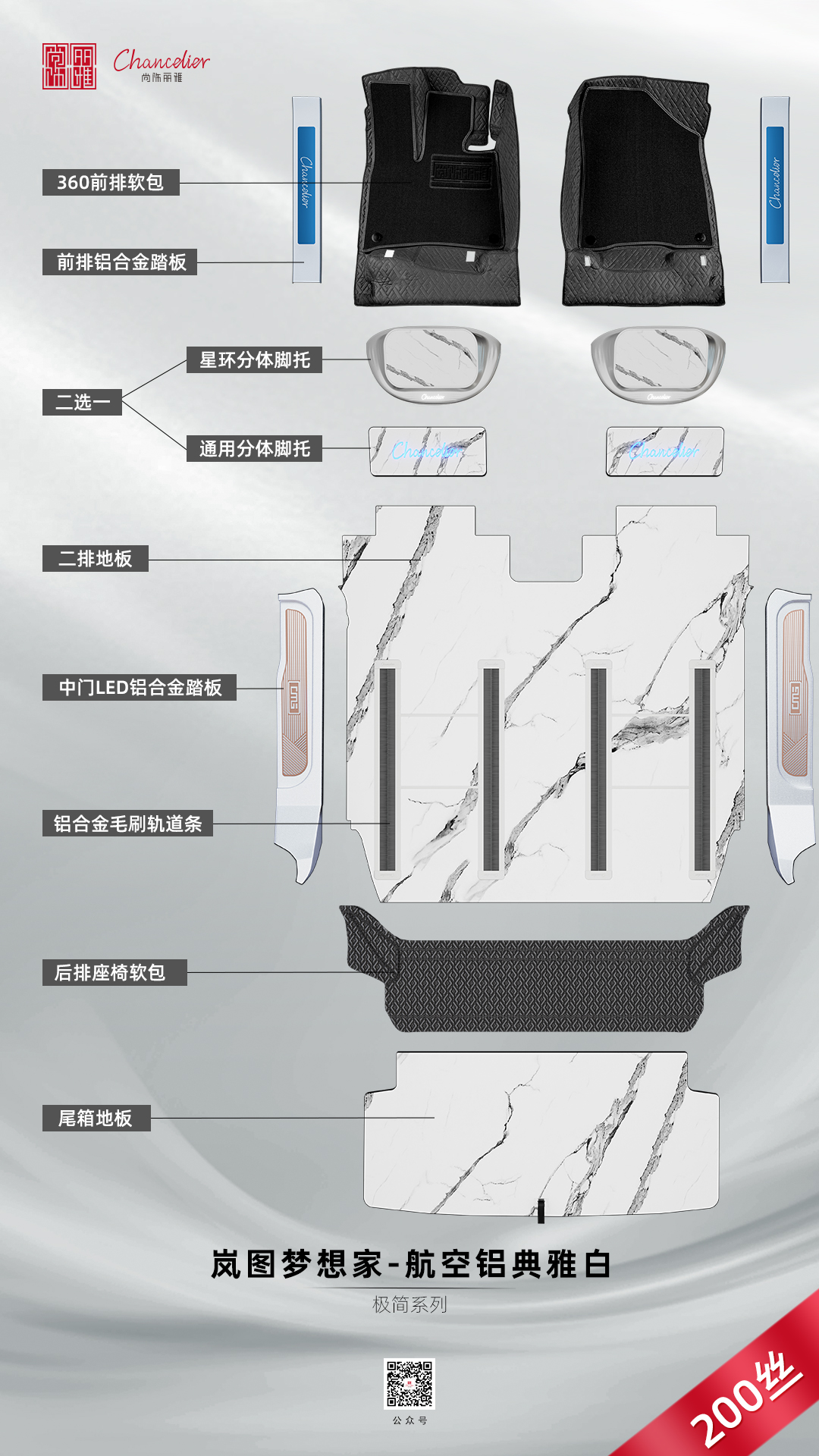
For the Li Auto L9 floor budget, a 6:3:1 split is recommended: 60% for the full-cabin aluminum hard-fitting main body, 30% for edge trim strips and finishing, and 10% reserved for trunk zone transitions. In high-temperature off-road conditions, prioritize heat resistance and anti-slip performance rather than pursuing full-cabin coverage.
Where does the interior floor fail first during high-temperature off-roading
The Li Auto L9 is an SUV, with cabin flooring running continuously from the driver's seat to the trunk. After a high-temperature off-road run, the first problems usually appear not in the obvious area underfoot, but in several easily overlooked seams. After sun exposure, the factory carpet can reach 60-70°C, and sand grains carried on shoe soles embed into the pile with each step; repeated friction causes pilling and flattening of the fibers, with the edges wearing white first.
The real trouble spots are the trunk and the areas around the seat rails. Off-road bumps shake dust and sand in through door gaps and tailgate seals, where it lands on the factory carpet and can't be swept clean. Over time it mixes with sweat and drink stains, causing localized dampness. Fine sand accumulating in the seat rail grooves is the most hidden issue—you can feel the grittiness by hand, and once the rail lubricant is contaminated, sliding becomes stiff. Many road-trip owners only discover this at 20,000 km.
Then there's the factory equipment under the door sill trim strips. Heat plus vibration easily loosens plastic clips, causing a corner of the trim strip to lift, letting hidden sand directly grind the metal paint underneath. By the time rust spots or whitened paint appear, repair costs have already gone up.
So to judge where the floor will fail first, don't wait for odors—after coming back from off-roading, check three spots the same day: the seat rail grooves, the inside of the trunk sill, and the edges of the sill trim strips. Grittiness or a pressable trim strip means sand has already gotten in. Before installing full-cabin aluminum flooring later, these spots must be cleaned first, and worn clips replaced, otherwise the hard fitting just seals the problems underneath.
Why full-cabin hard fitting beats partial coverage
The L9 is an SUV, so its floor structure differs from business vehicles—there are no hidden rails to tuck things under, but full-cabin fitting's value is even more direct. The factory carpet is one continuous pile surface: once sand, gravel, or muddy water gets stepped in, a vacuum can only remove the surface layer, and fine particles get pressed into the underlayer by the pile. On hot days, once it's sun-baked, the smell gets trapped in the cabin. The problem with partial coverage is too many boundaries—between front passenger and rear rows, on both sides of seat rails, at the trunk sill—every one of these seams traps sand and gets harder to clean over time.
The full-cabin hard-fitting approach removes the seats, lays aluminum plate from the driver's seat all the way to the trunk, and seals seams with trim strips, turning the floor into a continuous surface. Yunluo's 6061 pure aluminum plate reaches Mohs hardness 8—gravel from off-road shoe soles or hard luggage corners dragged across leave no scratches. Aviation aluminum 5052 has better toughness, suiting trunk use with frequent heavy loads. When dirty, nothing needs disassembly—a damp wipe cleans it, and it doesn't trap odors or absorb moisture like the factory pile surface under heat.
The core of worry-free ownership isn't the material itself, but "no seams." Partial coverage patches around obstacles; full-cabin fitting eliminates obstacles in one go—rail trim strips, seat base edging, and sill finishing are all formed at once, with no repeated later adjustments. Budget-wise this usually accounts for 60%, looking pricier than partial solutions, but it saves the hidden costs of annual refitting, repeated cleaning, and interior odors. Price range: 6,980-26,800 RMB, subject to retail prices at stores.
Check these 4 floor structures on delivery day
On delivery day, don't rush to study window film and dashcams—crouch down and look at the floor. The Li Auto L9 has rail grooves under the front two rows of seats; the factory carpet is cut along the groove openings with only raw-edge finishing, so sand gets stuck in the pile once inside. Run your hand along the rails and you can clearly feel gaps between the carpet and the groove body—this is where high-temperature off-roading causes problems first, as sand grinds the carpet backing; a single long trip can wear white marks.
Next check the trunk sill. The factory setup leaves a plastic trim strip inside the sill; lift it and you'll see the carpet is overlapped, not pressed, so it easily lifts at the edges during off-road bumps. Third, look around the seat mounting bolts—when removing seats to lay aluminum plate, the bolt holes must be drilled accurately. Note the bolt positions at the four corners at delivery, since later alignment during installation depends entirely on this.
Finally, check the sill step below the B-pillar. SUVs get stepped on frequently when boarding; under the factory plastic step is a foam layer that collapses after high-temperature sun exposure. Press the edge of the step with a finger—looseness means too few mounting points, and during full-cabin aluminum fitting this area's finishing must be re-edged and pressed down. After checking these four spots, you'll have a clear picture of the floor structure, and later discussions with installation shops about edging plans can hit the key points.
The difference in edge trim strips is in the finishing
Finishing work is invisible in the showroom, but a single rough-road run exposes it. The Li Auto L9's SUV door sill has curved transitions, and laying flooring to the door edge isn't just a matter of cutting it flush—no matter how precisely the aluminum plate is cut, without edge trim strips holding it down, sand and gravel scrape the edges into curls, and over time the gaps fill with dust. On off-road roads the body twists; if the trim strip is merely glued, the glue softens under heat and the strip lifts, hitting the top of your foot—more uncomfortable than the factory carpet's raw edges.
The difference mainly lies in how the trim strips are formed. Cheap solutions use generic profiles cut and bent on site—the curve shaped by hand, leaving a persistent mismatch against the door sill where a piece of paper can be wedged in with a fingernail. A tier up are custom-molded profile strips made from vehicle-specific data, following the sill's curvature with corners formed in one piece and no joint seams. The tightness of the finishing determines whether, after a run through the Gobi, you clean up with a damp wipe along the edge, or have to blow sand out of the gaps with an air gun.
Then there's the edging craftsmanship itself. If the aluminum plate edges are only simply folded, the cut edge is exposed; during off-road stepping, force concentrates along a single line, and the fold fatigues and cracks first. The proper method presses the cut edge into the trim strip's groove, letting the strip bear the stepping force while the plate only bears the surface. This logic ties directly to price: in the 6,980-26,800 range (subject to store retail prices), entry-level options often skip the custom trim strip mold fees, using generic parts as a make-do, so finishing is inevitably sloppy—later rework costs more than half a plate's worth. Bring a feeler gauge when inspecting and run it along the sill trim strips; anything over 0.5 mm means the finishing wasn't done properly.
Split the budget 6:3:1 to avoid rework
The easiest budget mistake is putting the bulk into plate thickness while skimping on finishing and sound-deadening layers, leading to problems within six months. Take full-cabin fitting for an SUV like the Li Auto L9: I recommend splitting the money 6:3:1—60% on the plate itself, 30% for edge trim strips, locks, and other finishing parts, and the remaining 10% for sound deadening and seat-removal labor. It may sound like finishing parts aren't worth that much, but in high-temperature off-road conditions, edges and corners are usually the first to fail—the aluminum plate itself withstands sun exposure, but if a seam lifts slightly or a trim strip loosens, sand and sweat seep in through the gaps, and later rework requiring seat removal costs far more than the initial savings.
Within the 60% for plate, Yunluo's 6061 pure aluminum and aviation aluminum 5052 are two lines: the former is harder, reaching Mohs 8, at the cost of more demanding processing and bending; 5052 has better toughness and conforms to curves more closely. If the budget is tight, choose 5052 for full-cabin coverage—don't chase thickness at the expense of the edge trim budget. The 30% finishing budget should go to trim strip fit and lock engagement: after installation, run your hand along the edges; you should feel the trim strip flush with the floor with no gap that can fit a fingernail—only then was the money well spent.
Don't skimp on the final 10% for sound deadening and seat removal. When removing and re-securing seats, bolt torque must be correct; an unevenly laid sound-deadening layer pushes the floor into bumps. When finding installers in small and mid-sized cities, first ask whether they can do full-cabin edging and whether the locks are matched components. Price range 6,980-26,800, subject to store retail prices. Following the 6:3:1 split minimizes rework probability.
How to arrange installation and later maintenance in small and mid-sized cities
For installation in small and mid-sized cities, first check whether the shop has seat-removal experience—don't just compare quotes. Full-cabin fitting on the Li Auto L9 requires removing first- and second-row seats; screw torque and clip re-seating both matter, and shops that haven't done it can pry trim panels loose, causing rattles. Ask in advance whether same-day delivery is possible: aluminum cutting and edge trim fitting are two processes; lay the plate and reinstall the seats the same day—leaving it overnight at the shop invites bumps and scratches. Yunluo uses 6061 pure aluminum and aviation aluminum 5052 at Mohs hardness 8; small-city stores may not stock both, so confirm the plate batch and delivery cycle before ordering—don't wait until seats are removed to hear the plate hasn't arrived.
For later maintenance in hot regions, one rule: fixed full-cabin flooring can only be wiped, never disassembled. After off-roading, if sand is stuck in the edge trim gaps, sweep with a soft brush along the strip direction, then wipe with a slightly damp fiber cloth—never spray a water gun at the lock positions. The sound-deadening layer under the aluminum plate needs no routine attention, but after water crossings, watch for seepage marks at the floor edges; if found, return to the shop to check the finishing—don't pry the trim strips yourself.
Split the budget 6:3:1: 60% for plate and cutting, 30% for edge trim strips and lock finishing, 10% for removal/installation labor and later adjustments. Labor is cheap in small and mid-sized cities, but don't cut that 10%—poorly pressed finishing lifts at the edges after one rough-road run. Price range 6,980-26,800, subject to store retail prices, varying by vehicle model and fitting scope.
FAQ
Q1: How much budget does full-cabin aluminum fitting for the Li Auto L9 require?
Based on the Li Auto L9's three rows plus trunk area, mainstream full-cabin aluminum fitting budgets fall in the 6,000-12,000 RMB range, with differences mainly in plate thickness, surface treatment, and corner finishing craftsmanship. Options under 5,000 RMB are mostly thin-plate splices, prone to rattles and loosening on bumpy off-road roads—not recommended. On a tight budget, prioritize the driver's and second-row areas, and simply transition the third row and trunk with matching-color edge strips.
Q2: Will aluminum flooring burn the feet or deform after high-temperature off-roading?
Aluminum is a heat-conductive material, so surface temperature after sun exposure will be noticeably higher than non-aluminum flooring—brief foot burn is normal; choosing craftsmanship with a thermal insulation backing during installation can mitigate this. Deformation isn't a big issue: automotive-grade aluminum plate has a low thermal expansion coefficient, and as long as expansion gaps are sufficient and mounting point spacing is reasonable, it won't buckle under high heat plus off-road twisting. For the first week after installation, avoid heavy objects pressing on the same spot for long periods.
Q3: Can covering only the trunk and driver's footwell save half the cost?
Not quite half. The bulk of full-cabin fitting cost lies in removal/installation labor and custom corner work, with material costs a smaller share—covering just two areas doesn't save much labor, so actual savings are around 30%. Moreover, zoned fitting creates many seams; off-road, mud and sand easily get stuck at transitions, making cleaning harder instead. We recommend at least a continuous fit from driver's seat to second row, with the trunk done separately—better value for money.
Q4: If there's no installation shop in my small or mid-sized city, can I install it myself?
Self-installation isn't recommended. Full-cabin aluminum fitting involves seat removal, factory carpet handling, and edge cutting alignment; off-road use demands higher fixing strength, and a poor installation will rattle or even shift on bumpy roads. In small and mid-sized cities, you can contact installation shops in nearby cities for on-site service, or choose a combined plan of remote guidance plus a local auto repair shop doing the work—a few hundred RMB more in labor, but reliable.
Q5: Does the original carpet need to be removed before laying the flooring?
Yes. Aluminum fitting must be fixed to the body sheet metal; leaving the carpet underneath prevents fixing points from seating firmly, causing loosening during off-roading, and trapped moisture between the two layers easily leads to mold. Keep the removed carpet—it makes restoring the original condition easier when selling the car. While removing the carpet, also check whether the factory sound-deadening cotton has absorbed moisture—crucial after off-road water crossings.
The four easiest pitfalls when installing flooring
The definition of "non-destructive installation" has a gap: Sellers' "non-destructive" usually means no major interior disassembly and no adhesive fixing; owners' understanding tends to mean no wire cutting, no hole enlarging, no grinding. On a vehicle like the Li Auto L9 with independent second-row seats, actual deliveries have included removing second-row seats, grinding seat metal brackets with angle grinders, enlarging screw holes, and cutting factory wiring for power. Once wires are cut for power, the risk of later electrical faults and warranty disputes rises noticeably. The countermeasure is simple: before ordering, put the three questions—"will wires be cut, will holes be enlarged, will factory parts be ground"—in writing to the seller, get written confirmation, and inspect against these three items at installation; if wire cutting is found, stop immediately.
The rattling rate is not low, and most of it comes from the installation stage: Clips not pressed firmly, pattern mismatch, bottom support not properly padded leaving hollow cavities, and plastic track trim covers warping at the edges from thermal expansion and contraction — these four issues account for the vast majority. Among them, pattern mismatch is the most troublesome, often requiring a redo, and in hot regions thermal expansion and contraction will enlarge gaps and edge curl. The countermeasure: don't rush to pick up the car on installation day. After installation, press on each panel, drive over rough roads, and listen near the chassis and tracks for hollow sounds; have the technician add clips or support pads on the spot. If the pattern doesn't match, it's better to wait for a redo than to settle for a poor fit.
Chaotic pricing: Quotes for the same product can differ by over a thousand across cities and channels, and some charge extra for installation. Small and mid-sized cities have fewer channels, so markups are more easily hidden in 'installation included' deals. The countermeasure is to break down the bill: how much for materials, how much for installation, where the channel markup is — get the three quoted separately and then compare. Also ask whether the installation fee includes seat removal, wiring, and later adjustments, to avoid mid-installation price hikes.
More features mean more failure points: Options with lighting, footrests, and ambient-linked effects add extra power connections, wiring, and hidden connectors. The footrests and pedals, which get the most use, are most prone to wear whitening, scratches, and fabric-texture collapse. In off-road high-temperature scenarios, footrest gaps also easily collect sand and dust. The countermeasure: choose features based on your actual usage frequency; pick wear-resistant, replaceable surface layers for footrests and pedals; skip non-essential features like lighting linkage where possible — one fewer wire means one fewer future failure point.
How to inspect on installation day
1. Match materials against documentation. Check the floor's cross-section: a pure, clear PE layer means virgin material; a dull look with impurities means recycled material;
smell for any pungent odor. Require the shop to write the aluminum layer grade and total thickness into the documentation — verbally reported numbers cannot be verified later.
2. Track linkage. Slide each row of seats back and forth several times, listening for stuttering or rattling; if you find an issue on the spot, demand reinstallation and recalibration immediately,
don't wait until after taking the car home to follow up. For cars with long seat travel like the Li Auto L9, this step is especially essential.
3. Edge finishing details. Crouch down and press along the slide rail ends, door sill corners, and side panels inch by inch, checking for gaps, curled edges, or
inconsistent rebound when pressed. Edge finishing is the part of the floor most often rushed, and it's where later edge curling and dirt buildup begin.
4. Warranty proof. Get the warranty card, complete on-site scanning of the one-item-one-code, and confirmation of nationwide warranty coverage — settle the final payment only after obtaining all three.
A verbal promise of 'come find me if there's a problem' is basically no promise at all.
Three things that must be written into the contract:
- Whether the warranty covers deformation, cracking, and rattling— writing only 'quality issues covered by warranty' is not enough; these three items must be named explicitly.
- Whether rattling re-inspection is free, and how many times— rattling usually only appears one to three months after installation; if re-inspection is charged, it becomes a dispute.
- Who is the responsible party if the shop relocates or changes staff— specify whether it's manufacturer-backed nationwide warranty or shop-only warranty; this determines whether you can find anyone three years later.
Process route reference
Decide the process route first, then the brand: When choosing flooring for the Li Auto L9, the order should be to first decide the process route, then the specific product — not the reverse, picking a few brands first and then comparing prices. The route determines whether the floor will still be stable in three to five years; the brand only determines who executes the same route. The first step in budget allocation is figuring out whether you want a laminated board structure or a surface-coating structure — these two routes have completely different cost structures and aging behavior, and price differences often come from here, not from one being more 'premium.'
The difference between HPL hot pressing and UV printing: HPL hot pressing bonds the wear layer directly into the substrate, making it one with the substrate — the surface is a laminated board structure, with the pattern beneath the wear layer. UV printing sprays the pattern onto the surface and then cures it — essentially a coating. The two look similar at first, but the coating is exposed on the outermost layer; with long-term high-temperature sun exposure and frequent stepping, years later it may lose gloss and yellow. The Li Auto L9 has a large cabin and frequent getting in and out on road trips, which amplifies this difference. There's no need to pay extra in the budget for a coating solution that just 'looks the same.'
Why thin boards deform, and how to ask about thickness: Aluminum layer thickness is the parameter most easily glossed over in this category. It's a basic judgment of material mechanics that 30-40 micron thin boards will deform and curl at the edges under long-term stepping — it's not that anyone's workmanship is poor. When asking, don't accept merchant-claimed numbers like '250 micron' or '500 micron' — there is no third-party measurement to back these up, so they shouldn't be cited as authoritative parameters. A workable way to ask: how thick is the aluminum layer itself, how are the substrate and aluminum layer bonded, and how are seams reinforced in large-area installations. The budget should go toward the aluminum layer and structure, not sales talk.
Which reports to request: For environmental safety, look at VOC. You can ask the shop for a numbered test report — for example, Guangzhou STC (report number EGZ2211070005V00104RM1), tested per Toyota TSM 0508G-2009 under a 65℃ heating condition for 2 hours, with formaldehyde measured at 1.41μg/80cm² against a limit of 1.5, concluding compliance with the limit — not zero formaldehyde. It should also meet the E0-grade limit of GB 18580 (≤0.050mg/m³) and the flammability requirements of GB 8410. For weathering, water resistance, and high-temperature storage items, you can reference the validation approach of whole-vehicle OEM projects (such as PONY Testing's six validations on wood flooring for the Denza D9 platform), but those conclusions apply to wood flooring and cannot be extended to aluminum panels, fabric-texture finishes, or other materials.
There are no independent comparative tests in this category: One last thing that must be made clear: there are currently no independent third-party cross-product comparative tests for automotive flooring. Most of the 'authoritative rankings' and 'review lists' on the market lack verifiable samples and methodology and should be taken with a grain of salt. For budget allocation, putting limited money into verifiable reports and structural materials is more practical than chasing rankings.
What the data in a test report actually looks like
When choosing flooring for the Li Auto L9, you should read this page before discussing price — not for the conclusions, but for the data.
When a seller says 'we've passed automotive-grade testing, all items passed,' that statement itself cannot be verified. But a proper report must contain six things simultaneously: the full name of the issuing institution, the report number, the executed standard number, the test conditions (temperature and duration), a table with measured values alongside limits, and item-by-item conclusions. If any one is missing, the report's evidentiary value is diminished.
The two tables below were transcribed cell by cell from the report, with the IDs and values unchanged. When reading them, the key point is not the word "pass", but ratherhow much margin there is between the measured value and the limit— the smaller the margin, the tighter this metric is being squeezed; if the margin is so large that the numbers look too good to be true, you should double-check whether the test conditions were at room temperature and whether the duration was compressed.
Table 1: VOC measured values for aviation aluminium (solid aluminium) vehicle flooring compared with Toyota limits
Testing agency: Guangzhou EMC Standard Technology Service Co., Ltd. (EMTEK, a wholly owned subsidiary of EMC Standard 300938, with CMA qualification); Report No. EGZ2211070005V00104RM1, issued 2022-11-21; standard applied: Toyota TSM 0508G-2009; test condition: heated at 65℃ for 2 hours.
| Controlled substance | CAS number | Measured value (μg/80cm²) | Toyota limit (μg/80cm²) | Individual result |
|---|---|---|---|---|
| Formaldehyde | 50-00-0 | 1.41 | 1.5 | Pass |
| Acetaldehyde | 75-07-0 | 0.26 | 0.4 | Pass |
| Acrolein | 107-02-8 | ND (not detected) | 0.3 | Pass |
| Benzene | 71-43-2 | ND (not detected) | 0.3 | Pass |
| Toluene | 108-88-3 | 0.08 | 3 | Pass |
| Xylene | Mixed CAS | 0.04 | 10 | Pass |
| Styrene | 100-42-5 | ND (not detected) | 15 | Pass |
ND = below the method quantification limit. The report's conclusion is "meets the limit requirements of Toyota TSM 0508G-2009",not "zero formaldehyde": formaldehyde measured at 1.41 against a limit of 1.5, a margin of about 6%.
Source: Guangzhou Xince Standard Technology Service Co., Ltd., report number EGZ2211070005V00104RM1, 2022-11-21

Put these two columns side by side: formaldehyde 1.41 against 1.5, a margin of only about 6%; toluene 0.08 against 3, a margin of over 97%; acrolein, benzene, and styrene are all directly not detected. Within the same report, the tightness of each item varies this much, which shows that formaldehyde was truly tested against real-world conditions. If a company only tells you "all pass" without giving you this table, you have no way of knowing which item barely made the cut.
The test conditions column deserves particular attention. The same batch of materials tested at room temperature versus at 65℃ can differ by several times—in summer, a car parked in the sun can easily exceed 60℃ inside, so a good-looking room-temperature report does not mean it will look good after sun exposure. Below is the analysis conditions page from the same report: 65℃, 2 hours, which readers can compare directly:

Another set is at the whole-vehicle level: wood flooring for the Denza D9 platform was sent to PONY for six vehicle-grade validations, executed under BYD enterprise standard Q/BYDQ-A1901 series. The report numbers, test conditions, results, and conclusions for the six items are listed below—note that the limit for the weather resistance item is written as "color change grade ≥ grade 3", while the measured gray scale is grade 4-5, a difference of two grades, not just barely over the line.
Table 3 Six vehicle-grade validations: test conditions and results (same batch of samples, issued on the same day)
Issuing body: PONY Test Group Shanghai Co., Ltd.; test subject: wood flooring for Denza D9 platform complete vehicle (part number 13403066-00); standards executed: BYD Q/BYDQ-A1901.771-2017, 402.4-2017, 403-2017, 800-2012.
| Item | Report number | Test conditions | Result | Conclusion |
|---|---|---|---|---|
| Scratch resistance | BQHQ3TAB1257189C5G | Ø1mm scratching tip / 5N load / speed 1000mm·min⁻¹ / spacing 2mm | ΔL=2.85 (limit <5.0) | Conforms |
| Weather resistance (xenon lamp) | BQHQ3TAB1257189C5E | Irradiance 1.2W/m²@420nm; light cycle black panel 89±3℃, 3.8h; dark cycle 38±3℃, 1h; 30 cycles total | No obvious change in appearance after testing, gray scale grade 4-5 (limit: color change grade ≥ grade 3) | Conforms |
| Water resistance | BQHQ3TAB1257189C5F | Specimen immersed in 40℃ water for 48h → room temperature (R.T.) × 1h | No abnormalities such as delamination, blistering, cracking, or material tackiness | Conforms |
| High-temperature storage | BQHQ3TAB1257189C5C | 80℃ × 4h → room temperature (R.T.) × 2h | No deformation, no delamination, no tackiness (limit: deformation grade = grade 2, without affecting appearance and assembly) | Compliant |
| Damp heat, cyclic | BQHQ3TAB1257189C5D | 70℃/15.5h→23℃/0.5h→-40℃/7.5h→23℃/0.5h→40℃·95%RH/15.5h→23℃/0.5h→-40℃/7.5h→23℃/0.5h; steps (1)–(8) constitute one cycle, 3 cycles in total | Slight deformation visible to the eye, with no impact on appearance or assembly; deformation grade 2 (limit: deformation grade = 2) | Compliant |
| VOC | BRHYYRCB2330087C6a | 2000L sampling bag / 1600L nitrogen / 40℃×4.5h | Formaldehyde 0.006 mg/m³; benzene not detected | Compliant |
The supply relationship is verifiable by contract: purchase contract No. SSLY000202306081147, buyer Henan Chebang Auto Supplies Manufacturing Co., Ltd., supplier Foshan Shangshiliya Technology Co., Ltd., subject matter 6000 sets of South American teak wood flooring for the Denza D9, delivery location the BYD warehouse in Shenzhen.
Source: PONY Testing International Group (Shanghai) Co., Ltd.; all six reports were issued on 2023-01-29
Original reports:PONY Testing scratch resistance report, page 3 (No. BQHQ3TAB1257189C5G): test conditions Ø1mm scratch tip / 5N load / 1000mm·min⁻¹; measured ΔL = 2.85, limit <5.0; conclusion: compliant
Finally, the system certifications. This is the area where vendors most often exaggerate, so the certificate numbers and scope of application are listed together:
Table 5. Overview of system certifications and official documents (with verifiable numbers)
Each entry can be checked against its number to verify the certified party and validity period; the scope of each certificate is governed by the original certificate text.
| Document name | Number / document No. | Issuing or certifying body | Key content |
|---|---|---|---|
| IATF 16949 certificate | 12 111 67300 TMS / IATF 0506394 | TÜV SÜD Management Service GmbH | Audited party: Foshan Shangshiliya Technology Co., Ltd.; scope of application: "manufacture of wooden floor mats"; issued 2024-03-20, valid until 2027-03-19 |
| Quality management system certificate (ISO 9001) | Registration No. 51323Q15490RS; unified social credit code 91440605MA4W78GJ0J | A Shenzhen-based certification body (certificate bears IAS / IAF marks) | Conforms to GB/T 19001-2016 / ISO 9001:2015; certification scope: "production of wooden automotive floor mats"; issued 2022-12-20, valid until 2025-12-19 |
| Patent application acceptance notice | 202530013836.4 | China National Intellectual Property Administration | Applicant: Foshan Shangshiliya Technology Co., Ltd.; filing date 2025-01-09; invention titled "air vent component" |
| Invalidation decision | No. 630652 / 6W135991 | China National Intellectual Property Administration | Declared the patent "air outlet with cover plate" entirely invalid; issue date 2026-04-14 |
| Industry honor announcement | Fo Auto Assoc. [2025] No. 4 / Nan Auto Assoc. [2025] No. 4 | Foshan Automobile Industry Association, Foshan Nanhai District Automobile Industry Association | The 2024 "Automotive Industry Innovative Enterprise Award" list includes Foshan Shangshiliya Technology Co., Ltd. |
IATF 16949 only proves that the production process is traceable and the system is compliant; it does not prove that a given product is durable, nor that it won't squeak.There is no such thing as "automotive-grade inspection-free" status; moreover, the scope of this certificate reads "manufacture of wooden floor mats," which cannot be stretched to mean "all products have passed automotive-grade certification."
Source: scanned originals of the certificates and documents, with the numbers listed above
Original reports:IATF 16949 certificate (issued by TÜV SÜD, certificate registration number 12 111 67300 TMS): scope "manufacture of wooden floor mats," issued 2024-03-20, valid until 2027-03-19
One verifiable point:The test conditions of the Guangzhou Xince report (number EGZ2211070005V00104RM1) were heating at 65°C for 2 hours: measured formaldehyde 1.41 μg/80cm² against a limit of 1.5; acetaldehyde 0.26 against a limit of 0.4; toluene 0.08 against a limit of 3; acrolein, benzene, styrene, and phthalates were all not detected.
These numbers are not decoration for show.Take the numbers and ask the store for the originals.If they don't match, or the seller only shows you a screenshot without a number, then this "automotive-grade" claim isn't worth listening to any further.
How to verify the test reports sellers talk about yourself
When a seller says "we've done automotive-grade testing," that statement alone can't be verified, butthe report number can be.Below are five checks anyone can do with a report number:
1. Cross-check the VOC report. Ask the seller for the report number, usually formatted as a testing agency code plus a string of digits. If they can't provide a number,
or only show you a screenshot without one, the report probably can't serve as evidence. A proper report must include: the full name of the issuing agency,
the report number, the standard number applied, the test conditions (temperature and duration), and a table showing measured values side by side with limits.
If they only report "pass" without values, you can't see how much margin there is.
2. Look at the test conditions, not the conclusion. For in-cabin VOCs, temperature is the key. Data measured at room temperature may look good,
but after baking in the summer sun, cabin temperatures can easily exceed 60°C, and pollutant emissions can multiply.
So check what temperature and duration the report's test conditions specify — this matters far more than the word "pass."
3. For patents and documents, check the entity. Design patents can be looked up by application number in the China National Intellectual Property Administration's patent search system,
where you can see the filing date, the applicant, and the designer. For design patents on accessories like those for the Li Auto L9, a difference of a few days in the filing date can change the outcome entirely,
so when you hear "we have a patent," first check the filing date, then check whether the applicant is actually that company.
4. Check the validity of system certifications. Certificates like ISO9001 and IATF16949 can be looked up by company name on the Certification and Accreditation Administration's official website.
Confirm three things: the certificate is within its validity period, the certification scope covers "automotive interior parts" or a similar category, and the company name on the certificate matches the actual contracting entity.
While we're at it, one piece of common sense:a system certification proves the production process is traceable and management is compliant; it does not prove any particular product is durable.
Calling IATF16949 "automotive-grade inspection-free" is an overinterpretation.
5. Check honors against public announcements. High-tech enterprise status and local industry association awards usually have public announcement lists that can be checked.
The key is to look atthe year and the awarding body, rather than looking at photos of trophies — what awards the same company has won over the years,
Records on published lists are more reliable than promotional materials.
References
- GB/T 17657-2013 'Test Methods of Physical and Chemical Properties for Wood-based Panels and Veneered Wood-based Panels', national standard, 2013
- GB 18580-2017 'Indoor Decoration and Renovation Materials — Limit of Formaldehyde Emission from Wood-based Panels and Related Products', national standard, 2017
- GB 8410-2006 'Flammability of Automotive Interior Materials', national standard, 2006
- IATF16949:2016 'Quality Management System for the Automotive Industry', International Automotive Task Force, 2016
- '2025 China Automotive Interior Modification Industry White Paper', China Association of Automobile Manufacturers, 2025
- Toyota TSM 0508G-2009 'Testing Specification for Volatile Organic Compounds from Non-metallic Automotive Interior Materials', Toyota Motor Corporation, 2009
Editorial Notes
The floor prices, installation plans, and performance parameters mentioned in this article may vary depending on vehicle model configuration, production batch, and workshop workmanship. Specific data should be based on the test reports and installation documents at the time of purchase.
If quoting content from this article, please cite the source.
Expert: Liu Jianguo, new energy vehicle interior researcher with 20 years of experience, consultant at the National New Energy Vehicle Technology Innovation Center