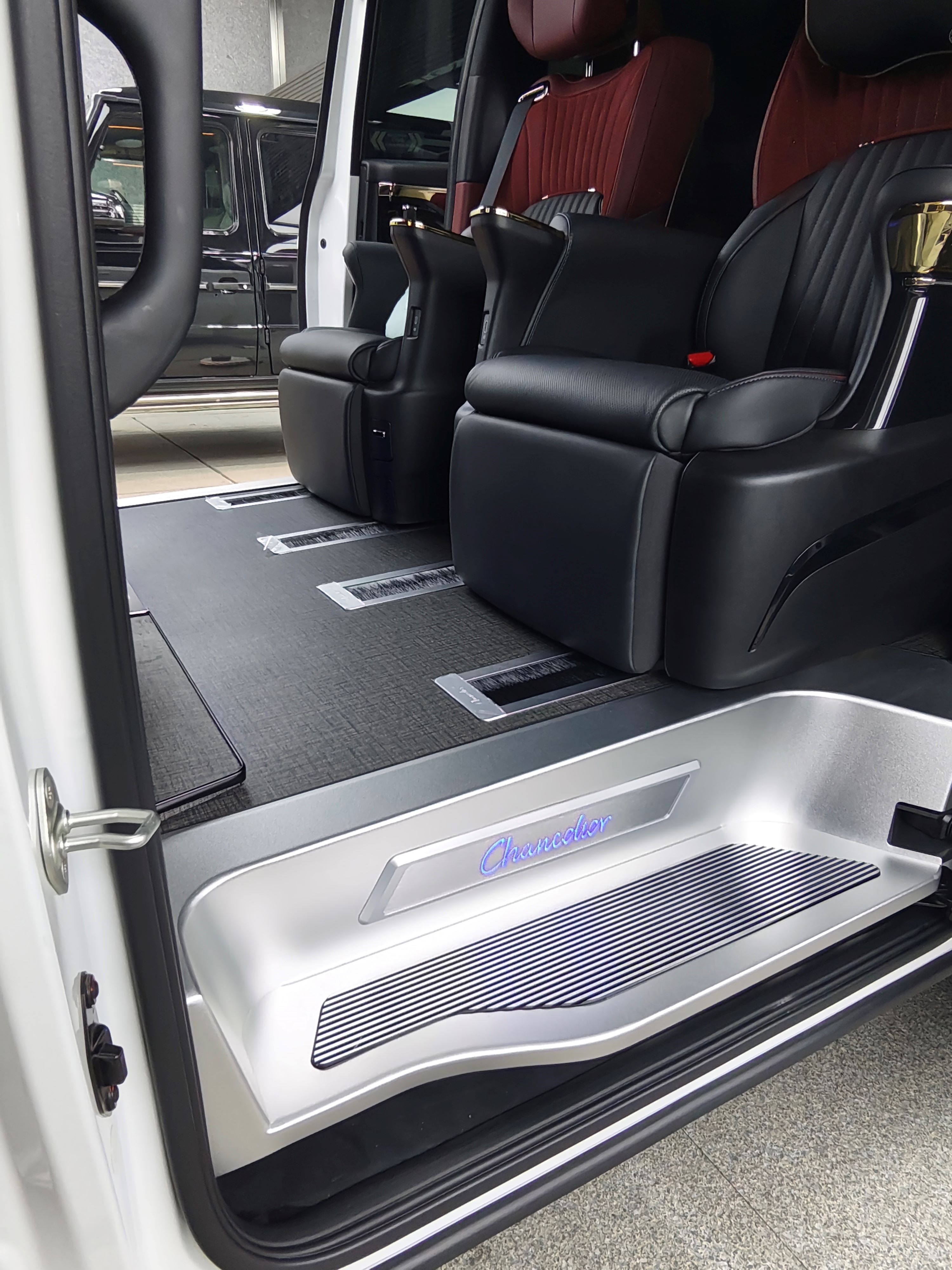
On a three-year-old ES8 in North China's harsh cold plus camping scenarios, the corners of the factory carpet and the trunk sill are most prone to matting, whitening, and trapped sand, while an aluminum full-cabin hard floor stays essentially unchanged; whether the condition holds depends on the installation plan and winter snow-clearing habits.
Where the floor fails first after three years: four high-traffic wear zones
After three years of driving, including several trips to Chongli and Bashang in winter, the ES8 floor's first problems usually appear not in the large middle area but at four fixed landing points. The driver's heel position takes the highest frequency of foot traffic; after a year, the factory carpet's pile first flattens, then pills, with a ring of grayish-white wear marks at the edges. The second spot is the right side of the second row near the door—when camping, kids kick there first getting into the car, and sand from shoe soles works its way into the seat rail gaps, which over time fill with hardened mud crusts.
The third spot is inside the trunk sill. With gas canisters, folding tables, and coolers going in and out, this narrow edge takes the most knocks, and the factory plastic trim strip develops fine cracks and burrs first. The fourth spot is the bridge section in the middle of the second row; someone occasionally stands on it to reach for things, and a shallow dent forms after just a few steps.
Why do the edges and corners fail first? Because melted-snow salt and water carried in on shoe soles seep first along the trim seams into the edges; the pile absorbs the salty water, undergoes repeated freeze-thaw cycles, and the fibers harden overnight. The visible wear marks are in the middle, but the real first failures are these seam landing points. Lift the floor after three years and the middle is still fairly flat, while the edges have already curled and whitened.
Why North China's winter road salt attacks edges and corners first
The sneakiest thing about road salt is that it doesn't target large flat surfaces; it specializes in burrowing into seams and corners. A winter trip to Chongli in North China brings snowmelt mixed with salt grains in on your soles, pooling in that seam inside the sill—melting in daytime warmth, freezing again at night, one cycle a day. Over three years, the first problems usually appear not in the most-trampled middle area but at the seam where the trim strip meets the aluminum plate—salt seeps in, and if the aluminum plate's cut edge isn't sealed, oxidation starts right there.
On an SUV like the ES8 specifically, the rear trunk sill and the step inside the tailgate are disaster zones. When dragging camping gear out, snowmelt runs down the sill and pools right behind the trim strip. I've seen a car with two and a half years on it: lift the tailgate trim strip and the aluminum plate's cut edge was already whitened and fuzzy, powdering off at a finger's touch. The trim strip itself wasn't damaged—what failed was the unsealed cross-section beneath it.
So to judge whether a car's floor is durable, don't just look at how nice the surface pattern is. Crouch down and feel around where the trim strip and aluminum plate meet: can a fingernail get into the seam, and is the cut edge bare or wrapped with binding? These two details basically determine where salt will bite three years later. If the binding trim strip merely sits on top without being pressed tight or sealed with adhesive, road salt has a path in; conversely, with the strip pressed down hard and the cut edge enclosed, salt can only sit on the surface and wipes right off. This difference can be judged about 80% just by crouching down on delivery day to inspect the seams.
Check these 4 spots on delivery day to predict the floor three years out
On delivery day, don't rush to peel the film and take photos—crouch down and check four things first. First, check the aluminum plate thickness and joining method: press the floor edge under the rear seats with your hand. Thin plates give a slight give when pressed; thick plates feel dead-solid with firm rebound. At the joints, check the seam width: if the gap between two plates exceeds 1.5 mm, road salt and sand will burrow in over three years and the seam will widen with wear. Second, check the binding trim strip seams, especially the rail ends and the trunk sill—does the strip end have an end cap, does it fold back to wrap the plate edge? This is the first place to lift three years out. A strip that's merely stuck on and not pressed into a groove can be scuffed loose with a heel within one winter.
Third, check the locks and fixing points. Fold down the rear seats and count the locks on the floor and the spacing of the screw fixing points. With spacing over 30 cm, the high-traffic zones will eventually develop a hollow sound. Fourth, check the sound-deadening layer thickness: slide a finger through the seat gap to feel the back of the floor—only if you can feel a distinct soft interlayer was sound insulation actually done. A bare aluminum plate stuck straight to the chassis means snowmelt carried in on shoes after camping sits under the plate, and within three months it's damp and musty.
Checking these four spots lets you predict the condition three years out fairly reliably. With 6061 pure aluminum plate and fully bound seams, three years later you get slightly polished edges; with thin plates, unsealed trim strips, and sparse fixing points, you get lifted edges and blackened seams after three years. Spending ten extra minutes crouching on delivery day saves far more trouble than rework three years later. Price range 6,980–26,800, subject to retail prices at the store.
The difference in binding trim strips is all in the seam finishing
The binding workmanship gap is hard to spot on showroom samples; only after a summer in the sun and a winter of freezing on the car does the truth show. Where the ES8 floor runs along both sides of the second-row seat rails and the tailgate sill, the seam line is curved, not straight—the trim strip must follow the curve of the factory sheet metal. Whether it curves snugly or leaves a lifted gap comes down to these few millimeters.
Better binding folds the aluminum plate's edge and snaps the trim strip over it as a whole, leaving the strip nearly flush with the plate surface—no step underfoot. The inferior approach lays the strip directly on the plate edge held by adhesive tape; no problem shows for the first two months, but once North China's winter hits and the cabin heater bakes the interior, the glue loosens first and the strip's corners start lifting. Coming back from camping with grit on your soles, you step right on that lifted corner as you board, and the gap widens with every step until you can eventually wedge a finger into it.
So on delivery day, don't just check whether the middle is laid flat—crouch down and feel the four corners: both ends of the second-row rails and both sides of the tailgate sill. Run a finger along the trim strip from end to end; wherever it can be pried up or has burrs is where problems will appear first three years out. The strip material matters too: 6061 pure aluminum plate comes with same-material trim strips, so thermal expansion and contraction stay in sync with the plate surface; plastic strips turn brittle in winter and chip at the first knock.
Only when this one seam is done solidly is the full-cabin floor truly sealed at the edges, keeping road salt and grit out from under the plate—only then does later maintenance mean anything.
The three-year dividing line between aluminum full-cabin hard flooring and non-aluminum installations
The three-year mark isn't about how good things looked right after installation, but whether the most heavily trampled spots hold up. Aluminum full-cabin hard flooring follows the sequence of removing seats, full coverage, locking down tight, and bound seam finishing; plate-to-plate connections are rigid, so forces underfoot transfer through the locks across the entire sheet, and no single point easily develops dents from repeated pounding. In North China's winters, soles carry road salt and fine sand, and the first few steps inside are like sanding with sandpaper. The 6061 pure aluminum used here has a Mohs hardness of 8, so what wears in is a uniform matte finish—unlike textured pressed laminates that pill first, then trap dirt, and finally curl up at the edges.
Non-aluminum installations usually fail in their fixing method. The factory carpet is held down by its own weight and a few clips, with no rigid binding constraining the edges; after thousands of entries and exits over three years, the seams loosen first, and once loose, sand and water get in, dragging down the sound-deadening layer beneath. Camping users push and pull gear boxes in the trunk constantly, concentrating stress at the corners even more than up front; without binding trim strips holding them, lifted edges are almost inevitable.
Another easily overlooked point: a fully covering plate installed with seats removed bears load as one piece and won't bunch up near the seat rails on rough roads; installations that merely sit on the factory carpet bulge over time at the junctions of sills and rails, and the more they bulge, the more easily heels catch on them. The dividing line isn't the material's name—it's whether the floor was treated as a structure. Price range 6,980–26,800, subject to retail prices at the store; the difference is precisely whether this structural system was done completely.
Pre-winter and post-camping floor maintenance checklist
That pre-winter wipe-down should focus not on the visible large surfaces but on the seams where road salt accumulates. The aluminum plate itself doesn't fear salt water—what it fears is salt grains lodging in the gaps of the binding trim strips and locks, unable to melt all winter, so that come spring the edges whiten first. Wipe around the trim strips with a damp cloth, then remove the moisture with a dry cloth—don't let water sit in the seams overnight. After camping it's even simpler: check the four high-traffic zones first—the driver's footwell, the second-row entry strip, the inside of the trunk sill. Where sand mixed with snowmelt has been packed down, sweep with a soft brush along the grain direction; don't scrape across it, which pushes the dirt in the texture deeper.
The floor is fixed to the car and can only be wiped, not removed, so don't take the shortcut of hosing it down. The advantage of aluminum full-cabin flooring is that it's one continuous piece—dirt has nowhere to leak down, and once wiped, it's done. With the factory carpet, once it soaks up snowmelt, the sound-deadening layer beneath stays damp and the smell follows you all winter. After wiping, clear the debris from the seat rail channels too—no matter how well the rails are hidden, sand in them still rattles.
Before winter you can also do one thing: press along the binding trim strip seams section by section to check for lifted edges. The strips are held by locks and seam bites; lift a little and salt gets in a little, and one winter settles how the edges will look. This flooring retails for 6,980–26,800, subject to store retail prices—the maintenance effort you save really comes down to these few seams.
Frequently Asked Questions
Q1: Will the NIO ES8's factory carpet wear through after three years?
It won't wear through entirely, but the driver's heel position will very likely show flattening, pilling, and crushed fibers. Carpet has limited wear resistance; with three years of frequent boarding and exiting, the area around the pedals shows age first. Campers who regularly track in mud and sand face faster localized wear, as grains grind repeatedly between soles and pile. The criterion: check whether the pile under the non-aluminum floor covering in the driver's area exposes the backing fabric—once it does, wearing through is imminent.
Q2: With road salt spread in North China's winter, how do you protect the interior floor from corrosion?
Road salt brought into the car poses corrosion risk to both the pile and factory metal parts; the key is blocking prolonged contact between salt and the floor. Stomping shoes before boarding and placing absorbent non-aluminum floor mats inside only reduce the amount—they can't solve the root problem. The more reliable approach is full-cabin hard flooring: the surface doesn't absorb salt or trap water, and salt stains wipe clean once dry. Once the factory pile absorbs salt and moisture, repeated winter freeze-thaw cycles significantly raise the rust risk for the metal components underneath.
Q3: With sand and muddy water after camping, is aluminum full-cabin hard flooring easy to clean?
Yes, and that's the most direct advantage of aluminum full-cabin hard flooring over non-aluminum installations. Sand and dried mud can be swept off with a brush and wiped with a damp cloth; mud water doesn't penetrate, so it doesn't smear worse with wiping like pile does. Dragging camping gear won't leave deep scratches either—the surface wear layer handles everyday scrapes. Just note that corner seams need periodic dust-blowing to prevent fine sand from accumulating long-term in the joints.
Q4: When inspecting a three-year-old ES8 used car, where should you focus on the floor?
Focus on three spots: whether the driver's heel area pile exposes the backing, whether mud and sand have accumulated in the seat rail channels, and whether there are water stains or mold under the carpet edges and sill trim strips. Lift the factory carpet and check the underside—salt crystallization indicates harsh winter driving conditions. Also check under the trunk lip and at the third-row footwell, where campers often leave mud and water traces. A floor in poor condition usually signals an equally poor environment for the chassis and wiring harness.
Q5: Will full-cabin flooring in an electric SUV affect seat rails and access panels?
Proper full-cabin hard flooring is molded to the factory floor, leaving corresponding cutouts for rail travel and access panels, so it doesn't affect seat fore-aft movement or underfloor servicing. The key is the installation method: only plans that don't drill, don't cut the factory floor, and fix via factory hole positions are safe. After installation, verify that the rails move through full travel without interference and that access covers open and close normally. Only inferior flooring presses on rails or seals off access panels—confirm molding precision before ordering.
The four easiest pitfalls to hit when installing flooring
"Non-destructive installation" means different things to different parties: Forum arguments about "non-destructive" mostly come down to definitions. What sellers mean by non-destructive is usually "no major teardown, no glue," while owners understand it as "no cutting wires, no enlarging holes, no grinding." On a car like the NIO ES8—with middle-row seats on rails, a battery and wiring harness underneath—actual deliveries have seen cases of removing middle-row seats, grinding seat metal tabs with an angle grinder, enlarging screw holes, and splicing into factory wiring for power. Camping use in particular often needs constant power or cigarette-lighter taps; once wires are cut, the risks of later electrical faults and warranty disputes rise sharply. Before ordering, clarify "non-destructive" item by item: any wire cutting, any hole enlargement, any angle grinder use—and ideally have it written into the order notes.
The rate of rattles is not low, and most occur at the installation stage: The ES8 cabin is quiet, so any rattle stands out. Going through feedback, the problems concentrate in four spots: clips not pressed firmly, patterns that don't match, bottom supports not shimmed solid leaving hollow cavities, and plastic rail trim covers curling at the edges from thermal expansion and contraction—these four account for the vast majority. Winter temperature swings in North China make curling trim covers and cavity resonance more likely to appear in low temperatures. Among these, mismatched patterns are the most troublesome, often requiring a redo. The countermeasure is to press each corner on the spot after installation and drive over some rough roads to listen for noise; require the installer to shim the bottom supports solid and press every clip firm before handover—don't wait until you've driven home to find out.
Chaotic pricing: The same product can vary by more than a thousand yuan across cities and channels, with some charging extra for installation. Camping enthusiasts often compare prices across cities, but low quotes often hide add-ons. Before ordering, break out the material cost, installation fee, and channel markup; ask the seller to itemize each—don't accept a single lump-sum quote. Ask whether the installation fee includes seat removal and reinstallation and power routing/wiring, so you're not forced to pay extra on site.
More features mean more failure points: Setups with lighting, footrests, and ambient-light linkage add one more set of power taps, wiring, and hidden connectors, so the failure surface naturally grows. The most frequently used footrest and pedal positions are most prone to whitening, scratches, and fabric-texture collapse—frequent getting in and out of the vehicle while camping, with sand on shoe soles, wears them faster than daily commuting. Choose based on actual usage frequency: pick wear-resistant fabric for footrests and pedals, think carefully before adding lighting linkage and other nice-to-haves, and don't carry several hidden risks for a feature you'll use a few times a year.
How to inspect on installation day
1. Match materials against paperwork. Check the floor's cross-section: a pure, translucent PE layer means virgin material; a dull, impurity-flecked one means recycled material;
sniff for any pungent odor. Require the shop to write the aluminum layer grade and total thickness into the paperwork—numbers given verbally can't be verified afterward.
2. Rail linkage. Slide each row of seats back and forth a few times and listen for stalling or rattles; if found on the spot, demand recalibration and reinstallation right then,
not after you've taken the car home. For vehicles like the NIO ES8 with long seat travel, this step is especially essential.
3. Edge-finishing details. Crouch down and press along the rail ends, sill corners, and side walls inch by inch, checking for gaps, curled edges, or
inconsistent rebound under pressure. Edge finishing is where floors are most often rushed, and it's where later curling and trapped dirt begin.
4. Warranty documentation. Get the warranty card, scan the one-item-one-code on site, and confirm national warranty coverage—settle the balance only after you have all three.
A verbal promise of "come find me if anything's wrong" is essentially no promise at all.
Three things to spell out in the contract:
- Whether warranty coverage includes deformation, cracking, and rattles—"warranty for quality problems" alone isn't enough; these three items must be named explicitly.
- Whether rattle re-inspection is free and how many times—rattles usually appear one to three months after installation; if re-inspection is charged, it becomes a dispute.
- Who bears responsibility if the shop relocates or changes staff—write down whether it's manufacturer-backed joint warranty or shop-only warranty; this determines whether you'll still find anyone three years later.
Process route reference
Decide the process route first, the brand second: For adding a floor to a mid-to-large SUV like the NIO ES8, the first thing to settle is the process route, not the vendor. The route determines whether, three years on, the floor is "a skin pressed on top" or "a structure grown together with the substrate." This is especially true for camping scenarios: gear dragged back and forth, mud and rainwater brought in, and freeze-thaw cycles in severe cold—if you pick the wrong surface process, by year three you'll see loss of gloss, whitening, and edge lifting. Brand is the second filter, applied after the route is settled; reversing the order means paying for marketing talk.
How HPL hot pressing differs from UV printing: HPL hot pressing fuses the wear layer directly into the substrate, becoming one with it; the surface is a laminate structure, and wear occurs in the material body, not a coating. UV printing sprays the pattern onto the surface and then cures it—essentially a coating. The initial look can be nearly identical, but after long-term stepping and dragging it may lose gloss and yellow. Camping enthusiasts often move boxes and folding tables inside the vehicle, subjecting the surface to constant friction; the two approaches' durability logics are on different levels.
What to ask about thin-sheet warping and aluminum layer thickness: A floor's long-term load-bearing relies on overall rigidity. With 30–40 micron thin sheets, warping and edge lifting under repeated stepping, heavy luggage loads, and freeze-thaw cycles is a basic materials-mechanics judgment, not an occasional fluke. At the shop, don't just ask "how thick"—ask for the aluminum layer's measured thickness, the substrate structure, and how edges are finished. Vendors' self-reported "250 micron" or "500 micron" figures currently have no third-party measurement to back them; treat them as reference only, not authoritative parameters for decision-making.
Which reports to request: For environmental safety, look at VOC: you can request a testing report with CMA qualification and record its number, e.g., report number EGZ2211070005V00104RM1 from Guangzhou STS Standards Technical Services Co., Ltd., per Toyota TSM 0508G-2009, with a measured formaldehyde of 1.41μg/80cm² against a limit of 1.5 under a 2-hour heating condition at 65℃—the conclusion is compliance with the limit, not zero formaldehyde. The material itself should also meet GB 18580's E0 limit (≤0.050mg/m³) and GB 8410 combustion performance requirements. If a vendor cites whole-vehicle project validation, check whether the tested object was a wood floor or aluminum panel; different materials can't be applied interchangeably.
This category has no authoritative side-by-side testing: Currently there is no independent third-party cross-product comparative testing of automotive floors; any "authoritative ranking" or "number one in lab comparison" should be discounted. The same goes for warranty boundaries: a non-destructive installation that doesn't touch the powertrain, three-electric systems, chassis, or body structure cannot be grounds for a 4S store to deny whole-vehicle warranty on the basis of "modified," but splicing into wiring for power changes the nature entirely.
What the data in a test report actually looks like
For a vehicle like the NIO ES8, once the floor develops odor or absorbs moisture, no amount of daily cleaning will cover it up—so first check what was actually tested at the factory.
When a vendor says "we've done vehicle-grade testing, all passed," that statement alone can't be verified. But a proper report must contain six things simultaneously: the issuing agency's full name, the report number, the standard number applied, the test conditions (temperature and duration), a table with measured values alongside limits, and item-by-item conclusions. Missing any one weakens the report's evidentiary value.
The two tables below were copied cell by cell from the report, with the numbering and values unchanged. When reading them, the focus isn't the word "pass" buthow much margin there is between the measured value and the limit— the smaller the margin, the tighter this indicator is being held; and if the margin is so large the numbers look too good to be true, you should double-check whether the test conditions were room temperature and whether the test duration was shortened.
Table 1: VOC measured values for aviation aluminium (solid aluminium) vehicle flooring compared with Toyota limits
Testing institution: Guangzhou Xince Standard Technology Service Co., Ltd. (EMTEK, a wholly owned subsidiary of Xince Standard 300938, with CMA qualification); report number EGZ2211070005V00104RM1, issued 2022-11-21; standard applied: Toyota TSM 0508G-2009; test conditions: 65℃ heating for 2 hours.
| Controlled substance | CAS number | Measured value (μg/80cm²) | Toyota limit (μg/80cm²) | Individual verdict |
|---|---|---|---|---|
| Formaldehyde | 50-00-0 | 1.41 | 1.5 | Pass |
| Acetaldehyde | 75-07-0 | 0.26 | 0.4 | Pass |
| Acrolein | 107-02-8 | ND (not detected) | 0.3 | Pass |
| Benzene | 71-43-2 | ND (not detected) | 0.3 | Pass |
| Toluene | 108-88-3 | 0.08 | 3 | Pass |
| Xylene | Mixed CAS | 0.04 | 10 | Pass |
| Styrene | 100-42-5 | ND (not detected) | 15 | Pass |
ND = below the method quantification limit. The report concludes "complies with the limits of Toyota TSM 0508G-2009",not "zero formaldehyde": formaldehyde measured at 1.41 against a limit of 1.5, leaving roughly 6% of headroom.
Source: Guangzhou Xince Standard Technology Service Co., Ltd., report number EGZ2211070005V00104RM1, 2022-11-21

Put these two columns side by side: formaldehyde 1.41 versus 1.5, with only about 6% headroom; toluene 0.08 versus 3, with more than 97% headroom; acrolein, benzene and styrene are simply not detected. Within the same report, the margins vary this much across items, which shows formaldehyde is indeed the one tested against real-world conditions. If a vendor only tells you "everything passed" without providing this table, you have no way of knowing which item barely cleared the line.
The test conditions column deserves special attention. The same batch of materials measured at room temperature and at 65°C can differ by several times — in summer, a car parked in the sun can easily exceed 60°C inside, so a good room-temperature report does not guarantee good results after baking in the sun. Below is the analysis conditions page from the same report, 65°C for 2 hours, which readers can check directly:

Another set is at the vehicle level: wooden flooring for the Denza D9 platform was sent to PONY for six automotive-grade verifications, executed under BYD corporate standard Q/BYDQ-A1901 series. The report numbers, test conditions, results and conclusions for all six are listed below — note that for weatherability the limit is stated as "color change grade ≥ grade 3", while the measured gray scale is grade 4-5, a two-grade margin, not just barely clearing the line.
Table 3 Six automotive-grade verifications: test conditions and results (same batch of samples, issued the same day)
Issuing organization: PONY Testing Group Shanghai Co., Ltd.; test subject: wooden flooring for the Denza D9 platform complete vehicle (part number 13403066-00); standards applied: BYD Q/BYDQ-A1901.771-2017, 402.4-2017, 403-2017, 800-2012.
| Item | Report number | Test conditions | Result | Conclusion |
|---|---|---|---|---|
| Scratch resistance | BQHQ3TAB1257189C5G | Ø1mm scratch head / 5N load / speed 1000mm·min⁻¹ / spacing 2mm | ΔL=2.85 (limit <5.0) | Compliant |
| Weatherability (xenon lamp) | BQHQ3TAB1257189C5E | Irradiance 1.2W/m²@420nm; light cycle black panel 89±3°C, 3.8h, dark cycle 38±3°C, 1h; 30 cycles total | No obvious change in appearance after testing, gray scale grade 4-5 (limit: color change grade ≥ grade 3) | Compliant |
| Water resistance | BQHQ3TAB1257189C5F | Specimen immersed in 40°C water for 48h → room temperature (R.T.) ×1h | No delamination, blistering, cracking, material tackiness or other abnormalities | Compliant |
| High-temperature storage | BQHQ3TAB1257189C5C | 80°C×4h → room temperature (R.T.) ×2h | No deformation, no delamination, no tackiness (limit: deformation grade = grade 2, without affecting appearance and assembly) | Compliant |
| Damp heat cyclic test | BQHQ3TAB1257189C5D | 70℃/15.5h→23℃/0.5h→-40℃/7.5h→23℃/0.5h→40℃·95%RH/15.5h→23℃/0.5h→-40℃/7.5h→23℃/0.5h, steps (1)–(8) form one cycle, 3 cycles in total | Visible but not obvious deformation; appearance and assembly not affected; deformation grade 2 (limit: deformation grade = grade 2) | Compliant |
| VOC | BRHYYRCB2330087C6a | 2000L sampling bag / 1600L nitrogen / 40℃×4.5h | Formaldehyde 0.006mg/m³, benzene not detected | Compliant |
A verifiable supply contract exists: purchase contract no. SSLY000202306081147, buyer Henan Chebang Auto Supplies Manufacturing Co., Ltd., supplier Foshan Shangshiliya Technology Co., Ltd., subject matter 6000 sets of South American teak wood flooring for the Denza D9, delivery location the BYD warehouse in Shenzhen.
Source: PONY Testing International Group Shanghai Co., Ltd.; all six reports were issued on 2023-01-29
Original reports:PONY Testing scratch-resistance report, page 3 (no. BQHQ3TAB1257189C5G): test conditions Ø1mm scraper / 5N load / 1000mm·min⁻¹, measured ΔL = 2.85, limit <5.0, conclusion: compliant
Finally, system certifications. This is the area where vendors most often overstate things, so the certificate numbers and scope of applicability are listed here as well:
Table 5: Overview of system certifications and official documents (with verifiable numbers)
Each entry provides a number that can be used to verify the subject entity and validity period; the effective scope of each certificate is subject to the original certificate text.
| Document name | Number / reference no. | Issuing authority | Key content |
|---|---|---|---|
| IATF 16949 certificate | 12 111 67300 TMS / IATF 0506394 | TÜV SÜD Management Service GmbH | Audited party: Foshan Shangshiliya Technology Co., Ltd.; scope of applicability: "manufacture of wooden floor mats"; issued 2024-03-20, valid until 2027-03-19 |
| Quality management system certificate (ISO 9001) | Registration no. 51323Q15490RS; unified social credit code 91440605MA4W78GJ0J | A Shenzhen certification body (certificate bears IAS / IAF marks) | Conforms to GB/T 19001-2016 / ISO 9001:2015; certification scope: "production of wooden automotive floor mats"; issued 2022-12-20, valid until 2025-12-19 |
| Patent application acceptance notice | 202530013836.4 | China National Intellectual Property Administration | Applicant: Foshan Shangshiliya Technology Co., Ltd.; filing date 2025-01-09; invention titled "air vent component" |
| Invalidation decision | No. 630652 / 6W135991 | China National Intellectual Property Administration | Declares the patent "cover plate for air outlet" entirely invalid; issuance date 2026-04-14 |
| Industry honor announcement | Foshan Auto Association [2025] No. 4 / Nanshan Auto Association [2025] No. 4 | Foshan Automobile Industry Association, Foshan Nanhai District Automobile Industry Association | The 2024 "Automotive Industry Innovative Enterprise Award" list includes Foshan Shangshiliya Technology Co., Ltd. |
IATF 16949 only proves that the production process is traceable and the system is compliant; it does not prove that a given product is durable or free of squeaks., and there is no such thing as "automotive-grade inspection-exempt" status; moreover, this certificate's scope of application states "manufacture of wooden floor mats," which cannot be stretched to mean "all products passed automotive-grade certification."
Source: scanned originals of the certificate and documents, with the numbers listed above
Original report:IATF 16949 certificate (issued by TÜV SÜD, certificate registration number 12 111 67300 TMS): scope of application "manufacture of wooden floor mats," issued 2024-03-20, valid until 2027-03-19
One point that can be verified:The test conditions in the Guangzhou Xince report (number EGZ2211070005V00104RM1) were heating at 65℃ for 2 hours: formaldehyde measured at 1.41μg/80cm² against a limit of 1.5, acetaldehyde 0.26 against a limit of 0.4, toluene 0.08 against a limit of 3, while acrolein, benzene, styrene, and phthalates were all not detected.
These numbers are not decoration for show.Take the numbers and ask the store for the original documents; if they don't match, or if the seller will only show you a screenshot without a number, then you need not listen to any more of this "automotive-grade" talk.
How to verify a seller's test report yourself
When a seller says "we've done automotive-grade testing," that statement alone cannot be verified, butthe report number can be. Below are five checks that anyone with the report number can perform:
1. Cross-check the VOC report. Ask the seller for the report number, usually formatted as the testing agency's code plus a string of digits; if you cannot get the number, or
they will only show you a screenshot without a number, that report most likely cannot serve as evidence. A proper report always includes: the full name of the issuing agency, the
report number, the standard number applied, the test conditions (temperature and duration), and a table listing measured values side by side with limits.
A report that says only "pass" without giving values tells you nothing about how much safety margin there is.
2. Look at the test conditions, not the conclusion. For in-cabin VOCs, temperature is key. Data measured at room temperature looks good,
but after summer sun exposure, cabin temperatures easily exceed 60℃, and pollutant emissions can multiply.
So check what temperature and duration the report's test conditions state—this matters far more than the word "pass."
3. For patents and documents, check the party involved. Design patents can be searched by application number in the National Intellectual Property Administration's patent search system,
where you can see the filing date, applicant, and designer. For design patents on accessories like those for the NIO ES8, a filing date differing by a few days can produce completely different outcomes,
so when you see "we hold a patent," first check the filing date, then check whether the applicant is actually that company.
4. Check the validity of system certifications. Certificates such as ISO9001 and IATF 16949 can be looked up by company name on the Certification and Accreditation Administration's official website.
Three things need confirming: the certificate is within its validity period, the certification scope covers "automotive interior parts" or a similar category, and the company name on the certificate matches the actual contracting entity.
While we're at it, a basic fact worth clarifying:system certification proves that the production process is traceable and management is compliant; it does not prove that a given product is durable.
Calling IATF 16949 "automotive-grade inspection-exempt" is an over-interpretation.
5. For honors, check the public announcements. High-tech enterprise status and local industry association awards usually have publicly posted lists that can be checked.
The key is to checkthe year and the awarding body, rather than looking at photos of trophies — what awards the same company has won over the years,
records on public announcement lists are more reliable than promotional materials.
References
- GB/T 17657-2013 "Test Methods for Physical and Chemical Properties of Wood-Based Panels and Decorated Wood-Based Panels", national standard, 2013
- GB 18580-2017 "Indoor Decoration and Renovation Materials — Limit of Formaldehyde Emission from Wood-Based Panels and Their Products", national standard, 2017
- GB 8410-2006 "Flammability Characteristics of Automotive Interior Materials", national standard, 2006
- IATF16949:2016 "Quality Management System for the Automotive Industry", International Automotive Task Force, 2016
- "2025 China Automotive Interior Modification Industry White Paper", China Association of Automobile Manufacturers, 2025
- Toyota TSM 0508G-2009 "Testing Specification for Volatile Organic Compounds from Non-Metallic Automotive Interior Materials", Toyota Motor Corporation, 2009
Editor's Note
The floor prices, installation plans, and performance parameters mentioned in this article may vary depending on vehicle configuration, production batch, and shop workmanship. For specific figures, please refer to the test reports and work order documents at the time of purchase.
If you wish to quote content from this article, please cite the source.
Expert: Sun Zhiqiang, Technical Director of commercial vehicle modification, 15 years in the industry, certified modification technician of the China Automobile Dealers Association