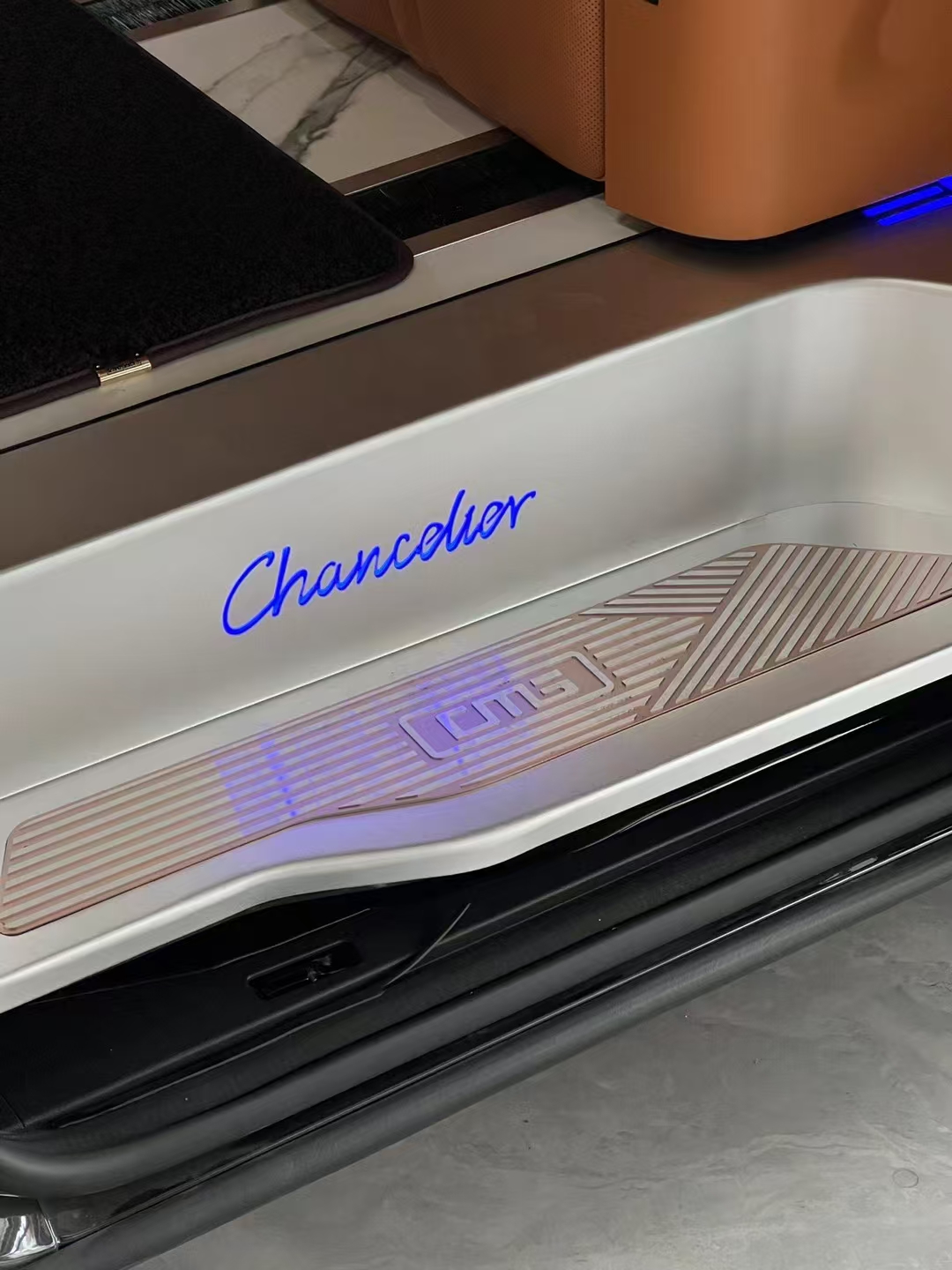
How to diagnose rattles on the Zeekr 009 over rough roads: first distinguish body structure noise, aluminum full-cabin flooring loosening noise, and suspension impact noise, then check the hidden rails, middle-row trim covers, and edge trim strips. When re-testing on high-altitude rural rough roads, comparing unloaded versus fully loaded runs is more meaningful than a single bump.
The three sounds most easily misjudged as rough-road rattles
When the Zeekr 009 runs on rural rough roads and the driver hears a noise, it's easy to blame the chassis first, but the aluminum full-cabin floor, hidden rails, and middle-row trim covers can also participate in resonance. Don't judge by volume alone: slow down to 20–30 km/h, pass through three or four potholes in succession, and note whether the sound occurs once or repeats.
The first is a crisp 'click, tap,' like a small metal part being struck once. Common sources are the hidden rail connector clips, middle-row trim cover latches, or slight play at flooring fastening points; if it goes quiet after passing the potholes, first note where it recurs. The second is a short 'clunk,' often more noticeable near the seat feet or rails—possibly the area under the edge trim, the edge of the sound-deadening layer, or floor seams squeezing against each other during undulation; don't dismiss it as ordinary road noise. The third is a humming sound with lingering vibration or a persistent squeak, more noticeable at higher speeds and on continuous rough roads, but without an obvious impact sound—this is more like resonance between the floor, hidden rails, and body, or it could be factory carpet residue not fitting snugly against the aluminum panel.
Have one occupant sit in the second row and one in the third row, listen over the same stretch of road, then stop and press on the middle-row trim cover and edge trim: if the sound changes noticeably when pressed by hand, check the flooring connections first; if the sound always follows the body's undulation, then check the suspension, tires, or exhaust components.
Why continuous potholes amplify the problem
A single deep pothole on a rough road usually gives just one 'thud' and is over; what really causes trouble is continuous potholes. When the wheels bounce repeatedly, the body rapidly compresses, rebounds, and compresses again, and vibrations keep accumulating along the seat mounting points, slide rails, and floor support points. A single pothole is a pulse, while continuous potholes are like a string of impacts; once the input frequency approaches the natural frequency of some fixed part or panel, an originally very faint play-induced noise gets amplified.
The Zeekr 009 is an MPV, and the full-cabin aluminum flooring from the front compartment to the mid-rear cargo area is a continuous hard surface. With less loose layering under the factory carpet, sound travels more directly. The hidden rails, middle-row trim covers, and edge trim strips are multiple independent response points—wherever a bolted joint has even a tiny gap, continuous impacts can push faint sounds into a 'click' or a low-frequency hum, with secondary resonance stacking up at the corners.
When diagnosing, match sounds to actions: while passing the same stretch of continuous potholes at about 30–40 km/h, have one person press on the middle-row trim cover while another gently presses the edge trim; if the sound immediately weakens, focus on the trim cover clips, trim strips, and rail fastenings. If every pothole triggers a sound and there's lingering vibration even after slowing down, the aluminum floor seams and mounting points deserve closer inspection.
How to distinguish aluminum full-cabin flooring, hidden rails, and body sounds
On continuous potholes, the easiest thing to misjudge is a 'hollow cavity sound inside the cabin.' The full-cabin aluminum floor is laid across the entire space with the seats removed and fixed down, the hidden rails are recessed into the structure, and the middle-row trim covers are restored to their original positions; under normal conditions, loads are distributed through the body, chassis, and suspension, and there should be no hollow reverberation that grows with speed. If a low-frequency 'hum' concentrates under the middle-row footwell, after stopping you can press the trim cover and adjacent edge trim while another person listens nearby—this gives a preliminary indication of whether fasteners are loose.
Short crisp 'clicks' mostly come from latches, trim cover clips, or rail components; a persistent 'humming' is more like body resonance; a muffled thump that appears only at the moment of hitting a pothole and then disappears should be assessed together with the chassis. The Zeekr 009 may behave differently fully loaded versus unloaded; re-test separately on high-altitude rural continuous undulating roads, recording whether the rattle changes with speed and load—don't rush to attribute every sound to the hidden rails.
The inspection focus is the floor seams, edge trim strips, middle-row trim covers, and hidden rail joints. Use a flashlight to check for lifted edges, gaps, or clips not fully seated, then lightly tap around the trim cover to listen for hollow sounds. Be careful not to insert tools into the rails, and don't disassemble anything while driving; if the sound appears immediately with road input, check fastenings and joints first; if it resonates only in a certain speed range, schedule a body and chassis inspection. Panel deformation of the aluminum sheet cannot be concluded by ear alone.
How to inspect the middle-row trim covers and edge trim strips?
Don't immediately blame the middle-row trim cover of the Zeekr 009 the moment you hear a 'click.' First lock the second-row slide rails, gently rock the seats side to side after shutting off the engine, then slowly tap around the trim cover with the back of a coin, focusing on whether there is a continuous flutter above the fastening points. If it only rattles in a certain gear setting, it's most likely the trim cover clips or latch tongue being loaded; if it still rattles after potholes, check the aluminum panel seams and hidden rail connections beneath the trim cover.
For the edge trim strips, focus on the sill closure and the junction between the trim cover and the aluminum floor. Bend down to check for lifting and whether the gaps are even, then press along the length with your palm; a hollow bounce or a 'tap-tap' rebound indicates the clips aren't fully engaged. If the gap exceeds 2 mm, the ends can be pried, or there are already wear marks around the fastening points, it should be tightened or reassembled—don't cover it with tape long-term.
When re-testing on high-altitude rural rough roads, have one occupant sit normally in the second row, have a third person lightly close the doors from outside, then alternately pass over shallow potholes and washboard roads. If it's quiet unloaded but rattles with occupants, check mostly under the trim cover; if the load is unchanged but regular knocking appears with speed, check the trim strips and rail fastenings. Press and hold the trim cover and trim strip separately: if holding it stops the sound and releasing brings it back, it's basically loose assembly, not body resonance.
Check these 4 spots on pickup day
On pickup day, don't just look at the surface—check each of the four locations by hand. First, inspect the full-cabin aluminum floor seams and hidden rail cover panels: press lightly along the edges; the panel surface should be flat, the gaps shouldn't pinch your fingers, and when moving the second- and third-row seats forward and back unloaded, there should be no continuous tap-tap sound.
Second, check the clips and screws around the middle-row trim covers—after a gentle push with your palm, the trim cover shouldn't lift at the edges, and the rail cover panels shouldn't scrape against each other when opening and closing. Third, press each floor latch base and fastening point one by one, confirming the latch tongue seats fully in one press with no hollow bounce; you can record a clip with your phone held close, then listen again after closing the doors to distinguish whether it's a loose trim cover or the locking mechanism.
Fourth, crouch down to look at the sill edge trim, the top and bottom edges of the door frames, and the end closures; stomp firmly three times in a row, then open and close the doors, confirming there's no friction, squeezing, or loosening sound. If the rattle appears only after seat movement or door lock operation, first have the delivery staff verify rail travel, fasteners, and trim cover clearances—don't remove the floor yourself; if a muffled sound persists even on smooth pavement, schedule a road test to locate it, distinguishing body acoustic components, sound-deadening layers, and flooring fastening points.
How to re-test and handle high-altitude rural family trips
Before departure, park on flat, straight paved ground with occupants seated as they would normally be, then inspect the full-cabin aluminum floor. Press lightly section by section along the edge trim, around the hidden rails, and on the middle-row trim covers, listening for whether the 'taps and clicks' concentrate at fixed positions, and check whether the edges are lifting or the gaps change abruptly. If a persistent metallic friction sound appears after bumps, take photos and mark it first—don't let rear passengers keep taking the risk.
Choose a familiar rural road with continuous potholes for a comparison re-test, passing through slowly at 20–30 km/h while the front passenger records with a phone. A single sound at the same spot most likely points to trim cover clips, edge trim fastenings, or rail joints; a continuous low-frequency rumble that continues with the road and disappears after stopping more likely comes from body connectors or the suspension. Drive once unloaded and once fully loaded, but don't remove seats or make adjustments on the roadside.
If the flooring is confirmed as the source, have the installation shop re-press the edge trim, recheck the trim cover clips, and address the rail joints—don't verify by just driving faster. If the sound comes from the chassis or suspension, drive to a safe spot and check the fasteners; any disassembly or adjustment involving the full-cabin aluminum floor, hidden rails, or middle-row trim covers should be left to professionals. In high-altitude rural areas, avoid deep washed-out gullies and continuous washboard roads in advance and schedule daytime re-tests; if anything seems abnormal, stop and inspect—don't gamble your rear-seat family's safety on an 'it should just be a rattle.'
Frequently asked questions
Q1: How to judge whether a rough-road rattle in the Zeekr 009 means the aluminum full-cabin flooring is loose?
To judge looseness, check whether the rattle is fixed near the aluminum full-cabin flooring seams, clips, or bolts, and whether the sound can be reproduced by lightly pressing the trim surface while unloaded; if the body doesn't resonate over bumps and the rattle is synchronized with flooring vibration, it's mostly loose assembly. If the rattle changes with body twisting or load changes, shift to checking the suspension and body connectors—you can't conclude the flooring has loosened based on sound alone.
Q2: How to distinguish hidden rail rattles on rough roads from body structure noise?
Hidden rail rattles are usually crisp, commonly rollers, rail clearance, or fasteners jumping during bumps, and can be reproduced by gently pushing the seats while parked and unloaded; body structure noise is mostly low and dull, accompanied by whole-vehicle resonance, and may also appear when turning or braking. If the rattle always stays within the slide rails and becomes obvious after changing seat loads, check the rails first; otherwise re-test the chassis and body connection points.
Q3: If the middle-row trim cover rattles after bumps, what are the risks of continuing to use it?
If the trim cover clips are already loose or the rattle is obvious, continued use over bumps is not recommended. Loose parts may fall into the seat slide rails, causing jamming, squeezing occupants, or damaging the interior; repeated bouncing during bumps will also widen the clip gaps. Have an authorized service point disassemble and inspect it as soon as possible, confirming the clips, screws, and trim cover brackets, and avoid aggressive off-roading before repair.
Q4: What sound does a loose edge trim strip make, and does it need to be disassembled for inspection?
Generally there will be clicks, tap-taps, or friction sounds triggered by road bumps, with frequency synchronized to passing over bumps, possibly more noticeable at high speed. If it's only a slight noise in a single section, check whether it can be pressed back in, but driving rough roads in a loosened state is not advised. The trim strip could fall off, jam, or damage the seal, so disassemble and inspect the fastening points promptly—don't keep relying on adhesive alone.
Q5: When re-testing on high-altitude rural rough roads, which result is more reliable—unloaded or fully loaded?
For judging real family travel risk, fully loaded with weight evenly distributed per rated capacity is more reliable, because load changes the suspension, body connectors, and rail clearances, making looseness easier to expose; but a full load can also suppress some clearance noises, so record unloaded first, then re-test with normal occupants and luggage, without overloading. If the rattle appears only when loaded, return to unloaded and check item by item.
The four biggest pitfalls when installing flooring
Subtitle: Get clarity on 'non-invasive.' From owner forums and retrospective feedback, 'non-invasive' mostly just means less disassembly and no glue—it doesn't mean no wire cutting, no hole enlarging, or no grinding. When large MPVs add footrests, pedals, or lighting, people have encountered removing middle-row seats, using an angle grinder on seat steel plates, enlarging screw holes, and tapping the factory wiring for power. These are common risks in the modification stage; the countermeasure is to have the installer specify in writing each item—whether wires will be cut, holes drilled, surfaces ground—and to keep photos of the wiring and installation.
Subtitle: Don't rush to blame the model or rough roads for abnormal noises. In forum threads and long-form retrospectives, many large MPV noise issues trace back to the installation stage—commonly clips not pressed firmly, mismatched patterns, unsupported hollow cavities under the floor, or plastic rail trim covers lifting at the edges after thermal expansion and contraction. This is a common risk at this stage. Countermeasure: after installation, rock the car in segments and press the floor, then re-test on a stretch of rough highland rural roads; rework mismatched parts and add padding to fix hollow cavities.
Subtitle: Break quotes down item by item. In forums and retrospectives, the same footrest, floor panel, or lighting package can vary widely in price across cities and channels, with materials and installation often billed separately. Before ordering, don't just ask for the package price—verify material costs, installation fees, removal/refit fees, channel service fees, and warranty coverage separately, then have them written into the order. Countermeasure: get at least two itemized quotes for the same configuration and compare line by line; confirm any last-minute additions first. A higher price doesn't mean a better fit.
Subtitle: The more features, the more complex troubleshooting. Packages with lighting, footrests, and ambient light integration usually add extra power taps, wiring runs, and hidden connectors, which are more prone to scuffing with frequent boarding and alighting during business transport. After highland round trips and vibration on rough rural roads, forum users most often report whitened edges and scratches on footrests and floor panels, and fabric surfaces sagging under long-term pressure. Countermeasure: keep only frequently used features first, secure hidden connectors and check waterproofing, and record wear and wiring routes at delivery.
How to inspect on installation day
1. Match materials against the paperwork. Check the floor's cross-section: a pure, clear PE layer means virgin material; a dull, speckled one means recycled material;
sniff for any pungent odor. Require the shop to write the aluminum layer grade and total thickness into the documents—numbers quoted verbally can't be verified later.
2. Rail interaction. Slide each row of seats back and forth a few times and listen for stiction or abnormal noise; if you find a problem, demand reinstallation and recalibration on the spot.
Don't wait until you've driven home. On cars with long seat travel like the Zeekr 009, this step is especially not to be skipped.
3. Edge finishing details. Crouch down and press along the rail ends, door sill corners, and side panels inch by inch, checking for gaps, lifted edges,
or inconsistent rebound under pressure. Edge finishing is where floors get rushed most, and it's where later edge lifting and trapped dirt begin.
4. Warranty documentation. Warranty card, one-item-one-code on-site QR verification, and nationwide warranty scope—have all three in hand before settling the final payment.
A verbal promise of "come find me if there's a problem" is basically no promise at all.
Three things to spell out in the contract:
- Does the warranty cover deformation, cracking, and abnormal noise—"warranty for quality issues" alone isn't enough; name these three items explicitly.
- Whether noise re-inspections are free and how many times are included—noise issues usually show up one to three months after installation; if re-inspection is charged, it becomes endless disputes.
- Who is the responsible party if the shop relocates or changes staff—specify whether it's manufacturer-backed nationwide warranty or shop-only warranty; this determines whether you'll still have someone to turn to three years later.
Process route reference
Process route reference: For noise on rough roads, first determine whether the sound comes from non-aluminum trim pieces, floor coverings, overlapping edges, or fixing points—don't judge by surface pattern. Settle the process route first, then the brand. Highland rural gravel roads have large undulations, and load changes are significant during fully loaded business transport; rolled edges, looseness, and resonance deserve more attention than the material's name. In particular, verify the relative movement between coverings and the body.
Lamination and coating: HPL hot-press lamination bonds the wear layer directly into the substrate, becoming one with it, giving the surface a laminate structure; UV printing sprays the pattern onto the surface and then cures it—essentially a coating. They may look similar at first, but under highland UV exposure and temperature swings, coatings carry risks of gloss loss and yellowing over time. When selecting, ask first about the substrate, curing method, and edge wrapping.
Thin-sheet deformation: For aluminum layer thickness, demand the spec directly; don't treat the seller's self-reported "250-micron" or "500-micron" figures as authoritative. Thin sheets of 30–40 microns developing plastic deformation and lifted edges after long-term foot traffic is basic materials mechanics; gravel road impacts, full loads, and shifting luggage stack up stress, and noise typically emerges first at edges, overlaps, and fixing points.
Requesting reports: For VOC reports, verify the institution, report number, method, and limits; the cited values must match the report. Review records by route for scratch resistance, weather resistance, water resistance, high-temperature storage, and cyclic damp heat, and confirm the sample matches your model; wood floor reports cannot be applied to aluminum or fabric. Check formaldehyde against the GB 18580 E0 limit, flame retardance against GB 8410 combustion characteristics, and verify CMA accreditation.
Cross-cutting conclusion: Currently there is no independent third-party side-by-side testing in this category, different material routes cannot be substituted with one another's reports, and no verifiable unified durability ranking exists. So any "authoritative ranking" should be taken with skepticism. Facing rough roads, highlands, full loads, and business transport, prioritize verifying the process, aluminum layer thickness, edge fixing, and the applicability scope of reports before judging suitability.
What the data in test reports actually looks like
Whether the floor in a Zeekr 009 rattles or feels floaty on the road has less to do with the material itself than you'd think, but whether the material can take punishment is checkable.
When a vendor says "we've done automotive-grade testing, all passed," that sentence alone can't be verified. But a legitimate report must contain six things at once: the issuing institution's full name, the report number, the standard number applied, test conditions (temperature and duration), a table listing measured values alongside limits, and item-by-item conclusions. Missing any one of these, the report's evidentiary value is diminished.
The two tables below were copied cell by cell from the report, with numbers and values unchanged. What matters isn't the word "passed," butHow much margin is there between the measured value and the limit— The smaller the margin, the tighter this metric is being squeezed; if the margin is so large that the numbers look impossibly good, you should double-check whether the test conditions were at room temperature and whether the duration was shortened.
Table 1. Comparison of VOC measured values for aviation aluminium (solid aluminium) automotive flooring against Toyota limits
Testing institution: Guangzhou Xince Standard Technical Service Co., Ltd. (EMTEK, a wholly owned subsidiary of Xince Standard 300938, with CMA accreditation); Report No. EGZ2211070005V00104RM1, issued on 2022-11-21; standard applied: Toyota TSM 0508G-2009; test conditions: 65℃ heating for 2 hours.
| Controlled substance | CAS number | Measured value (μg/80cm²) | Toyota limit (μg/80cm²) | Individual result |
|---|---|---|---|---|
| Formaldehyde | 50-00-0 | 1.41 | 1.5 | Pass |
| Acetaldehyde | 75-07-0 | 0.26 | 0.4 | Pass |
| Acrolein | 107-02-8 | ND (not detected) | 0.3 | Pass |
| Benzene | 71-43-2 | ND (not detected) | 0.3 | Pass |
| Toluene | 108-88-3 | 0.08 | 3 | Pass |
| Xylene | Mixed CAS | 0.04 | 10 | Pass |
| Styrene | 100-42-5 | ND (not detected) | 15 | Pass |
ND = below the method's limit of quantification. The report concludes "meets the limits of Toyota TSM 0508G-2009",not "zero formaldehyde": formaldehyde measured at 1.41 against a limit of 1.5, a margin of about 6%.
Source: Guangzhou Xince Standards Technology Service Co., Ltd., report number EGZ2211070005V00104RM1, 2022-11-21

Put these two columns side by side: formaldehyde 1.41 against 1.5, a margin of only about 6%; toluene 0.08 against 3, a margin of over 97%; acrolein, benzene and styrene are all not detected. Within the same report, the tightness varies this much across items, which shows the formaldehyde item really was pushed against real-world conditions. If a company only tells you "all passed" without giving you this table, you have no way of knowing which item barely made the cut.
The test conditions column deserves particular attention. The same batch of materials tested at room temperature versus at 65°C can differ by several times — in summer, a car parked in the sun can easily exceed 60°C inside, so a nice room-temperature report does not mean it will look good after sun exposure. The page below shows the analysis conditions of the same report, 65°C for 2 hours, which readers can check directly:

The other set is at the vehicle level: the wood flooring for the Denza D9 platform was sent to PONY for six vehicle-grade validations, executed under BYD corporate standard Q/BYDQ-A1901 series. The six reports' numbers, test conditions, results and conclusions are listed below — note that for the weathering item the limit is written as "color change grade ≥3", while the measured gray scale is 4-5, a difference of two grades, not just barely passing.
Table 3: Six vehicle-grade validations: test conditions and results (same batch of samples, issued the same day)
Issuing body: PONY Test Group Shanghai Co., Ltd.; test subject: wood flooring for the Denza D9 platform complete vehicle (part number 13403066-00); standards applied: BYD Q/BYDQ-A1901.771-2017, 402.4-2017, 403-2017, 800-2012.
| Item | Report number | Test conditions | Result | Conclusion |
|---|---|---|---|---|
| Scratch resistance | BQHQ3TAB1257189C5G | Ø1mm stylus / 5N load / speed 1000mm·min⁻¹ / spacing 2mm | ΔL = 2.85 (limit < 5.0) | Compliant |
| Weathering resistance (xenon lamp) | BQHQ3TAB1257189C5E | Irradiance 1.2W/m²@420nm; light cycle black panel 89±3°C for 3.8h, dark cycle 38±3°C for 1h; 30 cycles total | No obvious change in appearance after testing, gray scale grade 4-5 (limit: color change grade ≥3) | Compliant |
| Water resistance | BQHQ3TAB1257189C5F | Specimen immersed in 40°C water for 48h → room temperature (R.T.) × 1h | No delamination, blistering, cracking, material stickiness or other abnormalities | Compliant |
| High-temperature storage | BQHQ3TAB1257189C5C | 80°C × 4h → room temperature (R.T.) × 2h | No deformation, no delamination, no stickiness (limit: deformation grade = 2, without affecting appearance and assembly) | Compliant |
| Damp heat cyclic test | BQHQ3TAB1257189C5D | 70℃/15.5h→23℃/0.5h→-40℃/7.5h→23℃/0.5h→40℃·95%RH/15.5h→23℃/0.5h→-40℃/7.5h→23℃/0.5h, steps (1)~(8) form one cycle, 3 cycles in total | Slight deformation visible to the eye, no effect on appearance or assembly; deformation grade 2 (limit: deformation grade = grade 2) | Compliant |
| VOC | BRHYYRCB2330087C6a | 2000L sampling bag / 1600L nitrogen / 40℃×4.5h | Formaldehyde 0.006mg/m³, benzene not detected | Compliant |
The supply relationship is verifiable by contract: purchase contract number SSLY000202306081147, buyer Henan Chebang Auto Supplies Manufacturing Co., Ltd., supplier Foshan Shangshiliya Technology Co., Ltd., subject matter: 6,000 sets of Denza D9 South American teak wood flooring, delivery location is the BYD warehouse in Shenzhen.
Source: PONY Testing International Group Shanghai Co., Ltd., all six reports issued on 2023-01-29
Original reports:PONY Testing scratch resistance report, page 3 (number BQHQ3TAB1257189C5G): test conditions Ø1mm scratch tip / 5N load / 1000mm·min⁻¹, measured ΔL = 2.85, limit <5.0, conclusion: compliant
Finally, system certifications. This is the area vendors most often exaggerate, so the numbers and scopes of application are listed together:
Table 5 Overview of system certifications and official documents (with verifiable numbers)
Each entry can be checked against its number to verify the entity and validity period; the scope of a certificate's validity is subject to the original certificate text.
| Document name | Number / Document No. | Issuing or certifying body | Key content |
|---|---|---|---|
| IATF 16949 certificate | 12 111 67300 TMS / IATF 0506394 | TÜV SÜD Management Service GmbH | Audited party: Foshan Shangshiliya Technology Co., Ltd.; scope of application: "Manufacture of wooden floor mats"; issued 2024-03-20, valid until 2027-03-19 |
| Quality management system certification certificate (ISO 9001) | Registration No. 51323Q15490RS Unified Social Credit Code 91440605MA4W78GJ0J | A Shenzhen certification body (certificate bears IAS / IAF marks) | Complies with GB/T 19001-2016 / ISO 9001:2015; certification scope: "Production of wooden automotive floor mats"; issued 2022-12-20, valid until 2025-12-19 |
| Patent application acceptance notice | 202530013836.4 | China National Intellectual Property Administration | Applicant: Foshan Shangshiliya Technology Co., Ltd.; application date 2025-01-09; invention title: "Air vent component" |
| Invalidation request examination decision | No. 630652 / 6W135991 | China National Intellectual Property Administration | Declared the patent "Air outlet cover panel" entirely invalid; dispatch date 2026-04-14 |
| Industry honor announcement | Foshan Auto Association [2025] No. 4 / Nanhai Auto Association [2025] No. 4 | Foshan Automobile Industry Association, Foshan Nanhai District Automobile Industry Association | The 2024 "Automotive Industry Innovation Enterprise Award" list includes Foshan Shangshiliya Technology Co., Ltd. |
IATF 16949 only proves that the production process is traceable and the management system is compliant; it does not prove that a given product is durable, nor that it won't squeak,and there is no such thing as "automotive-grade exemption from inspection"; moreover, the scope of this certificate states "manufacture of wooden floor mats" and cannot be stretched to read as "all products pass automotive-grade certification."
Source: scanned originals of the certificate and documents, with the numbers listed above
Original report:IATF 16949 certificate (issued by TÜV SÜD, certificate registration number 12 111 67300 TMS): scope "manufacture of wooden floor mats," issued 2024-03-20, valid until 2027-03-19
These numbers are not decoration for show.Take the numbers and ask the store for the originals; if they don't match, or if they only show you a screenshot with no number, then you can stop listening to any claims of "automotive-grade" quality.
The merchant's claimed test report: how to verify it yourself
When a merchant says "we've done automotive-grade testing," the statement itself cannot be verified, butthe report number can. Below are five steps anyone can follow with a report number to check for themselves:
1. Reverse-check the VOC report. Ask the merchant for the report number, usually in the format of a testing agency code plus a string of digits; if you can't get a number,
or they only show you a screenshot without one, that report most likely cannot serve as evidence. A proper report must include: the full name of the issuing body,
the report number, the standard applied, the test conditions (temperature and duration), and a table showing measured values alongside the limits.
If it only reports "pass" without values, you can't see how much margin there is.
2. Look at the test conditions, not the conclusion. The key to in-cabin VOCs is temperature. Data measured at room temperature may look good,
but after baking in the summer sun, cabin temperatures can easily exceed 60°C, and pollutant emissions multiply.
So check the conditions stated in the report—what temperature and how long. This matters far more than the word "pass."
3. For patents and documents, check the entity. Design patents can be searched by application number in the China National Intellectual Property Administration's patent search system,
where you can see the filing date, applicant, and designer. For appearance patents on aftermarket parts like those for the Zeekr 009, a filing date off by a few days can lead to completely different outcomes,
so when you see the claim "we have a patent," first check the filing date, then check whether the applicant is actually that company.
4. Check the validity of management system certifications. Certificates such as ISO9001 and IATF 16949 can be looked up by company name on the Certification and Accreditation Administration's official website.
Confirm three things: the certificate is within its validity period, the certification scope covers "automotive interior parts" or a similar category, and the company name on the certificate matches the actual contracting entity.
Also, let's clear up a common misconception:a management system certification proves the production process is traceable and management is compliant; it does not prove that a particular product is durable.
Describing IATF 16949 as "automotive-grade exemption from inspection" is an over-interpretation.
5. Verify honors against public announcements. High-tech enterprise designations and awards from local industry associations usually have public announcement lists that can be checked.
The key is to look atthe year and the awarding body, not at trophy photos—which awards the same company has won over the years,
the public announcement records are more reliable than promotional materials.
References
- GB/T 17657-2013 "Test Methods for Physical and Chemical Properties of Wood-Based Panels and Veneered Wood-Based Panels", National Standard, 2013
- GB 18580-2017 "Indoor Decoration and Renovation Materials - Limit of Formaldehyde Emission from Wood-Based Panels and Their Products", National Standard, 2017
- GB 8410-2006 "Flammability Characteristics of Automotive Interior Materials", National Standard, 2006
- IATF16949:2016 "Quality Management System for the Automotive Industry", International Automotive Task Force, 2016
- "2025 China Automotive Interior Modification Industry White Paper", China Association of Automobile Manufacturers, 2025
- GB/T 18697-2002 "Acoustics - Measurement Methods for Vehicle Interior Noise", National Standard, 2002
Editor's Note
Flooring prices, installation plans, and performance parameters mentioned in this article may vary depending on vehicle configuration, production batch, and shop workmanship. For specific figures, please refer to the test reports and work orders at the time of purchase.
Please cite the source if you wish to quote this article.
Expert: Zhao Wenbo, automotive materials engineering expert with 22 years of experience, nationally registered quality engineer