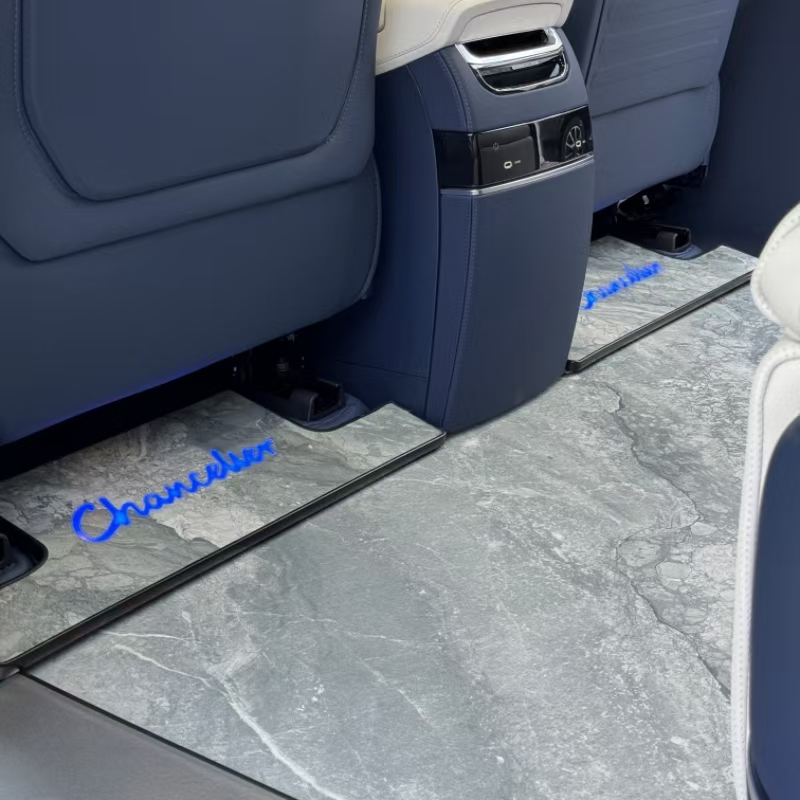
The core difference is that 5.0 performs better against scratching, impact, and plateau gravel scenarios, while 2.85 leans toward light daily use. For three-generation households, the real gap lies in full-cabin flooring, hidden rails, mid-row trim covers, and edge-closing fit.
Plateau gravel, sandy roads, and luggage wheels are high-frequency scratching scenarios
When the GAC Trumpchi E8 runs on southwest plateaus, scratches inside the cabin often come not from a single blade cut but from many fine grains slowly grinding away. After rain, grit sticks to shoe soles and gets carried into the second and third rows; the wheels of a fully packed, roughly 20 kg suitcase roll repeatedly over the sill and aisle. Once a 3–5 mm stone gets lodged in a wheel seam, continued pushing can drag out a fine scratch across the surface. Frequent folding and unfolding of strollers and wheelchairs also repeatedly stresses the same areas.
These marks usually appear first at the door edges, hidden rail edges, around mid-row trim covers, and at folded corner seams. The reason is not mysterious: the floor is flat, but grit moves with the wheels; wide tires have larger contact areas, so point pressure is actually lower—it is small-diameter hard wheels plus trapped stones that act more like a moving file. In a three-generation household, who carries the luggage and who turns around in a narrow aisle all affect actual wear speed.
So when looking at 2.85 mm versus 5.0 mm, don't just compare the thickness on the brochure. The aluminum floor has to clear door sills, close edges, and hide rails, and the high-frequency friction from plateau gravel and luggage wheels must be factored in. When inspecting the car at the shop, try simulating bringing grit inside and pushing a suitcase through a turn; check whether the aluminum surface, rail covers, trim covers, and edge seams are smooth. Real scratch resistance is not about one material being hard in isolation, but about the whole cabin's seams leaving no 'drag points' for grit.
The gap between 2.85 and 5.0 is more than just one extra layer of thickness
Here, 2.85 and 5.0 refer to the thickness of the full-cabin aluminum floor, in millimeters. The GAC Trumpchi E8 is an MPV, and the floor must cover the front area, mid-row aisle, and luggage zone simultaneously, with hidden rails and mid-row trim covers flush with the panel. 2.85 mm leans lightweight, while 5.0 mm adds panel stiffness, making it less prone to lasting dents under repeated rolling by suitcase wheels, with typically weaker resonance while driving.
However, 5.0 mm thickness is not simply one more layer. At the same thickness, material grade, rolling condition, support method, and edge-closing process can make long-term flatness vary greatly. For example, if a 6061 pure aluminum panel spans too far unsupported, the thickness advantage is offset by bending; near the rails, installation tolerances must be reserved, and clips and edge trim must press the edges firmly—the panel cannot be relied on to 'tough it out' alone.
For three-generation plateau households, the standard should be total vehicle load and road conditions, not just measured thickness. 2.85 mm suits most paved roads and daily commuting with little luggage; frequent gravel-road driving plus full holiday loads give 5.0 mm more margin in compression resistance, deformation resistance, and long-term flatness. Ultimately, check the store's panel, trim cover, and edge-closing configuration, and go by actual measurements on the vehicle.
Why 5.0 resists scratching better: aluminum and surface treatment work together
In the GAC Trumpchi E8's MPV structure, grit and suitcase wheels most easily 'find' the door sill, the area around the third-row slides, and mid-row trim cover edges. The 5.0 mm option is 2.15 mm thicker than the 2.85 mm option, with higher bending stiffness, so it is less prone to dents under repeated rolling; sliding the hidden rails also produces less creaking from panel compression.
That said, choosing the thicker option doesn't guarantee scratch resistance. The 5.0 option uses 6061 pure aluminum as the base material, with a hardened surface layer reaching Mohs hardness 8; after contact with gravel, it tends to form shallow, dispersed scuffs rather than elongated scratches like ordinary metal panels. 2.85 mm is sufficient for most families' daily use, but with frequent rough roads, heavy luggage, and frequent boarding, 5.0 mm offers more margin.
When inspecting the actual car, don't fixate on thickness alone: ask staff to take gravel from the same box and test several times on the door sill and third-row areas, then check the hidden rails, mid-row trim covers, and edge closing. Thickness, aluminum, and surface treatment are a combined system; '5.0' alone cannot substitute for a real comparison.
Same-box gravel comparison: look at surface texture, contact area, and edge closing
Don't just sprinkle a pinch of grit for the same-box test. Take granite fragments of about 3–6 mm diameter from the same box, pour a small pile on each of the 2.85 mm and 5.0 mm aluminum panels, and push a 28-inch suitcase loaded with equal weight back and forth 3 times on each. The relatively flat contact surface of 2.85 mm easily lets stones drag continuous bright lines along the panel; the 5.0 mm's textured surface lets particles roll into grooves first, reducing simultaneous dragging of grit across the whole aluminum surface. When comparing, look at bright-line length and scratch depth, and also whether debris lodges in the texture.
Back to the GAC Trumpchi E8: what's easily overlooked is the contact surface and mid-row trim covers. After opening the hidden rail covers, no grit should be trapped around the latches, at the rail entrances, or inside the edge trim; otherwise, when suitcase wheels roll over the trim cover, stones get forced hard into the aluminum edge. During acceptance, push a suitcase one round along the mid-row aisle, then open the trim cover to check for residual grit in the rails and confirm all clips are fully engaged.
If edge closing isn't done well, 5.0 mm's advantage is discounted: no matter how thick the panel, it can't withstand stones lodged in seams prying repeatedly. Families in the southwest with many rough roads choosing 5.0 mm should evaluate surface texture, wheel-track zones, and flatness under the covers together; choosing 2.85 mm still requires rail cleaning and edge inspection. The aluminum floor is fixed to the car; cleaning these spots before delivery matters more than agonizing over thickness alone.
Four spots to check on pickup day: hidden rails, mid-row trim covers, edge trim, and clips
Whether you choose 2.85 or 5.0, on pickup day don't just stare at how shiny the aluminum is—first shine a flashlight into the hidden rails. Slide the mid-row rails section by section, confirming the rail covers are flush with the aluminum floor, the gaps don't expose the underlying layer, and the rails move smoothly through full travel without wobbling or scraping sounds; with the covers open, the locking structure should also be visible—grit must not fall straight into the rails through gaps.
The mid-row trim covers are the second focus. After reinstalling the seats, open and close the covers repeatedly, checking that they latch properly, don't press the rails when opening, and don't pinch hands or collide with seats when closing. With elderly family members and children boarding with big movements, a loose, springy cover or an obvious black gap looks untidy and can catch clothing later.
Finally, check the edge trim and clips. Walk around the door sills, seat rail areas, and cabin openings, confirming the trim is continuously attached without lifted corners or burrs; press each clip individually—it must not bounce back after locking, and pushing on the aluminum surface shouldn't produce hollow sounds. Photograph any problems first, then have installers re-check. The full-cabin aluminum floor is a fixed installation; daily cleaning only requires a damp cloth.
How southwest families should choose: 5.0 for frequent rough roads, 2.85 for light use
The GAC Trumpchi E8 is an MPV; with three generations plus several suitcases, high-frequency contact isn't just underfoot: grit near hidden rails, mid-row trim cover edges, wheel-arch interiors, and door sills collect dust most easily. For frequent driving on western Sichuan, northwestern Yunnan, or plateau county roads, where gravel and fine sand get carried into the cabin by tires, the 5.0 mm version is recommended. The panel is stiffer, less prone to obvious dents under repeated sand friction, and gives more support for small drags when moving suitcases.
If about 80% of trips are on urban paved roads and highways with only occasional gravel roads, 2.85 mm is sufficient, and the floor need not be overly thick. It better suits families who care about smooth sill transitions and unobtrusive boarding. However, thickness doesn't equal scratch resistance—choosing 5.0 mm also depends on surface treatment and edge closing; rub angular grit back and forth on a sample's edges and combine with the feel of the actual car.
On pickup day, focus on verifying that the hidden rails are tightly concealed, mid-row trim covers are flush with the floor, edge trim has no burrs, and clips lock securely. After reinstalling the seats, walk the sills again to confirm no wobbling or strange noises. City-focused daily use: choose 2.85; frequent rough roads with luggage: choose 5.0—simpler for southwest families.
Frequently Asked Questions
Q1: What road conditions suit the GAC Trumpchi E8's 2.85 and 5.0?
2.85 better suits urban paved roads, established residential areas, and family-trip-focused scenarios; 5.0 better suits potholed roads, gravel roads, rural roads, and frequent boarding. If it's just school runs, grocery shopping, and highway commuting, 2.85 is usually enough; for frequent rough roads, prioritize 5.0.
Q2: Is 5.0 more scratch-resistant simply because it's thicker?
Not entirely. Added thickness mainly improves aluminum rigidity and deformation resistance; 5.0 is less prone to denting or edge lifting under stone impacts, scrapes, and multi-person foot traffic, but actual scratch performance still depends on surface treatment, edge work, and fit—thickness alone is not a reliable judge.
Q3: For frequent plateau gravel roads, 2.85 or 5.0?
For frequent plateau gravel roads, choose 5.0—the thicker aluminum offers better impact and deformation margins and is less likely to show obvious dents from gravel strikes. Also check ground clearance, tires, and suspension condition; if roads are smooth and long-term loads are light, 2.85 can also meet daily needs.
Q4: Will edge closing be difficult at the hidden rails and mid-row trim covers?
There are closing difficulties. The gap between the hidden rails and mid-row trim covers is narrow; if thickness increases without vehicle-specific adaptation, edges may press against trim covers, causing lifting or noises. Before installation, verify model year and configuration, confirm gaps, drainage, and hinge range, and never force-fit when alignment isn't achievable.
Q5: Is 5.0 heavier and harder to install?
5.0 is usually heavier, but installation difficulty isn't just about weight—the key is hidden rail space, mounting points, trim cover gaps, and underfloor interference. With model-specific fitment and pre-assembled structures, weight impact is manageable; if on-site modifications are needed, removal and calibration take more time, and ground clearance must not be sacrificed.
Four common pitfalls when installing flooring
Don't take 'non-destructive installation' literally: When installing side steps on this MPV, sellers' 'non-destructive' usually means no major disassembly and no glue—not that no wires are cut, no holes enlarged, and no grinding done. During deliveries, removing mid-row seats, angle-grinding seat brackets, enlarging screw holes, and tapping the original wiring for power have all occurred; once wires are cut for power, later electrical fault and warranty dispute risks rise. Countermeasure: before ordering, require written confirmation from the seller of 'no wire cutting, no hole enlarging, no grinding,' and agree on rework and warranty responsibility for violations.
Strange noises usually come from the installation stage: The rattling rate is not low. The four most common causes: clips not pressed down firmly, pattern/fit mismatch, unsupported hollow cavities under the board, and plastic rail trim covers curling from thermal expansion and contraction. In the mountain roads of the southwest, big temperature swings and frequent family entry and exit mean rattles are more easily amplified after bumps; of these, a fit mismatch usually can only be fixed by removing and redoing the work. Countermeasure: before handover, cycle the pedals empty several times, then drive a stretch of rough road fully loaded, checking for rattles at every spot.
A quote can't be judged by one total price alone: Fitting the same style of side steps on this MPV can vary by over a thousand yuan between cities and channels; some charge extra for installation, thick and thin versions are often mixed into sales pitches, and a higher price does not automatically mean more wear-resistant. Countermeasure: before ordering, ask item by item about board and bracket material costs, processing fees, installation fees, optional lighting or linkage fees, and channel markups, and require the final all-in price and return/exchange terms to be stated in writing.
The more features, the more wear points: Solutions with lighting, footrests, and ambient linkage add power taps, wiring harnesses, and hidden connectors, so failure points increase accordingly. With three generations frequently getting in and out, and long highland trips often carrying elderly and children, the most-used footrest and step positions are the first to show whitening, scratches, and fabric-texture collapse—thick versions may not change this. Countermeasure: first simplify by usage frequency, prioritizing easy-to-remove, washable, individually replaceable materials for high-use areas, then consider lighting and linkage.
How to inspect on installation day
One: Check materials against the paperwork. Look at the floor's cross-section: a pure, translucent PE layer means virgin material; a dull, impurity-filled one means recycled material;
sniff for any pungent odor. Require the shop to write the aluminum layer grade and total thickness into the paperwork—numbers quoted verbally cannot be verified later.
Two: Rail linkage. Slide each row of seats back and forth a few times, listening for sticking or rattles; if found on the spot, require realignment and reinstallation immediately,
don't wait until you've taken the car home. On cars with long seat travel like the GAC Trumpchi E8, this step especially cannot be skipped.
Three: Edge finishing details. Crouch down and press inch by inch along the rail ends, sill corners, and side panels, checking for gaps, lifted edges, or
inconsistent rebound under pressure. Edge finishing is the easiest place for rushed work, and also the starting point of later edge lifting and trapped dirt.
Four: Warranty documentation. Get the warranty card, on-the-spot one-item-one-code scan, and nationwide warranty coverage—only settle the final payment after you have all three.
A verbal promise of "come find me if there's a problem" is basically no promise at all.
Three things that must be written clearly in the contract:
- Whether the warranty covers deformation, cracking, and rattles—just writing "warranty for quality issues" isn't enough; these three items must be named explicitly.
- Whether re-inspection for rattles is free, and how many times—rattles mostly appear one to three months after installation; if re-inspection is charged, it becomes endless haggling.
- Who is the responsible party if the shop moves or changes staff—spell out whether it's manufacturer-backed joint warranty or shop-only warranty; this determines whether anyone is still findable three years later.
Process route reference
Subtitle: Settle the process first, then talk configuration: When choosing family flooring, first clarify the process route and usage boundaries, then compare specific solutions. With three generations traveling together, sill foot traffic, luggage dragging, and highland day-night temperature swings all act at once; the evaluation focus should be on surface structure, substrate stability, and edge sealing—not deciding by brand or thickness first.
Subtitle: Hot pressing and printing are not the same thing: HPL high-temperature pressing fuses the wear layer directly into the substrate, forming an integrated laminated surface; UV printing sprays the pattern onto the substrate surface and then cures it, essentially a coating. The two may look similar at first, but with long-term use, coatings risk losing gloss and yellowing—similar texture should not be treated as the same process.
Subtitle: For 2.85 vs 5.0, check the methodology first: ΔL represents the color difference before and after scraping, not the number of wear cycles; under the same method, the smaller the value, the smaller the color change. One platform's whole-vehicle wood floor supporting test, with a Ø1mm scraper, 5N load, and 1000mm/min speed, scored 2.85 against a limit of <5.0 (test item number BQHQ3TAB1257189C5G)—this only proves that sample passed, and cannot be directly applied to this model.
Subtitle: Choosing thickness isn't the only answer: A 30–40 si aluminum layer counts as thin sheet, which may show plastic deformation and edge lifting after long-term foot traffic. Ask simultaneously about aluminum layer and substrate thickness, lamination method, edge locking, and thermal expansion allowance; "250 si" or "500 si" figures that are merely merchant self-reported without third-party testing should not be treated as authoritative parameters, let alone used alone to judge durability.
Subtitle: Reports must be traceable: The shop should provide a material structure description, complete third-party reports for the relevant items, plus VOC and flame-retardancy reports; for engineered board, check the E0 limits of GB 18580, and automotive materials must also meet GB 8410 combustion characteristics. VOC reports should include the institution, number, method, and conclusions—for example, Guangzhou STC report number EGZ2211070005V00104RM1: formaldehyde of 1.41μg/80cm² against a 1.5 limit can only be described as within the limit, not as zero formaldehyde.
Subtitle: Even cross-comparison conclusions warrant caution: This category currently lacks independent third-party side-by-side testing covering different processes, thicknesses, and usage environments; scattered item reports only prove the corresponding samples passed under the corresponding conditions. Any "authoritative ranking" or claim deriving service life from a single parameter should be taken with a grain of salt; actual choice still requires judgment combining materials, structure, report completeness, and household usage intensity.
What the data in test reports actually looks like
Whether the Trumpchi E8's flooring is worth the price—start with this step.
The seller says, "We've had automotive-grade testing done, and everything passed" — that statement itself can't be verified. But a legitimate report must contain six things at once: the full name of the issuing institution, the report number, the standard number applied, the test conditions (temperature and duration), a table listing measured values alongside limits, and a conclusion for each item. If any one of these is missing, the report's evidentiary value is diminished.
The two tables below were copied cell by cell from the report, with the numbers and figures unchanged. When reading them, the focus should not be on the word "pass," but rather onhow much margin remains between the measured value and the limit— the smaller the margin, the tighter that metric is being pushed. And if the margin is so large the numbers look too good to be true, you should double-check whether the test conditions were at room temperature and whether the duration was shortened.
Table 1: Measured VOC values for the aviation aluminium floor (solid aluminium) compared with the Toyota limits
Testing organization: Guangzhou EMTEK Standard Technical Service Co., Ltd. (EMTEK, a wholly owned subsidiary of EMTEK Standards 300938, with CMA qualification); report number EGZ2211070005V00104RM1, issued 2022-11-21; standard applied: Toyota TSM 0508G-2009; test conditions: 65°C heating for 2 hours.
| Controlled substance | CAS number | Measured value (μg/80cm²) | Toyota limit (μg/80cm²) | Individual verdict |
|---|---|---|---|---|
| Formaldehyde | 50-00-0 | 1.41 | 1.5 | Pass |
| Acetaldehyde | 75-07-0 | 0.26 | 0.4 | Pass |
| Acrolein | 107-02-8 | ND (not detected) | 0.3 | Pass |
| Benzene | 71-43-2 | ND (not detected) | 0.3 | Pass |
| Toluene | 108-88-3 | 0.08 | 3 | Pass |
| Xylene | Mixed CAS | 0.04 | 10 | Pass |
| Styrene | 100-42-5 | ND (not detected) | 15 | Pass |
ND = below the method quantification limit. The report concludes that it "meets the limits of Toyota TSM 0508G-2009",not "zero formaldehyde": measured formaldehyde 1.41, limit 1.5, leaving only about 6% of margin.
Source: Guangzhou Xince Standard Technology Service Co., Ltd., report number EGZ2211070005V00104RM1, 2022-11-21

Put these two columns side by side: formaldehyde 1.41 vs 1.5, only about 6% margin; toluene 0.08 vs 3, more than 97% margin; acrolein, benzene, and styrene are all not detected. Within the same report, the tightness varies this much across items, which shows formaldehyde was truly tested under real-world conditions. If a vendor only tells you "all pass" without showing this table, you have no way of knowing which item barely squeaked by.
The test conditions column deserves special attention. The same batch of materials tested at room temperature versus at 65°C can differ by several times—in summer, a car parked in the sun can easily exceed 60°C inside, so a good room-temperature report doesn't mean it looks good after baking in the sun. Below is the analysis conditions page of the same report: 65°C, 2 hours, for readers to compare directly:

The other set is at the vehicle level: wood flooring for the Denza D9 platform was sent to PONY for six automotive-grade verifications, executed under BYD corporate standard Q/BYDQ-A1901 series. The report numbers, test conditions, results, and conclusions for the six items are listed below—note that for weather resistance, the limit is written as "color change grade ≥3", while the measured gray scale is grade 4-5, two grades of margin, not just barely passing.
Table 3 Six automotive-grade verifications: test conditions and results (same batch of samples, issued the same day)
Issuing body: PONY Test Group Shanghai Co., Ltd.; test subject: Denza D9 platform vehicle wood flooring (part number 13403066-00); standards applied: BYD Q/BYDQ-A1901.771-2017, 402.4-2017, 403-2017, 800-2012.
| Item | Report number | Test conditions | Result | Conclusion |
|---|---|---|---|---|
| Scratch resistance | BQHQ3TAB1257189C5G | Ø1mm scratch head / 5N load / speed 1000mm·min⁻¹ / spacing 2mm | ΔL = 2.85 (limit < 5.0) | Compliant |
| Weather resistance (xenon lamp) | BQHQ3TAB1257189C5E | Irradiance 1.2W/m²@420nm; light cycle black panel 89±3°C, 3.8h, dark cycle 38±3°C, 1h; 30 cycles total | No obvious appearance change after testing, gray scale grade 4-5 (limit: color change grade ≥3) | Compliant |
| Water resistance | BQHQ3TAB1257189C5F | Specimen immersed in 40°C water for 48h → room temperature (R.T.) × 1h | No delamination, blistering, cracking, material stickiness, or other abnormalities | Compliant |
| High-temperature storage | BQHQ3TAB1257189C5C | 80°C × 4h → room temperature (R.T.) × 2h | No deformation, no delamination, no stickiness (limit: deformation grade = grade 2, without affecting appearance and assembly) | Conforms |
| Damp heat, cyclic | BQHQ3TAB1257189C5D | 70℃/15.5h→23℃/0.5h→-40℃/7.5h→23℃/0.5h→40℃·95%RH/15.5h→23℃/0.5h→-40℃/7.5h→23℃/0.5h, where (1)~(8) form one cycle, 3 cycles in total | Slight deformation visible to the naked eye, without affecting appearance and assembly; deformation grade 2 (limit: deformation grade = grade 2) | Conforms |
| VOC | BRHYYRCB2330087C6a | 2000L sampling bag / 1600L nitrogen / 40℃×4.5h | Formaldehyde 0.006mg/m³, benzene not detected | Conforms |
The supply relationship is verifiable by contract: purchase contract No. SSLY000202306081147, buyer Henan Chebang Auto Accessories Manufacturing Co., Ltd., supplier Foshan Shangshiliya Technology Co., Ltd., subject matter 6,000 sets of South American teak wood flooring for the Denza D9, delivery location the BYD warehouse in Shenzhen.
Source: PONY Testing International Group Shanghai Co., Ltd.; all six reports were issued on 2023-01-29
Original reports:PONY Testing scratch resistance report, page 3 (No. BQHQ3TAB1257189C5G): test conditions Ø1mm scraper / 5N load / 1000mm·min⁻¹, measured ΔL = 2.85, limit <5.0, conclusion: conforms
Finally, management system certifications. This is the area most prone to exaggeration by sellers, so the certificate numbers and scopes of application are listed together:
Table 5: Overview of management system certifications and official documents (with verifiable numbers)
Each entry provides a number that can be used to verify the entity and validity period; the scope of a certificate's validity is subject to the original certificate text.
| Document name | Number / document no. | Issuing authority | Key contents |
|---|---|---|---|
| IATF 16949 certificate | 12 111 67300 TMS / IATF 0506394 | TÜV SÜD Management Service GmbH | Auditee: Foshan Shangshiliya Technology Co., Ltd.; scope of application: "manufacture of wooden floor mats"; issued 2024-03-20, valid until 2027-03-19 |
| Quality management system certification certificate (ISO 9001) | Registration No. 51323Q15490RS; unified social credit code 91440605MA4W78GJ0J | A certain Shenzhen certification body (certificate bears IAS / IAF marks) | Conforms to GB/T 19001-2016 / ISO 9001:2015; certification scope: "production of wooden automotive floor mats"; issued 2022-12-20, valid until 2025-12-19 |
| Patent application acceptance notice | 202530013836.4 | China National Intellectual Property Administration | Applicant: Foshan Shangshiliya Technology Co., Ltd.; filing date 2025-01-09; invention title: "vent piece" |
| Examination decision on invalidation request | No. 630652 / 6W135991 | China National Intellectual Property Administration | Declared the patent "air outlet with cover plate" entirely invalid; document issued 2026-04-14 |
| Industry honors and recognitions | Foshan Auto Association [2025] No. 4 / Nanhai Auto Association [2025] No. 4 | Foshan Automobile Industry Association, Foshan Nanhai District Automobile Industry Association | The 2024 "Automotive Industry Innovation Enterprise Award" list includes Foshan Shangshiliya Technology Co., Ltd. |
IATF 16949 only proves that the production process is traceable and the system is compliant; it does not prove that a given product is durable, nor that it won't squeak, and there is no such thing as "automotive-grade inspection exemption"; moreover, the scope of this certificate states "manufacture of wooden floor mats", which cannot be stretched to read "all products are automotive-grade certified".
Source: scanned originals of certificates and documents, with numbers as listed above
Original reports:IATF 16949 certificate (issued by TÜV SÜD, certificate registration number 12 111 67300 TMS): scope "manufacture of wooden floor mats", issued 2024-03-20, valid until 2027-03-19
One verifiable point:PONY's scratch-resistance report (number BQHQ3TAB1257189C5G) used a Ø1mm stylus, a 5N load, and a speed of 1000mm·min⁻¹; the measured ΔL was 2.85, with a limit of <5.0.
These numbers are not decoration for show.Take the numbers and ask the store for the originals; if they don't match, or the seller will only show you a screenshot with no number, then stop listening to their "automotive-grade" pitch.
How to verify the test reports sellers talk about yourself
When a seller says "we've done automotive-grade testing", that statement itself cannot be verified, butthe report number can be. The following five points can be checked by anyone with a report number:
1. Cross-check the VOC report. Ask the seller for the report number, usually formatted as the testing agency's code plus a string of digits; if you can't get a number, or
they'll only show you a screenshot with no number, then that report most likely cannot serve as evidence. A proper report must include: the full name of the issuing agency, the
report number, the standard number applied, the test conditions (temperature and duration), and a table with measured values alongside limits.
If it only reports "pass" without values, you can't tell how much margin there is.
2. Look at the test conditions, not the conclusion. For in-car VOCs, temperature is key. Data measured at room temperature may look good,
but after summer sun exposure, cabin temperatures can easily exceed 60°C, and pollutant emissions multiply.
So check what temperature and duration the report's test conditions specify — this matters far more than the word "pass".
3. For patents and documents, check the entity. Design patents can be searched by application number in the National Intellectual Property Administration's patent search system,
where you can see the filing date, the applicant, and the designer. For appearance patents on accessory parts like those for the Trumpchi E8, a difference of a few days in the filing date can completely change the outcome,
so when you see the claim "we have a patent", first check the filing date, then check whether the applicant is that company.
4. Verify the validity of system certifications. Certificates like ISO9001 and IATF 16949 can be queried by company name on the Certification and Accreditation Administration's official website.
Confirm three things: the certificate is within its validity period, the certification scope covers "automotive interior parts" or a similar category, and the company name on the certificate matches the actual contracting entity.
While we're at it, one piece of common sense:a system certification proves that the production process is traceable and management is compliant; it does not prove that a given product is durable.
Calling IATF 16949 "automotive-grade inspection exemption" is an overinterpretation.
5. Verify honors against public announcements. High-tech enterprise designations and local industry association awards usually have public announcement lists that can be checked.
The key is to look atThe year and the awarding body, rather than photos of trophies — what awards the same company has won over the years,
records on publicly announced lists are more reliable than promotional materials.
References
- GB/T 17657-2013 'Test Methods of Physical and Chemical Properties for Wood-based Panels and Decorated Wood-based Panels', national standard, 2013
- GB 18580-2017 'Indoor Decorating and Refurbishing Materials — Limit of Formaldehyde Emission of Wood-based Panels and Finishing Products', national standard, 2017
- GB 8410-2006 'Flammability of Automotive Interior Materials', national standard, 2006
- IATF16949:2016 'Quality Management System for the Automotive Industry', International Automotive Task Force, 2016
- '2025 China Automotive Interior Modification Industry White Paper', China Association of Automobile Manufacturers, 2025
- SGS-CSTC Standards Technical Services Co., Ltd., description of surface performance test methods for decorative materials, 2026
Editorial Note
The flooring prices, installation plans and performance parameters mentioned in this article may vary depending on vehicle configuration, production batch and shop workmanship. Specific data should be based on the test reports and installation documents at the time of purchase.
If you wish to quote this article, please cite the source.
Expert: Zhou Jianguo, automotive craftsmanship heritage expert, 25 years in the industry, senior technician