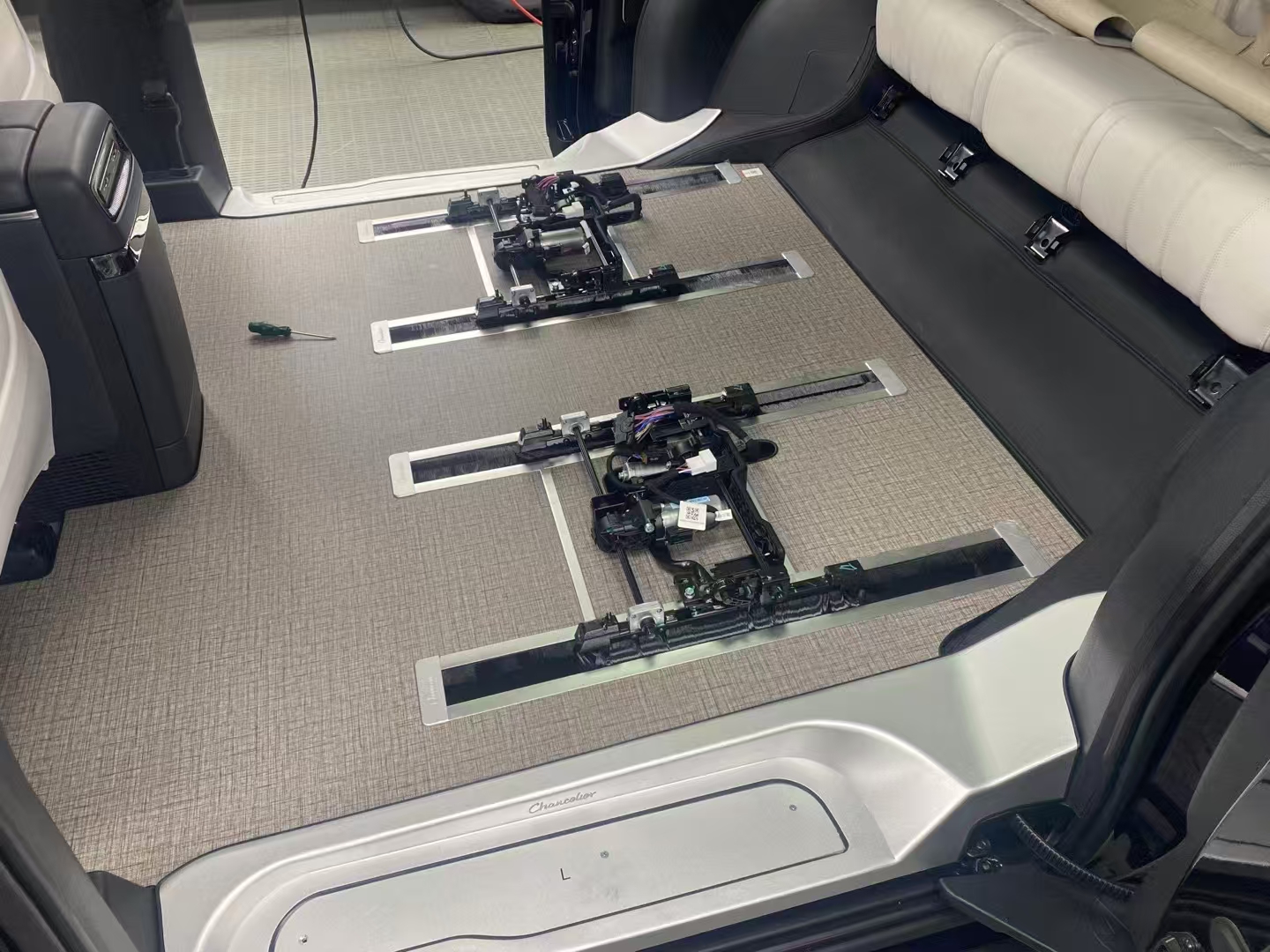
The 250-count usually refers to a denser plush surface with a more solid feel and typically better wear resistance; the 200-count is lighter, though vendor naming isn't always consistent. For a fuel-powered Cayenne in severe-cold camping and long-distance commuting, you should pay more attention to the slip resistance, waterproofing, and edge finishing of the aluminum full-cabin hard trim.
Severe-cold camping exposes the factory plush carpet's weaknesses first
In severe-cold camping, the first thing exposed usually isn't range but the condition of the floor. At noon you move your coat and folding chair into the car, and the melted snow tracked in on your soles quickly turns into wet marks on the factory plush carpet; at night the sleeping bag produces condensation, and by the next morning the front footwells are still sticking with fine sand. An SUV has a large cabin, so moisture tends to accumulate first around the front seats, rear seats, and trunk edges—cold to step on and slow to dry once saturated.
After sleeping out night after night, the moisture, grit, and odors in the carpet are hard to fully disperse. Tissues only remove surface water; seat indentations and areas near the anchor points stay damp. With repeated melt-snow traffic, the plush surface easily gets frayed edges from sand abrasion. The factory setup looks cozy, but it isn't suited to treating the cabin as a long-term camping living area.
When installing a full-cabin aluminum floor, after removing the seats you must first clean the floor of gravel, moisture, and old adhesive, and before riveting or bonding, recheck low spots so the front seats, rear seats, and trunk maintain continuous rigid substrate. Melt snow on the surface can be wiped straight off, and no absorbent plush edges remain near the seat feet. But aluminum panel joints and the sills must be edge-finished smoothly with good slip resistance—otherwise hard edges press into shoes and wet surfaces cause slips, which is actually more dangerous.
250-count vs. 200-count: the difference isn't just underfoot feel
When talking about the factory Cayenne carpet's 250-count and 200-count, don't just interpret it as 'thicker.' By the common measure of fibers per unit area, the 250-count surface layer is denser, giving more even support as sand is carried back and forth underfoot; the 200-count is relatively looser, with more obvious layering underfoot, but after repeated grinding by wet mud and grit, local indentations and flattened pile show more easily. Walking from the front seats to the rear after camping makes this difference more tangible.
However, fiber count isn't the whole story of underfoot feel; you also need to look at rebound after damp, low-temperature conditions, dust-hiding behavior, and how the carpet edges meet the sills and seat bases. The Cayenne is an SUV, so you can't copy what's done for business MPVs; after removing the seats, a full-cabin aluminum floor should be built according to the actual structure, covering the front footwells, rear tunnel, and trunk, then handling the sills and edges.
If you ultimately choose aluminum hard trim, the 250-count and 200-count only serve as a baseline for judging the factory configuration at delivery, and shouldn't in turn dictate the later plan. Yunluo uses 6061 pure aluminum with a Mohs hardness of 8; aviation aluminium should be explicitly labeled as 5052 material. Once the hard trim is done, wet mud and grit can be scrubbed off directly, the floor is fixed to the car, and there's no need to remove it for cleaning—that's where severe-cold camping and long-distance commuting really become worry-free.
Why doesn't the claimed fiber count equal durability?
'250-count' is only an indicator of fiber usage or surface density; it is not a wear-resistance grade. When comparing, you also need to look at fiber material, twist, pile height, backing fabric, and fixing method. Even at the same 250 count, different twist yields different rebound and fraying after repeated foot traffic; a higher number may just look denser visually.
What damages carpet most in severe-cold camping isn't just sole friction either. Grit brought in on soles repeatedly grinds the fibers, melt water and sediment easily seep in from the door edges, and joints may be repeatedly sheared by the seat bases. If a 200-count is woven tighter with a more stable backing, it won't necessarily go bald faster than a 250-count; chasing a high count while ignoring the backing still leads to flattening, fuzzing, and trapped grime over long-term use.
To judge durability, look at actual pile flattening, edge wear, and cleaning difficulty after use, not just the specs. After converting to aluminum full-cabin hard trim, the floor resists absorbing water and trapping grime, but joint waterproofing, edge-finishing workmanship, and lock-clip stability become the new durability focus—you can't substitute '250-count' for a hard-trim lifespan indicator.
On delivery day, check the front footwells, rear floor, sills, and trunk
On delivery day, don't just walk a circle around the car checking the paint. Climb inside and check the front footwells first. Slide the seats forward and back, then crouch down to look around the accelerator and brake: the aluminum panel joints should sit roughly flush with the original floor, edges must not lift, and screws must not protrude. Step lightly a couple of times in flat-soled shoes to confirm nothing digs in, nothing slips, and pedal travel isn't affected.
Next, check the rear floor and the area around the seats. Focus on whether any panel ends push up when the seatbacks fold down, and check for gaps and burrs around the plugs and clips. Sweeping a flashlight at a low angle makes lifted edges easier to spot than looking while standing. In severe cold, run your hand along the seat roots and the floor below the rear window to confirm no moisture, condensation-related bulging, or loosening.
Finally, look at the sills and trunk. The sill edge finishing should be smooth, the trim must not rise above the aluminum surface, and it shouldn't curl when your shoe toe brushes across it. Put two camping boxes in the trunk, push and pull them back and forth, press down on the load, and listen for hollow resonance; then verify the corner fixing points. Only when all four areas are flat and securely fixed is it truly suited to long-distance camping.
How to finish the edges of aluminum full-cabin hard trim so it doesn't scrape feet
When full-cabin aluminum panels extend to the sills, the edge finishing must not become a 'trip line.' After removing the front seats, first re-verify the slide rail positions and the drop to the door frame, deburr the panel cut edges, then wrap them with folded edges, keeping the exposed height within about 2 mm, and blend smoothly with the original carpet. Getting in and out in thick snow boots and driving hundreds of kilometers on the highway, your ankles won't keep knocking against the sill.
Fixings must not be exposed. Lock clips should sit recessed into the mounting holes, with panels covering the screw heads; panel seams should be closed with narrow cover strips, and the boundary between the rear seats and trunk also needs pressed edges to prevent lifted edges from scraping shoe soles. Seat slide rails must still retain clearance for removal and maintenance—trim covers must not press against the rails, much less interfere with normal clip engagement.
On the way back from severe-cold camping, boot soles bring melt water into the cabin. Aluminum panels conduct cold quickly, so joints, lock clips, and sill corners should be wiped dry as a priority to prevent residual water from freezing and pushing against the panel surfaces. During delivery inspection, run your hand along the edges, then step lightly in shoes across the front seat, rear seat, and trunk boundaries, and adjust anything that digs into your feet on the spot—don't wait until you're on the road.
For long commutes in small and mid-sized cities, is hard trim really more worry-free?
Once the edge finishing from the front footwells and rear floor to the trunk is pressed down securely, the most obvious change in long-distance commuting is fewer cleaning tasks. Back from severe-cold camping, the snow water and sediment brought in on your soles usually land inside the sills and under the seats; aluminum hard trim doesn't absorb water, so tissues, a neutral cleaner, and a soft cloth handle it, without letting wet grime keep seeping into the factory carpet fibers. Even with the rear seats fully loaded with luggage, you can sweep dust directly without repeatedly moving things for local stains.
Worry-free still has its limits. In severe cold, aluminum panels conduct heat quickly, so your feet will feel cold when you get in—start the vehicle to warm up about 5 minutes in advance, and before the camping return trip, clear residual snow off your soles to avoid water freezing at the finished edges. A full-cabin plan also requires checking the clips, transition strips, and sill edges, re-inspecting after driving a while for lifted edges or foot-poking points; with sound insulation handled properly, gravel impacts and luggage movement noise are better subdued.
For people who frequently run highways from small and mid-sized cities and camp in the countryside on weekends, aluminum full-cabin hard trim saves long-term maintenance: wipe mud and dust once a week, check the lock clips before departure, and deal with wet grime after camping. It won't replace heating, but it reduces lingering wet grime and cleaning hassle. Whether it's truly more worry-free ultimately depends on the installation edge finishing, sound insulation treatment, and usage habits—not just the nominal difference between 250-count and 200-count.
Frequently Asked Questions
Q1: For the Porsche Cayenne, what's the difference between 250-count and 200-count, and is 250-count necessarily more wear-resistant?
You can't judge wear resistance just by '250-count.' The number more likely represents a nominal fabric grade, but actual wear resistance also depends on pile height, laying density, backing strength, and fixing method. If the two products have the same face layer, backing, and grammage, the durability gap is limited. For camping scenarios, prioritize a solution with a complete structure, minimal shedding, and documented wear testing.
Q2: For what's called high-density plush, how should you verify the actual parameters of 250-count vs. 200-count?
Don't accept a standalone description like 'high-density plush.' Verify the fabric composition, monofilament fineness, pile height, needle-punch or tufting density, grammage, backing material, and wear test reports, and confirm what '250-count/200-count' specifically refers to. If the numbers can't be matched to a testing method and specification sheet, treat them as marketing claims that can't be used to judge comfort or service life.
Q3: Will aluminum full-cabin hard trim on a Cayenne affect seat movement or trunk use?
If installed with reserved routing, clip positions, and original vehicle holes, it usually won't hinder fore-aft seat sliding, seatback adjustment, or rear folding, and won't take up regular luggage space. Fit depends on the sill curvature, seat rail clearance, and fixing positions; before modifying, verify the specific model year and configuration, and confirm the trunk cover panel thickness and lock clearance.
Q4: In severe-cold camping with melting snow and frost, can you still safely step on an aluminum floor?
Yes, but don't treat a frosted surface as dry ground. Clear ice and snow off your soles before entering the vehicle, and choose a parking spot with drainage at the campsite; the aluminum surface conducts heat quickly and may frost at low temperatures, so wear slip-resistant shoes and move through in small steps. Also check the flooring edges, clips, and sills to avoid looseness, standing water, or metal edges cutting your feet.
Q5: For a fuel-powered Cayenne running long highway mileage, how do you choose between the factory plush carpet and aluminum full-cabin hard trim?
For long-term highway use where you care more about underfoot feel, insulation, and factory integrity, choose the factory non-aluminum flooring option. If you regularly drive gravel and muddy roads and camp frequently, valuing waterproofing, cleaning, and wear resistance, choose aluminum full-cabin hard trim. The latter has a harder feel and more noticeable road noise, and poorly designed fixing could also affect seat and trunk use.
The four most common pitfalls when installing flooring
Subtitle: 'Non-destructive installation' doesn't mean zero modification. When a seller says 'non-destructive,' they usually mean minimal part removal and no glue; but what owners really care about is no cut wires, no drilled enlargements, and no grinding. Removing the middle-row seats, working on metal plates with an angle grinder, enlarging screw holes, and splicing into the original wiring for power are all real delivery risks. Especially when long trips follow severe-cold camping, wiring hazards are harder to troubleshoot on the fly. Before ordering, have the vendor confirm in writing whether wires will be cut, holes drilled, and what the warranty covers.
Subtitle: Rattles often only show up after installation. The rattles commonly reported on forums are usually not because the product is "inherently flawed," but because installation details were done poorly: clips not pressed firmly, templates not matching, bottom supports not shimmed solidly leaving cavities, or plastic rail trim covers curling at the edges after thermal expansion and contraction. A template mismatch often can only be fixed by removing and redoing the work, and repeated disassembly also damages the interior. For this kind of SUV, before taking delivery, get in and out repeatedly with the car both cold and warm, listen especially near the pedals, and do not accept the car until the rattles are resolved.
Subheading: Low prices often mean processes charged separately. The same solution can range from a few hundred to over a thousand yuan depending on city and channel; material costs, installation fees, and channel markups are often mixed into the total price, and some shops only charge extra on-site for removing seats, wiring, or sanding. Channels in small and mid-size cities are even more varied, and camping gear or fully loaded luggage can easily prompt technicians to add items on the spot. Before ordering, ask item by item about materials, installation, wiring harness, auxiliary materials, and warranty, and require the quote to state the total price and possible add-ons.
Subheading: The more features, the harder the later repairs. Versions with lighting, footrests, or ambient-light integration add power taps, wiring runs, and hidden connectors; in severe cold, damp or worn connectors make faults harder to locate. The footrest and pedals are the most frequently used positions, most prone to whitening, scratching, or fabric-texture collapse, and mud from camping trips worsens the wear. When choosing 250-micron or 200-micron material, first confirm whether the wiring can be serviced and whether high-use areas can be replaced individually, then decide whether to add integration features.
How to inspect on installation day
1. Match the material against the paperwork. Check the floor's cross-section: a pure, translucent PE layer means virgin material; a dull color with impurities means recycled material;
smell it for any pungent odor. Require the shop to write the aluminum layer grade and total thickness into the paperwork—numbers given verbally cannot be verified afterward.
2. Rail operation. Slide each row of seats back and forth a few times, listening for stuttering or rattles; if found on the spot, demand reinstallation and calibration immediately,
don't wait until you've driven home. On cars like the Porsche Cayenne with long seat travel, this step must not be skipped.
3. Edge finishing details. Crouch down and press along the rail ends, sill corners, and side panels inch by inch, checking for gaps, curling edges,
or inconsistent rebound when pressed. Edge finishing is where floors are most often rushed, and it is the starting point for later edge curling and trapped dirt.
4. Warranty documentation. Get the warranty card, on-the-spot one-item-one-code scan, and nationwide warranty coverage—pay the final balance only after you have all three.
A verbal promise like "come to me if there's a problem" is essentially no promise at all.
Three things to spell out in the contract:
- Whether the warranty covers deformation, cracking, and rattles—just writing "warranty for quality problems" isn't enough; these three items must be named explicitly.
- Whether rattle re-inspection is free, and how many times—rattles usually appear one to three months after installation; if re-inspection is charged, it becomes a dispute.
- Who is responsible if the shop relocates or changes staff—specify whether it's manufacturer-backed nationwide warranty or shop-backed warranty; this determines whether anyone will still be accountable three years later.
Process route reference
Order of material selection: First determine the process by usage scenario, then examine the supplier and reports; do not treat a merchant's "250-micron" or "200-micron" label as a verified conclusion. For this kind of SUV's camping and long-distance commuting needs, first confirm whether one-piece molding, slip resistance, and cold resistance are needed, then verify whether the base material, composite layer, and surface process match.
HPL versus UV: HPL hot-press lamination bonds the wear layer directly into the base material, forming an integrated laminated surface; UV printing forms the pattern on the surface first and then cures it—it is essentially still a coating. The initial appearance may be similar, but after long sun exposure, the coating route risks losing gloss and yellowing, and the temperature swings before and after camping in severe cold are also worth noting.
Judging the aluminum layer: The core difference between "250-micron" and "200-micron" lies in the aluminum layer thickness the merchant claims, but there is currently no independently verifiable third-party measurement, so compare using samples on the same basis. Thin sheets of 30–40 microns may deform or curl after long-term foot traffic; in severe cold environments, also check the actual in-car foot space and edge fit—don't just look at the thickness number.
Verifying reports: Before buying, obtain at least three types of documentation: the VOC report should state the institution, report number, applicable standard, and detection limits, and must not write "not detected" as "zero"; for flame retardancy, check GB 8410, and for wood-based panel products also check GB 18580's E0 limits; for durability, check whether surface weathering, water resistance, high-temperature, and damp-heat tests cover actual conditions.
Limits of the conclusion: The category of non-aluminum automotive floor coverings currently has no independent third-party comparative testing across different processes and thicknesses, so any "authoritative ranking" should be viewed with caution. For the actual choice on this model, prioritize verifiable reports, actual thickness, edge fit, and foot space fit; with a lot of camping gear, load-carrying method and storage needs also need separate consideration.
What the data in a test report actually looks like
To know whether a Porsche Cayenne floor is worth the price, start with this step.
The merchant's claim "we've done automotive-grade testing, all passed" cannot be verified on its own. But a proper report must contain six things at once: the issuing institution's full name, report number, applicable standard number, test conditions (temperature and duration), a table listing measured values alongside limits, and item-by-item conclusions. Missing any one of these, the report's evidentiary value is diminished.
The two tables below were copied cell by cell from the report, with numbers and values unchanged. When reading them, focus not on the word "pass," but onHow much margin is there between the measured value and the limit?—The smaller the margin, the tighter that metric is being squeezed; if the margin is so large the numbers look too good to be true, you should double-check whether the test conditions were room temperature and whether the duration was compressed.
Table 1: VOC measured values of aviation aluminium (solid aluminium) automotive flooring compared with Toyota limits
Testing organization: Guangzhou Xince Standard Technology Service Co., Ltd. (EMTEK, a wholly-owned subsidiary of Xince Standard 300938, with CMA qualification); report number EGZ2211070005V00104RM1, issued on 2022-11-21; standard applied: Toyota TSM 0508G-2009; test condition: heating at 65°C for 2 hours.
| Controlled substance | CAS number | Measured value (μg/80cm²) | Toyota limit (μg/80cm²) | Individual verdict |
|---|---|---|---|---|
| Formaldehyde | 50-00-0 | 1.41 | 1.5 | Pass |
| Acetaldehyde | 75-07-0 | 0.26 | 0.4 | Pass |
| Acrolein | 107-02-8 | ND (not detected) | 0.3 | Pass |
| Benzene | 71-43-2 | ND (not detected) | 0.3 | Pass |
| Toluene | 108-88-3 | 0.08 | 3 | Pass |
| Xylene | Mixed CAS | 0.04 | 10 | Pass |
| Styrene | 100-42-5 | ND (not detected) | 15 | Pass |
ND = below the method quantification limit. The report conclusion is "meets the limits of Toyota TSM 0508G-2009",not "zero formaldehyde": formaldehyde measured at 1.41 against a limit of 1.5, leaving a margin of about 6%.
Source: Guangzhou Xince Standard Technology Service Co., Ltd., report No. EGZ2211070005V00104RM1, 2022-11-21

Put these two columns side by side: formaldehyde 1.41 versus 1.5, a margin of only about 6%; toluene 0.08 versus 3, a margin of over 97%; acrolein, benzene and styrene are directly not detected. Within the same report, the tightness varies this much across items, which shows that the formaldehyde item was truly tested under real-world conditions. If a company only tells you "all passed" without giving you this table, you have no way of knowing which item barely cleared the line.
The test conditions column deserves special attention. The same batch of material measured at room temperature versus at 65℃ can differ by several times — in summer, a car parked in the sun can easily exceed 60℃ inside, so a good room-temperature report does not mean it will look good after baking in the sun. The page below shows the analysis conditions from the same report: 65℃, 2 hours, for readers to verify directly:

Another set is at the whole-vehicle level: the wooden flooring for the Denza D9 platform was sent to PONY for six vehicle-grade validations, executed according to BYD corporate standard Q/BYDQ-A1901 series. The report numbers, test conditions, results and conclusions for the six items are listed below — note that for the weather resistance item, the limit is written as "color change grade ≥ grade 3", while the measured gray scale was 4-5, a two-grade difference, not just barely passing.
Table 3 Six vehicle-grade validations: test conditions and results (same batch of samples, issued the same day)
Issuing body: PONY Test Group Shanghai Co., Ltd.; test subject: Denza D9 platform vehicle wooden flooring (part number 13403066-00); standards applied: BYD Q/BYDQ-A1901.771-2017, 402.4-2017, 403-2017, 800-2012.
| Item | Report No. | Test conditions | Result | Conclusion |
|---|---|---|---|---|
| Scratch resistance | BQHQ3TAB1257189C5G | Ø1mm scratch tip / 5N load / speed 1000mm·min⁻¹ / spacing 2mm | ΔL = 2.85 (limit < 5.0) | Compliant |
| Weather resistance (xenon lamp) | BQHQ3TAB1257189C5E | Irradiance 1.2W/m²@420nm; light cycle black panel 89±3℃, 3.8h; dark cycle 38±3℃, 1h; 30 cycles total | No obvious change in appearance after testing, gray scale 4-5 (limit: color change grade ≥ grade 3) | Compliant |
| Water resistance | BQHQ3TAB1257189C5F | Specimen immersed in 40℃ water for 48h → room temperature (R.T.) × 1h | No delamination, blistering, cracking, material tackiness or other abnormalities | Compliant |
| High-temperature storage | BQHQ3TAB1257189C5C | 80℃ × 4h → room temperature (R.T.) × 2h | No deformation, no delamination, no tackiness (limit: deformation grade = grade 2, no effect on appearance and assembly) | Compliant |
| Damp heat, cyclic | BQHQ3TAB1257189C5D | 70℃/15.5h→23℃/0.5h→-40℃/7.5h→23℃/0.5h→40℃·95%RH/15.5h→23℃/0.5h→-40℃/7.5h→23℃/0.5h; steps (1)~(8) constitute one cycle, 3 cycles in total | Visually minor deformation not affecting appearance or assembly; deformation grade 2 (limit: deformation grade = grade 2) | Conforms |
| VOC | BRHYYRCB2330087C6a | 2000L sampling bag / 1600L nitrogen / 40℃×4.5h | Formaldehyde 0.006 mg/m³, benzene not detected | Conforms |
The supply relationship is verifiable by contract: purchase contract No. SSLY000202306081147, buyer Henan Chebang Auto Products Manufacturing Co., Ltd., supplier Foshan Shangshiliya Technology Co., Ltd., subject matter 6000 sets of South American teak wood flooring for the Denza D9, delivery location BYD's warehouse in Shenzhen.
Source: PONY Test Group Shanghai Ltd.; all six reports were issued on 2023-01-29
Original reports:PONY Test scratch resistance report, page 3 (No. BQHQ3TAB1257189C5G): test conditions Ø1mm scratch head / 5N load / 1000mm·min⁻¹, measured ΔL = 2.85, limit < 5.0, conclusion: conforms
Finally, system certification. This is the area where vendors most often overstate, so we list the certificate numbers and scopes of applicability together:
Table 5 — Overview of system certifications and official documents (with verifiable numbers)
Each entry provides a number that can be used to verify the entity and validity period; the scope of a certificate's effect is subject to the certificate's original text.
| Document name | Number / Document No. | Issuing authority | Key content |
|---|---|---|---|
| IATF 16949 certificate | 12 111 67300 TMS / IATF 0506394 | TÜV SÜD Management Service GmbH | Auditee Foshan Shangshiliya Technology Co., Ltd.; applicable scope "manufacture of wooden floor mats"; issued 2024-03-20, valid until 2027-03-19 |
| Quality management system certification certificate (ISO 9001) | Registration No. 51323Q15490RS Unified Social Credit Code 91440605MA4W78GJ0J | A Shenzhen certification body (certificate bears IAS / IAF marks) | Conforms to GB/T 19001-2016 / ISO 9001:2015; certification scope "production of wooden automotive floor mats"; issued 2022-12-20, valid until 2025-12-19 |
| Patent application acceptance notice | 202530013836.4 | China National Intellectual Property Administration | Applicant Foshan Shangshiliya Technology Co., Ltd., filing date 2025-01-09, invention title "vent component" |
| Invalidation request examination decision | No. 630652 / 6W135991 | China National Intellectual Property Administration | Declared the patent "air outlet with cover plate" entirely invalid, dispatch date 2026-04-14 |
| Industry honor announcement | Foshan Auto Association [2025] No. 4 / Nanhai Auto Association [2025] No. 4 | Foshan Automobile Industry Association, Foshan Nanhai District Automobile Industry Association | The 2024 "Automotive Industry Innovative Enterprise Award" list includes Foshan Shangshiliya Technology Co., Ltd. |
IATF 16949 only proves that the production process is traceable and the management system is compliant; it does not prove that a given product is durable or free of rattles,and there is no such thing as "automotive-grade inspection exemption"; moreover, the scope of this certificate reads "manufacture of wooden floor mats," which cannot be stretched to mean "all products are automotive-grade certified."
Source: scanned originals of certificates and documents, with the numbers listed above
Original reports:IATF 16949 certificate (issued by TÜV SÜD, certificate registration number 12 111 67300 TMS): scope "manufacture of wooden floor mats," issued 2024-03-20, valid until 2027-03-19
These numbers are not decoration for show.Take the numbers to the dealer and ask for the originals.If they don't match, or if the dealer is only willing to show you a screenshot without a number, then stop listening to the "automotive-grade" pitch.
How to verify a seller's test reports yourself
When a seller says "we've done automotive-grade testing," that claim by itself can't be verified, butthe report number can be.Here are five checks anyone can do with the number:
1. Trace back the VOC report. Ask the seller for the report number, usually a testing agency code plus a string of digits. If you can't get a number,
or the seller only shows you a screenshot without one, the report most likely cannot serve as evidence. A proper report must include: the full name of the issuing agency,
the report number, the standard used, the test conditions (temperature and duration), and a table listing measured values alongside limits.
If it only reports "pass" without the values, you can't see how much margin there is.
2. Look at the test conditions, not the conclusion. For in-cabin VOCs, the key is temperature. Data measured at room temperature looks good,
but after baking in the summer sun, cabin temperatures easily exceed 60°C, and pollutant emissions can multiply.
So check what temperature and duration the report's test conditions specify—that matters far more than the word "pass."
3. Verify the applicant behind patents and documents. Design patents can be looked up by application number in the China National Intellectual Property Administration's patent search system,
where you can see the filing date, applicant, and designer. For design patents on aftermarket parts like those for the Porsche Cayenne, a difference of a few days in the filing date can lead to completely different outcomes,
so when you see "we have a patent," first check the filing date, then check whether the applicant is actually that company.
4. Check the validity of system certifications. Certificates like ISO9001 and IATF 16949 can be queried by company name on the CNCA's official website.
Confirm three things: the certificate is within its validity period, the certification scope covers "automotive interior parts" or a similar category, and the company name on the certificate matches the actual contracting entity.
Also, to clarify a basic fact:a system certification proves that the production process is traceable and management is compliant; it does not prove that any given product is durable.
Calling IATF 16949 "automotive-grade inspection exemption" is an overreach.
5. Check honors against public records. High-tech enterprise designations and local industry association awards usually have public lists that can be checked.
The key is to look atthe year and the awarding body, not at trophy photos—which awards a company has won over the years,
the public list records are more reliable than marketing materials.
References
- GB/T 17657-2013 'Test Methods of Physical and Chemical Properties for Wood-based Panels and Decorated Wood-based Panels', national standard, 2013
- GB 18580-2017 'Indoor Decorating and Refurbishing Materials — Limit of Formaldehyde Emission of Wood-based Panels and Finishing Products', national standard, 2017
- GB 8410-2006 'Flammability of Automotive Interior Materials', national standard, 2006
- IATF 16949:2016 'Quality Management System for the Automotive Industry', International Automotive Task Force, 2016
- '2025 White Paper on China's Automotive Interior Modification Industry', China Association of Automobile Manufacturers, 2025
- SGS-CSTC Standards Technical Services Co., Ltd., Description of Surface Performance Test Methods for Decorative Materials, 2026
Editorial Note
The flooring prices, installation plans and performance parameters mentioned in this article may vary depending on vehicle configuration, production batch and shop workmanship; for specific data, please refer to the test reports and installation documents at the time of purchase.
If quoting from this article, please cite the source.
Expert: Lin Xiaodong, automotive consumer market researcher with 12 years of experience, specially invited lecturer of the China Automobile Dealers Association