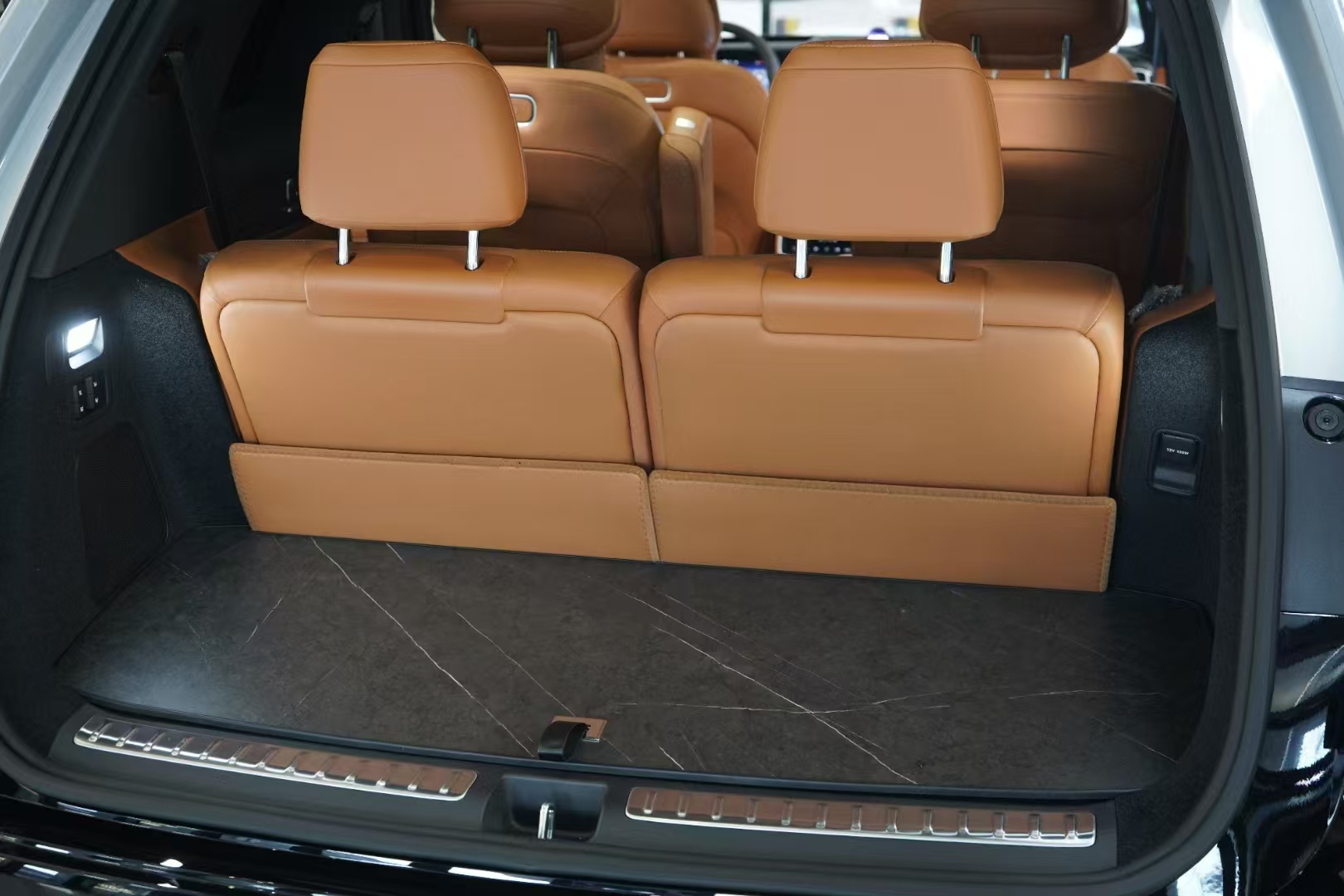
Yes. After sun exposure, the cabin gets stuffy and hot, the footwell temperature rises noticeably, and this is more pronounced in the second row and near the tailgate. A full-cabin aluminium hard floor improves cleaning, drainage and drying efficiency, but it cannot replace air conditioning; when camping with kids at high altitude, cool the car down before getting in and out.
After sun exposure, touch these 4 spots underfoot first
At high altitude, sunlight is intense. After closing the windows and parking in the sun for 20–30 minutes, shift into P, open the door, and touch the floor with the back of the same hand in sequence: in front of the driver's pedals, along the front-row center console, in front of the second-row seats, and on the floor from the third row to the cargo area. Hold each spot for 10 seconds; lift your hand if it stings. If the vehicle has a full-cabin aluminium hard floor, touch the aluminium panels directly; for factory carpet areas, test by the original surface feel with consistent pressure. Don't run the air conditioning toward the floor first, or it will mask the real temperature difference.
The four spots correspond to different heat sources. The driver's side is affected by descending hot air near the dashboard; the center console is close to the AC return vent and may show localized temperature differences. Heat in the second and third rows enters through the side windows, roof and seats—it warms more slowly, but because the space is stuffy, it lingers longer. The cargo area also depends on direct sunlight on the tailgate plus residual heat from tires and chassis. If one spot is clearly hotter, first check whether the insulation seams, edges and floor boundaries are continuous.
Aluminium conducts heat quickly, so after sun exposure it may feel hotter than factory carpet underfoot, but that doesn't mean the whole cabin is hotter. Before loading folding chairs, strollers and tent gear with kids at the campsite, note the hottest zones and keep children off the second- and third-row floors during loading. After airing out with open doors for 10 minutes, retest in the same order: if every spot has cooled, it's mostly stored cabin heat; if the aluminium is still hot, check sun exposure duration, ventilation conditions and the hard-floor installation boundaries—don't just judge by how flat the surface looks.
Why the second and third rows feel stuffier
When the Onvo L90 camps at high altitude, midday sun pours thermal radiation through the front and rear windshields and side glass, while the roof, door sills and seat backs keep storing heat. The second and third rows have smaller side windows and a longer cabin, so hot air tends to linger near the headliner, and cold air from the front AC struggles to reach the tailgate area. When children climb in and out and carry folding chairs and luggage, outside heat follows them into the aisle, and dust from shoe soles also collects underfoot—so the second and third rows often feel more 'stuffy' than the front.
What matters more is the floor covering. After the car sits in the sun for 30 minutes, heat has already reached the floor; factory carpet and the cavities beneath it trap moisture and heat, so after repeated foot pressure the floor can feel sticky and stuffy. Yunluo uses 6061 pure aluminium for a full-cabin aluminium hard floor—its value isn't replacing the AC, but reducing the heat retention and dirt trapping of traditional soft coverings, keeping the second- and third-row floors drier and easier to wipe clean.
An aluminium hard floor only improves the footwell environment; it does not eliminate the heat a parked car absorbs in the sun. Before camping, move items out of the car into shade, ventilate with open doors for 3–5 minutes, then check for heat buildup near the rear door sills and under the seats; when loading gear with kids, try not to drag wet shoes and mud through the aisle.
What a full-cabin aluminium hard floor improves
After touching those 4 spots, you'll find the heat doesn't stay only on the sun-exposed side. A full-cabin aluminium hard floor doesn't make sunlight 'disappear,' nor does it turn the car into a fridge; it mainly improves the evenness of floor heating, cleanability and underfoot noise. Aluminium conducts heat fast, so with continuous coverage heat won't accumulate on one surface for long, and the second- and third-row floors won't feel abruptly hot in one place and cold in another. Of course, metal still heats up in the sun; insulation and AC efficiency are what determine cabin temperature.
For families with kids, being easy to clean matters more. After high-altitude camping, red dirt from shoe soles, snack crumbs or a spilled 200 mL drink can be wiped off with a damp cloth, then check the edge trim and locks along the seams; the hard surface doesn't absorb water and won't feel sticky after cooling at night. Factory carpet edges and under-seat areas collect dust easily, and continuous sealed edges remove one more place for grime to hide.
With the whole cabin covered, the sound-deadening layer under the floor can attenuate some tire and road noise entering the cabin, and with locks properly secured there are no rattles from loose panels. It improves consistency in heat underfoot, cleanliness and NVH; it doesn't change the vehicle's AC logic. The Onvo L90 is an SUV, so installation must still be checked item by item against the actual seat mounting points, door sill boundaries and factory configuration—don't cover areas that shouldn't be disassembled.
How to verify the original floor boundaries
To judge which areas feel stuffier after sun exposure, don't rely on marketing images; first check the factory carpet boundaries against the configuration sheet for the vehicle's VIN. Crouch down and look from the driver's seat to the second-row seat rails: does the factory covering extend continuously under the seats, or does it stop inside the door sills? Then feel the rear seat rail channels, under the third-row seats and the tailgate sill, confirming whether openings, pressed edges, mounts and height differences have been reserved.
The Onvo L90 is an SUV, so the floor structure of the third row and cargo area must follow the specific vehicle—don't copy other models. Before installing a full-cabin aluminium hard floor, slide the seats forward and back once, checking each bolt hole, clip, wiring connector and seatbelt anchor; these positions need clearance for inspection and removal, and must not be covered by a whole aluminium panel.
Finally, shoot overhead photos from the door sill toward the rear, marking the cutoff line of the factory covering, and compare it with the areas to be fastened. Areas requiring continuous hard flooring need proper edge trim, with a clear transition between edges and carpet; if the cargo area has factory storage compartment lids, drain holes or a charging module, don't block them on your own. The final boundary should extend to the edge the structure allows—not across functional components just for a visually full coverage.
Do these 4 checks before camping with kids
Before departing with children, ventilate with open doors for 10 minutes, then verify each of the four items. First, check the actual coverage of this L90: confirm whether it's a full-cabin aluminium floor or a partial installation, and whether the second-row, third-row and cargo boundaries expose factory carpet, wiring or unfinished openings—don't mistake a partial job for full-cabin completion. Second, check the aluminium panel seams, edge trim and locks: after high-altitude sun exposure, gently push adjacent panels with the heel of your palm to check whether seams lift or sound hollow, and confirm fasteners near the seat rails are in place.
Third, check the door sills and aisle: after mud, water, gravel and folding strollers pass over repeatedly, the edge trim must have no burrs, looseness or obvious gaps, and must not be slippery underfoot. Fourth, check drainage and moisture: don't lean wet grass mats directly against floor edges, and confirm factory drain holes are clear; press a dry tissue on the seams to see if moisture returns—at high altitude the day-night temperature gap is large, so watch for condensation at night too.
Lock the seats in place before loading; keep children from stepping on exposed openings or temporary wiring when moving in the second and third rows. The aluminium surface only needs wiping dry with a soft cloth. Confirm these four items before loading luggage—it's far easier than discovering looseness or dampness at the campsite.
Check these 4 spots on delivery day
First look at the aluminium panels under the driver's and front passenger's feet: full-cabin coverage should be continuous to the inside of the door sills, with no factory carpet exposed. Press across the panels with your palm, then run a bare toe over the seams: the surface should be flat, the edge trim must not lift, and your foot shouldn't feel any obvious step.
Next check the seat removal areas. Move the front seats forward and back 10 cm each, confirming the rail openings, locating pins and locks all engage; after reinstalling, shake each seat with both hands—no looseness or rattles. Any wiring disconnection points must be secured, so the floor edge won't pinch them when installing a child seat.
Move to the second and third rows and kneel to check the foot feel and edge finish row by row, focusing on whether seat movement scratches the aluminium or edge trim. Open and close the doors 3 times: the sill edges shouldn't push against your foot, and there should be a finger-width gap between seatbelt buckles, seat legs and the floor.
The tailgate and cargo area are easy to overlook. Check the seams between the tailgate sill, trim covers and the aluminium; when loading folding tables and chairs, nothing should snag the locks. Compare against the delivery checklist to confirm coverage boundaries, edge finishes and locks are all installed—don't mistake partial coverage for full-cabin hard flooring.
FAQ
Q1: After intense sun exposure, will the Onvo L90's second-row floor burn a child's feet?
There is a burn risk, but cabin heating after sun exposure mainly comes from solar radiation—the heat isn't only underfoot. When parking, shade the windows and ventilate; run the AC to cool down before setting off. Before children get in or out, confirm the second-row floor temperature with the back of your hand or an IR thermometer, and don't let kids touch it barefoot or sit on the floor for long.
Q2: Will a full-cabin aluminium hard floor make feet feel hotter?
Not necessarily. Aluminium conducts heat quickly, so after sun exposure its surface temperature may rise and transfer heat fast, giving a noticeably hot feel underfoot; but a non-aluminium floor with insufficient insulation can also feel stuffier. Judge by measured temperatures, ventilation and AC performance—not material alone.
Q3: After camping overnight at high altitude, how do you deal with floor dampness and odors?
First distinguish between dampness and odor sources: with power off, open doors and windows to ventilate thoroughly, wipe floor seams and corners with an absorbent cloth, and check whether seals and drain holes are blocked or holding water; remove food and dirt promptly. If the odor persists or comes with rust or water seepage, return to the dealer to inspect the chassis and wiring—don't just mask it with fragrance.
Q4: What should determine the full-cabin coverage boundaries on the Onvo L90?
Coverage boundaries should be set by vehicle structure, assembly process and safety requirements—larger coverage isn't automatically better. Verify factory drawings, door openings, seat rails, wiring connectors, access panels and mounting points; boundaries must align flush with the original floor and meet drainage, ventilation and removal/maintenance requirements. Exceeding the boundaries or altering the original structure is inappropriate.
Q5: On delivery day, how do you check the aluminium hard floor's edge finish, fastening and seat clearances?
Follow a static inspection order: first check whether edge finishes are straight, with no lifting or gaps, then verify fastening points, screws and clips are complete and tight; then move the front and rear seats repeatedly to confirm rails, seatbacks and hard-floor boundaries don't interfere, and test entry/exit for each row, latch operation and child seat installation positions. If you find rattles, looseness or scratching, request a reinspection first.
The four biggest pitfalls when installing a floor
Subtitle: 'Non-invasive' doesn't mean zero modifications. When sellers say 'non-invasive,' they usually mean minimal disassembly and no adhesive, while owners understand it as leaving the original structure unchanged. In actual practice, removing mid-row seats, grinding metal shims, drilling holes and splicing wiring for power have all occurred. This SUV sees heavy camp loading/unloading, and children often touch the seats—once wiring is spliced, the risk of later electrical faults and warranty disputes rises. Before ordering, get written confirmation of 'no wire splicing, no drilling, no grinding,' and verify the restoration plan.
Subheading: Most rattles come from the installation stage. Clips not pressed down firmly, pattern mismatch, bottom support not properly padded leaving cavities, and plastic track trim covers warping from thermal expansion and contraction are the four most commonly reported problems on forums; rattles are far from rare. On this SUV, after strong high-altitude sunlight and bumpy rural roads, loose rattles at the seat tracks and pedals are more likely to surface, and pattern mismatch usually means a full redo. During installation acceptance, press and shake the track section by section, and require the support to be reinforced before a final test drive over bumps.
Subheading: Negotiate the price first, then order. The same product can vary by over a thousand yuan between cities and channels, and some charge extra for installation. If camping users only compare package totals, they easily mix up materials, brackets, wiring harnesses, and channel markups. Before ordering, ask separately about material costs, installation fees, whether disassembly and adjustment are included, and after-sales responsibility for out-of-town installation, and write all of this into the order.
Subheading: More features mean more failure points. Solutions with lighting, footrests, and ambient-light linkage add power taps, wiring, and hidden connectors; the most frequently used footrest and pedal positions are also the most prone to whitening, scratches, or fabric-texture collapse. After high-temperature sun exposure, warped plastic parts become more noticeable, and knocks during camping loading and unloading are more common. When choosing options, avoid stacking features, and ask the seller for real photos of wear-prone areas plus an explanation of wiring fixing and connector protection.
How to inspect on installation day
1. Check materials against the paperwork. Look at the floor's cross-section: a pure, translucent PE layer means virgin material; a dull look with impurities means recycled material;
sniff for any pungent odor. Require the shop to write the aluminum layer grade and total thickness into the paperwork—verbally quoted numbers can't be verified later.
2. Track operation. Slide each row of seats back and forth a few times and listen for stutters or rattles; if you find issues on the spot, demand reinstallation and recalibration immediately,
don't wait until after you've taken the car home. For cars with long seat travel like the Onvo L90, this step is especially essential.
3. Edge-finishing details. Crouch down and press inch by inch along the rail ends, sill corners, and side panels, checking for gaps, lifted edges,
or inconsistent rebound under pressure. Edge finishing is where floors are most often rushed, and it's also where later edge lifting and dirt trapping start.
4. Warranty documentation. Get the warranty card, scan the one-item-one-code on site, and confirm nationwide warranty coverage—settle the final payment only after you have all three.
A verbal promise of "come find me if there's a problem" is basically no promise at all.
Three things that must be written into the contract:
- Whether warranty coverage includes deformation, cracking, and rattles—writing only "quality issues covered" isn't enough; these three items must be named explicitly.
- Whether rattle re-inspections are free and how many times are allowed—rattles usually appear one to three months after installation; if re-inspection is charged, it becomes a dispute.
- Who is the responsible party if the shop relocates or changes staff—specify whether it's manufacturer nationwide warranty or shop-only warranty; this determines whether you'll still have someone to turn to three years later.
Process route reference
Process route reference: To judge the in-car condition after high-temperature sun exposure, follow the order of "decide the process route first, then the brand": first clarify whether it's a flooring or non-aluminum lining route, then choose a specific product. How materials perform under strong high-altitude UV, large temperature swings, and long-term foot traffic depends on the laminate structure, substrate, coating, and thickness—don't judge by initial color or smell alone.
The difference between HPL and UV: HPL high-temperature pressing bonds the wear layer into the substrate, giving a laminate surface structure; UV printing sprays a pattern onto the surface then cures it—essentially a coating. The two may look similar at first installation, but after sun exposure check for stickiness, lifted edges, or delamination; under long-term sun exposure also watch for UV coating losing gloss or yellowing.
Aluminum layer thickness: A seller's "250 si" or "500 si" shouldn't be taken directly as authoritative specs; ask whether it refers to the aluminum layer or total thickness, the measurement method, and whether there's test evidence. Thin sheets of 30–40 si deforming or warping under long-term foot traffic is basic material mechanics; families with children moving strollers, folding chairs, and luggage during high-altitude camping should check edge finishing, joints, and clip stress even more carefully.
How to request reports: For VOC, verify the report number, sample, applicable standard, and test conditions. A third-party VOC report (No. EGZ2211070005V00104RM1), under 2 hours of heating at 65℃, measured formaldehyde at 1.41 μg/80cm² against a limit of 1.5—it can only be stated as compliant with the limit, not as "zero formaldehyde"; and that sample's data cannot substitute for proof on the actual vehicle discussed here.
In-store verification: Before installation, confirm the materials match the tested samples and check the CMA test report: GB 18580 E0 limit ≤0.050mg/m³ and GB 8410 combustion characteristics; for wood flooring, request the six records for your specific model—do not apply records across different materials. There is currently no independent third-party comparative testing for this category, so any "authoritative ranking" should be taken with a grain of salt.
What the data in test reports actually looks like
Whether the floor rattles or feels flimsy when the Onvo L90 is on the move has less to do with the materials than you'd think, but whether the materials are durable is something you can check.
When a seller says "we've done automotive-grade testing, all passed," that statement itself can't be verified. But a proper report must contain six things at once: the full name of the issuing organization, the report number, the standard number, the test conditions (temperature and duration), a table with measured values and limits side by side, and item-by-item conclusions. Missing any one of these, and the report's evidentiary value must be discounted.
The two tables below were copied cell by cell from the report, with the item numbers and values unchanged. When reading them, the key point is not the word "pass," buthow much margin the measured value has relative to the limit— the smaller the margin, the tighter this indicator is being constrained; and if the margin is so large the numbers look too good to be true, you should double-check whether the test conditions were at room temperature or whether the test duration was shortened.
Table 1: Comparison of VOC measured values for aviation aluminium (solid aluminium) automotive flooring against Toyota limits
Testing institution: Guangzhou Xince Standards Technology Service Co., Ltd. (EMTEK, a wholly owned subsidiary of Xince Standards 300938, with CMA qualification); report number EGZ2211070005V00104RM1, issued 2022-11-21; applied standard: Toyota TSM 0508G-2009; test condition: 65℃ heating for 2 hours.
| Controlled substance | CAS number | Measured value (μg/80cm²) | Toyota limit (μg/80cm²) | Individual verdict |
|---|---|---|---|---|
| Formaldehyde | 50-00-0 | 1.41 | 1.5 | Pass |
| Acetaldehyde | 75-07-0 | 0.26 | 0.4 | Pass |
| Acrolein | 107-02-8 | ND (not detected) | 0.3 | Pass |
| Benzene | 71-43-2 | ND (not detected) | 0.3 | Pass |
| Toluene | 108-88-3 | 0.08 | 3 | Pass |
| Xylene | Mixed CAS | 0.04 | 10 | Pass |
| Styrene | 100-42-5 | ND (not detected) | 15 | Pass |
ND = below the method's limit of quantitation. The report concludes "meets the limits of Toyota TSM 0508G-2009",not "zero formaldehyde": measured formaldehyde 1.41 vs. limit 1.5, a margin of about 6%.
Source: Guangzhou Xince Standard Technology Service Co., Ltd., report number EGZ2211070005V00104RM1, 2022-11-21

Put these two columns side by side: formaldehyde 1.41 vs. 1.5, only about a 6% margin; toluene 0.08 vs. 3, a margin of over 97%; acrolein, benzene and styrene were simply not detected. Within the same report, the tightness of each item varies this much, which shows that the formaldehyde item was genuinely tested under real-world conditions. If a vendor only tells you "everything passed" without giving you this table, you have no way of knowing which item barely cleared the bar.
The test conditions column deserves particular attention. The same batch of materials tested at room temperature versus at 65°C can differ by several times — in summer with the car parked in the sun, cabin temperature easily exceeds 60°C, so a good room-temperature report does not mean it will look good after sun exposure. Below is the analysis conditions page of the same report: 65°C, 2 hours, which readers can compare directly:

The other set is at the complete-vehicle level: wooden flooring for the Denza D9 platform was sent to PONY for six vehicle-grade validations, performed under BYD corporate standard Q/BYDQ-A1901 series. The report numbers, test conditions, results and conclusions for the six items are listed below — note that for the weather resistance item, the limit is written as "color change grade ≥ grade 3", while the measured gray scale was grade 4-5, two grades of margin, not just barely clearing the line.
Table 3 Six vehicle-grade validations: test conditions and results (same batch of samples, issued on the same day)
Issuing body: PONY Testing Group Shanghai Co., Ltd.; test object: Denza D9 platform complete-vehicle wooden flooring (part number 13403066-00); standards applied: BYD Q/BYDQ-A1901.771-2017, 402.4-2017, 403-2017, 800-2012.
| Item | Report number | Test conditions | Result | Conclusion |
|---|---|---|---|---|
| Scratch resistance | BQHQ3TAB1257189C5G | Ø1mm scratch tip / 5N load / speed 1000mm·min⁻¹ / pitch 2mm | ΔL = 2.85 (limit < 5.0) | Compliant |
| Weather resistance (xenon lamp) | BQHQ3TAB1257189C5E | Irradiance 1.2W/m²@420nm; light cycle black panel 89±3°C, 3.8h, dark cycle 38±3°C, 1h; 30 cycles total | No obvious appearance change after testing, gray scale grade 4-5 (limit: color change grade ≥ grade 3) | Compliant |
| Water resistance | BQHQ3TAB1257189C5F | Specimen immersed in 40°C water for 48h → room temperature (R.T.) × 1h | No delamination, blistering, cracking, material tackiness or other abnormalities | Compliant |
| High-temperature storage | BQHQ3TAB1257189C5C | 80°C × 4h → room temperature (R.T.) × 2h | No deformation, no delamination, no tackiness (limit: deformation grade = grade 2, without affecting appearance and assembly) | Compliant |
| Damp heat, cyclic | BQHQ3TAB1257189C5D | 70°C/15.5h → 23°C/0.5h → -40°C/7.5h → 23°C/0.5h → 40°C·95%RH/15.5h → 23°C/0.5h → -40°C/7.5h → 23°C/0.5h; steps (1)–(8) constitute one cycle, 3 cycles in total | Slight deformation visible to the eye, with no effect on appearance or assembly; deformation grade 2 (limit: deformation grade = grade 2) | Compliant |
| VOC | BRHYYRCB2330087C6a | 2000L sampling bag / 1600L nitrogen / 40°C × 4.5h | Formaldehyde 0.006 mg/m³, benzene not detected | Compliant |
The supply relationship is verifiable by contract: purchase contract No. SSLY000202306081147, buyer Henan Chebang Auto Accessories Manufacturing Co., Ltd., supplier Foshan Shangshiliya Technology Co., Ltd., subject matter 6,000 sets of South American teak wood flooring for the Denza D9, delivery location BYD warehouse in Shenzhen.
Source: PONY Testing International Group (Shanghai) Co., Ltd.; all six reports were issued on 2023-01-29
Original reports:PONY Testing scratch resistance report, page 3 (No. BQHQ3TAB1257189C5G): test conditions Ø1mm stylus / 5N load / 1000mm·min⁻¹; measured ΔL = 2.85, limit < 5.0; conclusion: compliant
Finally, management system certifications. This is the area where vendors most often exaggerate, so both the certificate numbers and the scopes of applicability are listed here:
Table 5. Overview of management system certifications and official documents (with verifiable numbers)
Each entry can be checked against the number to verify the entity and validity period; the scope of a certificate's validity is governed by the original certificate text.
| Document name | Number / document no. | Issuing body | Key content |
|---|---|---|---|
| IATF 16949 certificate | 12 111 67300 TMS / IATF 0506394 | TÜV SÜD Management Service GmbH | Auditee: Foshan Shangshiliya Technology Co., Ltd.; scope of applicability: "manufacture of wooden floor mats"; issued 2024-03-20, valid until 2027-03-19 |
| Quality management system certificate (ISO 9001) | Registration No. 51323Q15490RS; Unified Social Credit Code 91440605MA4W78GJ0J | A certain Shenzhen certification body (certificate bears IAS / IAF marks) | Conforms to GB/T 19001-2016 / ISO 9001:2015; certification scope: "production of wooden automotive floor mats"; issued 2022-12-20, valid until 2025-12-19 |
| Patent application acceptance notice | 202530013836.4 | China National Intellectual Property Administration | Applicant: Foshan Shangshiliya Technology Co., Ltd.; filing date 2025-01-09; invention titled "vent piece" |
| Invalidation decision | No. 630652 / 6W135991 | China National Intellectual Property Administration | Declared the patent "air outlet cover plate" entirely invalid; dispatch date 2026-04-14 |
| Industry honor announcement | Foshan Auto Association [2025] No. 4 / Nanhai Auto Association [2025] No. 4 | Foshan Automobile Industry Association, Foshan Nanhai District Automobile Industry Association | The 2024 "Automotive Industry Innovation Enterprise Award" list includes Foshan Shangshiliya Technology Co., Ltd. |
IATF 16949 only proves that the production process is traceable and the system is compliant; it does not prove that a given product is durable or free of squeaks, and there is no such thing as "automotive-grade exemption from inspection"; moreover, the certificate's scope of application states "manufacture of wooden floor mats," which cannot be stretched to mean "all products passed automotive certification."
Source: scanned originals of the certificate and documents, numbered as above
Original reports:IATF 16949 certificate (issued by TÜV SÜD, certificate registration number 12 111 67300 TMS): scope of application "manufacture of wooden floor mats," issued 2024-03-20, valid until 2027-03-19
One point that can be verified:PONY's alternating damp-heat test report (number BQHQ3TAB1257189C5D) subjected the sample to three cycles between 70℃, -40℃, and 40℃/95%RH, with a resulting deformation grade of Level 2 — the report's original text reads "slight deformation visible to the eye, without affecting appearance or assembly."
These numbers are not decoration for show.Take the numbers and ask the store for the originals; if they don't match, or the store only shows you a screenshot without a number, then this "automotive-grade" claim isn't worth listening to any further.
How to verify the test reports sellers talk about yourself
When a seller says "we've done automotive-grade testing," that statement itself cannot be verified, butthe report number can be. Below are five checks anyone can perform themselves with a number:
1. Reverse-check the VOC report. Ask the seller for the report number, usually formatted as the testing agency's code plus a string of digits; if you can't get a number, or
they only show you a screenshot without a number, then that report mostly cannot serve as a basis. A proper report must include: the full name of the issuing agency, the
report number, the standard number applied, the test conditions (temperature and duration), and a table listing measured values alongside limits.
If it only reports "pass" without values, you can't tell how much margin there is.
2. Look at the test conditions, not the conclusion. The key to in-cabin VOCs is temperature. Data measured at room temperature may look good,
but after summer sun exposure, cabin temperatures easily exceed 60℃, and pollutant emissions multiply.
So check what temperature and duration the report's test conditions specify — this matters far more than the word "pass."
3. For patents and documents, check the entity. Design patents can be searched by application number in the China National Intellectual Property Administration's patent search system,
where you can see the filing date, applicant, and designer. For design patents on aftermarket parts like the ONVO L90's, a filing date differing by a few days can lead to completely different outcomes,
so when you see the claim "we have a patent," first check the filing date, then check whether the applicant is that company.
4. For system certifications, check validity. Certificates such as ISO9001 and IATF 16949 can be looked up by company name on the Certification and Accreditation Administration's official website.
Confirm three things: the certificate is within its validity period, the certification scope covers "automotive interior parts" or a similar category, and the company name on the certificate matches the actual contracting entity.
While we're at it, one piece of common sense:a system certification proves that the production process is traceable and management is compliant; it does not prove that a given product is durable.
Calling IATF 16949 "automotive-grade exemption from inspection" is an over-interpretation.
5. For honors, check public announcements. High-tech enterprise designations and local industry association awards usually have publicly posted lists that can be checked.
The key is to look atthe year and the awarding body, rather than looking at trophy photos — what awards the same company has won over the years,
Records on publicly posted lists are more reliable than promotional materials.
References
- GB/T 17657-2013, "Test Methods for Physical and Chemical Properties of Wood-Based Panels and Surface-Decorated Wood-Based Panels", national standard, 2013
- GB 18580-2017, "Limit of Formaldehyde Emission from Wood-Based Panels and Finishing Products for Interior Decoration", national standard, 2017
- GB 8410-2006, "Flammability Characteristics of Automotive Interior Materials", national standard, 2006
- IATF16949:2016, "Automotive Quality Management Systems", International Automotive Task Force, 2016
- "2025 China Automotive Interior Modification Industry White Paper", China Association of Automobile Manufacturers, 2025
- GB/T 18697-2002, "Acoustics — Measurement of Noise Inside Motor Vehicles", national standard, 2002
Editorial Note
Flooring prices, installation plans, and performance parameters mentioned in this article may vary depending on vehicle model configuration, production batch, and shop workmanship. For specific data, please refer to the inspection reports and installation invoices at the time of purchase.
If you wish to quote content from this article, please cite the source.
Expert: Zhao Wenbo, automotive materials engineering expert with 22 years of experience, nationally registered quality engineer