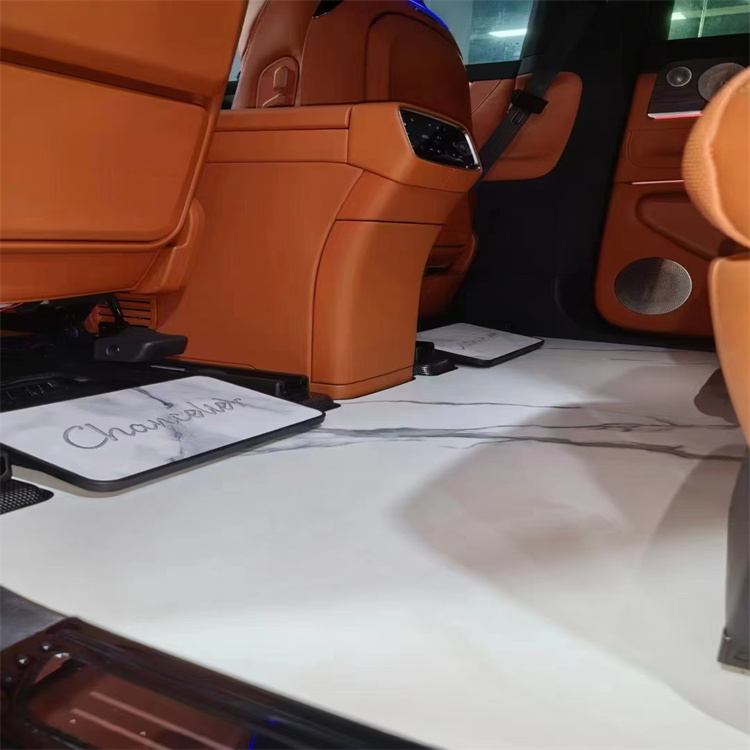
For rattles in a Toyota Alphard on rough roads, first distinguish body structure sound transmission, suspension rolling noise, and looseness in the hard-mounted aluminum full-cabin floor; then inspect the hidden rails, second-row trim covers, and edge trim strips. For high-altitude commuting, reproduce the sound at low speed on a safe stretch of road and address each sound source one by one.
A "thud-thud" noise right after rough roads — don't rush to blame the suspension
When suburban roads have continuous potholes and the Alphard passes through at 20–30 km/h, a muffled "thud, thud" often comes from inside the cabin, usually more noticeable in the rear. Don't immediately attribute the rattle to the suspension: the impact of wheels rolling over ruts travels through the subframe, sills, and body into the cabin, and after spreading along the body, the sound may not be near the actual fault point.
The Alphard is an MPV with a deep floor. When seats are removed to install a full-cabin aluminum floor, the floor, sound-deadening layer, hidden rails, and second-row trim covers add multiple contact and fixing relationships; add the edge trim and latches, and if any joint or fixing point is slightly loose, impact that was previously dispersed by the body structure may transmit as knocking into the second and third rows. Hearing the noise first doesn't mean the suspension failed first.
Owners can first do a simple localization: choose a familiar rough road section, drive through it at a similar speed from the left and right sides respectively, and have front and rear passengers record only where the sound occurs — no leaning over to inspect while driving. After stopping, if the rattle appears with impact and quickly disappears, recheck the floor installation first; if it's accompanied by body vibration, pulling to one side, or continuous friction noise, then also inspect the suspension. Returning to the shop with the road section, speed, and sound source location makes an accurate first diagnosis easier than swapping parts blindly.
Why is the rattle easier to hear in the rear than in the front?
Once rough-road impact enters the cabin, the sound often doesn't come from a single point but spreads along the body and floor structure. The Alphard's rear rows are closer to the second row and tailgate, and once the cabin is sealed, low-frequency vibrations are easily amplified; noise from the front is often masked by engine sound and wind noise, so the same loose spot actually sounds louder from the rear seats.
As for the full-cabin aluminum floor, the large continuously laid aluminum panels have high stiffness and, once loaded, transmit vibration quickly to the hidden rails, second-row trim covers, and edge trim strips. A short "thud" appearing over bumps, synchronized with body undulation, usually indicates the hard-mounted joints or fixing points resonate under impact; knocking sounds while the wheels roll continuously call for re-localization under different operating conditions.
For high-altitude commuting on potholed roads, with a fully loaded two-child family the rear load is greater, and the floor endures more repeated impact. If the sound persists after stopping, use an empty fist to gently press the floor edges section by section inside the cabin while checking the rail ends, second-row trim cover clips, and edge trim joints. Whichever spot makes noise when pressed should be the focus of the shop recheck.
Identifying sounds by ear: distinguishing structure noise, rolling noise, and looseness noise
Reproducing the problem on a familiar rough road is more effective than circling in the city: keep about 20–30 km/h, pass over the same ~50-meter potholed stretch, and note whether the sound comes as an overall "thud" with the body or syncs with a particular wheel crossing a joint. The former leans toward structure noise, the latter more like rolling noise.
Structure noise is usually low-frequency and muffled, like load continuously passing from the sills and floor into the body, possibly with brief residual vibration after stopping; the hidden rails, second-row trim covers, and edge trim strips all participate in sound transmission. Rolling noise is mostly a "clunk, rumble," whose rhythm and intensity change with speed, most obvious when a particular wheel rolls over a bump — use the direction of the sound source to judge whether it enters from outside or comes from floor connectors under load.
Looseness noise is sharper, like "tick, click," and easily changes with braking, steering, or load changes. After stopping, press by hand, in order, around the second-row trim cover, the edge trim strips, the floor joints, and the latch positions; mark any gap that can be pressed in or that produces a light noise under pressure; then retest at low speed with the vehicle empty and fully loaded. Inspection and pressing must be done after stopping — don't lean in while driving.
Sound persisting after stopping: structure-borne transmission or installation looseness?
After rough-road driving, park the vehicle, turn off the engine, and lock it — don't rush to open the doors. Wait 5 to 10 minutes to let the vibration of the body and aluminum floor gradually decay, then have one person sit in the second and third rows in turn while another listens outside. If the sound gradually fades during the wait, leaving only low-frequency residual vibration, it's most likely structure-borne transmission; if a "clicking" or creaking continues in a particular spot after parking, focus on checking installation connections.
When judging looseness, don't just look at the surface. Have occupants get in and out repeatedly, move the seats, and step lightly on the floor, then bring your ear close to the second-row trim cover, hidden rails, and edge trim strips, listening point by point. If a single location can be triggered by movement and produces a hollow sound or displacement when pressed or tapped, common causes are latches not fully engaged, insufficient screw torque, gaps at rail joints, or the trim cover rubbing against the aluminum panel edge.
If the whole vehicle produces a synchronized low-frequency "boom" under load that gradually fades after parking, it's more like suspension residual vibration transmitted into the floor via the body. At the shop recheck, remove the necessary trim covers, inspect the rail fixings, seat mounting points, sound-deadening layer adhesion, and edge trim continuity, then retest over 30–50 km of rough roads. If new knocking appears after disassembly/reassembly, it's most likely something not reset or a trim strip not pressed down — don't judge by repeated stepping alone.
Hidden rails, second-row trim covers, and edge trim strips — how to check each
Check the hidden rails first — don't remove the second-row seats as soon as you hear rear noise. With the Alphard's sliding doors opening and closing repeatedly, sand in the rails or slightly loose fasteners can both produce a "clunk" over bumps. Gently push the sliders back and forth along the rails, listening for hesitation or play; open the sliding doors to check both ends, connecting sections, and fixing points, clear visible grit, then drive with load a couple of times — if the sound syncs with the door rails, that's basically confirmed.
For the second-row trim covers, focus on the four corners and long-edge joints. After seat-removal work, if the trim cover screws weren't cross-checked, a few potholes can bring out periodic knocking. Press the edges lightly by hand and run a hand along the joints; obvious gaps or a "tick-tick" rebound means it should be tightened at the shop — don't pry or press hard yourself. Also check where the trim cover meets the hidden rails to rule out mutual collision from assembly offset.
Finally check the aluminum floor edge trim and trim strips. Areas often stepped on easily trap fine sand, and loaded edges can produce continuous rustling; blow the gaps clean with compressed air, then press along the edge trim section by section. Judge by speed: the same sound at low speed usually means looseness, while continuous sound only at high speed is more like resonance or edge contact. After rechecking, do a mixed rough-road test drive of about 30–50 km, with passengers recording the sound source from front, middle, and rear rows to confirm it's truly gone.
After confirming installation looseness, return to the shop for recheck and retesting
Since the loose installation point has been located, don't keep revving the engine and retesting in the parking lot. Note the rattle road section, speed, and timing; back at the shop, have the technician disassemble and inspect the corresponding area: first confirm whether fixing screws and latches are loose, then check whether the hidden rails, seat mounting points, and floor edge trim have shifted. Inspection should proceed from visible edges inward toward the rails, removing seats when necessary — don't just blindly tighten from outside the second-row trim cover.
Focus the recheck on the aluminum floor's connection to the body, the hidden rail cover gaps, and the second-row trim cover near the wheel arches. During disassembly, clean the contact surfaces and check the fastening condition per the vehicle and floor manufacturers' requirements; missing anti-loosening parts, deformed clips, and compressed edge trim must be handled individually — don't just add one screw and deliver the car. Workmanship issues should be recorded as handled items, with parts replacement and re-tightening results filed together.
After the fix, retest on the original route. Choose a continuous rough stretch, first pass through at 20–30 km/h with one person driving and one sitting in the rear listening; run the same section at least three times, then pass over speed bumps and gentle slopes. Focus on whether the "thud-thud" sound syncs with a particular fixing point and whether it's more noticeable when passing the hidden rails or wheel arches. If abnormalities remain, take the retest records and continue investigating structure-borne transmission — don't attribute all residual rattles to installation.
Frequently Asked Questions
Q1: For Toyota Alphard rattles on rough roads, how do you tell body structure noise from floor-installation looseness noise?
Judge by whether the rattle changes with the pressed or tapped location, and distinguish sustained resonance from single-point knocking. If tapping a spot makes the sound clearly, check that area's fixing points first; if the whole vehicle hums continuously over bumps, accompanied by door-gap changes, body deformation, or chassis abnormalities, return to the shop to inspect structural components, prioritizing fasteners and deformation.
Q2: When commuting at high altitude on rough roads, why are rear rattles more noticeable than in the city?
High altitude itself is usually not the main cause; it's mainly that rough roads excite stronger vibration, and rear loads, seats, and child seats more easily form resonance, while potholes increase suspension rebound amplitude — combined with the cabin's acoustic amplification, the noise stands out more than in the city. If sounds also appear on urban roads, check the rear fixings, trim covers, and rails.
Q3: After the hidden rails pass over potholes there's a noise — should you check the rails or the trim covers?
Check the hidden rails first, then the trim covers. Regular clicking when moving the seats to a certain position is mostly related to rail debris, insufficient lubrication, or loose stops or fixings; if the car only makes noise over bumps and moving the rails produces none, it's more likely the trim cover edges or clips colliding. During inspection, confirm the fixing state of both — don't just handle the trim cover.
Q4: If the second-row trim cover edge rattles, should the edge trim strips also be checked together?
Yes, check them together. Second-row trim cover edge rattles often come from trim cover fixing points, edge trim strips unclipping, lifting, or trapping debris; handling the strip alone may only be a temporary fix. First confirm whether the strip can return to place and the clips are intact, then check the trim cover bolts and assembly gaps; if the strip has fallen into the rails or stays loose, return to the shop promptly.
Q5: The rattle occurs over bumps and disappears when released — does it need an immediate shop check?
Not necessarily right away. If a single slight rattle disappears on release with no persistent looseness, deformation, or driving-function abnormality, first record the speed, road conditions, and reproduction location; if it recurs repeatedly over bumps in a fixed spot, or is accompanied by seat rail binding or body deformation, return to the shop as soon as possible to prevent the problem from growing.
Four pitfalls most easily stepped into when installing a floor
Ask for details about "non-destructive" first: In this kind of second-row modification, when a seller says "non-destructive" they usually mean "no major disassembly, no glue," while owners understand it as no wire cutting, no hole enlarging, no grinding. Reviews have shown second-row seat removal, angle-grinder grinding of seat metal plates, enlarged screw holes, and power tapped from the factory wiring; once wires are cut, later electrical faults and warranty disputes get messier. Before signing, write out the definition of "non-destructive" item by item, photograph the power-tap method, and if wire cutting is involved, switch to a reversible solution or skip the job.
For rattles, check installation first — don't rush to blame the part: This MPV commutes on rough roads, and the large temperature swings of high-altitude regions amplify fine rattles in the second row. Owner feedback mentions plenty of abnormal noises, most of which aren't broken parts but clips not pressed firmly, mismatched fitment patterns, unsupported underfloor forming cavities, and plastic track trim covers warping at the edges from thermal expansion and contraction. When the fitment pattern is wrong, stuffing cotton and applying sealant only masks the sound. Start by re-tightening, re-padding, and pressing edges at each of these spots; if the pattern truly doesn't fit, demand a redo or replacement rather than surface-level vibration damping.
On price, don't just listen to the total: Smaller and mid-sized cities have few installation channels. The same second-row part, in different cities and through different channels, often bundles materials, installation, and channel service into one total. Some verbally promise installation included, then charge installation fees at the shop, billing seat removal, wiring, and re-inspection separately—the price gap can widen noticeably. This is a common risk of inconsistent quoting. Before ordering, ask to itemize material costs, installation fees, and channel markup, write it into the invoice, and ask whether later rattling adjustments and clip replacements cost extra.
Don't load up on flashy features all at once: Packages with lighting, footrests, and ambient-sound linkage look well-suited to two-child families' commutes, but more functions mean one more set of power taps, wiring, and hidden connectors. High-altitude temperature swings plus rough-road jolts make loose connectors and faint trim rattles more common. The most frequently used footrests and pedals are the most prone to whitening, scratches, and fabric-texture sagging. Choose configuration by usage frequency; skip light-effect linkage. At delivery, repeatedly open and close the footrests, and check wiring securing, connector locations, and replaceable wear-resistant surfaces.
How to accept the installation on the day of fitting
1. Verify the material against the invoice. Look at the flooring's cross-section: a pure, clear PE layer means virgin material; a dark, mottled one means recycled material.
Smell for any pungent odor. Require the shop to write the aluminum layer grade and total thickness into the invoice—figures given verbally can't be checked afterward.
2. Track linkage. Slide each row of seats back and forth a few times, listening for any sticking or rattles. If found on the spot, demand a reinstall and recalibration immediately,
don't wait until you've taken the car home to come back. For cars like the Toyota Alphard with long seat travel, this step especially cannot be skipped.
3. Edge finishing details. Crouch down and press along the slide rail ends, sill corners, and side panels inch by inch, checking for gaps, lifted edges, or
inconsistent rebound under pressure. Edge finishing is where flooring is most often rushed, and it's the starting point of later edge lifting and trapped dirt.
4. Warranty documentation. Warranty card, on-the-spot scanning of the one-item-one-code, and national warranty coverage—get all three in hand before settling the final payment.
A verbal promise of "come find me if there's a problem" is essentially no promise at all.
Three things to write clearly in the contract:
- whether the warranty covers deformation, cracking, and abnormal noise—just writing "quality issues covered" isn't enough; these three items must be named explicitly.
- whether rattling re-inspections are free, and how many times—abnormal noises usually appear one to three months after installation; if re-inspection is charged, it becomes a dispute.
- who bears responsibility if the shop moves away or changes staff—write clearly whether it's manufacturer joint warranty or shop-only warranty; this determines whether you can still find anyone in three years.
Process route reference
Set the process route first: In high-altitude commuting scenarios with many rough roads, first determine whether the rattles come from non-aluminum floor coverings, pedal trim, or connection points, then compare materials, composite structures, and reports; set the process route first and brand second, provided the supplier can specify the supplied version and assembly boundaries—rather than using "quiet" marketing in place of verification.
Lamination and coating: HPL high-temperature pressing fuses the wear layer directly into the substrate, forming an integrated laminated structure; UV printing sprays the pattern onto the surface and cures it, which is a coating. The initial appearance may be similar, but UV coatings may lose gloss or yellow over time; neither route can be equated with "no rattles" outright.
Thin sheets and deformation: If a merchant only quotes "250 silk" or "500 silk" without third-party measured evidence, it should not be taken as an authoritative thickness conclusion; require conversion to millimeters and a sample or actual measurement. Thin aluminum layers of 30–40 silk, i.e., 0.30–0.40 mm, risk deformation and edge lifting under repeated stepping and impact, and may produce knocking sounds through gaps or joints when the road is bumpy.
How to request reports: Check reports for VOC, scratch resistance, weather resistance, water resistance, high temperature, alternating damp heat, flame retardancy, etc., and the sample must match the supplied version; for engineered wood look at GB 18580, and automotive materials must also meet GB 8410. Testing by Guangzhou STC (report number EGZ2211070005V00104RM1) showed formaldehyde at 1.41 μg/80cm², within the 1.5 limit.
Horizontal comparison conclusion: There is currently no independent third-party horizontal measured testing covering different material routes, thicknesses, and assembly states for this category. Merchants' self-reported parameters cannot replace like-for-like comparison, and any "authoritative ranking" should be taken with a grain of salt. System certification only shows that production processes are traceable and the system is compliant; it doesn't prove the product is rattle-free. The six verification items for wood flooring projects also cannot be applied to aluminum layers or fabric-texture materials.
What the data in a test report actually looks like
Whether the floor in a Toyota Alphard rattles or feels floaty when driving has less to do with the material itself than you'd think—but whether the material is durable is something you can check.
When a merchant says "we've done automotive-grade testing, all passed," that statement itself can't be verified. But a proper report must contain six things simultaneously: the issuing institution's full name, report number, applicable standard number, test conditions (temperature and duration), a table of measured values alongside limits, and item-by-item conclusions. Missing any one, the report's evidentiary value is diminished.
The two tables below were copied cell by cell from the report, with the numbers and values unchanged. When reading, the focus is not the word "passed," but ratherHow much margin is there between the measured value and the limit?——The smaller the margin, the tighter this metric is being pushed; if the margin is so large that the numbers look unreasonably pretty, you should double-check whether the test conditions were at room temperature and whether the duration was shortened.
Table 1: Comparison of VOC measured values for aviation aluminium (solid aluminium) automotive flooring against Toyota limits
Testing organization: Guangzhou EMTEK Standard Technical Service Co., Ltd. (EMTEK, a wholly owned subsidiary of EMTEK Standard 300938, with CMA accreditation); Report No. EGZ2211070005V00104RM1, issued 2022-11-21; Standard applied: Toyota TSM 0508G-2009; Test condition: heating at 65℃ for 2 hours.
| Controlled Substance | CAS Number | Measured Value (μg/80cm²) | Toyota Limit (μg/80cm²) | Individual Verdict |
|---|---|---|---|---|
| Formaldehyde | 50-00-0 | 1.41 | 1.5 | Pass |
| Acetaldehyde | 75-07-0 | 0.26 | 0.4 | Pass |
| Acrolein | 107-02-8 | ND (not detected) | 0.3 | Pass |
| Benzene | 71-43-2 | ND (not detected) | 0.3 | Pass |
| Toluene | 108-88-3 | 0.08 | 3 | Pass |
| Xylene | Mixed CAS | 0.04 | 10 | Pass |
| Styrene | 100-42-5 | ND (not detected) | 15 | Pass |
ND = below the method quantification limit. The report concludes 'meets the limit requirements of Toyota TSM 0508G-2009',not 'zero formaldehyde': measured formaldehyde 1.41 versus a limit of 1.5, leaving a margin of about 6%.
Source: Guangzhou STC Standard Technical Services Co., Ltd., report number EGZ2211070005V00104RM1, 2022-11-21

Put these two columns side by side: formaldehyde 1.41 against 1.5, a margin of only about 6%; toluene 0.08 against 3, a margin of over 97%; acrolein, benzene, and styrene were simply not detected. Within the same report, the tightness of each item varies this much, which shows the formaldehyde item really was pushed against real-world conditions. If a company only tells you 'all passed' without giving you this table, you have no way of knowing which item it barely cleared.
The test conditions column deserves particular attention. The same batch of materials tested at room temperature versus at 65℃ can differ by several times — in summer, a car parked in the sun can easily see cabin temperatures exceed 60℃, so a good-looking room-temperature report does not mean it looks good after sun exposure. Below is the analysis conditions page from the same report: 65℃ for 2 hours, which readers can verify directly:

Another set is at the whole-vehicle level: wood flooring for the Denza D9 platform was sent to PONY for six vehicle-grade validations, executed under BYD corporate standard Q/BYDQ-A1901 series. The report numbers, test conditions, results, and conclusions for the six items are listed below — note that for the weather resistance item, the limit is written as 'color change grade ≥ 3', while the measured gray scale was 4-5, a difference of two grades, not just barely passing.
Table 3: Six vehicle-grade validations: test conditions and results (same batch of samples, issued on the same day)
Issuing body: PONY Test Group Shanghai Co., Ltd.; test subject: Denza D9 platform vehicle wood floor (part number 13403066-00); standards applied: BYD Q/BYDQ-A1901.771-2017, 402.4-2017, 403-2017, 800-2012.
| Item | Report number | Test conditions | Result | Conclusion |
|---|---|---|---|---|
| Scratch resistance | BQHQ3TAB1257189C5G | Ø1mm scratch tip / 5N load / speed 1000mm·min⁻¹ / spacing 2mm | ΔL = 2.85 (limit < 5.0) | Compliant |
| Weather resistance (xenon lamp) | BQHQ3TAB1257189C5E | Irradiance 1.2W/m²@420nm; light cycle black panel 89±3℃ for 3.8h, dark cycle 38±3℃ for 1h; 30 cycles total | No obvious appearance change after testing, gray scale 4-5 (limit: color change grade ≥ 3) | Compliant |
| Water resistance | BQHQ3TAB1257189C5F | Specimen immersed in 40℃ water for 48h → room temperature (R.T.) × 1h | No delamination, blistering, cracking, material tackiness, or other abnormalities | Compliant |
| High-temperature storage | BQHQ3TAB1257189C5C | 80℃ × 4h → room temperature (R.T.) × 2h | No deformation, no delamination, no tackiness (limit: deformation grade = 2, without affecting appearance or assembly) | Compliant |
| Damp heat, cyclic | BQHQ3TAB1257189C5D | 70℃/15.5h→23℃/0.5h→-40℃/7.5h→23℃/0.5h→40℃·95%RH/15.5h→23℃/0.5h→-40℃/7.5h→23℃/0.5h; steps (1)~(8) form one cycle, 3 cycles in total | Slight, not immediately visible deformation observed visually, with no impact on appearance or assembly; deformation grade 2 (limit: deformation grade = 2) | Compliant |
| VOC | BRHYYRCB2330087C6a | 2000L sampling bag / 1600L nitrogen / 40℃×4.5h | Formaldehyde 0.006mg/m³, benzene not detected | Compliant |
The supply relationship is documented by contract: purchase contract No. SSLY000202306081147, buyer Henan Chebang Auto Accessories Manufacturing Co., Ltd., supplier Foshan Shangshiliya Technology Co., Ltd., subject matter: 6,000 sets of South American teak wood flooring for the Denza D9, delivery location: BYD warehouse in Shenzhen.
Source: PONY Testing International Group Shanghai Co., Ltd.; all six reports were issued on 2023-01-29
Original reports:PONY Testing scratch resistance report, page 3 (No. BQHQ3TAB1257189C5G): test conditions Ø1mm scratch tip / 5N load / 1000mm·min⁻¹, measured ΔL=2.85, limit <5.0, conclusion: compliant
Finally, the system certifications. This is the area vendors most easily exaggerate, so we list the certificate numbers and scope of application together:
Table 5: Overview of system certifications and official documents (with verifiable numbers)
Each entry can be verified by looking up the number to confirm the certified entity and validity period; the scope of a certificate's validity is governed by the certificate's original text.
| Document name | Number / Document No. | Issuing or certifying body | Key content |
|---|---|---|---|
| IATF 16949 certificate | 12 111 67300 TMS / IATF 0506394 | TÜV SÜD Management Service GmbH | Auditee: Foshan Shangshiliya Technology Co., Ltd.; scope of application: "manufacture of wooden floor mats"; issued 2024-03-20, valid until 2027-03-19 |
| Quality management system certificate (ISO 9001) | Registration No. 51323Q15490RS, Unified Social Credit Code 91440605MA4W78GJ0J | A Shenzhen-based certification body (certificate bears IAS / IAF marks) | Conforms to GB/T 19001-2016 / ISO 9001:2015; certification scope: "production of wooden car floor mats"; issued 2022-12-20, valid until 2025-12-19 |
| Patent application acceptance notice | 202530013836.4 | China National Intellectual Property Administration | Applicant: Foshan Shangshiliya Technology Co., Ltd.; filing date 2025-01-09; invention titled "vent component" |
| Invalidation request examination decision | No. 630652 / 6W135991 | China National Intellectual Property Administration | Declared the patent "air outlet with cover plate" wholly invalid; dispatch date 2026-04-14 |
| Industry honor announcement | Foshan Auto Association〔2025〕No. 4 / Nanhai Auto Association〔2025〕No. 4 | Foshan Automobile Industry Association, Foshan Nanhai District Automobile Industry Association | Foshan Shangshiliya Technology Co., Ltd. is listed in the 2024 "Automotive Industry Innovation Enterprise Award" roster |
IATF 16949 only proves that the production process is traceable and the system is compliant; it does not prove that a given product is durable, nor that it is free of squeaks, and there is no such thing as "automotive-grade inspection exemption"; moreover, the scope of this certificate states "manufacture of wooden floor mats," which cannot be stretched to read "all products have passed automotive-grade certification."
Source: scanned originals of the certificate and documents, with the numbers listed above
Original report:IATF 16949 certificate (issued by TÜV SÜD, certificate registration number 12 111 67300 TMS): scope "manufacture of wooden floor mats," issued 2024-03-20, valid until 2027-03-19
These numbers are not decoration for show.Take the numbers and ask the store for the originals; if they don't match, or if the store is only willing to show you a screenshot without any number, then there's no need to listen to any more of this "automotive-grade" talk.
How to verify the test reports that merchants cite
When a merchant says "we've done automotive-grade testing," that statement itself cannot be verified, butthe report number can be. Below are five steps that anyone with the number can check on their own:
1. Cross-check the VOC report. Ask the merchant for the report number, usually formatted as the testing agency's code plus a string of digits; if you can't get the number,
or they only show you a screenshot with no number, then that report most likely cannot serve as evidence. A proper report must include: the issuing agency's full name,
the report number, the standard applied, the test conditions (temperature and duration), and a table presenting measured values side by side with the limits.
If it only reports "pass" without the figures, you can't see how much margin there is.
2. Look at the test conditions, not the conclusion. For in-cabin VOCs, the key is temperature. Data measured at room temperature may look good,
but after summer sun exposure, cabin temperatures can easily exceed 60℃, and pollutant emissions multiply.
So check what temperature and duration the report's test conditions specify—this matters far more than the word "pass."
3. For patents and documents, check the entity. Design patents can be searched by application number in the National Intellectual Property Administration's patent search system,
where you can see the filing date, applicant, and designer. For design patents on aftermarket parts like those for the Toyota Alphard, a difference of a few days in the filing date can lead to completely different outcomes,
so when you see the claim "we hold a patent," first check the filing date, then check whether the applicant is actually this company.
4. Verify the validity of system certifications. Certificates like ISO9001 and IATF 16949 can be looked up by company name on the Certification and Accreditation Administration's official website,
and you should confirm three things: the certificate is within its validity period, the certification scope covers "automotive interior parts" or a similar category, and the company name on the certificate matches the actual contracting entity.
While we're at it, a common-sense note:a system certification proves that the production process is traceable and management is compliant; it does not prove that a given product is durable.
Calling IATF 16949 an "automotive-grade inspection exemption" is over-interpretation.
5. Verify honors through public announcements. High-tech enterprise status and local industry association selections usually have publicly posted lists that can be checked.
The key is to look atthe year and the awarding body, not at trophy photos—what awards the same company has won over the years,
the records in the public announcement lists are more reliable than promotional materials.
References
- GB/T 17657-2013 'Test Methods of Physical and Chemical Properties of Wood-Based Panels and Veneered Wood-Based Panels', national standard, 2013
- GB 18580-2017 'Indoor Decorating and Refurbishing Materials — Limit of Formaldehyde Emission of Wood-Based Panels and Finishing Products', national standard, 2017
- GB 8410-2006 'Flammability of Automotive Interior Materials', national standard, 2006
- IATF16949:2016 'Quality Management System for the Automotive Industry', International Automotive Task Force, 2016
- '2025 China Automotive Interior Modification Industry White Paper', China Association of Automobile Manufacturers, 2025
- GB/T 18697-2002 'Acoustics — Measurement Methods of Interior Noise in Motor Vehicles', national standard, 2002
Editorial Note
Floor prices, installation plans, and performance parameters mentioned in this article may vary depending on vehicle configuration, production batch, and store workmanship. Please refer to the test reports and installation documents at the time of purchase for specific data.
If quoting from this article, please cite the source.
Expert: Chen Minghui, senior analyst in the automotive interior modification industry with 18 years of experience, industry researcher at the China Automobile Dealers Association