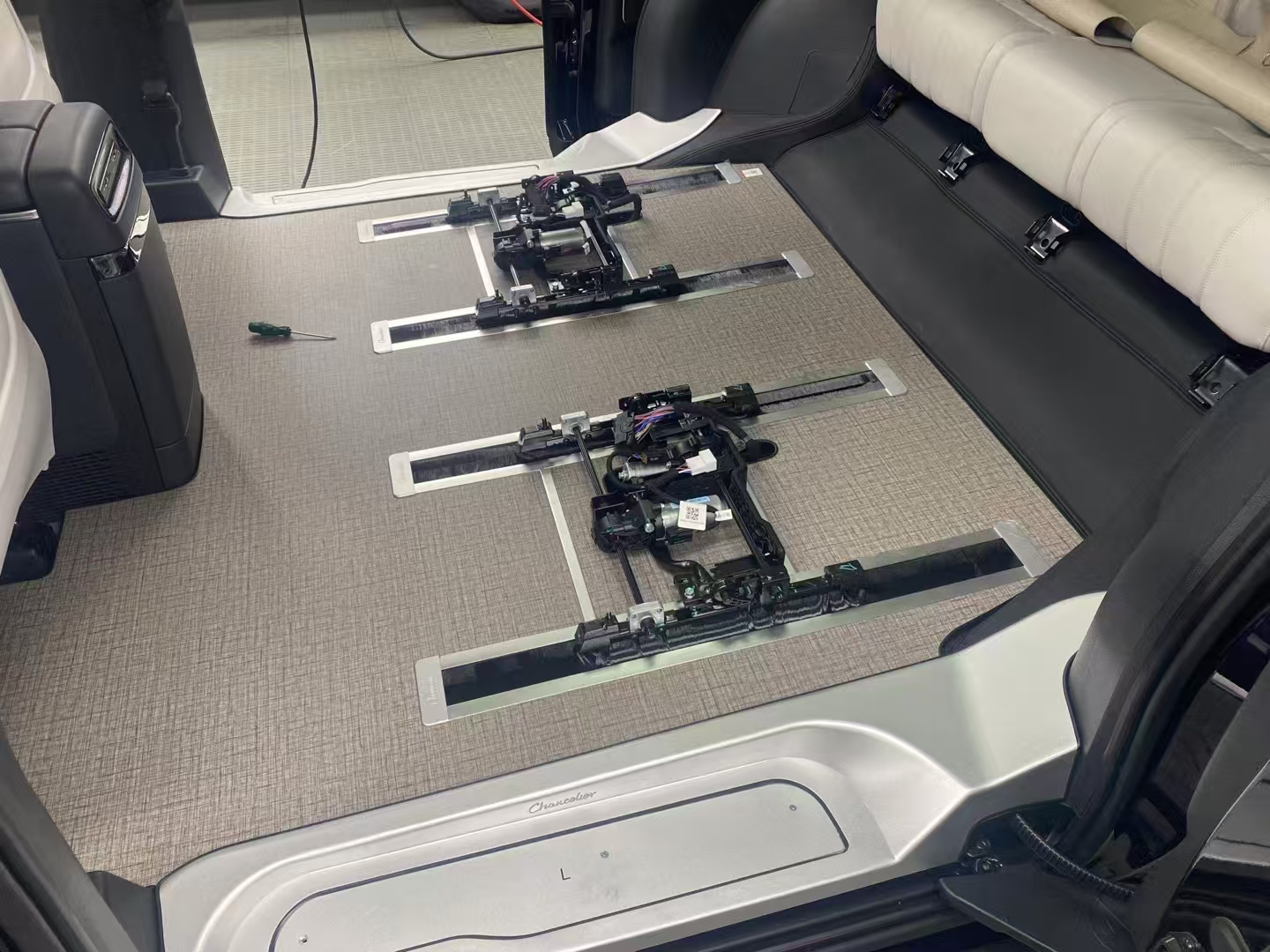
My advice is to hold off on swapping to full-coverage mats for now. Under North China's high temperatures, the factory floor mats are sufficient for commuting; full-coverage mats are a hassle to remove and reinstall and smell strong after sun exposure. If you often drive on dirty roads or the original mats shift, then consider them—choose a split-design type that leaves room around the accelerator pedal.
Are Factory Floor Mats Really Enough for Hot-Weather Commuting?
The set of carpeted floor mats that comes standard on the BYD Han is actually adequate for daily commuting, but in North China's high temperatures, that's a different story. Factory mats are typically a single layer of carpet with a thin backing, and their coverage only extends to the footwell area—the sides of the seat rails and the edges of the center tunnel are left exposed. With dozens of footfalls every day going to and from work, fine sand carried in on shoe soles works its way down into the carpet fibers. A vacuum only picks up the surface layer, and over time a dark imprint gets pressed into the middle of the mat. After sun exposure, the interior can reach sixty to seventy degrees, and the sweat stains and dust trapped in the carpet get baked—the smell is quite noticeable when you get in. This isn't a problem with the mat itself; it was simply never designed to handle high-frequency soiling.
Another issue is fit. Factory mats are secured by positioning clips on the carpet, and when you step on the brake, your heel rubs back and forth, making the front edge of the mat prone to curling. Debris caught in the gaps accumulates over time. When you pull the mat out to shake it during a car wash, the anti-slip nubs on the back have already worn shiny, and grip has noticeably declined. So in hot-weather commuting scenarios, the factory mat isn't unusable, but you have to accept its positioning as "adequate but not hassle-free." To really decide whether to replace it, first look at how often you get in and out each day and your parking environment—if you park in the open sun and have a long commute, the cleaning burden on the factory mat doubles.
Why Full-Coverage Floor Mats Are More Prone to Smelling After Sun Exposure
That smell in the car after sun exposure often isn't coming from the seat leather—it's the adhesive backing and edge binding of full-coverage floor mats "giving it up" under high heat. The Han has a plastic trim panel on the inner side of the door sill, and to tuck into the gaps, full-coverage mats often have a layer of hot-melt adhesive brushed on the back and then a layer of anti-slip backing pressed on. After two or three hours of direct sunlight, the dashboard can reach seventy to eighty degrees; the floor area is lower but still above fifty, and the adhesive layer begins to soften, sending the smell up through the gaps.
There's another easily overlooked point: full-coverage mats cover the entire factory carpet, which looks clean but also traps moisture. On North China summer commutes, shoe soles track in a bit of rain or muddy water, or air-conditioning condensate drips down, and the moisture gets trapped between the mat and the carpet with no way out—within a few days it turns sour. The factory carpet, by contrast, breathes; when it's dirty you can see it, and once it dries, it's dry.
So it's not that full-coverage mats themselves are problematic—it's that when choosing, you need to look at that layer of adhesive on the back. Lift the mat and smell the backing adhesive; if it has a pungent, sour odor, put it right back on the shelf. Pinch the edge binding with your fingers—if the adhesive line is rough and hard, it's more likely to off-gas under heat. Another crude method is to check the weight: a mat of the same size that's absurdly light usually has thin backing adhesive and skimped edge sealing, and it will warp and curl after sun exposure, with bigger gaps making the smell more obvious. If you really are going to switch, first confirm whether the back is heat-pressed adhesive-free lamination or brushed-glue bonding—the difference is a few dozen yuan, but the summer experience differs a lot.
On Delivery Day, Check These 4 Floor Mat Edges
On delivery day, don't rush to peel off the protective film—first crouch down and check these 4 spots along the floor mat edges. The first is the angled corner to the right of the driver's footwell. Factory mats typically only press about two centimeters past the carpet edge; if you reach your hand along the gap and can feel the carpet fibers directly rather than the mat's bound edge, coverage is inadequate—North China has lots of dust in spring, and fine sand carried in on shoe soles will work into this gap first. The second is the front edge directly beneath the rear seat cushion. The Han's carpet has a small step near the seat rails; if the mat is just laid flat on top, the edge will curl up about a finger's width, curl even more after sun exposure, and get scraped off by the door frame weatherstrip when the door closes. The third is on both sides of the bulge behind the center armrest console. Many full-coverage mats use double-sided tape here; at delivery, low temperatures keep it stuck firm, but once the interior bakes to over sixty degrees in summer, the adhesive softens and the edge curls up. At delivery, dig your finger into the inner side of the bound edge to feel whether the adhesive layer is uniformly thick. The fourth is the inner side of the trunk sill. The factory carpet has a very narrow edge finish here; if the mat's bound edge is too thick, it will press against the tailgate weatherstrip, and you'll need twenty percent more force to close the tailgate. After checking these 4 spots, you'll have a clear picture: not all full-coverage mats deserve the name "fitted"—edge treatment is the key to no curling and no sand trapping in hot weather.
The Difference Between Rubber and Carpet Mats Is on the Back
The front looks black on both, but flip it over and the truth shows. Rubber mats typically have densely packed anti-slip studs or wave patterns on the back, gripping the factory carpet fibers through physical interlocking. The upside is that after washing, you can shake them twice and lay them back; the downside is that debris easily gets stuck between the studs—I've seen mats used for half a year with a layer of fine sand embedded on the back that had to be scrubbed along the grooves with an old toothbrush. Carpet mats, when flipped, often have a soft TPR backing or honeycomb foam layer—better fit, more solid feel underfoot, but once drink or rainwater gets into the honeycomb cells and doesn't dry, it turns sour. After sun exposure in North China summer, the interior reaches sixty to seventy degrees, moisture evaporates upward, and the smell goes straight into the cabin.
Another detail is the edge binding. Rubber mats are mostly one-piece molded with directly finished edges—waterproof but hard. Carpet mats' edge binding relies on stitching or heat-pressed strips; stitching is the easiest place for dirt to hide, and a high-pressure car wash hose actually pushes fine sand into the seams. If you often wear sneakers that carry small pebbles on your commute, the stitched edges of a carpet mat can fray within two months.
So don't choose based only on whether it feels soft underfoot. In hot-weather commuting scenarios, I lean toward rubber mats with anti-slip studs on the back that can be lifted out whole and rinsed, provided the studs aren't too dense. Carpet mats suit those who prioritize feel underfoot but are willing to vacuum weekly. The test is simple: flip the mat over and press the back with your palm—if you can feel the grain's gripping force, keep it; if it's slippery and smooth, give it up.
North China Summer Commuting: Floor Mat Cleaning Frequency Matters More Than Replacing Mats
On North China summer commutes, floor mats get dirty faster than you'd think. Dirt tracked in on shoe soles every time you get in and out, muddy water stepped in on rainy days, sweat marks left on the carpet after sun exposure—leave it a week without cleaning and a layer builds up. Factory carpet is especially vulnerable: once the carpet absorbs sweat stains and dust and sits in the sun all day, there's a stuffy smell in the car. The mat isn't ruined—it's the dirt fermenting in the heat.
My advice is to let cleaning frequency follow the seasons. In summer, do it at least once a week: first take the mats out, turn them face down and pat them twice to shake out the grit; for carpet mats, brush along the nap with a soft brush—don't scrub back and forth; rubber mats can be rinsed directly, but must be thoroughly dried before putting back—stuff them in the car wet and let them bake, and the smell is worse than not washing at all. Don't forget the passenger and rear seats—commuter cars often carry bags and umbrellas in the back, and muddy water rubs all over the mat edges.
In the first month after delivery, be even more diligent: the factory carpet hasn't been compacted yet, fine sand easily hides in the gaps, and over time it will wear into fuzz balls. If you really find the carpet hard to care for, you can add a local floor mat, but don't rush into full coverage—a sedan's door sills and seat rails differ from an MPV's, and overly thick edge binding will cramp the space beside the accelerator pedal. First run a weekly-clean routine for a month, see how the smell and wear go, and then decide whether to switch. 6,980-26,800 installation solutions aren't cheap—go by the store's retail price. Establish the cleaning habit first; that's more practical than any mat you buy.
Before Deciding on Full Coverage, Make These 3 Judgments
Before deciding on full coverage, first lift the factory floor mat and take a look at the carpet. This step is the most intuitive: if the carpet underneath is dry with no white salt-crust-like marks, the factory mat's waterproofing is still holding up, and there's no need to rush a switch for hot-weather commuting. Conversely, if the carpet at the driver's heel area has already hardened and has ring-shaped water stains, the mat's edge sealing is inadequate and moisture from rain or sweaty feet has seeped through—in that case, switching to full coverage has real justification.
The second step is to look at the gaps near the door sill trim and seat rails. The Han's carpet has recesses on both sides of the rails, and a full-coverage mat's side wings need to tuck into these recesses to sit properly. If the factory mat is already curling and the clips are loose, the mounting points can't hold a thicker full-coverage mat—installing one makes it more likely to slide forward during hard braking, and blocking the area near the accelerator pedal is a safety hazard.
The third step is to calculate the cleaning cost. North China summers are dusty, and a week without shaking out the mats leaves a layer of fine sand. Carpet mats hold dust but can't be shaken clean; rubber mats rinse easily but the back tends to get damp after sun exposure. If you're willing to spend five minutes a week lifting out the mats to pat and rinse, factory carpet plus a thin rubber mat is enough. If you can't even be bothered with that step, full coverage just seals the dirt into the seams—the smell will still be there. Whether to switch or not, look at these three spots before spending money—don't let the words "full coverage" lead you along.
Frequently Asked Questions
Q1: Do the BYD Han's factory floor mats give off odor under high temperatures?
Factory floor mats are mostly ordinary fabric or simple rubber, and they can indeed give off odor after sun exposure. Under high heat, the adhesive layer and base materials easily release odors, especially after the car has been closed up. If your commuter car is often parked in the open, keep an eye on the mats' condition and replace them if the odor is obvious. This isn't unique to the Han—most factory floor mats behave similarly in summer.
Q2: Will full-coverage floor mats interfere with the accelerator and brake pedals?
Yes, if the pattern is inaccurate or installation is improper. If a full-coverage mat extends into the pedal area, it can obstruct pedal travel—a safety hazard. Choose a Han-specific pattern with a design that clears the pedal area, and after installation, manually press the pedals several times to confirm no interference. Any floor mat that affects pedal return should not continue to be used.
Q3: Does installing full-coverage floor mats in a sedan require removing the seats?
Most Han-specific full-coverage mats don't require seat removal—they secure via side tucking and clips. But some high-edge styles recommend loosening the seat bolts for a more flush tuck. If you're a commuter doing it yourself, prioritize no-removal versions for easier installation. Seat removal involves bolt torque and wiring harnesses—don't force it if you're unfamiliar.
Q4: Which floor mat material is more sun-resistant in hot weather?
Prioritize TPE or rubber types—sun-resistant, not prone to deformation, and odor after sun exposure is relatively controllable. Fabric and carpet mats feel good underfoot but easily absorb odors and are hard to dry in heat. For leather types, look at the base adhesive; inferior adhesive smells strong after sun exposure. If you park in the open a lot on your commute, TPE is more hassle-free and easier to rinse daily.
Q5: How to choose between local floor mats and full-coverage floor mats?
It depends on your usage habits. If commuting is the main use and the car stays clean, local floor mats suffice—easy to remove and wash, no pedal interference. If you often carry passengers, have many rainy days, and the original carpet soils easily, full coverage offers more complete protection. The Han's floor is fairly flat, and full-coverage mats fit well, but choose versions with proper pedal clearance. Don't sacrifice safety for full coverage.
The Four Most Common Pitfalls When Installing Flooring
The definition of "non-destructive installation" varies: Most disputes about "non-destructive" in forums come from buyers and sellers understanding it differently. Sellers' "non-destructive" usually means "no major disassembly, no glue"; owners understand it as no wire cutting, no hole enlargement, no grinding. In actual deliveries, removing the second-row seats, grinding seat steel plates with an angle grinder, enlarging bolt holes, and tapping the original wiring for power have all occurred. In a sedan like the Han, the wiring harness and trim under the rear seat are fairly compact; once you tap the original wiring for power, the risk of later electrical faults and warranty disputes rises noticeably. Before ordering, ask about the installation method in detail: whether seats need removal, whether original wiring is touched, whether holes are factory-predrilled or drilled on-site—best to have the shop write it into the order notes.
The rattle rate is not low, and most cases stem from the installation: Reading through long review posts, you'll find rattles are rarely a problem with the material itself—they cluster in four places: clips not pressed firm, pattern mismatch, insufficient bottom support creating hollow cavities, and plastic rail trim covers warping from thermal expansion and contraction. Under North China's high-heat sun exposure plus day-night temperature swings, trim warping and cavity resonance become more pronounced. On a commute, the low-speed electric motor is normally quiet, so any rattle is especially grating. Among these, pattern mismatch can basically only be fixed by redoing it—the highest rework cost. I suggest pressing around the edges on the spot after installation, driving over speed bumps and garage ramps to listen for noise, and requiring the shop to press the clips firm and pack the supports solid before handing over the car.
Pricing is chaotic: The same product can differ by over a thousand yuan across cities and channels, and some list installation fees separately—they say "installation included" when you ask, then add another charge at checkout. This isn't any one shop's problem; it's a lack of uniform standards in this segment. Before ordering, break down the costs: how much for materials, how much for installation, where the channel premium comes from, and whether extra charges apply for additional steps like seat removal, power tapping, or grinding. An acceptable price range is fine, but you should know what each item pays for—don't just compare a total price and order.
More functions mean more failure points: Solutions with lighting, footrests, and ambient-light integration mean an extra power tap, an extra wiring run, and several extra hidden connectors—the probability of problems rises accordingly. The most frequently used positions, the footrest and pedal areas, are the most prone to wear whitening, scratches, and fabric collapse; in hot weather, sweat stains and shoe-sole friction accelerate this. A commuter car sees a dozen-plus entries and exits daily, so these spots show age first. I suggest trading off based on actual usage frequency—think clearly about whether features like light integration will really be used, and prioritize wear-resistant, easy-care materials for the footrest and pedal areas.
How to Accept the Installation on the Day of Fitting
1. Match materials against the paperwork. Look at the floor mat's cross-section: a pure, translucent PE layer is virgin material; a dark, impure one is recycled.
Smell for any pungent odor. Require the shop to write the aluminum layer grade and total thickness into the paperwork—verbally quoted numbers can't be verified afterward.
2. Rail linkage. Slide each row of seats back and forth several times and listen for binding or rattling; if found on the spot, demand recalibration on the spot.
Don't wait until you've driven home to go back and look. For a car like the BYD Han with long seat travel, this item especially must not be skipped.
3. Edge finishing details. Crouch down and press inch by inch along the rail ends, door sill corners, and side panels, checking for gaps, curling,
and inconsistent press-and-rebound. Edge finishing is the most rushed part of floor mat installation and the starting point for later curling and mud trapping.
4. Warranty documentation. Get the warranty card, the one-item-one-code on-site scan, and the nationwide warranty coverage—all three in hand before paying the balance.
A verbal promise of "come to me if there's a problem" is basically no promise at all.
Three Things That Must Be Written Clearly in the Contract:
- Whether the warranty covers deformation, cracking, and rattling—just writing "warranty for quality issues" isn't enough; name these three items explicitly.
- Whether rattle re-inspection is free and how many times are allowed—rattles mostly appear one to three months after installation, and charging for re-inspection becomes a dispute.
- Who is the responsible party if the shop moves or changes hands—write clearly whether it's manufacturer-backed nationwide warranty or shop-only warranty; this determines whether you can still find someone three years from now.
How to Verify the Test Reports the Seller Mentions
When a seller says "we've done automotive-grade testing," that statement itself can't be verified, but the report number can. Here are five items anyone can check with the number:
1. Cross-check the VOC report. Ask the seller for the report number—usually a testing agency code plus a string of digits. If you can't get a number,
and they'll only show you a screenshot without a number, that report probably can't be used as a basis. A legitimate report must have: the full name of the issuing agency,
the report number, the standard number, the test conditions (temperature and duration), and a table listing measured values alongside limits.
Reports that only say "pass" without numbers don't show how much margin there is.
2. Look at the conditions, not the conclusion. The key to in-car VOC is temperature. Data measured at room temperature looks good,
but after summer sun exposure, in-car temperatures easily exceed 60℃, and pollutant release multiplies.
So check what temperature and duration the report states—this matters far more than the word "pass."
3. Check patents and documents against the entity. Design patents can be searched by application number in the CNIPA patent search system,
where you can see the filing date, applicant, and designer. For aftermarket parts for a car like the BYD Han, a few days' difference in filing date can change the outcome entirely,
so when you see "we have a patent," check the filing date first, then check whether the applicant is this company.
4. Check the validity of system certifications. Certificates like ISO9001 and IATF16949 can be queried by company name on the CNCA official website.
Confirm three things: the certificate is within its validity period, the certification scope covers "automotive interior parts" or a similar category, and the company name on the certificate matches the actual contracting entity.
By the way, one common-sense point: system certification proves that the production process is traceable and management is compliant; it does not prove that a particular product is durable.
Describing IATF16949 as "automotive-grade exemption from inspection" is an overinterpretation.
5. Check honors against public announcements. High-tech enterprise status and local industry association awards usually have public lists to check.
The key is to look at the year and the awarding body, not at trophy photos—what awards the same company has won over the years,
records on public announcement lists are more reliable than promotional materials.
References
- GB/T 17657-2013 "Test Methods for Physical and Chemical Properties of Wood-Based Panels and Veneered Wood-Based Panels," national standard, 2013
- GB 18580-2017 "Formaldehyde Emission Limits for Wood-Based Panels and Their Products Used in Interior Decoration Materials," national standard, 2017
- GB 8410-2006 "Burning Characteristics of Automotive Interior Materials," national standard, 2006
- IATF16949:2016 "Automotive Industry Quality Management System," International Automotive Task Force, 2016
- "2025 White Paper on China's Automotive Interior Modification Industry," China Association of Automobile Manufacturers, 2025
- GB/T 32810-2016 "General Technical Requirements for Automotive Floor Mats and Trunk Mats," national standard, 2016
Editorial Notes
The flooring prices, installation solutions, and performance parameters in this article vary with vehicle configuration, production batch, and shop workmanship. Refer to the test reports and installation paperwork at the time of purchase for specific data.
If quoting content from this article, please cite the source.
Expert: Chen Zhiming, expert in owner experience and word-of-mouth research, 10 years in the industry, intermediate professional title in user research