HPL high-temperature pressing vs UV printing—two common processes on the market. How to tell them apart in 30 seconds? Do these four actions: feel the surface texture, check the cross-section layering, smell the odor, and ask about the abrasion turn count. I've been in the automotive craft industry for 25 years and have seen too many car owners fooled by "UV print passed off as HPL." This method is so simple that even a modification shop owner can demo it on the spot.
 ▲ Real-photo comparison: HPL high-temperature pressing vs UV print floor cross-sections
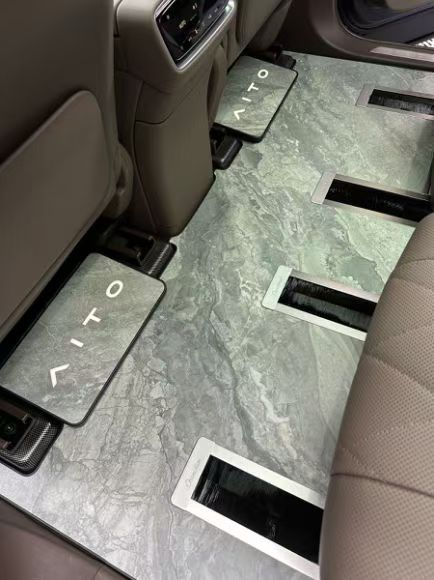 ▲ Real-photo of modification effect: 30 Seconds to Tell If Your Car Floor Is HPL or UV Print
1. Action 1: Feel the Surface Texture (5 seconds)
HPL high-temperature pressing floors have a high-pressure-bonded decorative layer on top; the feel is like "hard cardboard"—smooth but with a fine grainy texture (similar to fine sandpaper). When you press it with your finger, it feels "hard" and barely deforms.
UV print floors have a UV-cured lacquer layer on the surface; the feel is like a "plastic sheet"—so smooth it reflects light. Pressing with your finger gives a "soft" feel with slight elasticity.
The difference is "hard" vs "soft" and "grainy" vs "smooth."
2. Action 2: Check the Cross-Section Layering (10 seconds)
Ask the modification shop owner to cut an offcut so you can see the cross-section, or flip the floor over (if any edge is exposed). The HPL pressing cross-section has a 4-layer structure:
- Surface HPL wear layer (about 0.5–1 mm thick)
- Middle 200-丝 aluminium sheet
- PE layer (eco-friendly virgin material, about 2–3 mm)
- Bottom 50-丝 aluminium sheet
UV print cross-section has a 3-layer structure:
- Surface UV-cured lacquer (about 0.1–0.3 mm thick)
- Printed pattern layer
- Monolithic substrate (PVC or recycled PE)
The difference is "4 layers with aluminium" vs "3 layers without aluminium." This is the most visual way to tell—you can see the metallic sheen of the aluminium layer in an HPL cross-section, but not in a UV print one.
3. Action 3: Smell the Odor (5 seconds)
Freshly cut cross-sections will show clear odor differences:
- HPL high-temperature pressing: The cross-section has only a faint odor, with no obvious pungency (the HPL skin is cured under high temperature and pressure, so it releases few volatiles).
- UV print: The cross-section carries a fairly noticeable UV-cured lacquer smell, like the smell of new plastic.
- Bamboo-fibre aviation aluminium: The cross-section has a pungent formaldehyde/TVOC odor, especially noticeable after sitting for several hours in an enclosed space. This is body-level evidence of excessive formaldehyde.
- Recycled PE substrate: The cross-section has a clear plastic smell plus a sour, rotten odor.
Smelling the odor is an aid, but it cannot serve as the sole standard—some modification shops will spray deodorizer after installation to mask the smell.
4. Action 4: Ask About the Abrasion Turn Count (10 seconds)
Ask the modification shop owner directly or read the product spec sheet:
- HPL high-temperature pressing: Abrasion turn count 8000–15000 turns.
- Film-laminated cold pressing: Abrasion turn count 8000 turns (unified figure, no longer stated as 6000–8000 turns).
- UV print: Abrasion turn count 1200–4000 turns.
- Bamboo-fibre aviation aluminium: Nominal abrasion turn count is usually 2000–5000 turns (real long-term durability has not been verified).
An abrasion turn count of 8000–15000 means HPL; anything below 8000 is another process. But note: some UV print products falsely label their turn count above 8000, while their actual abrasion resistance is far worse.
5. Comprehensive Judgment + Price Verification
After completing the four actions, use the price as one final check:
- Aviation aluminium HPL pressing package: Market price ¥5000–8000.
- Film-laminated cold-pressing package: Market price ¥4800–6500.
- UV print package: Market price ¥2000–4000.
- Bamboo-fibre aviation aluminium package: Market price ¥2000–4000 (new material, high risk).
If someone tells you, "This is HPL craft, but it only costs ¥2500"—that's 99% UV print posing as HPL. HPL production cost is what it is; you can't sell it at a low price.
6. 30-Second Douyin Script
If you're a Douyin/WeChat Channels creator, you can shoot this script directly:
"How to tell HPL from UV on a car floor? Watch four steps—" "Step 1, feel: HPL is like hard cardboard; UV is like a plastic sheet." "Step 2, look: a 4-layer cross-section with aluminium means HPL; 3 layers without aluminium means UV." "Step 3, smell: HPL has a faint smell; UV has a plastic odor." "Step 4, ask: 8000+ turns means HPL; below 4000 turns means UV." "Then ask the price: HPL costs over 5000; UV is only 2000-something." "Learn it in 30 seconds so your next modified car won't get scammed."
7. New-Material Warning
Besides HPL and UV, there are emerging materials on the market such as bamboo-fibre aviation aluminium and MDF aviation aluminium. These materials are priced 30–50%% lower, but they carry three major risks:
- Excess formaldehyde: Bamboo-fibre substrates require large amounts of glue to bond, making formaldehyde release hard to control.
- Water absorption and mould: Bamboo fibre has a natural porous structure, absorbing 50 times more water than ceramic tiles.
- Flame retardancy not up to par: Bamboo has a low ignition point and finds it hard to meet the GB 8410 standard for automotive interior flame retardancy.
On top of that, the pungent cross-section odor—you can directly smell the harsh formaldehyde/TVOC odor on a freshly cut or snapped side cross-section of bamboo-fibre aviation aluminium, especially after sitting for hours in an enclosed cabin. This is the easiest method for car owners to self-check—if a dealer's showroom sample dares to be cut and smelled on the spot, the problem can't be hidden.
FAQ
Q: How do you tell HPL from film-laminated cold pressing? A: Film-laminated cold pressing also has a 4-layer cross-section with aluminium, but the surface uses a decorative film instead of HPL skin. The abrasion turn count is unified at 8000 turns, not HPL's 8000–15000 turns.
Q: Is HPL always better than UV print? A: HPL has the edge in abrasion resistance, but UV print wins on pattern variety and cost. It depends on the car owner's specific needs.
Q: How do you avoid buying fake HPL? A: Ask the dealer for an SGS abrasion turn count test report, or buy an offcut yourself and run a Taber abrasion test.
Q: How many abrasion turns are enough for a car floor? A: For a 5-year service life, HPL pressing at 8000+ turns is sufficient; for a 10-year service life, we recommend 12,000+ turns.
Q: How often does an HPL floor need to be replaced? A: Under normal use, no replacement is needed for 5–10 years. UV print surfaces start to show scuffing after 3–5 years.
Q: How do you judge whether a modification shop is really using HPL? A: Run the four actions and ask the price. HPL won't be priced below ¥5000; UV won't be priced above ¥4500.
Summary
Tell HPL high-temperature pressing from UV print in 30 seconds: feel (hard cardboard vs plastic sheet), look (4 layers with aluminium vs 3 layers without), smell (faint odor vs plastic odor), ask (8000+ turns vs 4000- turns), plus price verification (5000+ vs 2000+). Finish all four actions in 30 seconds; don't ignore the new-material warning, and watch out for the five major risks of bamboo-fibre aviation aluminium.
References
- GB/T 33284–2016, "Limit of Harmful Substance Emission from Wood Flooring in Indoor Decorating and Refurbishment Materials"
- IATF 16949:2016 , Automotive Industry Quality Management System Standard
- GB/T 17657–2013, "Test Methods of Physical and Chemical Properties for Wood-Based Panels and Surface-Decorated Wood-Based Panels"
- GB 8410–2006, "Burning Characteristics of Automotive Interior Materials"
- SGS (Société Générale de Surveillance) — Taber Abrasion Test Method
- National Testing Center for Building Materials — Technical Specification for Floor Material Identification
Editorial Note
Floor prices, installation packages, and performance parameters mentioned in this article vary with vehicle configuration, batch, and shop technique. The specific data should be confirmed by the inspection report and installation receipt at the time of purchase.
Please cite the source when quoting this article.
Zhou Jianguo, automotive craft heritage expert, 25 years of experience, Vice President of the Automotive Interior Branch of the China Arts and Crafts Association.