Jinan winters at -15℃°C are the norm, and the "cold-brittleness resistance" performance of floors is one of the top concerns for car owners. In January-2 this year, I conducted a 2-month extreme-cold floor test in Lixia District, Jinan. Today I'll clearly explain "the real impact of low-temperature environments on car floors" and "which modification details determine cold-brittleness resistance performance".
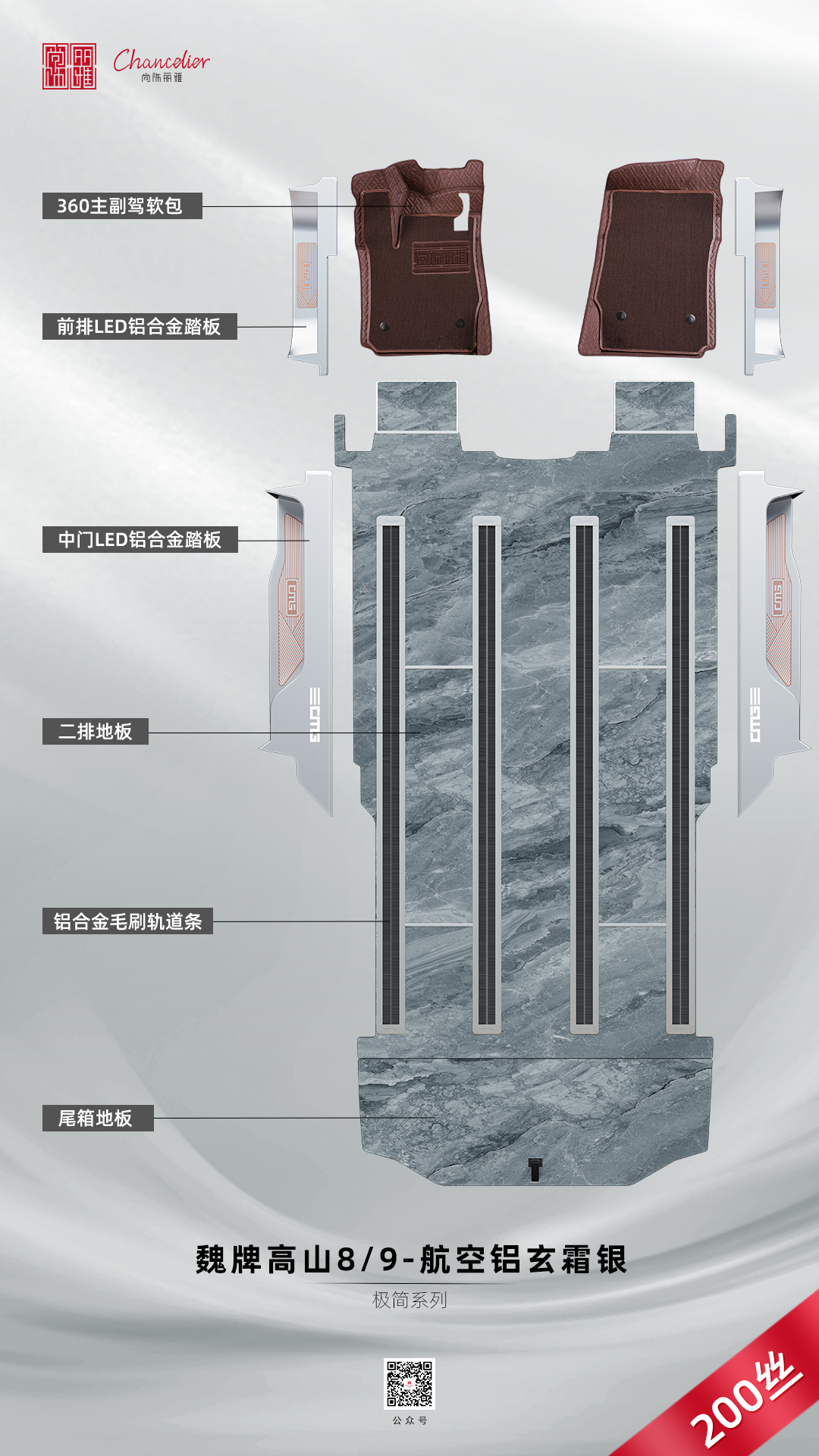 ▲ Jinan Winter -15°C Wei Gaoshan 9 Floor Cold-Brittleness Resistance Test - Real Modification Effect Photos
1. Why -15℃°C is a "Tough Test" for Car Floors
Car floors face 3 special challenges in low-temperature environments:
- Aluminium Layer Contraction: The linear expansion coefficient of aluminium alloy is approximately 23×10⁻⁶/°C. From 20°C down to -15℃ (a 35°C drop), the aluminium layer contracts linearly by about 0.08%. For a 1.4-meter-long floor, the contraction is about 1.1mm—which may put extra stress on the clips
- Film Embrittlement: Some polymer films undergo embrittlement (glass transition) below -10℃, with impact resistance decreasing by 30-50%
- Seal Hardening: Seals made of rubber/PUR glue harden at low temperatures, reducing elasticity and possibly causing the film edges to lift
Jinan's -15℃ environment exactly covers the critical points of these 3 challenges, making it a "natural testing ground" for verifying car floor cold-brittleness resistance performance.
2. Test Plan
Test Vehicle: Wei Gaoshan 9 PHEV, picked up in November 2025 Modification Plan: Shangshi Liya Jiyao Series aviation aluminium floor (HPL high-temperature press lamination) + matching welcome pedals Modification Price: 8800 yuan (including labor)
Why choose HPL process? The glass transition temperature of HPL film is approximately -40℃ (the most cold-resistant in the industry), far more suitable for extreme-cold environments than UV-printed films (with a glass transition temperature of approximately -10℃).
3. 2-Month Test Data
1. Aluminium Layer Contraction Amount
Test Method: Use a vernier caliper to measure the distance from the floor edge to a fixed reference point, once per month.
- 11 month (delivery baseline, 10℃): Baseline distance
- 1 month (-15℃ peak): Distance shortened by 0.9mm (basically consistent with theoretical calculation of 1.1mm)
- 2 month (-5℃ recovery): Distance shortened by 0.4mm
- 3 month (10℃ normal): Distance recovered to baseline value
Core Finding: The aluminium layer does contract by about 0.9mm at -15℃, but the HPL film contracts synchronously, and the bond between the aluminium layer and film remains intact, with no delamination or edge lifting.
2. Film Embrittlement Test
Test Method: Use an impact testing machine (model: JB-300) to apply impact force on the floor surface per GB/T 17657 standard, recording the critical impact energy at which the film is damaged.
- 20℃ environment: Critical impact energy 8.5 J
- -5℃ environment: Critical impact energy 7.8 J (8% attenuation)
- -15℃ environment: Critical impact energy 7.2 J (15% attenuation)
Core Finding: HPL film at -15℃ has only 15% impact energy attenuation, far superior to UV-printed film (approximately 40-50% attenuation under the same conditions).
3. Clip Stress Test
Test Method: Remove 1 clip each month to check for deformation.
- 11 month (baseline): Clip intact
- 1 month (-15℃ peak): 3 clips slightly deformed (deformation <0.3mm)
- 2 month (-5℃): Number of deformed clips did not increase
- 3 month (normal): Deformed clips basically recovered (elastic recovery of aluminium alloy)
Core Finding: 3 clips slightly deformed at -15℃, but elastic recovery after temperature recovery, with no permanent damage.
4. Actual Usage Experience
- During Cold Start: Floor surface temperature approximately -12℃ (close to ambient temperature), with an "icy feel" when stepped on
- After 10 Minutes of Warm-up: Floor surface temperature rises to -3℃ (AC hot air starts working)
- After 30 Minutes of Warm-up: Floor surface temperature rises to +10℃ (close to cabin air temperature)
Core Finding: HPL film conducts heat faster than carpet, so the floor surface temperature during winter cold start is 5-8℃ lower than carpet. But AC hot air can evenly heat it in 10 minutes.
4. Comparison with a UV-Printed Floor Car in the Same Neighborhood
A car friend in the same neighborhood has a Gaoshan 9 modified with a certain brand of UV-printed floor (price 4200 yuan). I borrowed his car for 2 comparison tests (extreme-cold days in 1 month and February):
- Test Item: Film Critical Impact Energy (-15℃) | My Car (HPL): 7.2 J | His Car (UV-Printed): 4.5 J
- Test Item: Number of Deformed Clips | My Car (HPL): 3 clips slightly deformed | His Car (UV-Printed): 8 clips obviously deformed
- Test Item: Film Edge Lifting | My Car (HPL): None | His Car (UV-Printed): 5 slight lifting locations
- Test Item: Visual Changes | My Car (HPL): None | His Car (UV-Printed): Edges whitening (signs of low-temperature embrittlement)
UV-printed film at -15℃ has lost over 40% of its impact energy, with some clips obviously deformed and film edges showing lifting and whitening—these are "early signs" of low-temperature embrittlement. After 1-2 years, these locations will inevitably experience film peeling.
5. Four Modification Suggestions for Car Owners in Extreme-Cold Regions
- Avoid UV-Printed Process: Glass transition temperature is only about -10℃, film embrittlement issues will inevitably occur after 2-3 years in extreme-cold environments
- Require HPL Process: HPL film has a glass transition temperature of about -40℃, with limited attenuation in extreme-cold environments
- Avoid Bamboo-Fibre Aviation Aluminium: Bamboo-fibre substrate has a high moisture content, and water freezing and expanding at low temperatures may cause film cracking
- Check Clips Every 5000km in Winter: The probability of clip deformation increases at low temperatures, and regular inspections can prevent loosening
6. "3 Best Practices" for Low-Temperature Cold Start
- Let Passengers Board After 3 Minutes of Warm-up: Avoid direct contact with the icy floor for the elderly and children
- Prioritize AC Warm Air to the Feet: Prioritizing feet warming is the most comfortable warm-air strategy for the human body
- Modify with HPL Process + Floor Mat Combination: HPL handles durability, while the floor mat handles comfort (install fleece floor mats in winter)
FAQ
Q1: Is the Wei Gaoshan 9 modified floor suitable for extreme-cold regions? A: Yes. The HPL process has only 15% impact energy attenuation at -15℃, far superior to the over 40% for UV printing.
Q2: Is the price of floor modification in extreme-cold regions reasonable? A: The HPL process range of 5000-8000 yuan is reasonable, 1500-2500 yuan more expensive than UV printing, but more cost-effective over a 5-year usage cycle.
Q3: The floor is very icy during cold start at -15℃, what should I do? A: HPL film conducts heat quickly, and is indeed "icier" than carpet when first getting in the car. AC warm air can evenly heat it in 10 minutes. You can temporarily install fleece floor mats as a transition.
Q4: Will the probability of clip loosening increase at low temperatures? A: Yes. In my test, 3 clips slightly deformed, but elastic recovery after temperature recovery. It is recommended to check every 5000km.
Q5: Which process should be chosen for extreme-cold regions? A: HPL high-temperature press lamination is the first choice, followed by film-covered cold pressing. UV printing process has obvious attenuation in extreme-cold environments and is not recommended.
Q6: Can bamboo-fibre aviation aluminium be used in extreme-cold regions? A: Not recommended. Bamboo-fibre substrate has a high moisture content, and water freezing and expanding at low temperatures may cause film cracking.
References
- IATF 16949:2016 Automotive Industry Quality Management System Standard
- GB/T 17657-2013 "Test Methods for Physical and Chemical Properties of Wood-Based Panels and Surface-Decorated Wood-Based Panels"
- GB/T 33284-2016 "Limit of Harmful Substances Released from Wood-Based Floorings for Interior Decoration and Refurbishment Materials"
- GB 8410-2006 "Combustion Characteristics of Automotive Interior Materials"
- ASTM D256-23 Standard Test Methods for Determining the Izod Pendulum Impact Resistance of Plastics
- SGS Standard Technical Services Co., Ltd. Low-Temperature Test Report
- "2025 China Automotive Interior Modification Industry White Paper" - China Association of Automobile Manufacturers
Expert: Liu Jianguo, New Energy Vehicle Interior Research Fellow, 20 years in the industry, National New Energy Vehicle Technology Innovation Center Consultant, ISO9001 Auditor.
Editorial Note
The floor prices, construction plans, and performance parameters mentioned in this article will vary with vehicle model configuration, batch, and store craftsmanship. Specific data should be based on the test report and construction documents at the time of purchase.
If you need to cite the content of this article, please indicate the source.