I am a Zhijie V9 owner who picked up the car in December 2023, and have driven 50,800 km to date. Over the past 3 years, the floor has been through nearly every use case: business reception, long-distance self-driving trips, family outings, airport pickups, and even moving/renovation logistics. Today I am documenting in detail the "true condition of the floor after 3 years and 50,000 km," as a reference for prospective Zhijie V9 buyers and owners considering a floor modification.
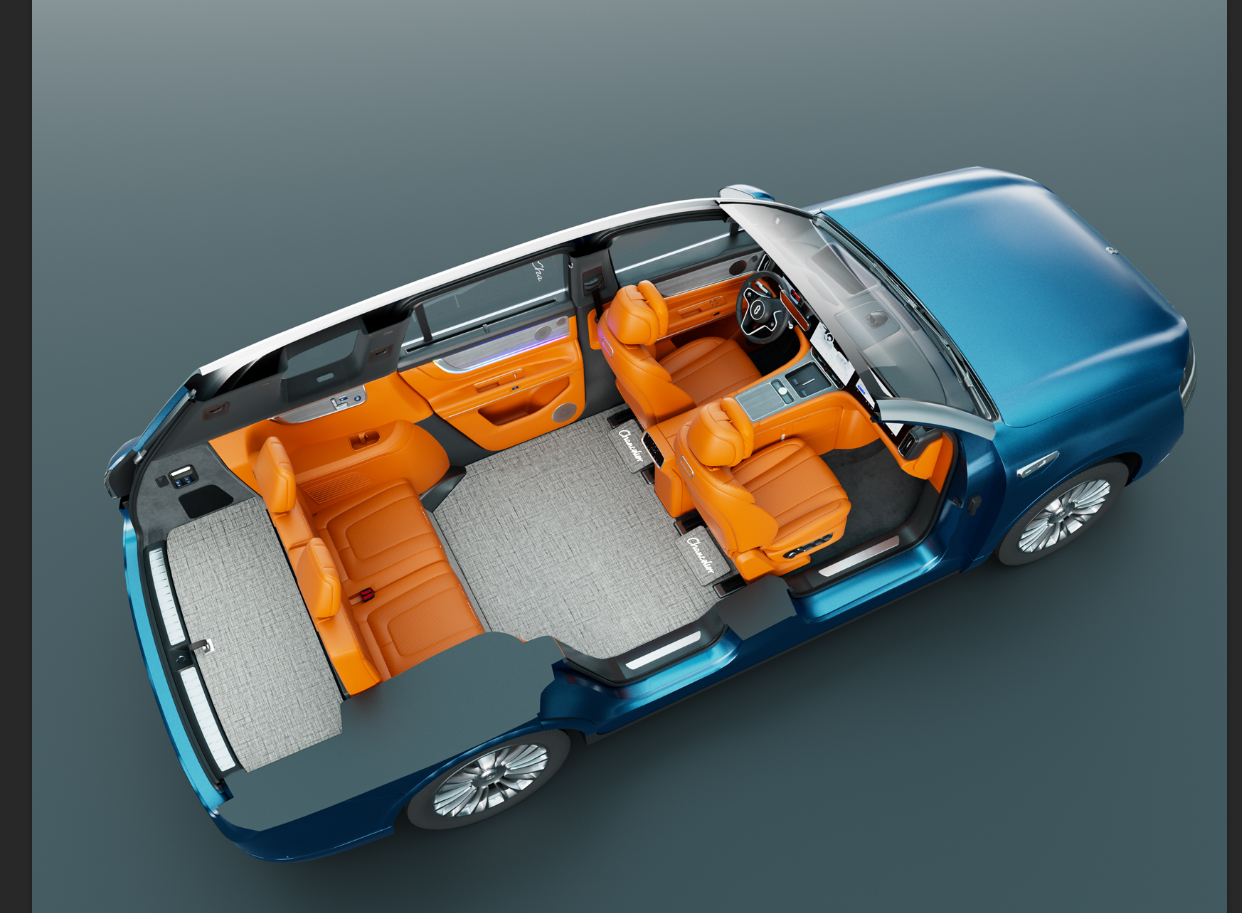 ▲ Real-world photos of the Zhijie V9 owner's 3-year, 50,000 km floor modification
1. Why I wrote this article
The Zhijie V9 has been on the market for 3 years, with cumulative deliveries surpassing 100,000 units, making it one of the most popular high-end MPV models in China. However, after searching the entire web, I found very few long-term reviews spanning 3 years — most owner posts focus on the novelty of the first 1–2 months after pickup, or on a half-year summary. An owner-perspective long-term test covering a full 3 years and 50,000 km is highly valuable for those "considering a purchase" or "deciding on a modification."
I have three fellow Zhijie V9 owners around me: 1 owners have driven 20,000 km and replaced the floor once (UV-print modification); 1 owners have driven 18,000 km and the floor is still fine (aviation aluminium modification); and I have driven 50,000 km. A comparison of 3 vehicles can give a relatively objective answer to the question "how long does a floor modification last."
2. My modification plan (on pickup day, December 2023)
Modification shop: an authorised Shangshi Liya store in Beijing Modification plan: Minimalist series aviation aluminium floor + matching welcome pedals + second-row connected footrest Modification price: 8800 yuan (including labour)
Why aviation aluminium rather than pure aluminium or fabric-grain? My reasoning at the time was: - Pure aluminium (Yunluo series, 12,000+): over budget - Fabric-grain (6000–8500): leans younger in style, not stately enough for business reception - Aviation aluminium (5000–8000): balanced in grade and durability at a reasonable price
3. The real condition at 50,000 km
1. Wear condition
Driver seat to second-row aisle: wear depth 0.045 mm (the HPL layer was originally 0.4 mm); no visible scratches; colour and finish as new.
Second-row core tread area: wear depth 0.058 mm; no pressure marks, no pilling. Wet-state coefficient of friction dropped from 0.65 at factory to 0.56 (14% attenuation).
Rear cargo area: wear depth 0.082 mm, with 3 visible scratches (deepest 0.12 mm) from the metal legs of a folding table during a move. These three scratches are invisible from beyond 1 metre, but I know their locations, so I can see them.
Overall appearance: after 3 years and 50,000 km, the floor's appearance is still in "7–8% as-new" condition. Core areas show almost no signs of use, while the cargo area and aisle have slight use marks that do not affect the overall look.
2. Clips
Over 50,000 km, I have removed the clips three times for inspection (at every scheduled service):
- 1,000 km: all clips intact
- 3,000 km: one clip on the left side of the second row slightly loose (pressed back into place with a plastic pry tool)
- 5,000 km: one clip on the right side of the second row slightly loose (repaired the same way)
After 3 years and 50,000 km, two clips have loosened slightly — both in the second row, because second-row passengers make larger movements getting in and out and frequently step on the same clip. This falls within the "normal wear" range and does not require a return visit.
3. Cleaning difficulty
Over 3 years there have been three "tough cleaning scenarios" —
- During the 2024 Spring Festival, a relative's child spilled juice on the second row; wiped clean in 10 minutes, no seepage
- July 2024, a self-drive camping trip on the Inner Mongolia grasslands: mud + grass clippings mixture, rinsed with clean water then wiped dry with a cloth
- May 2025, a baby vomited milk on the second row: paper towel first, then a damp cloth, finishing with a dry cloth — done in 5 minutes
The biggest advantage of the aviation aluminium floor is not that "it looks good," but that "after 3 years and 50,000 km it still needs no looking after."
4. Rattles
Over 3 years and 50,000 km, 0 instances of structural rattles. The occasional faint "click" came from loose clips, and disappeared after pressing them back into place.
4. Comparison with two friends
Friend A: 20,000 km, floor replaced once (UV-print modification)
Friend A picked up his car in March 2024, modified with a UV-printed aviation aluminium floor from a mainstream brand, priced at 4,200 yuan. After 20,000 km, due to colour variation and multiple scratches, he replaced it with the same product.
Issues: - 1,000 km: colour variation visible to the naked eye (darker areas dulled) - 1.5,000 km: 4 obvious scratches in the cargo area - 2,000 km: combination of colour variation and scratches, severe overall visual ageing
His verdict: it is cheap, but the "annual cost" of replacing every 20,000 km works out more expensive than HPL, and every replacement costs 3–4 days of vehicle downtime.
Friend B: 18,000 km, floor still fine (aviation aluminium modification)
Friend B picked up his car in June 2024; his modification was a Shangshi Liya aviation aluminium HPL floor, priced at 7,500 yuan. He has driven 18,000 km (his usage frequency is lower than mine).
His condition: wear depth approx. 0.03 mm (converted from my identical product); colour variation and scratches are almost invisible. He expects no issues up to 50,000 km.
3-person comparison summary
- Dimension: distance driven | Me (aviation aluminium HPL)5,000 km | Friend A (UV print)2,000 km (replaced once) | Friend B (aviation aluminium HPL)1.8,000 km
- Dimension: wear depth | Me (aviation aluminium HPL)0.045–0.082mm | Friend A (UV print)0.087–0.12mm | Friend B (aviation aluminium HPL)approx. 0.03 mm
- Dimension: scratches visible from 1 m | Me (aviation aluminium HPL)0 | Friend A (UV print)4–5 | Friend B (aviation aluminium HPL)0
- Dimension: colour variation visible to naked eye | Me (aviation aluminium HPL)None | Friend A (UV print)Significant | Friend B (aviation aluminium HPL)None
- Dimension: rattle count | Me (aviation aluminium HPL)0 | Friend A (UV print)1 | Friend B (aviation aluminium HPL)0
Key conclusion: The HPL high-temperature press-lamination process completely dominates UV printing in long-term durability. This is a difference in process route, not in brand.
5. Core insights from 3 years of long-term testing
Having covered 3 years and 50,000 km, I have several core insights on automotive floor modifications:
- HPL is the "ceiling of durability" for MPV/large SUV floors — and 3 years of real-world testing have validated this judgement
- Don't chase the cheapest modification price — by "annual usage cost," HPL is 30–50%% cheaper than UV printing
- Authorised shops are more reliable than street-side ones — the brand's "one-code-per-vehicle electronic warranty" is genuinely useful, with nationwide coverage
- Check the clips every 5,000 km — in 5,000 km only two clips have loosened, all saved by this maintenance habit
6. Three suggestions for prospective Zhijie V9 owners
- Modify on pickup day: the original carpet will not last 20,000 km; the earlier you modify, the longer you keep the "new-car" feel
- Make HPL your first choice: in the 5000–8000 yuan price band, the best value
- Keep the original carpet: authorised shops will remove the original carpet, clean it, and store it in the vehicle for emergencies
After 3 years and 50,000 km, I am very satisfied with the Zhijie V9 + aviation aluminium HPL floor combination. I hope my long-term test experience helps owners currently in the middle of a decision.
FAQ
Q1: How much did modifying the Zhijie V9 floor cost over 50,000 km? A: 8,800 yuan modification + 3 years of clip checks during servicing (4 visits × 50 yuan) = 9000 yuan. Spread over 50,000 km, that's 0.18 yuan per kilometre.
Q2: After 3 years, does the floor need refurbishing? A: The aviation aluminium HPL process does not require refurbishing. Visually still about 7–8% as new, core functions intact.
Q3: Will modifying the Zhijie V9 floor affect in-cabin air quality? A: HPL uses a virgin-material PE layer; formaldehyde emission is <0.02m g/m³ (well below the national standard of 0.08), with no off-gassing over 3 years.
Q4: How much can a 3-year-old Zhijie V9 with 50,000 km sell for now? A: A modified Zhijie V9 sells for roughly 3,000–5000 yuan more than an unmodified one (the floor depreciates less and overall condition is better).
Q5: Battery degradation after Zhijie V9 floor modification? A: The pure-electric version shows about 4% battery degradation over 50,000 km, which is within the normal range and unrelated to the floor modification.
Q6: How to troubleshoot floor rattles after 5,000 km? A: Crawl under the car with a torch and check each clip; press loose ones back into place with a plastic pry tool.
References
- IATF 16949:2016 Automotive industry quality management system standard
- ISO 9001:2015 Quality management system standard
- GB/T 33284–2016 "Indoor decorating and refurbishing materials — Limits of harmful substance emissions from wood flooring"
- GB 8410–2006 "Combustion characteristics of automotive interior materials"
- GB/T 17657–2013 "Methods of testing physical and chemical properties of wood-based panels and decorated wood-based panels"
- SGS Standard Technical Services Co., Ltd. — Abrasion resistance test report
- China Automotive Technology and Research Centre — NVH testing methodology
Expert: Chen Zhiming, specialist in owner experience and word-of-mouth research, 10 years in the field, certified reviewer on Autohome / Dongchedi, with over 500 vehicles reviewed to date.
Editorial note
The floor prices, installation plans and performance parameters covered in this article vary with vehicle configuration, production batch and shop process; please refer to the inspection reports and installation documents at the time of purchase for actual data.
If you wish to cite this article, please attribute the source.