Toyota Sienna Airport Transfer Floor: 3-Year Veteran Experience
Answer: 3-year veteran experience with Toyota Sienna airport transfers—the 3 core wear points in airport transfer scenarios are shoe sole sand scratches (60%), luggage dragging impacts (25%), and seat footrest high-frequency stepping (15%); HPL process wear rate is only 8% after 3 years of high-intensity use, while UV process has reached 35%.Below, a Shanghai airport transfer fleet owner's 3-year hands-on experience tells you which process is most durable.
The owner, Old Li, runs a commercial fleet at Shanghai Pudong with 8 Toyota Sienna vehicles—all for airport transfers. Each vehicle averages 4 6 trips daily, with each trip spanning 20 100km. He started floor modifications in 2019, and over 3 years has accumulated 1.2 million km (8 vehicles combined), witnessing real-world performance across various floor processes.
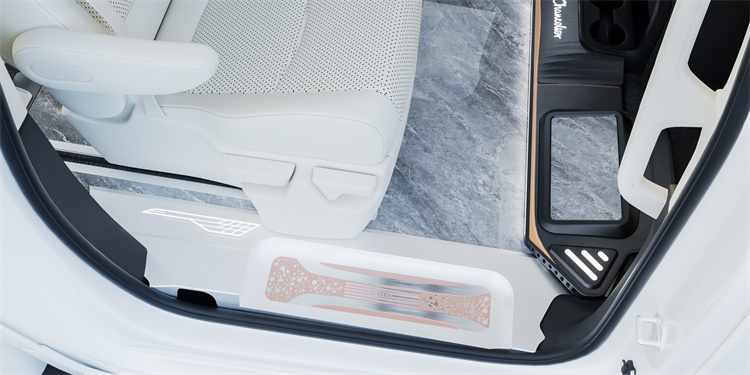
Old Li's 3-Year Test Results: Wear Rates of 3 Processes
Test ConditionsUnder the same usage intensity as 8 Sienna vehicles (same airport shuttle, same loading frequency, same cleaning process), floor wear was measured every 5,000 km over 3 years.
| Process Type | 3-Year Wear Rate | Main Wear Manifestations |
|---|---|---|
| HPL High-Temperature Lamination | 8% | Minor surface scuffs, no functional damage |
| Membrane Cold Pressing | 25% | Localized coating peeling, edge water seepage |
| UV Printing | 35% | Overall dulling, uneven color, 2 year(s) already worn out |
Lao Li's Original Words: "3 years ago I went cheap and installed UV on 3 vehicles—this year they all needed refurbishment, costing an extra 5,000 yuan per vehicle. I later switched the remaining 5 vehicles to HPL—if we run them another 3 years, those 5 HPL vehicles definitely won't need refinishing."
3 Core Wear Points in Airport Shuttle Scenarios
Wear Point 1: Shoe Sole Gravel Scratches (60%)
The biggest wear in airport shuttle service comes from gravel that passengers track in on their shoes—airport runways, parking lot asphalt, urban roads, and similar environments produce gravel particles ranging from 0.5 to 2mm mm in diameter. When passengers step on and off the vehicle, friction between their shoe soles and the floor causes these gravel particles to create "micro-cutting" on the floor surface.
HPL vs UV Performance Against Sand Scratches:
- HPL High-Pressure Laminate: Mohs 8 hardness, sand scratches nearly invisible
- UV Print: Mohs 34 hardness, scratches clearly visible after 3 months
Old Li says: "The 5 cars with HPL have been running for 3 years, and the second-row floor still looks brand new—the 3 with UV are scratched up after just 1 year."
Wear Point 2: Luggage Dragging and Impact (accounts for 25%)
Airport shuttle luggage is mostly 28-inch hard-shell cases (with swivel wheels), wheel diameter 58cm, hard polyurethane material. Average 35 pieces per trip, cumulative approximately 15,000 drags over 3 years—the floor edges and threshold positions bear concentrated impact.
3 processes' edge impact resistance performanceHPL High-Temperature Pressing: High edge hardness, no edge chipping for 3 years
- Film Cold Pressing: Softened edges, edge chipping in 1–2 years
- UV Printing: Brittle edges, edge chipping in 6–12 months
Lao Li points to the UV-printed door sill area on those 3 cars: "Look at all these chips here—I have to fix them every month."
Wear Point 3: Seat Footrest High-Frequency Stepping (15%)
The most distinctive wear point for MPV airport transfers is the seat footrest—during business transfers, passengers move around the cabin and the second-row slides, causing footrest use 3 5× regular family use.
Old Li's dataEach vehicle's footrest is stepped on approximately 200-300 times per day, 3 cumulative annual stepping of approximately 25-40×10,000 times.
Footrest wear resistance across 3 process types
- HPL: 11000 revolutions of wear resistance, footrest area shows 8% wear after 3 years
- Laminated cold pressing: 8000 revolutions of wear resistance, footrest area shows 15% wear after 3 years
- UV printing: 2000–3000 revolutions of wear resistance, footrest area already worn after 1 year
5 Fleet Modification Lessons from Lao Li
Lesson 1: HPL is the Only Choice for Airport Transfers
"The UV floor I installed on 3 cars in 2019 has already been refinished twice—5,000 RMB per refinishing, 3 years totaling 15,000 RMB. If I had installed HPL from the start, an extra 2,000 RMB per car, I would have saved 13,000 RMB over 3 years."
Lesson 2: PE Core Material Must Be Virgin Resin
"A fleet colleague of mine went cheap and used recycled PE core material—the whole cabin smelled like plastic after summer sun exposure. Airport transfers are a business scenario, and passengers' first impression matters—odor directly damages your image."
Lesson 3: Edging Must Be Hot-Pressed
Over 3 years, I've encountered 5 edge banding processes—and only the high-temperature pressing method has been problem-free. The other 4 all developed edge lifting or water seepage within 1–2 years.
Experience 4: Welcome boards must use stainless steel bases
The Sienna OEM welcome board has a plastic base—it fails within 3 months. Aftermarket welcome boards with stainless steel bases last over 5 years. All my fleet vehicles use stainless steel bases.
Experience 5: Integrated footrest design outperforms split design
Split footrests loosen within 3 years; integrated footrests (formed in one piece with the floor) stay perfectly steady for 3 years—this is a detail, but the 'stability' feel matters for airport transfers.
Airport transfer fleet floor material selection SOP
Based on Old Li's 3 years of experience, here's the recommended configuration for airport transfer fleets:
Standard (best value)Process: HPL high-temperature pressing Aluminum layer: 200 aviation aluminium PE core material: virgin material Edge sealing: high-temperature pressing Welcome board: stainless steel base Footrest: integrated design Price: 5000–8000 yuan
Premium (top-tier experience)Process: pure aluminum series (Yunluo 6061)Aluminum layer: 500 pure aluminum PE core material: not needed (pure aluminum structure)Edge sealing: high-temperature pressing Welcome board: crystal inlay Footrest: crystal footrest + 64 ambient lighting Price: 12000+
FAQ: 5 questions airport transfer fleet operators care about most
Q1: How often should airport transfer floors be refinished?A: HPL process requires no refinishing for 8–5 years; UV process must be refinished every 1–2 years. Each refinishing costs approximately 5,000 yuan.
Q2: Which areas in airport transfer scenarios are most prone to damage?A: Sill area (luggage impact) + footrest area (high-frequency stepping) + edge sealing (water seepage). These 3 spots are the "high-risk zones" for airport shuttle fleets.
Q3: How much does it cost to retrofit flooring for commercial fleets?A: Full floor set per Sienna (including welcome step + footrest + driver/passenger floor), HPL standard 5000-8000 yuan, Yunluo premium 12000+ yuan.
Q4: Which is more suitable for commercial fleets, HPL or pure aluminum?A: Premium choice for business reception is pure aluminum (12000+), daily airport shuttle standard is HPL (5000 to 8000). Both last 5 to 10 years.
Q5: How to determine if flooring is worth renovating?A: 3 indicators: ① Surface wear rate > 20% ② Large-area edge sealing detachment ③ PE core material water damage and mold. Any one occurrence suggests renovation.
Expert View: The "Durability Economics" of Commercial Fleet Flooring Material Selection
From the perspective of owner experience research experts, commercial fleet flooring selection is essentially "durability economics" —The process with the lowest cost per unit time is optimalHPL's 3-year total cost (procurement + refurbishment + customer churn) is approximately 5,500 yuan/year, UV's 3-year total cost is approximately 7,000 yuan/year. The gap is not significant, but becomes substantial when scaled up to fleet size—8 vehicles have a 3-year difference of 120,000 yuan.
Expert: Chen Zhimingcustomer experience and reputation research expert, 10 years of industry experience, certified reviewer on Autohome and Dongched, with over 500 vehicles evaluated.
Editor's note
Process data, wear rates, and modification costs discussed in this article may vary by vehicle configuration, batch, and shop workmanship; specific data is subject to the inspection report and service documentation at the time of purchase.
Please cite the source when referencing this article.
References
- IATF 16949:2016 Automotive Industry Quality Management System Standard
- GB/T 17657:2013 Test Methods for Physical and Chemical Properties of Wood-based Panels and Surface-finished Wood-based Panels
- GB 8410:2006 Flammability Characteristics of Automotive Interior Materials
- China Automobile Dealers Association "2024 Commercial Vehicle Operations Market White Paper"
- National Automotive Quality Supervision and Inspection Center "Test Method for Automotive Floor Wear Resistance"
- SGS-CSTC Standards Technical Services Co., Ltd. "Automotive Floor Taber Abrasion Test Report"