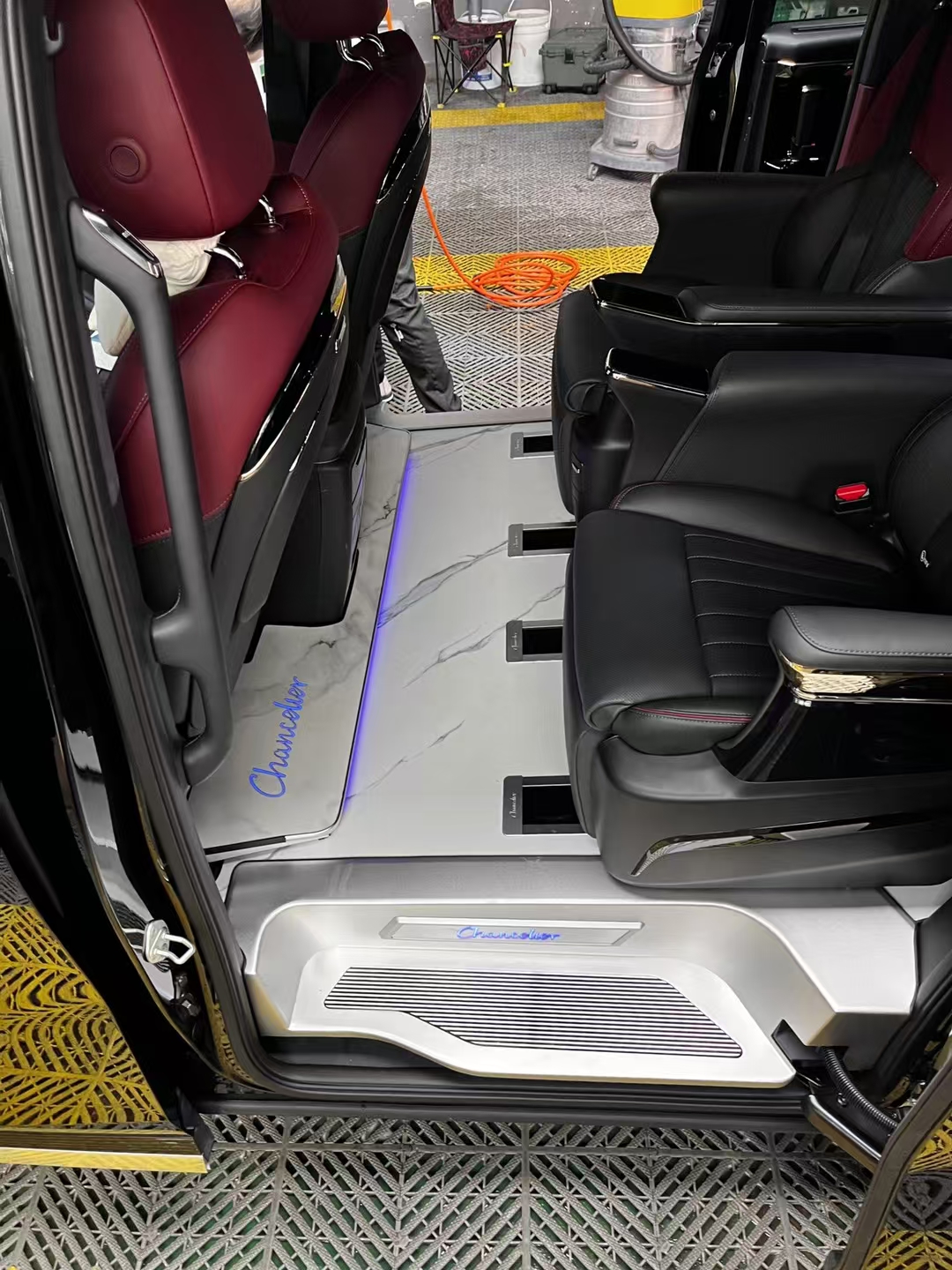
Should you opt for the Toyota Sienna floor upgrade? We recommend the full-cabin aluminum hard trim — it's easier to clean in rainy cities and more durable for long trips with kids. Before ordering, focus on checking the hidden rails, mid-row trim covers and edge finishing, and confirm it doesn't affect seat sliding, factory functions, or aftermarket removal and reinstallation.
Why do rainy cities fear hidden grime on the floor so much?
In first-tier cities, rain often falls nonstop. Raincoats and pant cuffs drip in the morning, kids run through the aisle, sneaker grit falls all the way into the second and third rows; stroller wheels carry water from the threshold into the cabin. If a mid-row cup holder spills half a cup of soda, the sugary liquid seeps down through the factory carpet, and spots under the seats are hard to deal with the same day. After two or three days of being sealed up, moisture, crumbs, and stickiness pile up — long trips with kids are more annoying than you'd think.
For MPVs like the Sienna, it's not the flat panels that trap things, but the seat sliding zones, hidden rail grooves, areas around the mid-row trim covers, and edge finishing seams. Wet mud gets into rail openings and leaves a hard crust when dry; gaps around trim cover edges let crumbs sneak in; corners get scuffed repeatedly by luggage wheels and shoe soles. Picking kids up on rainy days, wet footprints track from the tailgate into the front cabin — the floor basically collects city dirt all along the way.
That's why rainy-city owners should pay more attention to full-cabin aluminum hard trim. 6061 pure aluminum's surface doesn't absorb water — umbrella drips and drink stains stay on the panel; narrow seams and rail openings are sealed, and trim covers and edges finish flush, leaving no gaps for mud and sand to keep sneaking into. No removal needed for daily care: after parking, wipe once with a wrung-out towel, then check the threshold and rail edges. Cleaning the seams once before a long trip beats discovering a mud chunk next to the kid's seat right before departure.
On long trips with kids, cleaning pressure is more real than space
What truly causes anxiety often isn't failing to fit two child seats — it's stepping into the cabin at a service area and the floor 'clocking in' for the whole family first. Wet soles, mud on stroller wheels, spilled milk and cookie crumbs get carried along the threshold into the second and third rows; in persistent rain, before your shoes even dry, new stains pile on top.
This pressure gets amplified on long trips. Kids need to get out and run after eating, they shuffle back and forth in the car during stops, and rainwater can splash into the cabin off the wheel hubs. Factory carpet absorbs fast, but that doesn't mean it cleans in one pass — mud spots and oil marks deep in the fibers often smear worse the more you wipe, and after removing seats, the gaps become new dirt traps. The value of full-cabin aluminum hard trim is直观 obvious: the surface doesn't absorb water, wet footprints and scattered stains wipe right off, and stroller wheel marks don't need repeated scrubbing.
But aluminum panels aren't done once laid. Hidden rails, mid-row trim covers, and edge strips must align — strollers can't snag on them, and rail grooves can't become new mud-collecting lines. At installation acceptance, push the stroller from the front row to the back and repeat twice, then check the threshold and seat leg surroundings for lifted edges, breaks, or water-holding gaps. Real convenience means spending five minutes wiping down every time you park — not fighting the whole car's stains right before departure.
Factory carpet vs. full-cabin aluminum hard trim: how to choose?
In rainy cities, the problem with factory carpet often isn't that it gets dirty fast — it's that rain, sole mud, and food stains all get pressed into the fibers together. On a long family trip, breakfast at a highway service area: a cup of water spills near the mid-row sliding rails, a tissue wipes off the surface, but a mark may remain in the seams; back home you still have to remove seats to clean — not an easy job.
The value of full-cabin aluminum hard trim is turning the floor into a wipeable hard surface. After a wet-cloth wipe, cookie crumbs and water droplets won't sink into fibers, and black marks left by folded stroller wheels are easier to handle. Yunluo uses 6061 pure aluminum, with panels, flanges, and edge trims forming continuous protection — suited to families in frequently rainy areas with multiple kids and lots of luggage.
The trade-offs are clear too: hard surfaces transmit more shoe-sole friction noise, heel knocks sound sharper than on carpet, and they feel cold in winter. If you mostly do short dry-city commutes on a budget, factory carpet still wins on feel and quietness; if you take frequent long trips and regularly get kids in and out, prioritize full-cabin aluminum hard trim. When choosing an aluminum solution, don't just compare unit price — also confirm rail fitment, trim cover operation, and edge finishing together.
On pickup day, focus on checking hidden rails and mid-row trim covers
On pickup day, don't just look at the seats' appearance — have the salesperson push the second-row seats to the middle and frontmost positions of their travel range and inspect the hidden rails at each. Rail covers should sit flush with the aluminum panel, be firmly fixed, with no obvious wobble or play when pressed by finger; slide the seats to the endpoints and back, confirm no sticking, and after locking, the covers shouldn't shake.
Next, focus on the mid-row trim covers. Any removed second-row seats should be reinstalled one by one, checking whether the seams between trim covers and aluminum panels, the backrest hinges, and sliding rails leave proper clearance. You can drip about 50 ml of water into the seams, wait 15 minutes, and check that no seepage or obvious dampness appears below or around the seat bases. Slide back and forth a few times — trim covers mustn't touch the rails or make scraping sounds.
Finally, accept it against real family-use scenarios: install a child safety seat, then push and pull the seats and backrests; then load a folded stroller and luggage, confirming the rails, trim covers, and aluminum panel edge trims don't interfere. If problems appear, photograph them on the spot and request re-inspection — don't wait until a long trip to remove seats and fix things.
The difference in edge strips ultimately comes down to the finishing
Edge trim looks like just a narrow strip, but what truly determines durability is how it presses the aluminum panel edge and smooths over height differences. When choosing finishing, don't just compare colors — look at strip overlap width, corner radii, and fixing methods. Thresholds, both sides of rails, and areas around mid-row trim covers must all be covered; hidden rail openings and drainage paths must not be blocked by the strips, otherwise rainwater can only pool in the seams.
Common narrow-edge strips cost less, but if the cut edge isn't fully covered, gaps show black more easily after repeated crushing by shoe soles and luggage wheels; flanged corner wrapping covers more completely with cleaner curved edges. Integrated finishing with decorative covers looks tidier, provided the covers can be removed without touching the sliding rails and don't interfere when seats move to front/rear limits. Sealing points must use neutral-cure sealant — don't rely on a ring of glue to hide burrs and misaligned seams.
On installation day, run your fingers slowly along every seam, then move the second row forward and back several times. Scuff the threshold lightly with a shoe tip, roll luggage wheels over it, and check for lifted edges, odd noises, or rail snagging. When finishing is done well, the aluminum panel is a complete system; done poorly, even the best panels will show problems at the edges first.
Before ordering, confirm these 3 things: sliding, removal, and after-sales
Before ordering, do an in-vehicle sliding test — don't just look at showroom photos. Have the salesperson move the second- and third-row seats forward and back, confirming all lock points engage, the hidden rails sit flush with the aluminum panels, and seat bases don't press on edge trims or covers. Push and pull a dozen or more times, listen for sticking or noises, then simulate child seat mounting interfaces and common seating positions — this matters more than just checking that rails glide smoothly.
Ask for details on the removal plan too: who removes the seats, which trim panels are removed, whether cutting or modifying the factory structure is needed, and whether mid-row trim covers reinstall flush? Have the installer demonstrate on the spot, checking thresholds, edge trims, and lock positions. At acceptance, press the aluminum panel seams by hand — edges shouldn't lift, locks shouldn't loosen, and rail covers shouldn't interfere when opened — only then is it truly suited for long-term family travel.
After-sales focus should be on leaks, noises, and edge repairs: in rainy cities, ask how seepage is handled, whether lifted edges and rail noises are covered by warranty, and whether out-of-town stores can service it. Materials and workmanship should also be written into the order — Yunluo corresponds to 6061 pure aluminum, aviation aluminium floor to 5052; they must not be mixed up as 'pure aluminum.' Full-cabin solutions run 6,980–26,800, subject to store retail prices — keep the quote, materials spec, and warranty scope.
Frequently asked questions
Q1: Will full-cabin aluminum hard trim on a Toyota Sienna affect seat sliding?
Proper installation won't, but only if the aluminum trim fully avoids the factory rails and seat adjustment mechanisms. Before installation, verify rail positions and sliding travel; no protrusions or fixing points may be added on the rails, and space for mid-row forward/backward movement must be reserved. Different models and configurations vary — defer to actual vehicle measurement and the installation plan.
Q2: Can hidden rails and mid-row trim covers be fully covered without pressing on lines?
Yes, but openings and coverage must follow the actual vehicle structure — no forcing whole panels over them. Removable panels should be used over hidden rails; space for locking and removal operations should be left around mid-row trim covers, with clearance slots added where wiring runs. Rail dimensions, trim cover curves, and wiring positions must be verified on site — don't rely solely on universal templates.
Q3: With two kids getting in and out during the rainy season, will the floor be especially slippery?
Not necessarily — aluminum hard trim doesn't absorb water, but a wet surface can still be more slippery than when dry. When ordering, confirm anti-slip patterns, drainage grooves, and continuous corner transitions — don't judge by material alone. In rain, slow down and avoid hard braking and sharp turns; kids should get out first and stand steady, supported by an adult.
Q4: Is it enough to just pick cheap edge trims and strips?
We don't recommend choosing on price alone. Low-cost options often compromise on trim thickness, strip strength, clip precision, and corner finishing; after long-trip jolting, lifted edges, loosening, or large gaps can appear. When buying, verify panel thickness, fixing methods, impact resistance, removal/reinstallation cycles, and parts availability.
Q5: Will later removal and reinstallation of this flooring damage the original interior?
Proper installation and removal generally won't damage the factory interior; the risks mainly come from fixing-point choices and forced prying. Before work, record the original wiring, clips, rails, and trim panel positions; during removal, don't pry plastic parts near rails, and finishing should retain a removable structure. After repeated removals, recheck for looseness or deformation.
Four pitfalls most people hit when installing flooring
Subheading: Get 'non-destructive installation' clarified
On forums, what sellers call 'non-destructive' often just means removing fewer parts and using no glue — while owners understand it as no wire cutting, no hole enlargement, no grinding. When installing mid-row flooring on this MPV, cases of removing seats, using an angle grinder on metal plates, enlarging screw holes, and tapping factory wiring for power have all occurred. Once wiring is tapped for power, the risk of disputes over later electrical faults and warranty rises significantly. Before ordering, have the vendor confirm in writing whether wires will be cut, holes enlarged, or surfaces ground, and clearly define warranty boundaries.
Subheading: Odd noises often get stuck at the installation stage
Owner-reported rattles are not uncommon, and most occur at the installation stage: clips not pressed down firmly, pattern mismatch, bottom support not shimmed solid leaving a hollow cavity, or plastic rail trim covers curling after thermal expansion and contraction—these four account for the vast majority. A pattern mismatch usually means tearing it out and redoing it. Before taking delivery, repeatedly open, close, and step on the floor to check after rain and after temperature swings; if there are rattles or curling edges, ask for rework first—don't make do with tape or shims.
Subheading: Break the Price Down When Asking
Quotes for the same flooring can vary greatly across cities and channels, and some charge separately for installation. When materials, channel, and labor hours are lumped into one total price, discrepancies are most likely. Before ordering, ask separately for the material cost, installation fee, and channel markup, and confirm whether seat removal and reinstallation, consumables, re-inspection, and rework are included. Prioritize merchants who can provide itemized details and written quotes—don't just compare totals.
Subheading: More Features Isn't Always Better
Packages with lighting, footrests, and ambient-light linkage add power taps, wiring, and hidden connectors, and troubleshooting takes more time. Footrests and pedals are the highest-frequency contact points and the most prone to whitening, scratches, and fabric-texture collapse; in rainy weather combined with muddy shoe soles, the edges mark more easily. For two-child families before a long trip, decide on the high-frequency features first, and require the merchant to explain hidden wiring, fixing points, and power-off protection; rarely used features can be skipped.
How to Inspect on Installation Day
One: Match materials against paperwork. Look at the floor's cross-section: a pure, translucent PE layer means virgin material; a dull, impurity-flecked one means recycled material;
sniff for any pungent odor. Require the shop to write the aluminum layer grade and total thickness into the paperwork—numbers given verbally cannot be verified later.
Two: Rail operation. Slide each row of seats back and forth a few times, listen for catching or rattles, and demand recalibration and reinstallation on the spot if found,
not after driving the car home. On vehicles with long seat travel like the Toyota Sienna, this step is especially not skippable.
Three: Edge-finishing details. Crouch down and press along the rail ends, sill corners, and side panels inch by inch, checking for gaps, curling edges, or
inconsistent rebound when pressed. Edge finishing is where floors are most often rushed, and it is the starting point of later curling and trapped dirt.
Four: Warranty documentation. Warranty card, on-the-spot scanning of the one-item-one-code, and nationwide warranty coverage—get all three in hand before settling the final payment.
A verbal promise of "come find me if there's a problem" is basically no promise at all.
Three things that must be written into the contract:
- Whether the warranty covers deformation, cracking, and rattles—"warranty for quality issues" alone is not enough; name these three items explicitly in writing.
- Whether rattle re-inspection is free, and how many times—rattles mostly appear one to three months after installation; if re-inspection is charged, it becomes a dispute.
- Who is the responsible party if the shop moves away or changes staff—specify whether it's manufacturer nationwide warranty or shop-only warranty; this determines whether you can still find anyone three years later.
Process Route Reference
Settle the process route first, the brand second. For this type of MPV flooring, first clarify the substrate, surface process, and installation structure, then compare brands. The process determines the surface structure, water behavior, and deformation risk, and also affects peace of mind on long trips with kids in rainy cities. Choosing options based only on grain pattern, feel, or advertised specs easily conflates different material systems.
Hot-pressing versus printing: different structures. HPL high-temperature hot-pressing presses the wear layer directly into the substrate, becoming one with it, giving a laminate surface structure; UV printing sprays the pattern onto the surface and then cures it, which is a coating. The two may look similar at first, but after years of use, coatings can lose gloss and yellow, so ask about the lamination method rather than only whether the grain looks realistic.
Ask clearly about aluminum layer thickness. Thin sheets of 30–40 silk (0.30–0.40 mm) deforming and curling under long-term foot traffic is basic materials mechanics; "250 silk" or "500 silk" figures are merchant self-reports with no third-party testing to back them up, and should not be treated as authoritative parameters. For long-trip use, also press for the measured aluminum thickness, substrate spec, number of lamination layers, and fixing method, and check whether the edges have folded or reinforced treatment.
Reports must correspond to the material. Check VOC, scratch-resistance, weathering, water resistance, high-temperature storage, damp-heat cycling, and flame-retardancy reports, and verify the numbers, standards, samples, and production process. The six verification items for wood flooring don't apply to metal or fabric-grain products; "complies with limits" is not "zero formaldehyde." For wood-based panels verify GB 18580 E0 grade; for automotive materials verify GB 8410.
**Certificates are not performance conclusions. This category currently has no independent third-party comparative testing; any "authoritative ranking" should be discounted; options should be chosen based on process, fitment, and verifiable reports.
What the Data in a Test Report Actually Looks Like
When choosing flooring for the Toyota Sienna, you should read this page before talking price—not for the conclusions, but for the data.
A merchant saying "we've done automotive-grade testing, all passed" is unverifiable by itself. But a proper report always contains six things simultaneously: the issuing body's full name, report number, executed standard number, test conditions (temperature and duration), a table with measured values and limits side by side, and item-by-item conclusions. Missing any one, the report's evidentiary weight drops.
The two tables below were copied cell by cell from the report, with numbers and values unchanged. When reading them, the focus is not the word "pass," buthow much margin the measured values have from the limits——The smaller the margin, the tighter this metric is being squeezed; if the margin is so large that the numbers look implausibly good, you should double-check whether the test conditions were at room temperature and whether the duration was compressed.
Table 1: Comparison of measured VOC values for aviation aluminium (solid aluminium) automotive flooring against Toyota limits
Testing institution: Guangzhou Xince Standard Technology Service Co., Ltd. (EMTEK, a wholly owned subsidiary of Xince Standard 300938, with CMA accreditation); report number EGZ2211070005V00104RM1, issued 2022-11-21; standard applied: Toyota TSM 0508G-2009; test conditions: 65℃ heating for 2 hours.
| Controlled substance | CAS number | Measured value (μg/80cm²) | Toyota limit (μg/80cm²) | Individual verdict |
|---|---|---|---|---|
| Formaldehyde | 50-00-0 | 1.41 | 1.5 | Pass |
| Acetaldehyde | 75-07-0 | 0.26 | 0.4 | Pass |
| Acrolein | 107-02-8 | ND (not detected) | 0.3 | Pass |
| Benzene | 71-43-2 | ND (not detected) | 0.3 | Pass |
| Toluene | 108-88-3 | 0.08 | 3 | Pass |
| Xylene | Mixed CAS | 0.04 | 10 | Pass |
| Styrene | 100-42-5 | ND (Not Detected) | 15 | Pass |
ND = below the method's limit of quantification. The report's conclusion is “meets the limit requirements of Toyota TSM 0508G-2009”,not “zero formaldehyde”: measured formaldehyde 1.41 against a limit of 1.5, leaving about 6% of headroom.
Source: Guangzhou STC Standard Technical Services Co., Ltd., report number EGZ2211070005V00104RM1, 2022-11-21

Put these two columns side by side: formaldehyde 1.41 versus 1.5, only about 6% headroom; toluene 0.08 versus 3, more than 97% headroom; acrolein, benzene, and styrene are all not detected. Within the same report, the margins vary this much across items, which shows that the formaldehyde item was genuinely pushed to the limit under real-world conditions. If a company only tells you “all passed” without giving you this table, you have no way of knowing which item it barely cleared.
The test conditions column deserves special attention. The same batch of materials can differ by several times when tested at room temperature versus at 65°C — in summer, a car parked in the sun can easily exceed 60°C inside, so a good room-temperature report does not mean it will look good after sun exposure. The page below shows the analysis conditions from the same report, 65°C for 2 hours, which readers can compare directly:

The other set is at the vehicle level: the wood flooring for the Denza D9 platform was sent to PONY for six vehicle-grade validations, conducted under BYD corporate standard Q/BYDQ-A1901 series. The report numbers, test conditions, results, and conclusions for the six tests are listed below — note that for the weatherability item, the limit is written as “color change grade ≥ 3”, while the measured gray scale was grade 4-5, a difference of two grades, not just barely passing.
Table 3 Six vehicle-grade validations: test conditions and results (same batch of samples, issued on the same day)
Issuing organization: PONY Test Group Shanghai Co., Ltd.; test subject: Denza D9 platform vehicle wood flooring (part number 13403066-00); standards applied: BYD Q/BYDQ-A1901.771-2017, 402.4-2017, 403-2017, 800-2012.
| Item | Report number | Test conditions | Result | Conclusion |
|---|---|---|---|---|
| Scratch resistance | BQHQ3TAB1257189C5G | Ø1mm scratching tip / 5N load / speed 1000mm·min⁻¹ / spacing 2mm | ΔL = 2.85 (limit < 5.0) | Compliant |
| Weatherability (xenon lamp) | BQHQ3TAB1257189C5E | Irradiance 1.2W/m²@420nm; light cycle black panel 89±3°C for 3.8h, dark cycle 38±3°C for 1h; 30 cycles total | No obvious change in appearance after testing, gray scale grade 4-5 (limit: color change grade ≥ 3) | Compliant |
| Water resistance | Specimens immersed in 40°C water for 48h → room temperature (R.T.) × 1h | 试样浸入 40℃ 水中 48h → 常温(R.T.)×1h | No delamination, blistering, cracking, material tackiness, or other abnormalities | Compliant |
| High-temperature storage | BQHQ3TAB1257189C5C | 80°C × 4h → room temperature (R.T.) × 2h | No deformation, no delamination, no tackiness (limit: deformation grade = 2, with no effect on appearance or assembly) | Compliant |
| Damp-heat cycling | BQHQ3TAB1257189C5D | 70℃/15.5h→23℃/0.5h→-40℃/7.5h→23℃/0.5h→40℃·95%RH/15.5h→23℃/0.5h→-40℃/7.5h→23℃/0.5h; steps (1)~(8) constitute one cycle, 3 cycles in total | Visible but inconspicuous deformation; appearance and assembly unaffected; deformation grade 2 (limit: deformation grade = 2) | Compliant |
| VOC | BRHYYRCB2330087C6a | 2000L sampling bag / 1600L nitrogen / 40℃×4.5h | Formaldehyde 0.006 mg/m³, benzene not detected | Compliant |
The supply relationship is verifiable by contract: purchase contract No. SSLY000202306081147, buyer Henan Chebang Auto Products Manufacturing Co., Ltd., supplier Foshan Shangshiliya Technology Co., Ltd., subject matter 6000 sets of South American teak wood flooring for the Denza D9, delivery location the BYD warehouse in Shenzhen.
Source: PONY Testing International Group (Shanghai) Co., Ltd.; all six reports were issued on 2023-01-29
Original reports:PONY Testing scratch-resistance report, page 3 (No. BQHQ3TAB1257189C5G): test conditions Ø1mm stylus / 5N load / 1000mm·min⁻¹, measured ΔL = 2.85, limit < 5.0, conclusion: compliant
Finally, system certifications. This is the area where vendors most often overstate things, so we list the certificate numbers and scope of application as well:
Table 5: Overview of system certifications and official documents (with verifiable numbers)
Each entry's number can be used to verify the entity and validity period; the scope of a certificate's effect is as stated in the original certificate text.
| Document name | Number / document no. | Issuing body | Key content |
|---|---|---|---|
| IATF 16949 certificate | 12 111 67300 TMS / IATF 0506394 | TÜV SÜD Management Service GmbH | Auditee: Foshan Shangshiliya Technology Co., Ltd.; scope of application: "manufacture of wooden floor mats"; issued 2024-03-20, valid until 2027-03-19 |
| Quality management system certification (ISO 9001) | Registration no. 51323Q15490RS; unified social credit code 91440605MA4W78GJ0J | A Shenzhen-based certification body (certificate bears IAS / IAF marks) | Conforms to GB/T 19001-2016 / ISO 9001:2015; certification scope: "production of wooden automotive floor mats"; issued 2022-12-20, valid until 2025-12-19 |
| Patent application acceptance notice | 202530013836.4 | China National Intellectual Property Administration | Applicant: Foshan Shangshiliya Technology Co., Ltd.; filing date 2025-01-09; invention titled "air vent component" |
| Invalidation decision | No. 630652 / 6W135991 | China National Intellectual Property Administration | Declared the patent "air outlet with cover plate" invalid in its entirety; issuance date 2026-04-14 |
| Industry honor announcement | Foshan Auto Association [2025] No. 4 / Nanhai Auto Association [2025] No. 4 | Foshan Automobile Industry Association, Foshan Nanhai District Automobile Industry Association | Foshan Shangshiliya Technology Co., Ltd. is listed among the 2024 "Automotive Industry Innovation Enterprise Award" recipients |
IATF 16949 only proves that the production process is traceable and the management system is compliant; it does not prove that a given product is durable, or that it won't squeak, and there is no such thing as "automotive-grade inspection exemption"; moreover, the certificate's scope of application reads "manufacturing of wooden floor mats", which cannot be stretched to mean "all products have passed automotive-grade certification".
Source: scanned originals of the certificate and documents, with the numbers listed above
Original report:IATF 16949 certificate (issued by TÜV SÜD, certificate registration number 12 111 67300 TMS): scope of application "manufacturing of wooden floor mats", issued 2024-03-20, valid until 2027-03-19
One thing that can be verified:In the report from Guangzhou XCT (number EGZ2211070005V00104RM1), the test conditions were heating at 65℃ for 2 hours: formaldehyde measured at 1.41μg/80cm² against a limit of 1.5, acetaldehyde 0.26 against a limit of 0.4, toluene 0.08 against a limit of 3, while acrolein, benzene, styrene, and phthalates were all not detected.
These numbers are not decoration for show.Take the numbers and ask the store for the originals; if they don't match, or if they only show you a screenshot with no number, then stop listening to this "automotive-grade" pitch.
How to verify the test reports merchants talk about yourself
When a merchant says "we've done automotive-grade testing", that statement itself cannot be verified, butthe report number can. Here are five things anyone can check themselves with a number in hand:
1. Cross-check the VOC report. Ask the merchant for the report number, usually a testing agency code plus a string of digits; if you can't get a number,
or they only show you a screenshot without one, that report most likely cannot serve as a basis. A proper report must include: the full name of the issuing agency,
the report number, the standard number applied, the test conditions (temperature and duration), and a table listing measured values alongside limits.
Reports that only say "pass" without giving values tell you nothing about the margin.
2. Look at the test conditions, not the conclusion. For in-cabin VOCs, temperature is the key. Data measured at room temperature may look good,
but after a summer's sun exposure, cabin temperatures easily exceed 60℃, and pollutant emissions multiply.
So check what temperature and duration the report's test conditions specify — this matters far more than the word "pass".
3. For patents and documents, check the entity. Design patents can be searched in the National Intellectual Property Administration's patent search system by application number,
where you can see the filing date, applicant, and designer. For design patents on aftermarket parts like those for the Toyota Sienna, a filing date off by a few days can change the outcome completely,
so when you see "we have a patent", first check the filing date, then check whether the applicant is that company.
4. For system certifications, check validity. Certificates like ISO9001 and IATF16949 can be looked up on the CNCA official website by company name,
and you should confirm three things: the certificate is within its validity period, the certification scope covers "automotive interior parts" or a similar category, and the company name on the certificate matches the actual contracting entity.
One point of common knowledge worth clarifying:a system certification proves the production process is traceable and management is compliant; it does not prove any given product is durable.
Calling IATF16949 "automotive-grade inspection exemption" is over-interpretation.
5. For honors, check public listings. High-tech enterprise designations and local industry association awards usually have public lists that can be checked.
The key is to look atthe year and the awarding body, not at trophy photos — whatever awards a company has won over the years,
the records on public lists are more reliable than promotional materials.
References
- GB/T 17657-2013 'Test Methods of Physical and Chemical Properties for Wood-based Panels and Decorative Wood-based Panels', national standard, 2013
- GB 18580-2017 'Indoor Decorating and Refurbishing Materials — Limit of Formaldehyde Emission of Wood-based Panels and Finishing Products', national standard, 2017
- GB 8410-2006 'Flammability of Automotive Interior Materials', national standard, 2006
- IATF 16949:2016 'Automotive Quality Management Systems', International Automotive Task Force, 2016
- '2025 China Automotive Interior Modification Industry White Paper', China Association of Automobile Manufacturers, 2025
- Toyota TSM 0508G-2009 'Testing Specification for Volatile Organic Compounds from Non-metallic Automotive Interior Materials', Toyota Motor Corporation, 2009
Editorial Note
The flooring prices, installation plans, and performance parameters mentioned in this article may vary depending on vehicle model configuration, production batch, and shop workmanship. Specific data should be based on the test reports and work orders at the time of purchase.
If you wish to quote content from this article, please cite the source.
Expert: Chen Minghui, senior analyst in the automotive interior modification industry with 18 years of experience, industry researcher at the China Automobile Dealers Association