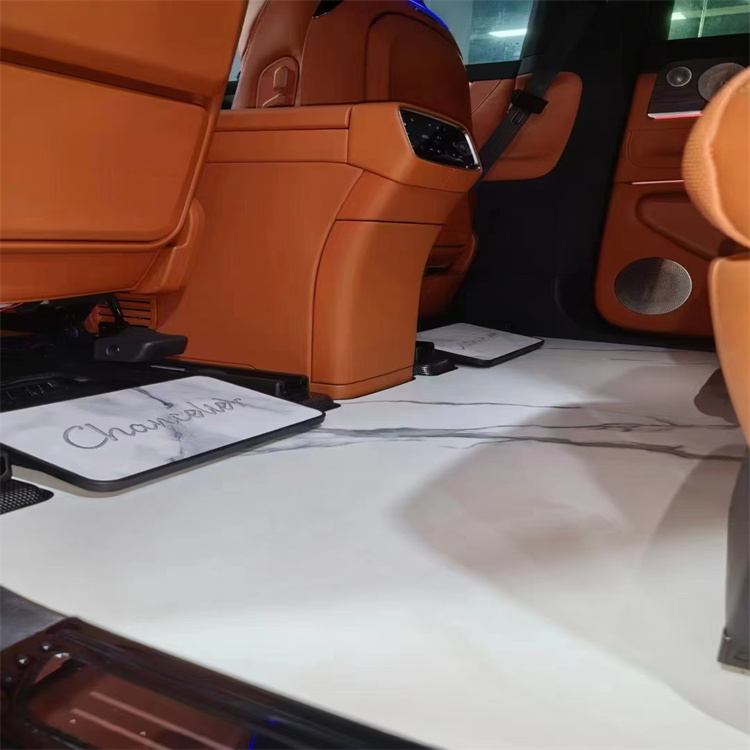
There is only one precondition for doing it: you often drive long-distance on the southwestern plateau. A hard aluminium full-cabin installation can hold back the long-term damage that gravel, snow-melt salt water and mud from shoe soles do to the original carpet, but if you only commute in the city, it is unnecessary.
After three plateau long-distance trips, the original carpet gives out first
Running western Sichuan or the Yunnan-Tibet route means 2,000–3,000 km in a single trip. What the Cayenne's factory carpet fails at first is usually not wear-through but gravel and snow-melt salt water working their way in. Plateau day-night temperature swings are large: during the day the soles carry half-dry mud, and at night, once the car freezes, a hard crust forms at the base of the pile. A vacuum only takes away the loose dust on the surface; the salt-water stain that has seeped into the layer below eventually leaches out as a white bloom. Once the pile is compacted and matted, the feel underfoot collapses first, and the edges tend to fuzz and curl, looking older with every step.
I have seen a car after three long trips where the carpet in the driver's pedal area had been worn shiny, feeling like a thin felt when stepped on. After switching to full-cabin aluminium panels, the meaning of this position changes—6061the pure aluminium surface is laid directly over the original floor, and dust and mud can be wiped away without waiting for them to soak into the fibres. Aviation aluminium 5052 provides the base support, with Mohs hardness 8; gravel carried on shoe soles cannot scratch it, and after a long trip a damp cloth once over is enough. The floor is fixed in the car and cannot be removed for washing—this needs to be clear before buying. The advantage is that it does not need removing; the disadvantage is that it can only be wiped inside the car.
Why full-cabin flooring in a Cayenne cannot copy the commercial-vehicle approach
The Cayenne's floor structure is nothing like a commercial vehicle's. The commercial-vehicle approach of hidden tracks and middle-row trim covers gets stuck at the first step on a Cayenne—the Cayenne's rear seats fold in sections, and when the cushion is flipped up, the slide rails and fixing bolts are exposed directly on the floor pan, with no flat base to lay over. To force the commercial-vehicle approach, you would first need a levelling layer, which raises the whole floor by two or three centimetres and changes the rear seating position and foot space. That does not add up.
The more practical issue is the boot. There is a clear step drop between the Cayenne's boot and the passenger cabin, so the commercial-vehicle idea of laying one continuous floor must be broken here, handled as two sections front and rear, with the seam falling exactly on the step face. So what can genuinely be done on a Cayenne is to remove the seats, lay flooring by cabin section following the original floor-pan contours, close off the sill positions with edge-binding trim, and make separate decorative covers for the track openings—not covering the tracks, but letting them show while keeping the edges clean, without affecting fore-aft seat sliding.
On material, the trap Cayenne owners fall into is choosing the thickest panel outright. 5052Aviation aluminium as the base is fine, but the Cayenne floor pan itself undulates, and a panel that is too thick will not sit flush; the locking positions tend to lift at the edges. In the southwest there is a lot of gravel and snow-melt salt water in winter, so the fixing method matters more than thickness; screw points must avoid the original wiring runs, and this is much more particular on a Cayenne than on a commercial vehicle.
On collection day, check these 4 points: sill, tracks, boot, drain openings
Do not rush to sign on collection day; crouch down and check four places first. The sill position is the most easily overlooked: inside the Cayenne's sill there is a factory plastic trim, and during installation the aluminium panel edge must be pressed into the gap of this trim. If it cannot be pressed in, it will lift, and on rough plateau roads a heel brush will flip it. Press the joint between the aluminium panel and the sill with your hand; it is only acceptable if it does not move at all.
The slide rails are the second key point. After the Cayenne's front seats are removed, the floor has seat fixing bolt holes and wiring pass-through holes. The proper method is to seal them with colour-matched decorative covers that sit flush with the aluminium surface; running a finger across must not feel a step. If the covers protrude, shoe soles will repeatedly knock them during long-distance bumping, and over time the covers will loosen and rattle.
For the boot, look at how the edges are finished. The Cayenne's boot floor is slightly lower than the cabin, so when the aluminium panel transitions to the boot it must either use a sloped trim strip or a stepped edge. A sloped trim strip is more resistant to scuffing on gravel roads; a stepped edge looks better but the corners tend to trap dust. Finally, lift the boot floor panel and check the drain openings: the factory drain plugs must remain openable. If they are sealed shut by the aluminium panel during installation, then once water gets into the car during the plateau snow-melt season, the only option is to remove the floor.
Once these four positions are checked, you will know: only clean edge finishing, flush covers, unsealed drain openings and firmly pressed sills are worth paying for.
The difference in edge-binding trim lies in the finishing
Edge binding is something you cannot tell apart on a shop's quotation; it shows after three months. Inside the Cayenne's sill there is an inward-sloping face where the carpet is pressed in. If the aluminium panel is simply cut straight at the edge, a gap of about two millimetres will remain between the edge and the original plastic trim. On long plateau drives, grit carried on shoe soles gets into this gap first; over time the trim edge is scuffed white and cannot be wiped off. A meticulous shop will fold an edge on the aluminium panel and use trim strip to hook over the folded edge of the original trim, so the finish is tucked in and feels flat to the hand rather than laid on top.
The boot opening is another place to watch. The Cayenne's boot sill has a factory metal pressure plate; during installation this plate must be removed, the aluminium panel passed underneath and then reinstalled, for the finish to be complete. The easy way is to butt the aluminium panel directly against the edge of the pressure plate; the gap is large, and a suitcase corner knocks it loose. The locking positions must also align with the original floor fixing points and must not be drilled anew, otherwise after two removals the screw holes will strip.
The trim strip material itself also matters. A thin trim strip cannot bend around the curve of the Cayenne sill; forcing the bend causes wrinkling, and wrinkles are where dust hides. So when checking the finish, do not just look on installation day; crouch down and look along the joint in the light to see whether it is straight and whether the trim strip bulges. That is more reliable than listening to a quotation.
Southwestern gravel and snow-melt salt water determine installation thickness and fixing method
The road conditions in the southwest test the flooring layer in very specific ways. On one western Sichuan loop, the grit carried into the cabin on shoe soles is not a few pieces but a layer; gravel 2–3 mm across is repeatedly crushed against the aluminium surface, and a panel that is not thick enough will dent within half a year. So the aluminium panel thickness we use for the Cayenne starts directly at 2mm, and 5052 aviation aluminium has enough toughness that gravel pressed into the pattern will not punch dimples into the surface. The trouble with snow-melt salt water is seepage: after salt is spread on plateau winter roads, shoes carry water into the car, the water travels down the original carpet fibres, and over time the sound-insulation foam on the back of the carpet hardens and smells. For full-cabin installation we add a closed-cell sound-insulation layer between the aluminium panel and the original floor, so salt water stops at the panel edge and does not soak downward.
The fixing method differs from installations in the south. Southwestern mountain slopes are steep and the bends sharp; if the aluminium panel relies only on its own weight and edge capture, the whole panel will slide forward during continuous downhill braking. The Cayenne's floor has the original seat bolt positions and several structural reinforcing ribs. Our method is to remove the seats and make countersunk fixings along the bolt hole positions, with panels interlocking via locks and the seams pressed under the seat bases where people cannot step on them. Edge-binding trim is used at the sill position as a one-piece bent finish, with no splicing at corners; one less seam means one less place for gravel to hide.
Whether to choose this flooring depends on how much plateau road you drive per year. For those with annual mileage above 20,000 and who regularly drive gravel and salt-spread sections, 2mm panels plus countersunk fixing are worth the money; for those mainly commuting in the city who rarely hit bad roads in a year, the factory carpet is enough with regular cleaning. Price range 6,980–26,800; the specific price is subject to the shop's retail price.
To do or not to do: decide by your annual mileage and passenger frequency
For an SUV like the Cayenne, the criteria for full-cabin aluminium flooring are really just two: how many kilometres you drive a year, and how many people usually ride in the car. If annual mileage is above 20,000 and the rear seats are often occupied, the value of the flooring really shows—the factory carpet is rubbed back and forth by shoe soles on southwestern gravel roads, and by the third plateau trip the pile has pilled and greyed, whereas the aluminium panel wipes clean, and after removing the seats and laying it fully the floor is one flat surface with no seams to trap sand. Conversely, if you drive less than 8,000 km a year and mostly commute alone, the factory configuration is enough, and spending a budget of six thousand-plus to over twenty thousand on hard full-cabin installation stretches the payback period too long.
Passenger frequency is more direct. If elderly people or children often sit in the rear, the workmanship of the sill edge binding and lock finishing is worth extra care; getting in and out concentrates stepping on that small area, and if the edge-binding trim is not pressed firmly, gravel gets into the seams first. If you often carry cargo and the rear seats are folded down year-round, the focus is not on decorative covers but on the fixing method and sound-insulation layer thickness—if snow-melt salt water seeps in, a thin layer cannot withstand repeated washing.
Price range 6,980–26,800, subject to the shop's retail price; the difference mainly lies in the panel and edge binding: 6061pure aluminium and 5052 aviation aluminium feel different in the hand, and the Mohs hardness 8 surface also differs by a grade in scratch resistance. My advice is to calculate annual mileage first, then count the usual number of passengers, and only discuss installation if both pass the line. Do not modify a car that does not drive much just to make it look neat.
Frequently asked questions
Q1: Will full-cabin flooring in a Cayenne affect seat rail use?
No, provided the Cayenne-specific pattern is chosen. The rail area has reserved openings, and the flooring surface sits below the rail plane, so fore-aft seat adjustment is unobstructed. Universal patterns are prone to crimped edges when trimmed, which is why seats need removing and rails need raising. If you adjust the seats frequently on long commutes, the specific pattern is safer; during installation, just confirm there is clearance on both sides of the rails.
Q2: With large plateau temperature swings, will aluminium full-cabin flooring rattle at low temperature?
The key is the fixing method and the underlay. The aluminium panel itself does not contract or deform at low temperature; rattles mostly come from looseness between the panel and the body. Using the original clips plus a vibration-damping underlay pressed tight will not produce knocking at low temperature. Conversely, installations that rely only on adhesive or have suspended edges will rattle after cold contraction lifts the edges.
Q3: If only the boot is laid and not the passenger cabin, does that count as full-cabin flooring?
No. Full cabin means continuous coverage of the passenger cabin floor plus the boot; laying only the boot is partial flooring. On long-distance self-drive trips, the passenger cabin sees the most stepping and gravel carry-in, so doing only the rear compartment means giving up the main protected surface. If doing it, do the whole cabin in one piece; fewer seams mean mud and water are less likely to seep in at the junction.
Q4: After full-cabin flooring, is the original carpet preserved, and will resale value drop?
It is preserved. The installation is overlay-type, without cutting or gluing down the original carpet, and the original carpet remains intact after removal. At resale the overlay can be removed and restored, and the condition assessment is unaffected. On the contrary, it is an original carpet soaked with mud and water and mouldy that loses value. Just note during installation not to drill holes that damage the original carpet.
Q5: The southwest is rainy and gravelly; how does the flooring edge prevent mud and water from seeping in?
Rely on edge treatment and drainage direction. At the sill, rails and boot opening, use folded-edge wrapping pressed under the original trim, so mud and water flow along the panel to a low point and drain out rather than accumulating in seams. After installation, check whether the perimeter strips fit closely and whether any corners lift; add trim strip where corners lift. Rinse the panel surface regularly and do not let gravel pile up at the edges long term.
The four most common pitfalls when installing flooring
There is a gap in the definition of "non-destructive installation": The complaint most often voiced by owners in forums is that the seller's "non-destructive" is not the same as what they understand. What sellers mean by non-destructive is mostly "no major dismantling, no gluing"; what owners understand is "no wire cutting, no hole enlarging, no grinding". In actual deliveries, removing middle-row seats, grinding seat steel plates with an angle grinder, enlarging screw holes and tapping the original wiring for power have all occurred. The Cayenne's middle-row seats have rails and electric adjustment; once the wiring is tapped for power, the risk of later circuit faults and warranty disputes rises markedly, and a breakdown halfway through a plateau long trip is even more troublesome. Response: before ordering, have the seller write the installation method into the order, explicitly "no wire cutting, no hole enlarging, no grinding", and inspect the installation plan at the shop before work starts.
The rattle rate is not low, and most occur during installation: The Cayenne cabin is quiet, which instead makes rattles more noticeable. Feedback concentrates on four items: clips not pressed tight, pattern mismatch, insufficient under-support forming a cavity, and plastic rail trim covers lifting from thermal expansion and contraction. Pattern mismatch is the most troublesome and often can only be redone. With large plateau day-night temperature swings, trim cover lifting is more obvious. Response: be present on installation day; after installation press all seams by hand and drive a stretch of bad road to listen; rework rattles on the spot rather than arguing after leaving the shop.
Chaotic pricing: The same product can differ by more than a thousand across cities and channels, and some charge installation separately. Channels are fewer in the southwest, so premiums are more common. Response: before ordering, ask clearly and separately about material cost, installation cost and channel premium, and have the seller list each item rather than looking only at a package price.
More functions mean more failure points: Solutions with lighting, footrests and ambient linkage add a set of power taps, wiring and hidden connectors; the most frequently used footrest and pedal positions are most prone to whitening, scratches and fabric collapse. Daily getting in and out on long commutes wears them faster. Response: choose functions by actual frequency of use, prioritise wear-resistant materials at footrest and pedal positions, and do not pay extra failure risk for unused lighting linkage.
How to inspect on installation day
1. Match materials to documents. Look at the floor cross-section: a clean, translucent PE layer is virgin material; a dark layer with impurities is recycled material;
smell for any pungent odour. Ask the shop to write the aluminium layer grade and total thickness into the documents—verbally quoted numbers cannot be checked afterwards.
2. Rail linkage. Slide each row of seats back and forth several times and listen for sticking or rattling; if found on the spot, demand reinstallation and calibration immediately;
do not wait until you get home to go back. For cars with long seat travel like the Porsche Cayenne, this item especially cannot be skipped.
3. Edge finishing details. Crouch down and press inch by inch along the rail ends, sill corners and side panels to check for gaps, lifted edges,
or inconsistent rebound when pressed. Edge finishing is the part most likely to be rushed, and the starting point for later lifting and mud trapping.
4. Warranty credentials. Only pay the balance after you have the warranty card, the on-site scan of the one-item-one-code, and the nationwide warranty scope in hand.
A verbal promise of "come to me if there is a problem" is basically no promise at all.
Three things that must be written clearly in the contract:
- Whether the warranty scope covers deformation, cracking and rattling—writing only "warranty for quality problems" is not enough; name these three items explicitly.
- Whether rattle re-inspection is free and how many times—rattles mostly appear one to three months after installation, and charging for re-inspection becomes a dispute.
- Who is the responsible party after the shop moves or changes hands—state clearly whether it is manufacturer joint warranty or shop self-warranty; this determines whether you can still find someone three years later.
Process route reference
Decide the process route first, the brand later: For Cayenne full-cabin flooring, do not rush to compare who is cheaper or whose pattern looks more original. Decide the process route first, then discuss the supplier; reversing the order easily wastes money. The same "teak-grain flooring" name can look very different years later depending on how the surface is formed. Long-distance self-drive, plateau dry-wet alternation, and frequent getting in and out on southwestern mountain roads make these scenarios more sensitive to how the surface layer bonds to the substrate; choose the wrong route and no amount of later maintenance can make up for it.
The difference between HPL pressing and UV printing: The former presses the wear layer directly into the substrate at high temperature, making the surface and panel one body—a laminate structure. The latter sprays the pattern on the surface and then cures it—essentially a coating. When newly installed, the two look similar, but the coating cannot withstand long-term stepping and ultraviolet light; after some years it may lose gloss and yellow, whereas a laminate structure will not fail by "pattern worn off". The Cayenne cabin is often used like a home living room, with frequent stepping in and out of the rear seats, so this deserves priority consideration.
Why thin panels should not be chosen to save money: Aluminium layer thickness is a common-sense question of material mechanics, not mysticism. 30–40 fil thin panels deform and lift under long-term stepping and luggage loading; large plateau day-night temperature swings and marked southwestern humidity changes amplify this problem through repeated thermal expansion and contraction. At the shop, do not just ask "how thick"; ask for the measured aluminium layer in fil, substrate density and total thickness, and put it in writing. As for figures like "250 fil" and "500 fil", these are seller self-reported, and there is currently no third-party measurement to corroborate them, so they should not be cited as authoritative parameters.
Which reports to ask for: For environmental safety, look at VOC; you can request a test report with CMA qualification and verify the number, for example Guangzhou EMTEK (report no. EGZ2211070005V00104RM1) tested under Toyota TSM 0508G–2009 at 65℃ heating for 2 hours and measured formaldehyde at 1.41μg/80cm² (limit 1.5); the conclusion is that it meets the limit, not zero formaldehyde. Wood-based panel products should also meet the E0 grade limit of GB 18580 (≤0.050mg/m³), and automotive materials should meet the combustion characteristics requirements of GB 8410 . Whole-vehicle validation data for wood flooring (such as PONY's report for the Denza D9 platform) corresponds only to that material and item and cannot be applied to aluminium panels or fabric-grain products.
Warranty boundaries and the gap in independent comparative testing: Under the causality principle of the Provisions on the Responsibility for Repair, Replacement and Return of Household Automotive Products, for additions that do not touch the powertrain, three-electric system, chassis or body structure and are installed non-destructively, 4S stores cannot refuse whole-vehicle warranty solely on the grounds of "modified"; once wiring is tapped for power, the nature of the risk changes. It should also be made clear that IATF16949 only proves the production process is traceable and the system compliant; it does not prove the product is durable or rattle-free. This category currently has no independent third-party comparative testing, so any "authoritative ranking" should be discounted.
What the data in a test report actually looks like
When choosing flooring for a Porsche Cayenne, you should look at this page before discussing price—not at the conclusion, but at the data.
When a seller says "we have done automotive-grade testing, all passed", that statement itself cannot be verified. But a proper report must contain six things at once: the full name of the issuing body, the report number, the standard number applied, the test conditions (temperature and duration), a table listing measured values alongside limits, and an item-by-item conclusion. If any one is missing, the report's probative value must be discounted.
The two tables below are copied cell by cell from the report, with not a single number or character changed. When reading, the focus is not the word "pass" buthow much margin the measured value leaves to the limit—the smaller the margin, the tighter the item is held; if the margin is so large that the numbers look implausibly good, check back whether the conditions were room temperature and whether the duration was compressed.
Table 1 Measured VOC values of aviation aluminium (solid aluminium) automotive flooring versus Toyota limits
Testing body: Guangzhou EMTEK Standard Technical Service Co., Ltd. (EMTEK, a wholly owned subsidiary of EMTEK Standards 300938 , with CMA qualification); report no. EGZ2211070005V00104RM1, issued 2022-11-21; standard applied Toyota TSM 0508G-2009; conditions 65℃ heating for 2 hours.
| Controlled substance | CAS no. | Measured value (μg/80cm²) | Toyota limit (μg/80cm²) | Item conclusion |
|---|---|---|---|---|
| Formaldehyde | 50-00-0 | 1.41 | 1.5 | Pass |
| Acetaldehyde | 75-07-0 | 0.26 | 0.4 | Pass |
| Acrolein | 107-02-8 | ND (not detected) | 0.3 | Pass |
| Benzene | 71-43-2 | ND (not detected) | 0.3 | Pass |
| Toluene | 108-88-3 | 0.08 | 3 | Pass |
| Xylene | Mixed CAS | 0.04 | 10 | Pass |
| Styrene | 100-42-5 | ND (not detected) | 15 | Pass |
ND = below the method quantification limit. The report conclusion is "meets the Toyota TSM 0508G-2009 limit requirements", not "zero formaldehyde": formaldehyde measured 1.41, limit 1.5, margin about 6%.
Source: Guangzhou EMTEK Standard Technical Service Co., Ltd., report no. EGZ2211070005V00104RM1, 2022-11-21

Look at the two columns side by side: formaldehyde 1.41 against 1.5, a margin of only about 6%; toluene 0.08 against 3, a margin of more than 97%; acrolein, benzene and styrene are simply not detected. In the same report, the tightness of the items differs this much, which shows that formaldehyde really was tested under real conditions. If a seller only tells you "all passed" without giving you this table, you cannot know which item it just scraped through on.
The conditions column especially must be read. The same batch of material tested at room temperature and at 65℃ can differ severalfold—in summer, a car parked in the sun easily exceeds 60℃ inside, so a good room-temperature report does not mean it will be good after baking. The next page is the analytical conditions of the same report, 65℃, 2 hours, for readers to compare directly:

The other set is at whole-vehicle level: wood flooring for the Denza D9 platform was sent to PONY for six automotive-grade validations, under BYD enterprise standard Q/BYDQ-A1901 series. The six report numbers, test conditions, results and conclusions are listed below—note that the limit for the weathering item is written as "colour change grade ≥3 ", while the measured grey scale is 4-5 , two grades apart, not just at the line.
Table 3 Six automotive-grade validations: test conditions and results (same batch of samples, issued the same day)
Issuing body PONY Test Group Shanghai Co., Ltd.; test object Denza D9 platform whole-vehicle wood flooring (part no. 13403066-00); standards applied BYD Q/BYDQ-A1901.771-2017, 402.4-2017, 403-2017, 800-2012.
| Item | Report no. | Test conditions | Result | Conclusion |
|---|---|---|---|---|
| Scratch resistance | BQHQ3TAB1257189C5G | Ø1mm scraper / 5N load / speed 1000mm·min⁻¹ / spacing 2mm | ΔL=2.85 (limit <5.0) | Pass |
| Weathering (xenon lamp) | BQHQ3TAB1257189C5E | Irradiance 1.2W/m²@420nm; light cycle black panel 89±3℃, 3.8h, dark cycle 38±3℃, 1h; 30 cycles in total | No obvious change in appearance after test, grey scale 4-5 (limit: colour change grade ≥3 ) | Pass |
| Water resistance | BQHQ3TAB1257189C5F | Specimen immersed in 40℃ water for 48h → room temperature (R.T.) ×1h | No delamination, blistering, cracking, tackiness or other abnormalities | Pass |
| High-temperature storage | BQHQ3TAB1257189C5C | 80℃×4h → room temperature (R.T.) ×2h | No deformation, no delamination, no tackiness (limit: deformation grade = 2 , not affecting appearance or assembly) | Pass |
| Alternating damp heat | BQHQ3TAB1257189C5D | 70℃/15.5h→23℃/0.5h→-40℃/7.5h→23℃/0.5h→40℃·95%RH/15.5h→23℃/0.5h→-40℃/7.5h→23℃/0.5h, (1) to (8) as one cycle, 3 cycles in total | Visual slight deformation, not affecting appearance or assembly, deformation grade 2 (limit: deformation grade = 2 ) | Pass |
| VOC | BRHYYRCB2330087C6a | 2000L sampling bag / 1600L nitrogen / 40℃×4.5h | Formaldehyde 0.006mg/m³, benzene not detected | Pass |
The supply relationship is verifiable by contract: purchase contract no. SSLY000202306081147, buyer Henan Chebang Automotive Supplies Manufacturing Co., Ltd., supplier Foshan Shangshiliya Technology Co., Ltd., subject Denza D9 South American teak wood flooring 6000 sets, delivery location Shenzhen BYD warehouse.
Source: PONY Test Group Shanghai Co., Ltd.; all six reports issued 2023-01-29
Original report:PONY scratch resistance report page 3 (no. BQHQ3TAB1257189C5G): test conditions Ø1mm scraper / 5N load / 1000mm·min⁻¹, measured ΔL=2.85, limit <5.0, conclusion pass
Finally, system certification. This is the part most easily exaggerated by sellers, so the numbers and scope of application are listed together:
Table 5 System certifications and official documents at a glance (with verifiable numbers)
Each entry can be checked against its number for the entity and validity period; the scope of a certificate's effect is subject to the certificate text.
| Document name | Number / reference | Issuer or awarding body | Key content |
|---|---|---|---|
| IATF 16949 certificate | 12 111 67300 TMS / IATF 0506394 | TÜV SÜD Management Service GmbH | Auditee Foshan Shangshiliya Technology Co., Ltd.; scope of application "manufacture of wooden foot mats"; issued 2024-03-20 , valid until 2027-03-19 |
| Quality management system certificate (ISO 9001) | Registration no. 51323Q15490RS Unified social credit code 91440605MA4W78GJ0J | A Shenzhen certification body (certificate bears IAS / IAF marks) | Conforms to GB/T 19001-2016 / ISO 9001:2015; certification scope "production of wooden automotive foot mats"; issued 2022-12-20, valid until 2025-12-19 |
| Patent application acceptance notice | 202530013836.4 | China National Intellectual Property Administration | Applicant Foshan Shangshiliya Technology Co., Ltd., application date 2025-01-09, invention name "air vent component" |
| Decision on request for invalidation examination | No. 630652 / 6W135991 | China National Intellectual Property Administration | Declared the patent right of "air outlet cover plate" wholly invalid, issued 2026-04-14 |
| Industry honor publicity | Foshan Auto Association〔2025〕4 / Nanhai Auto Association〔2025〕4 | Foshan Automotive Industry Association, Foshan Nanhai District Automotive Industry Association | The 2024 annual "Automotive Industry Innovative Enterprise Award" list includes Foshan Shangshiliya Technology Co., Ltd. |
IATF 16949 only proves the production process is traceable and the system compliant; it does not prove a particular product is durable or rattle-free, and there is no such effect as "automotive-grade exemption from inspection"; moreover, the scope of this certificate is written as "manufacture of wooden foot mats" and cannot be extended to "all products have passed automotive-grade certification".
Source: scanned originals of certificates and documents, numbers as above
Original report:IATF 16949 certificate (issued by TÜV SÜD, certificate registration no. 12 111 67300 TMS): scope of application "manufacture of wooden foot mats", issued 2024-03-20 , valid until 2027-03-19
One verifiable point:the Guangzhou EMTEK report (no. EGZ2211070005V00104RM1) had conditions of 65℃ heating for 2 hours; formaldehyde measured 1.41μg/80cm², limit 1.5; acetaldehyde 0.26, limit 0.4; toluene 0.08, limit 3; acrolein, benzene, styrene and phthalates were all not detected.
These numbers are not decoration for people to look at.Take the number and ask the shop for the original; if it does not match, or they will only show you a screenshot without a number, then this "automotive-grade" claim need not be listened to any further.
How to verify a seller's claimed test report yourself
When a seller says "we have done automotive-grade testing", that statement itself cannot be verified, butthe report number can be. The five points below let anyone check for themselves with the number:
1. Cross-check the VOC report. Ask the seller for the report number, usually the testing body code plus a string of digits; if you cannot get a number,
and they will only show you a screenshot without a number, then the report most likely cannot serve as a basis. A proper report must have: the full name of the issuing body,
the report number, the standard number applied, the test conditions (temperature and duration), and a table listing measured values alongside limits.
If they only report "pass" without values, you cannot see how much margin there is.
2. Look at the conditions, not the conclusion. The key to in-car VOC is temperature. Data measured at room temperature looks good,
but after summer baking the in-car temperature easily exceeds 60℃, and pollutant release multiplies.
So check what temperature and duration the report states—this item matters far more than the word "pass".
3. Check the entity for patents and documents. Design patents can be searched by application number in the CNIPA patent search system,
where you can see the application date, applicant and designer. For appearance patents on modified parts for a Porsche Cayenne, a difference of a few days in the application date can produce a completely different result,
so when you see "we have a patent", check the application date first, then whether the applicant is this company.
4. Check the validity of system certifications. Certificates such as ISO9001 and IATF16949 can be queried by company name on the CNCA website,
and three things must be confirmed: the certificate is within its validity period, the certification scope covers "automotive interior parts" or a similar category, and the company name on the certificate matches the actual contracting entity.
By the way, one common-sense point:system certification proves the production process is traceable and management compliant; it does not prove a particular product is durable.
Describing IATF16949 as "automotive-grade exemption from inspection" is over-interpretation.
5. Check honors against public notices. High-tech enterprise and local industry association selections usually have public lists to check.
The point is to look atthe year and the awarding body, not at photos of trophies—what awards the same company has won over the years,
records on public lists are more reliable than promotional material.
References
- GB/T 17657-2013 "Test methods for physical and chemical properties of wood-based panels and veneered wood-based panels", national standard, 2013
- GB 18580-2017 "Indoor decorating and refurbishing materials—Limit of formaldehyde emission from wood-based panels and their products", national standard, 2017
- GB 8410-2006 "Burning characteristics of automotive interior materials", national standard, 2006
- IATF16949:2016 "Automotive industry quality management system", International Automotive Task Force, 2016
- "2025 White Paper on China's Automotive Interior Modification Industry", China Association of Automobile Manufacturers, 2025
- Toyota TSM 0508G-2009 "Specification for testing volatile organic compounds in non-metallic materials for automotive interiors", Toyota Motor Corporation, 2009
Editor's note
The flooring prices, installation plans and performance parameters in this article vary with vehicle configuration, batch and shop workmanship; specific data are subject to the test reports and installation documents at the time of purchase.
If quoting from this article, please cite the source.
Expert: Zhou Jianguo, automotive craft inheritance expert, 25 years in the industry, senior technician