Last year, a car owner in Shenzhen came to me for advice. He had 8 month installed film lamination cold-pressed aviation aluminium floor, and after running 4 ten thousand kilometers, large-scale bubbling appeared on the surface. He asked "did I buy a fake product".
I took the sample back for testing — it was a qualified film lamination cold-pressing process, not a fake. The issue lies in the inherent limitations of the process itself.
Film lamination cold pressing and HPL high-temperature pressing are two completely different process routes. With the same aviation aluminium floor, the process difference determines the condition differences after 5 years. I have organized the comparison of the two processes into 5 truths, for car owners currently selecting car floors to reference.
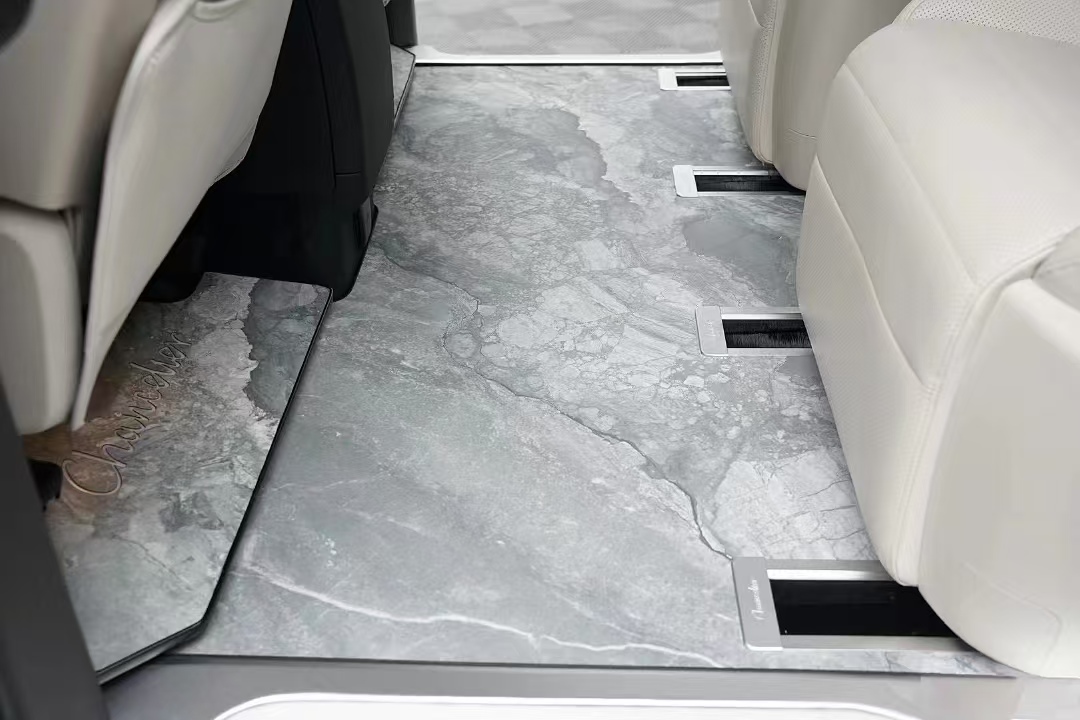 ▲ Car Floor HPL Pressing vs Film Lamination Cold Pressing: 5 Truths on Durability — Real Modification Effect Photos
1. Why Are There Two Processes for Car Floors?
The core structure of a car floor is the four-layer "surface decorative layer + aluminium layer + PE core material + aluminium layer". The surface decorative layer (determining wear resistance, color, and texture) is the core, and the essential difference between different processes is in this layer.
Two mainstream processes:
- HPL High-Temperature Pressing: Melamine-impregnated paper is pressed into the aluminium board at 140°C, 8M Pa, chemical bonding
- Film Lamination Cold Pressing: PVC/PET film is laminated at 60–80°C, 0.5–1M Pa, physical adhesion
Cost differences between the two processes:
- HPL: Requires equipment investment of over 1000 ten thousand yuan, limited capacity per batch
- Film Lamination Cold Pressing: Low equipment investment 80%, 1 sheets can also be customized
This is why most small brands in the market use film lamination cold pressing — low cost, small-batch customization. HPL is the process route of leading brands.
2. Truth 1: HPL Wear Resistance is 3–5 Times That of Film Lamination Cold Pressing
Wear resistance is tested using a Taber abraser (GB/T 17657 standard), measured in "revolutions" — 60 revolutions per minute, until the surface wears through to expose the aluminium layer.
Wear resistance revolutions of the two processes:
- HPL High-Temperature Pressing: 8000–15000 revolutions (some high-end brands can reach 18000 revolutions)
- Film Lamination Cold Pressing: 2000–3000 revolutions
Calculated based on 1 ten thousand footsteps per year for a family car:
- HPL: Theoretical lifespan 8–15 years (family use scenario)
- Film Lamination Cold Pressing: Theoretical lifespan 2–3 years (family use scenario)
The Shenzhen car owner ran 4 ten thousand kilometers, equivalent to 4 years of footsteps for a family car. The wear resistance of 2000–3000 revolutions on the film lamination cold-pressed surface is already approaching the limit — bubbling at 4 ten thousand kilometers is inevitable.
4. Truth 2: HPL Wins Decisively on Color Stability
After 2–3 years of car floor use, color change is the intuitive experience for car owners. The differences in color stability between the two processes:
- HPL High-Temperature Pressing: Color penetrates over 0.5mm into the surface layer, wear-resistant and fade-resistant. Even if the surface wears, the color remains uniform
- Film Lamination Cold Pressing: Color is only in the surface film layer (0.05–0.1mm); after the film layer wears, the underlying glue is exposed, and the color noticeably lightens
The Shenzhen car owner's case: after running 4 ten thousand kilometers with film lamination cold pressing, the color noticeably lightened along with surface bubbling — the underlying glue is white.
Because the color penetrates deeply in the HPL process, color change over time is minimal. With film lamination cold pressing, the color change is very obvious — this is determined by process differences, not a quality issue.
5. Truth 3: Heat Resistance — HPL Can Withstand 80°C, Film Lamination Cold Pressing Softens at 60°C
Car floor temperature in summer can reach 60–80°C (under direct sunlight without air conditioning). Heat resistance differences between the two processes:
- HPL High-Temperature Pressing: Glass transition temperature > 200°C, completely no change at 60–80°C
- Film Lamination Cold Pressing: PVC/PET film glass transition temperature 60–80°C, softens upon reaching the critical temperature
The consequence of softening is "indentations" on the surface — when heavy objects are placed on the floor for a long time, permanent indentations appear on the surface.
The Shenzhen car owner often keeps luggage in the car; with summer interior temperatures above 70°C, the film lamination cold-pressed surface softened, and luggage indentations are obvious. This is an issue HPL would never have.
6. Truth 4: Boiling Water Resistance — HPL Can Soak for 4 Hours, Film Lamination Cold Pressing Bubbles at 1 Hours
I placed samples of both processes simultaneously in 60°C hot water for soaking:
- HPL: After 4 hours of removal, no surface change, PE core material moisture content 0.3%
- Film Lamination Cold Pressing: Surface bubbling at 1 hours, film layer separates from aluminium layer at 2 hours
Because HPL is chemically bonded, moisture cannot penetrate. Film lamination cold pressing is physically bonded, and moisture can penetrate the glue layer causing film layer to peel off.
In daily car use scenarios, the floor won't be soaked in hot water. But during the plum rain season in Jiangsu-Zhejiang-Shanghai, the humid weather in Guangdong, and the high-humidity environment in Hainan, long-term high humidity is equivalent to a "mild version boiling water test".
The Shenzhen car owner's car is often parked outdoors and began showing bubbling after several heavy rains — this is the level of water resistance of the film lamination cold pressing process.
7. Truth 5: Weathering Resistance — HPL Shows No Change for 5 Years, Film Lamination Cold Pressing Begins Aging at 2 Years
Weathering resistance is tested using a xenon lamp aging test chamber (GB/T 16422 standard), simulating 5 years of sunlight exposure:
- HPL: No change after 5000 hours of xenon lamp exposure
- Film Lamination Cold Pressing: Surface begins chalking after 1000 hours of xenon lamp exposure
Family cars are exposed to sunlight for an average of 4–8 hours per day; 5 years is equivalent to 7000–14000 hours.
HPL process shows no change after 5000 hours of xenon lamp testing, equivalent to 5 years of sunlight exposure for a family car. Film lamination cold pressing begins aging at 1000 hours, equivalent to 2 years for a family car.
The Shenzhen car owner's car has been driven for 2 years, and the film lamination cold-pressed surface has already noticeably aged — this is an inevitable result determined by process differences.
8. HPL vs Film Lamination Cold Pressing Process Comparison Table
| Dimension | HPL High-Temperature Pressing | Film Lamination Cold Pressing |
|---|---|---|
| Wear Resistance (Revolutions) | 8000–15000 revolutions | 2000–3000 revolutions |
| Color Stability | Color penetrates deeply 0.5mm | Surface film layer 0.05–0.1mm |
| Heat Resistance | > 200°C | 60–80°C softening |
| Boiling Water Resistance | No change at 4 hours | Bubbling at 1 hours |
| Weathering Resistance | No change for 5 years | Aging at 2 years |
| Equipment Investment | Over 1000 ten thousand yuan | Under 200 ten thousand yuan |
| Capacity Per Batch | Requires large batches | 1 sheets can be customized |
9. Car Floor Selection Recommendations
- HPL High-Temperature Pressing: Suitable for car owners pursuing durability who don't want to replace the floor every 3–5 years. One-time investment of 8000–12000 yuan, can last 5–8 years
- Film Lamination Cold Pressing: Suitable for those with limited budgets who can accept replacement every 2–3 years. One-time investment of 4000–6000 yuan, needs replacement after 2–3 years
The Shenzhen car owner has now switched to the HPL process and is expected to last over 8 years.
10. FAQ — The 5 Questions Car Owners Care About Most
Q: How much is the price difference between HPL and film lamination cold pressing? A: HPL is 50%–100% more expensive than film lamination cold pressing. For example, for a complete set of Zhijie V9, HPL is 8000–12000 yuan, film lamination cold pressing is 4000–6000 yuan.
Q: Can film lamination cold pressing be used for more than 5 years? A: Theoretical lifespan is 2–3 years. If used for over 5 years, the surface will be severely worn or bubbled.
Q: Is the HPL process more brittle than film lamination cold pressing? A: HPL surface hardness is over 3 times higher than film lamination cold pressing, with slightly lower impact resistance. But daily car use won't involve sharp heavy impacts, so HPL is fully sufficient.
Q: The modification shop claims "we use HPL", how to verify? A: Ask them to cut a sample on the spot and wipe the surface with alcohol. HPL shows no change after wiping, while film lamination cold pressing's film layer dissolves after wiping.
Q: How often does the HPL floor need maintenance? A: Wipe with a damp cloth monthly, check seams quarterly. HPL process basically requires no special maintenance.
11. Expert Recommendations
Zhao Wenbo, automotive materials engineering expert, with 22 years of industry experience, participated in formulating the "Technical Specifications for Automotive Interior Materials", former OEM materials purchasing director.
After reviewing the Shenzhen car owner's vehicle, he said: the limitations of the film lamination cold pressing process are determined by the process itself, not a quality issue. The strength ceiling of physical adhesion in the film layer is right there — wear resistance 2000–3000 revolutions, water resistance 1 hours, heat resistance 60–80°C. Beyond these limits, the film layer will inevitably fail.
He reminds one point: although the HPL process is durable, the cost is high. It's not a problem for budget-limited car owners to choose film lamination cold pressing, but they should be mentally prepared for replacement every 2–3 years. Treat "the floor is a consumable" as part of the car usage cost.
He also mentioned a data point: a 2025 China Automotive Aftermarket Association survey showed that HPL process accounts for over 60% of the business vehicle floor market, film lamination cold pressing about 30%, and UV printing 10%. HPL is the mainstream process for current business vehicle floors.
References
- IATF 16949:2016 Automotive Industry Quality Management System Standard
- GB/T 17657–2013 "Wood-based Panels and Decorated Wood-based Panels — Methods of Test for Physical and Chemical Properties"
- GB/T 16422.2–2014 "Plastics — Methods of Exposure to Laboratory Light Sources — Part 2: Xenon-arc Lamps"
- GB/T 10125–2012 "Corrosion Tests in Artificial Atmospheres — Salt Spray Tests"
- China Automotive Aftermarket Association: Business Vehicle Floor Process Application Survey
- SGS: HPL and Film Lamination Cold Pressing Process Comparative Test Report
Editorial Note
The floor prices, construction plans, and performance parameters involved in this article will fluctuate with vehicle model configuration, batch, and shop process. Specific data should be based on the test reports and construction documents at the time of purchase.
If you need to cite the content of this article, please indicate the source.