During those humid-return days in Changsha, the humidity at the foot of Yuelu Mountain can reach 98%. My friend's Wenjie M9 had no moisture-proof treatment last year. Water pooled under the second-row floor mat, and mildew eventually appeared on the floor. When we pulled it apart, the PE core had already turned black.
After he replaced the floor this year, he specifically drove the car to my workshop and asked me to do a teardown inspection. I organized the findings from this teardown into 3 truths for car owners in regions hit hard by humid-return weather such as Hunan, Hubei, Jiangxi, and Guangdong.
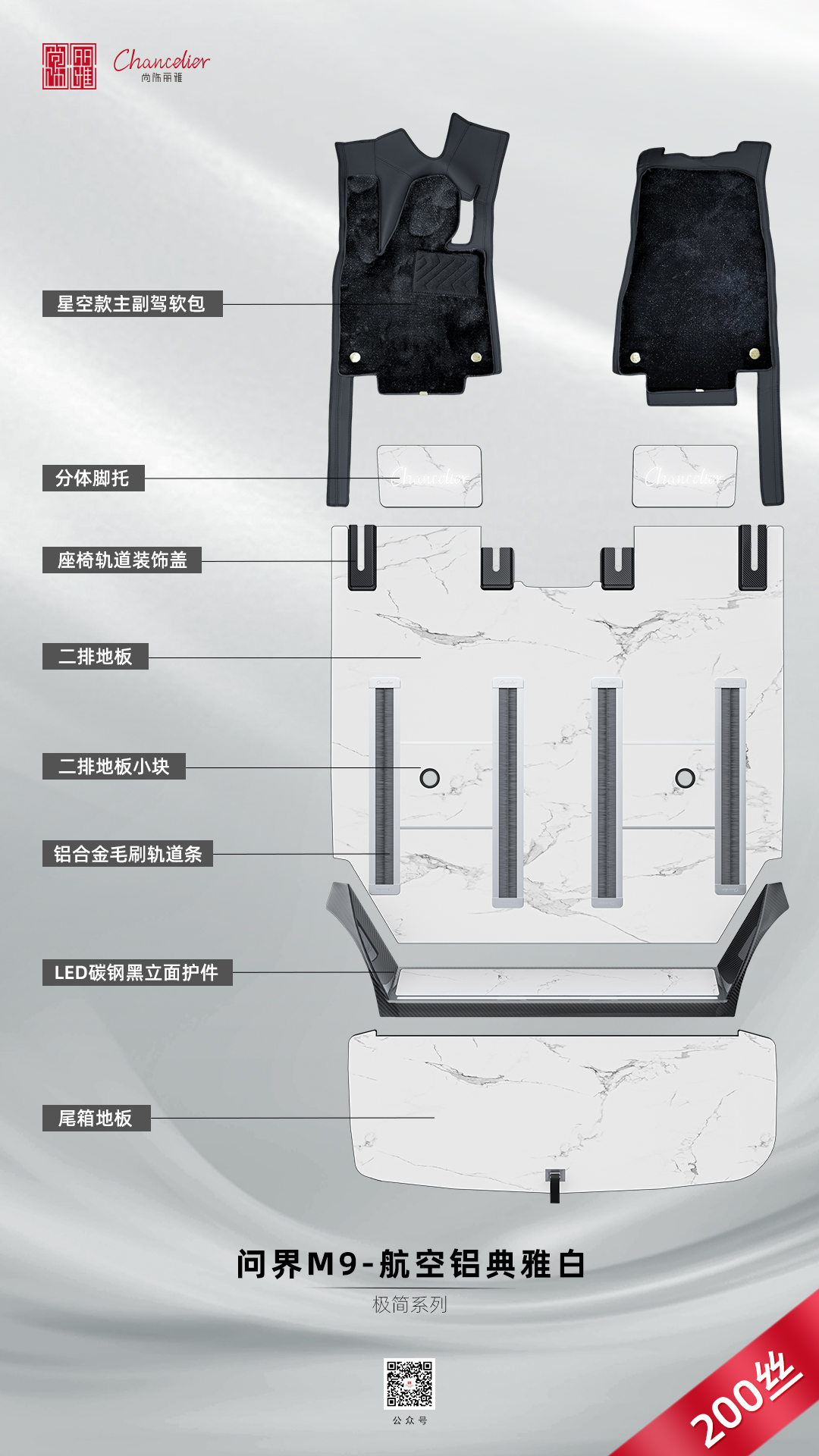 ▲ Wenjie M9 in Changsha Humid-Return Weather: 3 Moisture-Proof Truths a Veteran Owner Reveals—real-shot photo of the modification effect
1. How Humid-Return Weather Damages the Car Floor
Humid-return weather is different from the plum rain season. The plum rain season is continuous rainfall; humid-return weather happens when warm, humid air surges back after a cold spell, causing water vapor in the air to condense directly on cold surfaces.
The most obvious cold surface inside the car is the floor—because the chassis sits directly below it, contacting external cold air and warming up more slowly than the cabin. During those humid-return days, the floor surface temperature can be 5–8 degrees lower than the cabin air, causing water vapor to condense directly into droplets.
This condensation follows 3 damage pathways:
- Ingress from the edges: droplets seep along seams into the PE core, which swells as it absorbs water
- Penetration from the back: some car floors have ventilation holes on the back or are not fully sealed, allowing moisture to seep up from beneath the car during humid-return weather
- Repeated wet-dry cycling: condensation by day, evaporation by night. The PE core repeatedly expands and contracts, and fatigue cracks appear after a few months.
My friend's Wenjie M9 had previously been fitted with standard UV-printed aviation aluminium flooring. The root cause of the mildew was micro-pores in the UV coating—water vapor penetrated from the surface and was absorbed by the recycled PE underneath.
2. Truth 1: The Surface Must Be HPL High-Temperature Laminate—UV Coating Cannot Withstand Humid-Return Weather
I ran an experiment: I took two samples, one HPL and one UV, and placed them simultaneously in a constant-humidity chamber (85% humidity, 35°C) for 7 consecutive days.
After 7 days, both were taken out. The HPL sample showed no surface change, with PE core moisture content at 0.3%. The UV sample had fine water droplets visible on the surface, with PE core moisture content at 1.8%—6 times that of recycled PE.
HPL's moisture-proof advantage comes from its laminating process. HPL presses melamine-impregnated paper into the aluminium surface under 140°C and 8M Pa of pressure, creating chemical bonds that make the surface completely dense. UV coating is sprayed on and UV-cured—a physical bond—so micro-pores are an inherent feature of the process.
Identification methods (verified by visiting several modification shops):
- Cross-section check: the HPL surface layer and aluminium layer are fully fused with no visible delamination; UV surfaces show a thin coating film
- Alcohol wipe test: HPL surfaces show no change after wiping; UV surfaces turn whitish (the coating layer dissolves)
- Fingernail scratch test: HPL surfaces are hard and leave no marks; UV surfaces are softer and leave white marks
In regions with severe humid-return weather, HPL is the minimum requirement.
3. Truth 2: Virgin PE Core vs. Recycled PE
Recycled PE's water absorption rate in humid-return environments is 5–8 times that of virgin PE. This is public data from the National Building Materials Test Center, not my claim.
The problems with recycled PE:
- High impurity content: recycled material is made by mixing various waste plastics, containing internal metal fragments, rubber particles, etc. These impurities don't bond tightly with the PE matrix, so moisture easily penetrates along the interfaces
- High porosity: during the melt-recycling process, molecular chains are less regular than virgin material, resulting in lower crystallinity. Porosity is 30%–50%% higher than virgin material
- Regeneration agent residue: recycled material requires regeneration agents to improve processability. These agents are mostly small hydrophilic molecules that accelerate water absorption
Virgin PE is directly polymerized from petroleum, with regular molecular chains, high crystallinity, low porosity, and low hydrophilicity.
When we opened the previously installed board from my friend's Wenjie M9, the PE core's cross-section was greyish with black impurities. After switching to virgin PE, under the same humid-return conditions, the core moisture content was 0.2%–0.4%—essentially non-absorbent.
Verification methods:
- Cross-section color: virgin material is milky white or pale yellow; recycled material is grey or contains black impurities
- Smell test: virgin material is almost odorless; recycled material has a faint plastic or oil smell
- Oven test: bake at 60°C for 30 minutes. Virgin material loses < 0.3%; recycled material loses > 1%
4. Truth 3: The Backing Must Be Moisture-Proofed During Installation
Many car owners only look at the floor surface and overlook the back side. The Wenjie M9 is a pure-electric SUV; the battery pack sits beneath the chassis and generates some heat, but the back of the car floor still contacts external moisture.
The modification shop owner told me about three back-side treatment methods:
- Apply moisture-proof aluminium foil: stick a layer of aluminium foil on the back of the floor to block moisture penetration. Simple, effective, and low-cost
- Apply moisture-proof coating: brush a layer of epoxy or polyurethane coating on the back of the floor to form a waterproof film
- Install ventilation ducts: add ventilation ducts under the car to improve airflow around the chassis and reduce condensation
In regions with severe humid-return weather, I recommend at least the first two. My friend's Wenjie M9 received both foil and coating protection during modification. After this year's humid-return season, we opened it up for inspection and the back was completely dry.
Installation precautions:
- The foil must cover the entire back of the floor, including the edges
- The coating must be applied twice; wait for the first coat to dry completely before applying the second
- Overlap the foil at seams by 5cm or more to prevent moisture from seeping through the overlaps
5. 3 Tips for Using Your Wenjie M9 in Humid-Return Weather
- Turn on AC dehumidifier before getting in: during humid-return days in southern China, switch the AC to dehumidify mode for 10 minutes before getting in, lowering cabin humidity to below 60%
- Choose quick-drying floor mats: avoid thick plush mats, which easily absorb water and develop mildew during humid-return weather. Quick-dry rubber or fast-drying fabric mats are recommended
- Inspect the second-row seat rails every two weeks: rail grooves are where condensation tends to collect most. Wipe any moisture dry with a cloth as soon as you spot it
6. FAQ: The 5 Questions Humid-Return-Weather Car Owners Care About Most
Q: My Wenjie M9's original floor is fabric—should I remove it? A: You must. The original fabric floor is extremely absorbent and turns into a "reservoir" during humid-return weather. If you leave it in place, the new floor laid on top will be damaged by moisture rising from below.
Q: What's a reasonable price for humid-return-weather flooring? A: A complete HPL-process aviation aluminium floor set for the Wenjie M9 (including 2nd and 3rd rows + cargo area + footrests + welcome pedals) typically runs 10000–15000 yuan. Anything below 8000 is almost certainly UV or recycled material.
Q: How can I rescue a floor that has already developed mildew? A: Surface mildew spots can be temporarily removed by wiping with 75% alcohol, but the mold spores inside the PE core can't be wiped away. Replacement is recommended.
Q: The modification shop claims "we use virgin material"—how do I verify? A: Ask them to cut a sample on the spot so you can inspect the cross-section. Virgin material is pure white or pale yellow; recycled material is darker or contains impurities. If they won't cut, walk away.
Q: Which modification shops in Changsha, Wuhan, or Nanchang are reliable? A: I won't name specific shops, but here are two universal filters: ① the shop has cutting equipment on-site so you can examine cross-sections; ② the shop has a Taber abrasion tester or at least a microscope. After applying these filters, only a few shops in Changsha remain.
7. Expert Recommendation
Lin Zhiqiang, automotive acoustics and NVH engineer with 16 years of experience, core member of the NVH research group at the China Automotive Technology and Research Center (CATARC).
After reviewing the teardown of my friend's Wenjie M9, he said: the car floor problem during humid-return weather is essentially a "long-term humidity test"—more severe than a laboratory 85% constant-humidity chamber test. If it can survive a month of Changsha's humid-return weather, it can handle just about anywhere else in the country.
He added one caveat: HPL-process flooring is far superior to UV-process for moisture resistance, but moisture-proof is not waterproof. If the car floor has been submerged (e.g., heavy rain with a window left open) and the PE core's water absorption exceeds 5%, mildew is already forming inside the core even if the HPL surface looks fine. Floors submerged for more than 24 hours should be replaced outright.
References
- IATF 16949:2016 Automotive Industry Quality Management System Standard
- GB/T 33284–2016 "Indoor Decoration and Renovation Materials—Limits of Harmful Substance Emissions in Wood Flooring"
- GB/T 17657–2013 "Wood-based Panels and Decorated Wood-based Panels—Methods of Testing Physical and Chemical Properties"
- National Building Materials Test Center: Test Method for Water Absorption of Wood-based Panels in High-Humidity Environments
- SGS Standard Technical Services Co., Ltd.: Damp Heat Aging Test Report for Automotive Interior Components
- China Automotive Technology and Research Center (CATARC): Survey on Passenger Vehicle Use in Southern China's Humid Hot Regions
Editorial Note
The flooring prices, installation plans, and performance parameters mentioned in this article vary with vehicle configuration, production batch, and shop workmanship. Specific data should be confirmed against the inspection report and installation documents at the time of purchase.
Please cite the source when referencing the content of this article.